APSC Current Affairs: Assam Tribune Notes with MCQs and Answer Writing (27/11/2026)
In this post
- Current Affairs Notes
- ICMR SAMPADA Nutrition Survey and Assam’s Highest Anaemia Rates
- White-bellied Heron Sighting and the Fragile Waterbirds of Northeast Wetlands
- Food Price Rise in Assam: Joha Rice, Trading Syndicates and Market Regulation
- Street Children Rescue and Rehabilitation through Childline and Child Welfare Committees
- News in Short
- APSC Prelims MCQs
- Mains Answer Writing
For APSC CCE and other Assam competitive exam aspirants, staying consistently updated with reliable current affairs is essential for success. This blog provides a well-researched analysis of the most important topics from The Assam Tribune dated 27 November 2026. Each issue has been carefully selected and explained to support both APSC Prelims and Mains preparation, ensuring alignment with the APSC CCE syllabus and the evolving trends of the examination.
 For working professionals and full-time aspirantsAPSC CCE Foundation Programme₹24,999
Current Affairs Notes
From The Assam Tribune, 27 November 2026
ICMR SAMPADA Nutrition Survey and Assam’s Highest Anaemia Rates
Open this topic as a separate page, with its MCQs →
Syllabus Mapping
- Prelims: GS Paper I (Current events of State/National importance; General issues on health and nutrition; Assam: social development and government schemes).
- Mains: GS Paper II (Issues relating to development and management of social sector/services: health, nutrition; welfare schemes for vulnerable sections); GS Paper V (Assam: health and social development, government programmes and their implementation).
Why in News? A national nutrition survey by the Indian Council of Medical Research (ICMR) has placed Assam first in the country for anaemia among adult men, adult women and the elderly. The findings were reported from Guwahati on 26 November 2026. The paper describes SAMPADA as one of the largest and most comprehensive nutrition surveys conducted anywhere in the world.
Current Context (The Trigger)
- Survey name: The findings come from SAMPADA, the Survey for Assessment of Markers of Population Health, Activity, Diet, and Anthropometry.
- Agency and period: The ICMR-National Institute of Nutrition (ICMR-NIN) conducted it during 2023-25.
- Adult women: Assam recorded 72.8 per cent anaemia among women aged 20-59 years. This is the highest in India and well above the national average of 54.8 per cent.
- Adult men: Among men aged 20-59 years, Assam recorded 46.8 per cent, again the highest. The national average is 22 per cent, so Assam’s rate is more than double.
- Elderly: Men aged 60 years and above recorded 74 per cent against a national 44.7 per cent. Women of the same age recorded 76.9 per cent against 55.7 per cent.
- Reproductive age and adolescents: Women aged 15-49 years recorded 71.9 per cent against 55.9 per cent nationally. Only West Bengal, at 72.4 per cent, was higher. Adolescent girls (10-19 years) recorded 58.8 per cent and adolescent boys 37.4 per cent, against 46.3 and 22.8 per cent nationally.
Core Concepts & Static GK
- Anaemia: A person is anaemic when haemoglobin falls below a set cut-off for their age and sex. NFHS-5 used below 11.0 g/dl for children aged 6-59 months, below 12.0 g/dl for non-pregnant women and below 13.0 g/dl for adolescent boys.
- WHO cut-offs 2024: The 2024 WHO values lowered the cut-off by 0.5 g/dl, from 11 to 10.5 g/dl. This applies to children aged 6-23 months and to pregnant women in the second trimester. The other values stayed as in 2011.
- Severity grades: The Health Ministry guidelines classify anaemia into mild, moderate and severe, and each grade has its own management protocol.
- Non-nutritional causes: Iron deficiency is not the only cause. The Ministry names malaria, haemoglobinopathies and fluorosis in endemic pockets as other causes.
- Other deficiencies: Vitamin B12 and folic acid deficiencies also persist in India besides iron deficiency.
- Life-cycle approach: The Ministry’s strategy targets each stage of life, from infancy to pregnancy, instead of one age group.
Institutional Machinery
- ICMR-NIN: This institute ran SAMPADA. It was designed to give reliable national and State-level estimates of diet, body measurements, anaemia and other nutritional markers.
- NCEAR-A: The National Centre of Excellence and Advanced Research on Anaemia Control at AIIMS, Delhi, trains health care providers for the anaemia programme.
- Central Council of Health and Family Welfare: Union Health Minister J.P. Nadda released the new Anemia Mukt Bharat Abhiyaan guidelines at its 16th meeting at Vigyan Bhawan on 29 June 2026.
- National AMB Abhiyaan Unit: It is one of the seven institutional mechanisms in the revised framework, along with a dedicated portal.
Schemes & Initiatives
- Programme history: The National Nutritional Anemia Prophylaxis Programme began in 1970 and gave iron-folic acid tablets to pregnant and lactating mothers. It became the National Nutritional Anemia Control Programme in 1991.
- WIFS and NIPI: The Weekly Iron Folic Acid Supplementation programme began in 2012 for adolescents. The National Iron Plus Initiative followed in 2013 and covered six beneficiary groups.
- Anemia Mukt Bharat (2018): It was launched in 2018 as a 6x6x6 strategy: six target groups, six interventions and six institutional mechanisms.
- Anemia Mukt Bharat Abhiyaan (2026): The programme is now the Abhiyaan under a 7x7x7 framework. Low birth weight babies of 0-6 months are the seventh beneficiary group.
- Seventh intervention: “Eating Right” promotes iron-rich local foods and diet diversity as a daily habit.
- POSHAN Abhiyaan: It was launched on 8 March 2018 at Jhunjhunu in Rajasthan. It targets a 3 per cent a year cut in anaemia among children aged 6-59 months and among women and adolescent girls aged 15-49 years.
- Fortified rice: In October 2024 the Cabinet approved continuing the universal supply of fortified rice under all government schemes from July 2024 to December 2028. The Centre funds it fully through the food subsidy.
Reports, Indices & Data
- SAMPADA scale: It analysed over 1.7 lakh blood samples. It covered more than 2 lakh people from over 81,000 households in 183 districts of 35 States and Union territories.
- SAMPADA design: It used a multi-stage, stratified cluster sampling design. It produced life-course data on anaemia and micronutrient deficiencies for all age groups, including the elderly above 60 years.
- NFHS-5 India (2019-21): Anaemia stood at 57.0 per cent among women aged 15-49 years, up from 53.1 per cent in NFHS-4. Among children aged 6-59 months it was 67.1 per cent, up from 58.6 per cent.
- NFHS-5 men: Anaemia among men aged 15-49 years was 25.0 per cent.
- Few improvers: Only 13 States and Union territories showed a fall in anaemia among women aged 15-49 years in NFHS-5. Meghalaya and Arunachal Pradesh were among them.
Assam & Northeast Linkages
- NFHS-5 Assam, children: Anaemia among children aged 6-59 months rose from 35.7 per cent in NFHS-4 to 68.4 per cent in NFHS-5.
- NFHS-5 Assam, women: Among women aged 15-49 years it rose from 46.0 to 65.9 per cent. Among pregnant women it rose from 44.8 to 54.2 per cent.
- NFHS-5 Assam, adolescents: Anaemia among girls aged 15-19 years rose from 42.7 to 67.0 per cent. Among boys it rose from 23.5 to 39.6 per cent.
- Above the national average: Assam’s NFHS-5 figure of 65.9 per cent for women aged 15-49 years was above the India figure of 57.0 per cent.
- SAMPADA rank: The paper names Assam the highest in India for women aged 20-59, men aged 20-59 and men aged 60 and above. Elderly women in Assam recorded 76.9 per cent. Assam is second to West Bengal for women aged 15-49 years.
Prelims Trap Zones (Watch out for)
- Agency trap: SAMPADA is an ICMR-NIN survey. NFHS is conducted for the Health Ministry, and SAMPADA is a different exercise.
- Rank trap: Assam is not first in every group. For women aged 15-49 years, West Bengal (72.4 per cent) is higher than Assam (71.9 per cent).
- Age-band trap: The paper gives separate figures for 10-19, 15-49, 20-59 and 60+ years. Do not mix the 72.8 per cent (women 20-59) with the 71.9 per cent (women 15-49).
- Years trap: SAMPADA ran in 2023-25. NFHS-5 ran in 2019-21 and NFHS-4 in 2015-16.
- Framework trap: Anemia Mukt Bharat began in 2018 as 6x6x6. The 7x7x7 version dates from the June 2026 guidelines.
- Seventh-item trap: The seventh beneficiary group is low birth weight babies and the seventh intervention is Eating Right. Intravenous iron is a clinical measure inside the guidelines, not the seventh intervention.
- Target trap: POSHAN Abhiyaan’s anaemia target is 3 per cent a year. The 2 per cent a year targets are for stunting, under-nutrition and low birth weight.
Introduction
ICMR’s SAMPADA survey (2023-25) was reported from Guwahati on 26 November 2026. It shows that Assam has 72.8 per cent anaemia among women aged 20-59 years, against 54.8 per cent for India. Nearly every age group in the State is affected, and men and the elderly are affected too. This shows that Assam’s problem cannot be solved by tablets for pregnant women alone.
Why Assam’s Burden Persists (Underlying Drivers)
- Sharp rise in a decade: Assam’s anaemia among women aged 15-49 years rose from 46.0 per cent in NFHS-4 (2015-16) to 65.9 per cent in NFHS-5 (2019-21).
- Children hit hardest: Among children aged 6-59 months it nearly doubled, from 35.7 to 68.4 per cent, over the same period.
- Not only iron: Vitamin B12 and folic acid deficiencies also persist across India, so iron tablets alone leave part of the problem untouched.
- Non-nutritional causes: The Ministry flags malaria, haemoglobinopathies (inherited blood disorders) and fluorosis in endemic pockets as separate causes needing separate action.
- Intergenerational cycle: Low birth weight babies are born with low iron stores and can become anaemic within months. The new guidelines added them as a beneficiary group for this reason.
- Normalised anaemia: The Ministry itself says that people often accept anaemia as normal, which weakens tablet compliance. The new communication strategy aims to change this mindset.
Gaps in the Older Strategy
- Men outside the net: The 6x6x6 target groups covered children, adolescents, pregnant and lactating women and women of reproductive age. Adult men were not a target group.
- Men’s burden: NFHS-5 found 25.0 per cent anaemia among Indian men aged 15-49 years. SAMPADA found 46.8 per cent among Assam’s men aged 20-59 years.
- Elderly not targeted: The programme did not list people above 60 years as beneficiaries. Yet SAMPADA found 74 per cent of Assam’s elderly men and 76.9 per cent of elderly women anaemic.
- Plateau in national data: The 2026 guidelines admit that surveys across age groups show a near plateau in anaemia prevalence. This is why strategies were recalibrated.
- From prevention to treatment: The older strategy leaned on preventive supplements. The revised framework moves from prophylactic care to therapeutic care, which means more testing and treatment of those already anaemic.
- Women’s rise nationally: India’s anaemia among women aged 15-49 years rose from 53.1 per cent in NFHS-4 to 57.0 per cent in NFHS-5, despite the 2018 launch.
Government Initiatives (National & Assam)
| Level | Initiative | Purpose & Impact |
|---|---|---|
| Centre (Health) | Anemia Mukt Bharat (2018), now Abhiyaan with 7x7x7 | Gives iron-folic acid supplements, deworming, testing and treatment across the life cycle. The 2026 version adds low birth weight babies and Eating Right. |
| Centre (Health) | T4 approach and digital tracking | Test, Treat, Talk and Track. Haemoglobin records flow through the JANANI portal (pregnant women), RBSK portal (school children) and U-WIN portal (vaccination). |
| Centre (Women and Child Development) | POSHAN Abhiyaan and Saksham Anganwadi and POSHAN 2.0 | Targets a 3 per cent a year cut in anaemia. POSHAN 2.0 focuses on maternal nutrition, diet diversity, fortification and millets. |
| Centre (Food) | Fortified rice under PMGKAY, ICDS and PM POSHAN | Universal coverage was achieved by March 2024. Supply is approved till December 2028 with full Centre funding. |
| States and Union territories | National Health Mission support through annual Programme Implementation Plans | Health is a State subject. The Centre gives financial and technical support, and States run the delivery. |
Challenges
- Weak last-mile compliance: Iron tablets work only when taken regularly. The Ministry stresses compliance because anaemia is widely seen as normal.
- Surveys disagree on levels: NFHS-5 gave 65.9 per cent for Assam’s women aged 15-49 years, and SAMPADA gave 71.9 per cent. The two surveys differ in years and design, so they show a trend, not an exact change.
- Multiple causes: A single supplement cannot treat malaria, inherited blood disorders or fluorosis. Each needs its own health response.
- Training load: The Ministry built an AMB training toolkit and e-training modules for health care providers. It said Covid-19 made physical training difficult, so skills remained a gap.
- Disruption by the pandemic: The Ministry said Covid-19 hampered implementation and added to anaemia in all age groups.
- Federal delivery: Health is a State subject, so results depend on how each State uses funds and staff. Assam’s rank shows the gap.
Way Ahead
- Extend to men and the elderly: The Health Ministry and the Assam health department should add testing and treatment for adult men and people above 60 years. SAMPADA shows 46.8 per cent and 74 to 76.9 per cent burdens in these groups.
- Use the T4 system fully: Assam should enter every haemoglobin test into the JANANI, RBSK and U-WIN portals. This lets district officers follow each case to recovery.
- Separate the causes: The revised guidelines ask for separating nutritional from non-nutritional anaemia. Assam should do this with malaria and haemoglobinopathy screening in endemic pockets.
- Treat the severe cases: Severe anaemia and non-responders among pregnant and lactating women should get intravenous iron therapy, which the 2026 guidelines include.
- Break the cycle early: Newborn care units should follow the new guidance for low birth weight babies, with paediatrician advice.
- Link food schemes: Anganwadi meals, school meals and ration shops in Assam should serve fortified rice and iron-rich local foods. This is in line with the Eating Right intervention and the fortified rice approval till 2028.
Conclusion
SAMPADA shows that anaemia in Assam is a whole-population problem, not just a mother-and-child problem. The 2026 shift to 7x7x7 and Test, Treat, Talk and Track is the right tool. But Assam must also bring men and the elderly into it. It must also measure results district by district.
White-bellied Heron Sighting and the Fragile Waterbirds of Northeast Wetlands
Open this topic as a separate page, with its MCQs →
Syllabus Mapping
- Prelims: GS Paper I (General issues on Environment and ecology, biodiversity; Geography of Assam; Current events of State/National importance).
- Mains: GS Paper III (Conservation, environmental pollution and degradation, Environmental Impact Assessment); GS Paper V (Assam: wildlife, protected areas and environmental issues of the State).
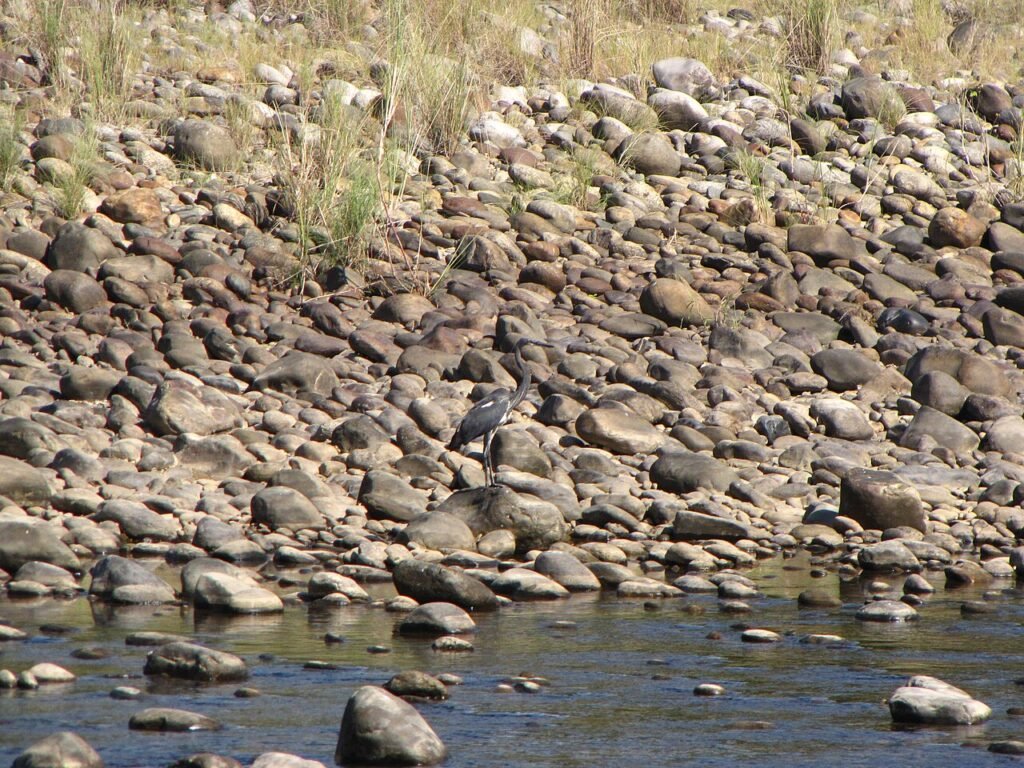
Why in News? Researchers of the Wildlife Institute of India recorded a rare White-bellied Heron on 12 November 2026 along the Lohit River in Arunachal Pradesh. The report also explained how wetland loss, hydropower projects and climate change threaten other rare waterbirds of the Northeast.
Current Context (The Trigger)
- The sighting: The Wildlife Institute of India (WII) recorded a White-bellied Heron (Ardea insignis) on 12 November 2026 along the Lohit River in Arunachal Pradesh.
- Tiny Indian population: India is thought to have fewer than 10 of these herons left in the wild. All of them are found only in undisturbed rivers and wetlands of Arunachal Pradesh and Assam.
- Global estimate: The whole species is put at 50 to 249 mature individuals. Studies call the population “extremely small and rapidly declining”.
- Past records in Assam: A heron was seen at Latajhar in Manas National Park and Tiger Reserve in 2021. Another was reported from Zomduar in Raimona National Park in 2022, and one along the Pekua River on 27 February 2023.
- Other waterbirds in the report: The article also covers the Black-necked Crane, the White-winged Wood Duck, the Spoon-billed Sandpiper and the Dunlin.
Core Concepts & Static GK
- White-bellied Heron: It is the second-largest living heron species. It depends on undisturbed rivers and lowland wetlands.
- Range: The bird occurs in very small numbers across Bhutan, Yunnan in China, northern Myanmar and Northeast India. It no longer survives in Nepal, where it is now extinct.
- EDGE bird: The heron is among the world’s top 100 EDGE birds. EDGE stands for Evolutionarily Distinct and Globally Endangered.
- IUCN status of the heron: The IUCN Red List places the White-bellied Heron in the Critically Endangered category. The paper also calls it Critically Endangered.
- Black-necked Crane: Grus nigricollis breeds on the Tibetan Plateau. Of the 15 crane species in the world, it is the only one that lives at high altitude.
- Black-necked Crane status: The IUCN Red List lists it as Near Threatened.
- White-winged Wood Duck: Asarcornis scutulata is called Deohanh in Assam. This large duck lives in thick tropical evergreen forest close to rivers and swamps.
Constitutional & Legal Framework
- Parent law: The Wild Life (Protection) Act, 1972 was amended by the Wild Life (Protection) Amendment Act, 2022. It is Act No. 18 of 2022 and received the President’s assent on 19 December 2022.
- Commencement: The Centre brought the 2022 amendment into force from 1 April 2023 through a notification dated 22 March 2023.
- Fewer schedules: The amendment cut the number of schedules from six to four. It reduced the schedules for specially protected animals to two, removed the vermin schedule and added a schedule for CITES-listed specimens.
- Schedule I birds: Part B (Birds) of Schedule I lists the White-bellied Heron, the Black-necked Crane and the White-winged Wood Duck. Schedule I gives the highest level of protection.
- Other schedules: Schedules I and II now cover wild animals, and Schedule III covers specified plants (earlier Schedule VI). Schedule IV covers species listed in the CITES Appendices, and a new Chapter VB regulates their international trade.
Institutional Machinery
- Wildlife Institute of India: WII researchers made the Lohit River sighting of the heron.
- Wildlife Trust of India: WTI carried out the recent survey of the White-winged Wood Duck in Assam and Arunachal Pradesh. Its preliminary estimate is only about 300 birds left in Northeast India.
- Namdapha Tiger Reserve: It was declared in 1983 as the 15th tiger reserve under Project Tiger. It lies in Changlang district of Arunachal Pradesh.
- Size of Namdapha: The reserve has a core area of 1,808 sq km and a buffer area of 177 sq km.
Reports, Indices & Data
- India count of heron: The paper gives fewer than 10 birds for India. The figure of 50 to 249 mature individuals is the estimate for the whole species.
- Wood Duck count: A preliminary WTI estimate puts the number at about 300 in Northeast India.
- Wood Duck status: The paper describes the White-winged Wood Duck as Endangered, which was its long-standing IUCN category. In the 2024 Red List update, based on a BirdLife International assessment, it was moved up to Critically Endangered, so Critically Endangered is its current status.
Assam & Northeast Linkages
- Heron sites: Assam records come from Manas National Park (2021), Raimona National Park (2022) and the Pekua River (2023). In Arunachal Pradesh, most sightings are from the Noa-Dihing, Lohit and Lahm river basins.
- Namdapha nests: Nesting sites were found along the Noa-Dihing, which flows through Namdapha Tiger Reserve. Sightings there are now rare because of disturbance and shifts in the river’s course.
- State bird of Assam: The Government of Assam declared the White-winged Wood Duck the State bird in 2003.
- Duck habitats: Key protected habitats are Dibru-Saikhowa, Dihing-Patkai and Nameri National Parks in Assam and Namdapha National Park in Arunachal Pradesh.
- Dibru-Saikhowa: Saving the Wood Duck was one of the main reasons the area got protected status. The park lies in Dibrugarh and Tinsukia districts.
- New national parks: Raimona (Kokrajhar district) and Dihing Patkai were notified as national parks in June 2021.
- Black-necked Crane in Arunachal: It winters in the Sangti Valley of West Kameng district. It has also been recorded in winter in the Zemithang Valley of Tawang.
- Lost visitors: Sivasagar district once had sightings of the Spoon-billed Sandpiper, but none have been recorded lately. The Dunlin is now rarely seen in the Subansiri wetlands of Lakhimpur district.
Prelims Trap Zones (Watch out for)
- Status Trap: The White-bellied Heron is Critically Endangered. The Black-necked Crane is only Near Threatened, not Endangered.
- Duck Status Trap: Many older notes, and today’s paper, call the White-winged Wood Duck Endangered. Its current IUCN category, since the 2024 update, is Critically Endangered.
- Schedule Trap: All three birds (heron, crane, wood duck) are in Schedule I of the Wild Life (Protection) Act, not Schedule II. Schedule IV is the CITES schedule, and plants are in Schedule III.
- Size Trap: The heron is the second-largest living heron, not the largest.
- Extinction Trap: The heron is extinct in Nepal, not in Bhutan, which is part of its present range.
- Number Trap: Fewer than 10 is the Indian count, while 50 to 249 mature individuals is the estimate for the whole species.
- Crane Trap: The Black-necked Crane breeds on the Tibetan Plateau and only winters in Arunachal Pradesh. It does not breed there.
- Place Trap: The Latajhar sighting was in Manas, and the Zomduar sighting was in Raimona.
Introduction
On 12 November 2026, Wildlife Institute of India researchers recorded a White-bellied Heron on the Lohit River, a bird with fewer than 10 individuals left in India. The sighting gives hope, but it also shows how the rivers, forests and wetlands of Assam and Arunachal Pradesh are losing their waterbirds. Saving the heron means saving the undisturbed river systems it needs.
Why These Waterbirds Matter
- Indicator of river health: The heron survives only in undisturbed river systems and wetlands. Its presence therefore signals a river that still works as a natural habitat.
- Global conservation value: The heron is among the world’s top 100 EDGE birds. Losing it would remove an evolutionarily distinct lineage from the planet.
- Protected area anchor: Nesting sites along the Noa-Dihing make Namdapha Tiger Reserve a vital habitat for the species. The reserve has 1,808 sq km of core area.
- Cultural value: The Buddhist Monpa tribes of Tawang and West Kameng revere the Black-necked Crane. This respect gives the bird a measure of local protection in its wintering valleys.
- State pride: The White-winged Wood Duck has been Assam’s State bird since 2003. Its fall to about 300 birds in Northeast India is a loss to the State’s identity.
- Reason for protected areas: Conserving the Wood Duck was among the main reasons for making Dibru-Saikhowa a protected area. A single species can thus shape the map of Assam’s national parks.
Causes of Decline
- Habitat loss: The heron is declining because lowland forests and wetlands are being lost and degraded. Studies expect this decline to continue in the near future.
- Direct pressure: Direct exploitation and disturbance also hurt the heron. Fishing and human movement along rivers can disturb nesting birds.
- River changes: Sightings along the Noa-Dihing have become scarce because of disturbance and shifts in the river’s course.
- Hydropower and infrastructure: Chinese infrastructure in Tibet and dams on rivers that rise on the Tibetan Plateau have badly damaged migratory bird habitats. Several wetlands have dried up as a result.
- Changed migration: Some species now go to other places because hydropower projects have left wetlands dry.
- Climate and human interference: Wetlands change naturally over time, but climate change and human activity have made this change much faster. The worst losses are in wetlands outside protected areas that waterbirds use only for part of the year.
Legal and Institutional Protection
| Level | Measure | Purpose and Impact |
|---|---|---|
| National law | Wild Life (Protection) Act, 1972, as amended in 2022 (in force from 1 April 2023) | Places the heron, the Black-necked Crane and the White-winged Wood Duck in Schedule I, the highest protection. |
| International trade | Schedule IV and Chapter VB of the amended Act | Covers species listed in the CITES Appendices and regulates their trade. |
| Protected areas | Dibru-Saikhowa, Dihing-Patkai and Nameri National Parks in Assam; Namdapha National Park in Arunachal Pradesh | Protect key habitats of the White-winged Wood Duck. |
| Tiger reserves | Namdapha (declared 1983, 15th Project Tiger reserve) | Gives forest and river protection to the Noa-Dihing nesting sites of the heron. |
| Research bodies | Wildlife Institute of India and Wildlife Trust of India | Record sightings and estimate numbers, which guide conservation. |
| New parks | Raimona and Dihing Patkai notified as national parks, June 2021 | Raise the legal status of Raimona, where a heron was reported in 2022. |
Challenges
- Very small populations: India has fewer than 10 herons and Northeast India about 300 Wood Ducks. At such low numbers, a single flood or poaching event can wipe out a local group.
- Wetlands outside protection: Large stretches of wetlands used by waterbirds outside protected areas are shrinking fast. Legal cover for parks does not reach them.
- Trans-boundary pressure: Infrastructure and hydropower in Tibet affect rivers that start on the Tibetan Plateau. India cannot control these decisions alone.
- Changing rivers: The shifting course of the Noa-Dihing has made heron sightings scarce. Natural and human-made river changes are hard to reverse.
- Data gaps: The heron’s global estimate is a wide range of 50 to 249 mature individuals. Many sources still give the Wood Duck’s older Endangered status, although the IUCN moved it to Critically Endangered in 2024.
- Disturbed nesting sites: Disturbance at nesting and roosting sites is a major reason for the Wood Duck’s decline. Wetlands in Dibru-Saikhowa where the Spot-billed Pelican once bred have now disappeared.
Way Ahead
- Protect river stretches: The Assam and Arunachal forest departments should treat the Noa-Dihing, Lohit and Lahm basins as priority heron habitat. They should regulate disturbance near nesting sites.
- Bring wetlands outside parks under care: State governments should map wetlands used by waterbirds outside protected areas and give them legal cover. These wetlands are disappearing the fastest.
- Regular monitoring: WII and the Wildlife Trust of India should run joint annual surveys of the heron, the Wood Duck and the Black-necked Crane. Better counts will narrow the wide population range.
- Check hydropower impact: Hydropower projects on Northeast rivers should face a bird and wetland impact assessment before approval. Dried-up wetlands show what poor planning costs.
- Work with Monpa communities: Forest departments should build on the Monpa reverence for the Black-necked Crane. Village-level crane watch programmes in the Sangti and Zemithang valleys can protect wintering birds.
- Cross-border cooperation: India should share survey data with Bhutan, Myanmar and China, the other range countries of the heron. Rivers and birds ignore borders.
Conclusion
A single heron on the Lohit shows that a few undisturbed rivers of the Northeast still work as a refuge for the rarest waterbirds. These birds will survive only if wetlands outside the parks, river courses and cross-border hydropower are managed as one connected system.
Asked in APSC
- APSC Prelims 2025: (answer in the MCQs below)
Match the following species (in List-I) with their correct conservation status (in List-II):
(List-I (Species)) – (List-II (IUCN Conservation Status))
a. One-horned rhinoceros (Rhinoceros unicornis) – 1. Endangered
b. White-winged duck (Asarcornis scutulata) – 2. Least concern
c. Golden langur (Trachypithecus geei) – 3. Critically endangered
d. Rhesus macaque (Macaca mulatta) – 4. Vulnerable
Select the correct match using the codes given below.- (A) a b c d – 1 4 2 3
- (B) a b c d – 2 1 3 4
- (C) a b c d – 4 3 1 2
- (D) a b c d – 3 1 4 2
All 500 APSC Prelims PYQs of CCE 2020 to 2025, with answers and explanations: practise free in the PYQ Explorer
Food Price Rise in Assam: Joha Rice, Trading Syndicates and Market Regulation
Open this topic as a separate page, with its MCQs →
Syllabus Mapping
- Prelims: GS Paper I (Indian Economy; Assam Economy; Current events of State/National importance).
- Mains: GS Paper III (Indian Economy and issues of growth and inclusive growth; Public Distribution System, buffer stocks and food security; storage, transport and marketing of agricultural produce). Also GS Paper V (Assam economy: major agricultural issues, welfare and governance in Assam).
Why in News? An editorial in The Assam Tribune on 27 November 2026 says the prices of everyday food items in Assam keep climbing. Joha rice, for example, has gone from Rs 100 to Rs 180 per kg. The paper’s editorial argues that trading lobbies and syndicates are largely to blame. It also says the State’s Food and Civil Supplies Department has failed to act.
Current Context (The Trigger)
- Wide price rise: The editorial says rice, flour, pulses, eggs, sugar and cooking oil have all become costlier, and a look at city markets bears this out.
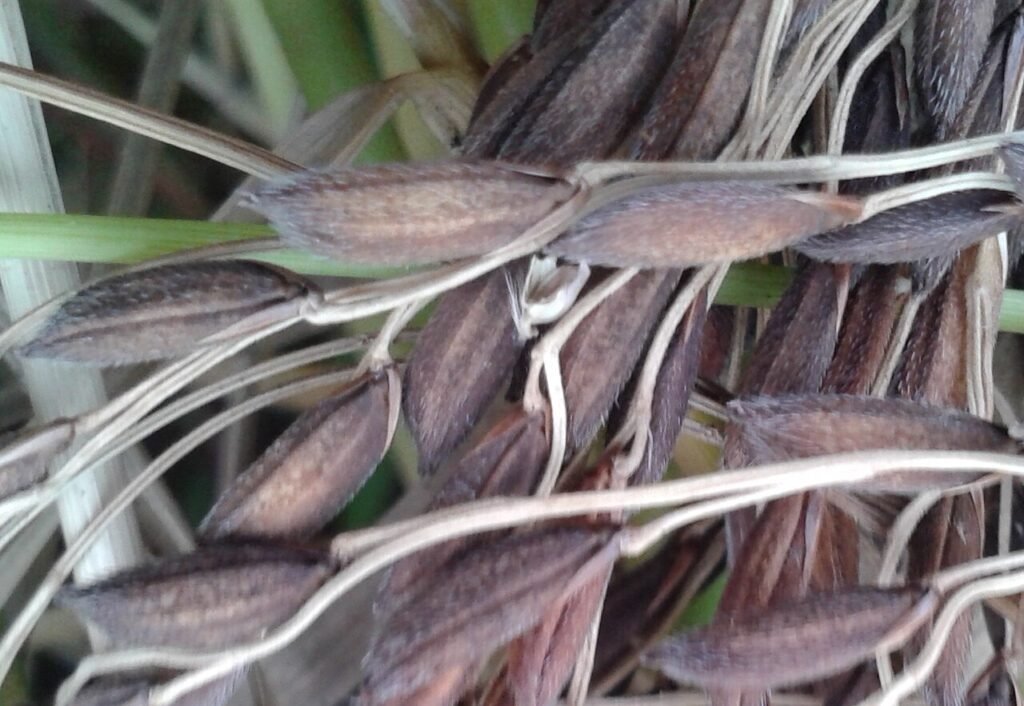
- Joha rice: The aromatic Joha variety has gone from Rs 100 to Rs 180 per kg, an 80 per cent jump. The editorial sees irony in this, because Joha is a popular choice in many Assamese homes.
- Pulses and eggs: Most pulses now cost about Rs 10 to Rs 20 per kg more. A plate of eggs sells for around Rs 230, up from Rs 200.
- Sugar, milk and mustard oil: The paper reports sharp rises in sugar, milk and several mustard oil varieties.
- Official explanation: The government blames a “rise at source”. The editorial replies that the rise in Assam is far bigger than the rise at source, and notes that traders use the same excuse.
- Remedy suggested: The editorial wants complaint booths in markets, so that consumers can report unjustified prices and action can follow at once.
Core Concepts & Static GK
- Essential commodity: Under the Essential Commodities Act, 1955, an essential commodity is one listed in its Schedule. The Schedule includes “foodstuffs, including edible oilseeds and oils”, drugs, fertiliser and petroleum products.
- Cartel: Section 2(c) of the Competition Act, 2002 defines a cartel as an association of producers, sellers, distributors, traders or service providers. The members agree among themselves to limit or control production, distribution, sale or price.
- Syndicate versus cartel: The editorial uses the word “syndicate”, but the Act uses “cartel”. The Competition Commission of India (CCI) says a cartel needs an agreement between competing enterprises not to compete.
- Presumed harm: Under Section 3(3) of the Competition Act, cartels and similar horizontal agreements are presumed to have an appreciable adverse effect on competition. Such agreements are void.
- Price Monitoring Division: The Union Department of Consumer Affairs set up this division in 1998. It oversees daily price monitoring of essential food items and price stabilisation work.
- Buffer stock: Under the Price Stabilisation Fund (PSF), the government buys onion, potato and pulses from farmers at harvest. It stores them and releases them in the lean season to bring prices down.
- Geographical Indication (GI): A GI tag marks a product whose quality comes from its place of origin. The GI Registry lists “Joha Rice of Assam” as a registered agricultural GI.
Constitutional & Legal Framework
- Entry 33, List III: The Centre can add or remove items in the Schedule of the Essential Commodities Act, in consultation with the States. This power covers only commodities under Entry 33 of the Concurrent List.
- Section 3(1): The Centre may issue orders to regulate or prohibit the production, supply, distribution and trade of an essential commodity. One stated aim is “equitable distribution and availability at fair prices”.
- Section 3(2): Such an order can control the price of a commodity, require licences for storage and transport, and bar the withholding of goods ordinarily kept for sale.
- Section 3(1A), 2020 to 2021: The 2020 amendment added price triggers for stock limits. A stock limit needed a 100 per cent retail price rise for horticultural produce and a 50 per cent rise for non-perishable foodstuffs. The Farm Laws Repeal Act, 2021 omitted this sub-section from 30 November 2021.
- Stock limits today: With Section 3(1A) gone, the Act sets no fixed price trigger. Stock limits again rest on the general order-making power under Section 3.
- Delegation to States: Under Section 5, the Centre can let a State Government or its officers use the power to make orders under Section 3.
- Penalty and cognizance: Breaking most Section 3 orders can bring imprisonment of three months to seven years plus a fine (Section 7). Section 10A makes every offence under the Act cognizable.
Institutional Machinery
- Price Monitoring Division (Centre): It collects daily retail and wholesale prices of 22 essential commodities and retail prices of 16 more. The data come from 555 price reporting centres through the Price Monitoring System mobile app.
- Items covered: The 38 monitored items include mustard oil, milk, egg, sugar, potato, onion and tomato. Several of these are the same items the editorial names.
- Northeast centres: The Department’s 2024 review says 87 of the 555 centres are in the Northeast. Assam centres on the list include Guwahati, Jorhat, Dibrugarh, Tinsukia, Majuli and Diphu.
- Coverage: In October 2024, Leh and Kargil were added, which took the price monitoring network to 35 States and Union Territories.
- Competition Commission of India: It can inquire into a suspected cartel under Section 19 of the Competition Act. The Director General investigates and has powers of search and seizure.
Schemes & Initiatives
- Price Stabilisation Fund: It was set up with an initial corpus of Rs 500 crore to tackle price swings in onion, potato and pulses.
- PM-AASHA link: The PSF is now a component of the PM-AASHA umbrella scheme of the Department of Agriculture and Farmers Welfare. The Department of Consumer Affairs still manages its price stabilisation work and daily price monitoring.
- State-level PSF in Assam: The Centre released Rs 75 crore to Assam in December 2019 as its first share for a Rs 200 crore State-level revolving fund. Assam said it would use the fund for market intervention in onion and masur dal.
- Northeast cost sharing: A State-level PSF is normally shared 50:50 between the Centre and the State. For North Eastern States the ratio is 75:25.
- Recent use: In 2024 the PSF was used to sell subsidised onion and tomato. Onion retail sale began on 5 September 2024 and had reached 23 States by 4 December 2024.
- Consumer helpline: The National Consumer Helpline (toll-free 1915) takes complaints in 17 languages, including Assamese.
Reports, Indices & Data
- Daily price data: The Department of Consumer Affairs says its daily prices help decide on market intervention, import and export duties and monetary policy.
- Price jump in numbers: Rs 100 to Rs 180 per kg is an 80 per cent rise, but the editorial gives no time period for it. Eggs rose from Rs 200 to Rs 230 a plate, a 15 per cent rise.
- Joha output: According to the Union Commerce Ministry, Joha was grown on about 21,662 hectares in Assam in 2024-25, with an estimated output of about 43,298 tonnes.
Assam & Northeast Linkages
- Joha GI: The GI Registry lists “Joha Rice of Assam” under application no. 439, filed on 10 September 2013. The Centre says Joha received its GI tag in 2017.
- Other rice GIs: Boka Chaul (filed 25 July 2016) and Chokuwa Rice of Assam (filed 14 December 2016) are separate Assam rice GIs on the same list.
- Main Joha districts: Nagaon, Baksa, Goalpara, Sivasagar, Majuli, Chirang and Golaghat are the major Joha-producing districts.
- Exports: On 12 March 2026, a first consignment of 25 tonnes of GI-tagged Joha left Assam for the United Kingdom and Italy. APEDA (Agricultural and Processed Food Products Export Development Authority) facilitated it with Assam’s Department of Agriculture.
- Earlier shipments: APEDA had earlier helped export 1 tonne of Joha to Vietnam and 2 tonnes to five Gulf countries: Kuwait, Bahrain, Qatar, Oman and Saudi Arabia.
- New marketing law: The Assam Agricultural Produce and Livestock Marketing (Promotion and Facilitation) Act, 2020 received the President’s assent on 29 June 2022. It provides for repeal of the Assam Agricultural Produce Market Act, 1972 and allows licensed private markets.
Prelims Trap Zones (Watch out for)
- Repeal trap: The 50 and 100 per cent stock-limit triggers came with the 2020 amendment. The Farm Laws Repeal Act, 2021 omitted them, so they are not current law.
- Cognizable trap: Offences under the Essential Commodities Act are cognizable (Section 10A), not non-cognizable.
- Repeal date trap: Parliament passed the Farm Laws Repeal Bill on 29 November 2021. The omission of Section 3(1A) took effect from 30 November 2021.
- Cartel penalty trap: The CCI can fine each cartel member up to 3 times its profit or 10 per cent of its turnover for each year of the cartel. The higher of the two applies. It is not a flat fine.
- Rice GI trap: Joha Rice of Assam, Boka Chaul and Chokuwa Rice of Assam are three different Assam GIs. Do not treat them as one.
- Year trap: The Joha GI application was filed in 2013, but the tag came in 2017. Questions may offer either year.
- Which department: The Price Monitoring Division sits in the Department of Consumer Affairs, not in the Reserve Bank or the Agriculture Ministry.
Introduction
On 27 November 2026, an editorial in The Assam Tribune noted that Joha rice had climbed from Rs 100 to Rs 180 per kg. Pulses, eggs, sugar and mustard oil were also dearer. These are daily needs, so the rise hurts Assam’s households quickly. The real question is whether the cause is genuine shortage or market manipulation, and whether the State can tell the two apart.
Causes and Underlying Drivers
- Rise at source: Higher prices in producing regions do pass through to Assam. However, the editorial argues that the size of the local hike does not match the rise at source.
- Trading lobbies: The paper’s editorial argues that trading lobbies and syndicates are largely responsible for the rise. It offers no data, so this is a charge to be tested, not a proven fact.
- Niche Joha supply: Joha output was only about 43,298 tonnes in 2024-25 from about 21,662 hectares. A small, speciality crop can see sharper price swings than common rice.
- Exports too small to explain it: The first Joha shipment to the United Kingdom and Italy in March 2026 was 25 tonnes. That is under 0.1 per cent of the year’s output, so exports alone cannot explain an 80 per cent jump.
- Weak local checks: The editorial says the Food and Civil Supplies Department defends price hikes by calling them an all-India trend. In its view, nobody checks whether the hike matches any real shortfall in production.
- Repeated hikes: The editorial says even locally grown vegetables become dearer every few months on one pretext or another. This suggests a pricing habit, not a one-time shock.
Impact on Households and Governance
- Household budgets: The editorial says families already facing rising living costs now struggle to make ends meet.
- Uneven burden: Rice, pulses, eggs and oil are daily items. A rise in their prices hits low-income families far harder than a rise in the price of luxury goods.
- Nutrition: Dearer pulses, eggs and milk can cut protein intake in poor homes. Food security means being able to afford a balanced diet, not only having enough grain.
- Loss of trust: The paper calls the measures announced so far “little more than an eyewash”. Weak action on prices lowers public trust in the administration.
- Silent watchdogs: The editorial faults opposition parties and mass organisations for not raising the issue. Without public pressure, officials have less reason to act fast.
- Policy use of data: The Centre uses daily price data to decide on market intervention and import duties. Assam towns such as Guwahati and Jorhat feed this data, so accurate local reporting shapes national decisions.
Statutory and Regulatory Tools
| Level | Instrument | Purpose and Limit |
|---|---|---|
| Centre | Essential Commodities Act, 1955, Section 3 | Allows orders on production, supply, distribution, licensing and price control of foodstuffs. Section 5 lets the Centre delegate this power to States. |
| Centre | Farm Laws Repeal Act, 2021 | Omitted Section 3(1A), the 2020 price triggers for stock limits, from 30 November 2021. |
| Centre | Competition Act, 2002 | The CCI can fine each member of a proven cartel up to 3 times profit or 10 per cent of turnover for each year. |
| Centre | Price Monitoring Division and Price Stabilisation Fund | Tracks 38 commodities daily and releases buffer stock to ease prices. |
| Assam | State-level Price Stabilisation Fund | A Rs 200 crore revolving fund, with Rs 75 crore from the Centre in December 2019, meant for onion and masur dal. |
| Assam | Assam Agricultural Produce and Livestock Marketing (Promotion and Facilitation) Act, 2020 | Provides market committees for market areas and licensed private markets, and provides for repeal of the 1972 Act. |
- Penal teeth: Breaking most Section 3 orders can bring three months to seven years in jail and a fine. The offence is cognizable, so police can register a case and investigate without a court order.
- Leniency route: Section 46 of the Competition Act lets the CCI impose a lesser penalty on a cartel member who gives full, true and vital information. This helps crack secret cartels.
- Interim relief: Under Section 33, the CCI can temporarily stop a party from continuing an alleged violation while the inquiry is on.
- Market orders: Under Section 27, the CCI can order cartel members to stop the agreement and not re-enter it.
- Consumer complaints: The National Consumer Helpline (1915) lets Assam’s consumers lodge grievances in Assamese before going to a consumer court.
Challenges
- Proof of agreement: A cartel needs an agreement among competing traders. The CCI notes that cartels work in secrecy and hide their activity, so evidence is hard to find.
- No fixed trigger: Since Section 3(1A) was omitted in 2021, the Act no longer says when a stock limit must be imposed. Action depends on Section 3 orders issued case by case, so it depends on the will of the Centre or the State.
- Data without action: Assam already reports prices from towns such as Guwahati, Dibrugarh and Tinsukia. The editorial’s complaint is that the “rise at source” claim is still rarely put to scrutiny.
- Weak market oversight: The editorial calls the Food and Civil Supplies Department a “white elephant” that explains away price rises instead of checking them.
- No quick redress on the spot: The editorial’s call for complaint booths shows that buyers lack a visible place in the market to report unfair prices.
- Mixed causes: Part of the rise may be genuine, for example from a poor harvest or higher transport costs. Action against honest traders would be unfair and could shrink supply.
Way Ahead
- Price complaint booths: The State’s Food and Civil Supplies Department should set up booths in district markets, as the editorial suggests. Consumers could then report unjustified prices and see quick action.
- Verify “rise at source”: District officers should compare Assam’s wholesale prices with prices in source markets every week. A published gap would expose unjustified mark-ups.
- Use the price network fully: Assam’s centres in the Price Monitoring System should be used to flag towns where prices jump first. The 2024-25 central help to strengthen price monitoring in Assam can support this.
- Use Section 3 orders: Under Section 5, the State can seek delegated powers for licensing, stock disclosure and anti-hoarding checks. Because offences are cognizable, enforcement can be quick.
- Refer cartels to the CCI: If market surveys show traders fixing prices together, the State should place the evidence before the CCI. Penalties of up to 3 times profit for each year are a strong deterrent.
- Use the State PSF: Assam can draw on its Rs 200 crore State-level Price Stabilisation Fund to release onion and masur dal when prices spike.
- Promote the helpline: The State should publicise the National Consumer Helpline (1915) in Assamese, so that complaints reach officials with names and places.
Conclusion
The editorial’s charge against syndicates is serious but unproven, and the law acts on evidence, not suspicion. Assam already has the Essential Commodities Act, the Competition Act, a State price fund and national price data to draw on. The test is whether the State uses these tools, with quick complaint redress, to separate real shortage from manipulation.
Street Children Rescue and Rehabilitation through Childline and Child Welfare Committees
Open this topic as a separate page, with its MCQs →
Syllabus Mapping
- Prelims: GS Paper I (Indian Polity and Governance: Constitution, Public Policy, Rights issues; Economic and Social Development: Inclusion, Social Sector Initiatives; Current events of State/National importance).
- Mains: GS Paper III (Welfare schemes for vulnerable sections; mechanisms, laws, institutions and bodies for their protection). Also GS Paper V (Assam syllabus: Social Justice, Governance, Government welfare schemes for the destitute and children).
Why in News? On 27 November 2026, The Assam Tribune carried a ground report from Guwahati (dated 26 November) on street and working children. It says Childline reportedly rescues around 100 children every month in the State. The harder task, it says, is keeping rescued children safe, in school and off the streets.
Current Context (The Trigger)
- Monthly rescues: Childline, the State’s free helpline that works round the clock for children aged 0-18, reportedly rescues around 100 children every month.
- Who is rescued: According to the Assam State Commission for Protection of Child Rights, children are rescued from different parts of Assam whenever information comes in. They include children in labour and children who have suffered abuse.
- Children resist shelter: Rita Barman, district project coordinator of the Assam Centre for Rural Development (ACRD), said many rescued children do not want to stay in children’s homes. Some say they will run away.
- Counselling and placement: Barman said children who have parents are usually counselled and then sent back to their families. Children with no parental support are placed in children’s homes.
- Role of the CWC: Rehabilitation starts at the Child Welfare Committee (CWC), the statutory body for children in need of care and protection. ACRD State Coordinator Apurba Sarma said the child’s statement is recorded before the CWC.
- Money and paperwork: Sarma said financial help is available through a central fund. Barman added that steps such as opening a bank account help a rescued child receive such aid.
Core Concepts & Static GK
- Children in Street Situations (CiSS): The National Commission for Protection of Child Rights (NCPCR) groups them in three types. These are children living alone on the streets, children who spend the day on the street but return home at night, and children living on the street with their families.
- Family first: A core principle of the NCPCR procedure (SOP 2.0) is to see the child in the context of the family. The reason given is that “family is the first resort for a child”. This is why counselling and restoration come before placement in an institution.
- Production before the CWC: Under Section 31 of the Juvenile Justice Act, 2015, a rescued child must be produced before the CWC within 24 hours. The time needed for the journey is not counted.
- Social Investigation Report and care plan: For a child living on the street with a migrant family, the District Child Protection Unit (DCPU) may visit the family. It prepares a Social Investigation Report. On its basis, an Individual Care Plan is prepared and monitored by the DCPU.
- Non-institutional care: Mission Vatsalya supports children through sponsorship, care by a substitute family (family-based alternative care under the JJ Act), adoption and after care. After care gives financial support to a child leaving an institution at 18, from 18 up to 21 years, extendable to 23.
- Open shelters: Section 43 of the 2015 Act lets the State set up open shelters, by itself or through NGOs. They give short-term residential support in the community and aim to keep children away from abuse and from life on the streets.
Constitutional & Legal Framework
- Article 39(f): This Directive Principle asks the State to ensure that children get opportunities and facilities to grow up in a healthy manner, in freedom and dignity. It also asks that childhood and youth be protected against exploitation and against moral and material abandonment. The present clause was substituted by the Forty-second Amendment Act, 1976.
- Article 21A: The Eighty-sixth Amendment Act, 2002 inserted this Fundamental Right. It requires free and compulsory education for children aged six to fourteen, and it took effect on 1 April 2010.
- Article 45: The same amendment substituted Article 45. It now asks the State to provide early childhood care and education for all children until they complete six years.
- Juvenile Justice Act, 2015: This Act deals with children in conflict with law and children in need of care and protection. Section 111 repealed the earlier Act of 2000.
- Amendment Act, 2021: It received the President’s assent on 7 August 2021. It moved adoption orders from civil courts to the District Magistrate (including the Additional District Magistrate), with appeal to the Divisional Commissioner.
- Commencement: The Centre notified 1 September 2022 as the date from which the 2021 Amendment Act came into force.
Institutional Machinery
- Child Welfare Committee (Section 27): The State Government constitutes one or more CWCs for every district by notification. Each has a chairperson and four other members, with at least one woman and one expert on children’s matters.
- Powers and tenure: A CWC works as a Bench with the powers of a Metropolitan Magistrate or a Judicial Magistrate of the First Class. No member can be appointed for more than three years.
- Eligibility after 2021: A person with a past record of violating human rights or child rights cannot be a CWC member. Nor can a person who is part of the management of a child care institution in the district.
- District Child Protection Unit: The State sets up a DCPU in every district under Section 106 of the Act. Since the 2021 amendment, it works under the supervision of the District Magistrate.
- Review by the District Magistrate: The District Magistrate now independently evaluates the working of DCPUs, CWCs, Juvenile Justice Boards, Special Juvenile Police Units and child care institutions. The DM also holds a quarterly review of each CWC.
- Assam State Commission for Protection of Child Rights: It was set up under Section 17 of the Commissions for Protection of Child Rights Act, 2005. One of its main tasks is to review the legal safeguards for child rights and recommend steps to enforce them.
Schemes & Initiatives
- Mission Vatsalya: This umbrella scheme of the Ministry of Women and Child Development subsumed the earlier Child Protection Services Scheme. It runs over the 15th Finance Commission period, 2021-22 to 2025-26.
- Sponsorship support: For children living with relatives, the monthly support of Rs 2,000 was raised to Rs 4,000 from 1 April 2022 under the scheme.
- Approval route: Sponsorship is given on the recommendation of the CWC and approved by a district-level sponsorship approval committee set up under Mission Vatsalya.
- Child Helpline 1098: A 24×7 WCD Control Room is set up for the helpline in each State and Union Territory. It is integrated with the Home Ministry’s Emergency Response Support System (ERSS-112).
- Call handling: Calls to 1098 are sorted into emergency, non-emergency and information calls. Emergency calls can be forwarded from 1098 to 112 or the other way round.
- Older arrangement: Under the earlier Child Protection Services Scheme, the helpline was run by the Childline India Foundation and its partner NGOs. That network covered only 568 districts, leaving almost 200 districts uncovered.
Reports, Indices & Data
- Institutions on paper: A National Legal Services Authority review of January 2019 found a gap. Only 17 of 35 States and Union Territories had all the basic bodies required under the Act. The rest were missing some of them.
- CWC coverage: The same review found Child Welfare Committees in 27 States and Union Territories. It noted that Assam, Bihar and Haryana did not have CWCs in all districts.
- Child care institutions: There were 2,162 child care institutions across India as of March 2020.
- Registration gap: A 2018 review committee found that only 32% of child care institutions were registered, although registration is mandatory under the 2015 Act.
- Online tracking: NCPCR runs the Baal Swaraj portal, launched for online tracking of children in need of care and protection. Its CiSS application, launched in June 2022, collects data on street children from all States and tracks their rescue and rehabilitation.
Assam & Northeast Linkages
- Guwahati as a hotspot: The report says many children in Guwahati and other parts of Assam spend their days on the streets. They look for food, ask strangers for money, sell small items or take any work they find.
- Children from other States: Some children are brought into Assam from other States. Authorities must confirm who they are, trace their families and work with other agencies before a safe return.
- NGO partner: The Assam Centre for Rural Development is named in the report as a field partner in rescue and rehabilitation work.
- Funding ratio: Mission Vatsalya is shared between the Centre and States in a 60:40 ratio. The share is 90:10 for the eight North-Eastern States, including Assam, and for Himachal Pradesh, Uttarakhand and Jammu and Kashmir.
- Coverage gap flagged in 2019: Assam was one of the States without CWCs in all districts. This was when the National Legal Services Authority reviewed the position in January 2019.
Prelims Trap Zones (Watch out for)
- Body Trap: The Child Welfare Committee handles children in need of care and protection, including street children. The Juvenile Justice Board handles children in conflict with law. Do not swap them.
- Number Trap: A CWC has a chairperson and four other members, so five in all. A member’s term is at most three years, not five.
- Age Trap: Article 21A covers ages six to fourteen. Article 45 covers children until they complete six years. Childline serves children aged 0-18.
- Authority Trap: Since the 2021 amendment, adoption orders come from the District Magistrate, not a civil court. Appeals go to the Divisional Commissioner within 30 days.
- Law Trap: The Assam State Commission for Protection of Child Rights comes from the Commissions for Protection of Child Rights Act, 2005. It is not created by the Juvenile Justice Act.
- Helpline Trap: Child Helpline 1098 has not been replaced by 112. Calls to 1098 land in the State WCD Control Room, and only emergency calls are forwarded to ERSS-112.
Introduction
Childline in Assam reportedly rescues around 100 children every month, yet child protection workers say rescue is only the first step. A child sent home without support, or placed in a home the child dislikes, often goes back to the street. So the real test of the system is rehabilitation, not rescue.
Why Children End Up on the Street
- Poverty: ACRD’s Rita Barman says poverty and parental neglect are among the main factors that push children to the streets or into exploitative work.
- Parental push: In some cases parents themselves encourage children to work. Some families say they would otherwise struggle to put enough food on the table.
- Abuse and neglect: Many rescued children have faced abuse, neglect or hard living conditions. The report says such children need counselling as a core part of their rehabilitation.
- Migration and trafficking: Some children are brought into Assam from other States, which makes tracing their families slow and difficult.
- Substance abuse: Children who have used substances or been exploited may need specialised counselling, medical help and rehabilitation.
- Dropout from school: A child who leaves school loses the daily protection of the classroom. This is why Article 21A on free education for ages six to fourteen is central to prevention.
The Rescue-to-Rehabilitation Pathway
- Information and rescue: A call or report reaches Childline, and the team rescues the child. The Assam Commission says rescue follows whenever information is received.
- Production before the CWC: The child must reach the CWC within 24 hours under Section 31 of the 2015 Act, not counting travel time.
- Inquiry by the CWC: The CWC records the child’s statement and studies the case. If parents or guardians are traced, they are informed and a return to the family is examined.
- Placement: Where no suitable family support exists, the child may be placed in a children’s home. Sponsorship and placing a child with another family are the family-based options under Mission Vatsalya.
- Care plan and follow-up: On the basis of the Social Investigation Report, the DCPU prepares and monitors an Individual Care Plan for the child.
- Financial inclusion: Opening a bank account lets a rescued child receive financial assistance and other benefits.
Government Initiatives (National & Assam)
| Level | Initiative | Purpose & Impact |
|---|---|---|
| Constitution | Articles 39(f), 45 and 21A | Set the duty to protect children from abandonment and to give them care and education. |
| National law | Juvenile Justice Act, 2015 and 2021 amendment | Creates CWCs in every district, open shelters and DCPUs, and tightens CWC eligibility. |
| National scheme | Mission Vatsalya | Funds the helpline, sponsorship, placing a child with another family, after care and child care institutions. |
| National procedure | NCPCR SOP 2.0 and Baal Swaraj CiSS application | Lays down steps for identification, CWC production and care plans, and tracks each child online. |
| National helpline | Child Helpline 1098 integrated with ERSS-112 | Gives one emergency route, with a 24×7 control room in each State. |
| Assam | Assam State Commission for Protection of Child Rights | Reviews child rights safeguards and reports rescues of children from labour and abuse. |
Challenges
- Children refuse shelter: Children used to street life find the routines of a children’s home strange and restrictive. Some say they will run away.
- Return to work: Some children want to go back to work or to the surroundings they know, so a placement can fail quickly.
- Weak family base: Sending a child home is not enough without financial support, parental counselling and regular monitoring. Otherwise the same pressure pushes the child back to work or begging.
- Tracing out-of-State children: Authorities must confirm identity and trace families across States before a child can be safely returned.
- Thin institutions: In 2019, only 17 of 35 States and Union Territories had all the required bodies, and Assam did not have CWCs in all districts.
- Poor institutional quality: A 2018 committee found only 32% of child care institutions registered. Many failed to give basic services such as individual bedding and proper nutrition.
Way Ahead
- Prevent first: Assam’s DCPUs should link poor families to sponsorship under Mission Vatsalya, which gives Rs 4,000 a month to a child living with relatives. Money at home reduces the pressure to send the child out to earn.
- Use the CiSS application fully: District teams should enter every rescued child on NCPCR’s Baal Swaraj portal. Citizens and NGOs can also report a street child there, and the case goes straight to the District Child Protection Officer.
- Prefer family-based care: CWCs should use sponsorship and placing a child with another family before children’s homes. This follows the family-first principle of the NCPCR procedure.
- More open shelters: The State should open more shelters under Section 43 in Guwahati and other towns. They give children a safe place by day without the strict routine that many rescued children resist.
- Strong CWCs: The District Magistrate should hold the quarterly review of each CWC. The State should also keep every district CWC fully staffed, since Assam lacked CWCs in some districts in 2019.
- Education bridge: The Education Department should enrol rescued children under Article 21A soon after rescue. A child in class has less reason to return to a traffic signal.
Conclusion
Assam has the laws, the helpline and the Child Welfare Committees to rescue a child, but the report shows that the real work begins after the rescue. The State will succeed only when a rescued child gets a family, a school seat and steady support, so that the street stops being the easier choice.
News in Short
- Jamnalal Bajaj Award 2026: Mizoram innovator Lalbiakzuala Ralte, known as BZa, received the award for Application of Science and Technology for Rural Development. It was presented at the 48th Jamnalal Bajaj Awards in Mumbai and carries a cash prize of Rs 20 lakh.
- India Post funding: The Union Cabinet has cleared about Rs 2,500 crore for the Department of Posts under two schemes. About Rs 1,140 crore goes to the Postal Operations Scheme and Rs 1,400 crore to the Estate Management Scheme.
- PM-ABHIM: The Pradhan Mantri Ayushman Bharat Health Infrastructure Mission has so far approved 19,983 health infrastructure units across India. It was launched on 25 October 2021 with an outlay of Rs 64,180 crore.
- Darjeeling tea: The Centre will launch an international marketing campaign for Darjeeling tea under the Export Promotion Mission, along with freight support for exporters. Darjeeling Tea became the first Indian product to receive a geographical indication (GI) tag, in 2004.
- New geckos in Meghalaya: Two new cave-dwelling bent-toed gecko species, Cyrtodactylus bossmit and Cyrtodactylus kremicola, have been described from limestone caves of the Khasi and Jaintia Hills. This raises the number of recognised species of the genus in Meghalaya to nine.
- PM Ujjwala Yojana (PMUY): Launched in May 2016, the scheme provides free LPG connections to economically weaker households. A Council on Energy, Environment and Water (CEEW) study estimates that it prevented about 15 per cent of India’s household PM2.5 emissions in 2025-26.
- BepiColombo: The joint mission of the European Space Agency (ESA) and the Japan Aerospace Exploration Agency (JAXA) arrived at Mercury on 21 November and started orbiting it. It had lifted off on an Ariane 5 rocket from Kourou, French Guiana, on 20 October 2018.
- Infrastructure cost overrun: Data from the Ministry of Statistics and Programme Implementation (MoSPI) show that large projects had a cumulative cost overrun of Rs 3.28 lakh crore in October. Each of these projects is worth over Rs 150 crore. Their revised total cost stands at Rs 38.11 lakh crore.
APSC Prelims MCQs
Practice questions on the topics above
Topic 1: ICMR SAMPADA Nutrition Survey and Assam’s Highest Anaemia Rates
Q1. A national nutrition survey by ICMR-NIN has reported anaemia rates for Assam. Consider the following statements about the survey (SAMPADA):
(i) It was conducted by the ICMR-National Institute of Nutrition during 2023-25.
(ii) It provides both national and State-level estimates.
(iii) Assam has the highest anaemia prevalence in India among women aged 15-49 years.
Which of the statements given above is/are correct?
- (a) (i) and (ii) only
- (b) (ii) and (iii) only
- (c) (i) and (iii) only
- (d) (i), (ii) and (iii)
Show answer
Answer: (a) Explanation: Statements (i) and (ii) are correct. SAMPADA was run by ICMR-NIN during 2023-25 and gives national and State-level estimates. Statement (iii) is wrong. For women aged 15-49 years, West Bengal recorded 72.4 per cent, which is above Assam’s 71.9 per cent. Assam is first for women aged 20-59 years (72.8 per cent), men aged 20-59 years (46.8 per cent) and men aged 60 and above (74 per cent). So options (b), (c) and (d), which include (iii), are wrong. Many students confuse the 15-49 band with the 20-59 band. Value addition: SAMPADA analysed over 1.7 lakh blood samples from more than 81,000 households across 183 districts.
Q2. Anemia Mukt Bharat Abhiyaan operational guidelines were released in June 2026. Consider the following statements:
(i) Anemia Mukt Bharat was launched in 2018 as a 6x6x6 strategy.
(ii) Low birth weight babies of 0-6 months are the seventh beneficiary group in the 7x7x7 framework.
(iii) Intravenous iron therapy is the seventh intervention in the 7x7x7 framework.
Which of the statements given above is/are NOT correct?
- (a) (i) only
- (b) (ii) only
- (c) (iii) only
- (d) (i) and (ii) only
Show answer
Answer: (c) Explanation: Only statement (iii) is incorrect. The seventh intervention is “Eating Right”, which promotes locally available iron-rich foods and diet diversity. Intravenous iron therapy (iron sucrose and ferric carboxymaltose) is included as a clinical measure for severe cases and non-responders among pregnant and lactating women. But it is not the seventh intervention. Statement (i) is correct because the programme began in 2018 with six groups, six interventions and six mechanisms. Statement (ii) is correct because low birth weight babies were added to break the intergenerational cycle. Value addition: the strategy also moves from the T3 approach (Test, Treat, Talk) to the T4 approach by adding Track.
Q3. Match List-I with List-II:
| List-I (Programme) | List-II (Year of start) |
|---|---|
| a. National Nutritional Anemia Prophylaxis Programme | 1. 2018 |
| b. Weekly Iron Folic Acid Supplementation (WIFS) | 2. 1970 |
| c. National Iron Plus Initiative (NIPI) | 3. 2012 |
| d. POSHAN Abhiyaan | 4. 2013 |
Select the correct answer using the codes given below:
- (a) a-2, b-3, c-4, d-1
- (b) a-2, b-4, c-3, d-1
- (c) a-3, b-2, c-1, d-4
- (d) a-1, b-3, c-4, d-2
Show answer
Answer: (a) Explanation: The National Nutritional Anemia Prophylaxis Programme started in 1970 and gave iron-folic acid tablets to pregnant and lactating mothers. WIFS began in 2012 for school-going adolescents and out-of-school adolescent girls. NIPI followed in 2013 as a life-cycle approach covering six groups. POSHAN Abhiyaan was launched on 8 March 2018 at Jhunjhunu, Rajasthan. Option (b) swaps the WIFS and NIPI years. Option (c) is wrong on all four pairs, for example it gives 1970 to WIFS and 2018 to NIPI. Option (d) swaps 1970 and 2018 between the first programme and POSHAN Abhiyaan. Value addition: the 1970 programme became the National Nutritional Anemia Control Programme in 1991, and Anemia Mukt Bharat was also launched in 2018.
Q4. According to NFHS-5 (2019-21) data cited by the Union Health Ministry, what was the prevalence of anaemia among children aged 6-59 months in Assam?
- (a) 35.7 per cent
- (b) 52.2 per cent
- (c) 67.1 per cent
- (d) 68.4 per cent
Show answer
Answer: (d) Explanation: Assam recorded 68.4 per cent in NFHS-5, a steep rise from NFHS-4 (2015-16). Option (a), 35.7 per cent, is Assam’s own NFHS-4 figure, so it is the older value. Option (b), 52.2 per cent, is the national figure for pregnant women aged 15-49 years in NFHS-5. Option (c), 67.1 per cent, is the all-India figure for children aged 6-59 months, which is close to Assam’s but not the State figure. Value addition: Assam’s NFHS-5 anaemia among women aged 15-49 years was 65.9 per cent, against 57.0 per cent for India.
Topic 2: White-bellied Heron Sighting and the Fragile Waterbirds of Northeast Wetlands
Q5. Researchers of the Wildlife Institute of India recently recorded a White-bellied Heron along the Lohit River in Arunachal Pradesh. Consider the following statements about the species:
(i) It is listed as Critically Endangered on the IUCN Red List.
(ii) It is placed in Schedule II of the Wild Life (Protection) Act, 1972 as amended in 2022.
(iii) A heron was reported from the Latajhar area of Manas National Park and Tiger Reserve in 2021.
Which of the statements given above is/are correct?
- (a) (i) and (ii) only
- (b) (i) and (iii) only
- (c) (ii) and (iii) only
- (d) (i), (ii) and (iii)
Show answer
Answer: (b) Explanation: Statement (i) is correct because the IUCN Red List places the White-bellied Heron in the Critically Endangered category. Statement (iii) is correct because a heron was recorded at Latajhar in Manas in 2021. Statement (ii) is wrong because the heron is listed in Part B (Birds) of Schedule I of the amended Act. This gives the highest legal protection, not the lower Schedule II. So options (a), (c) and (d), which include statement (ii), are wrong. The 2022 amendment cut six schedules to four, and Schedule IV now covers CITES species. Value addition: the Zomduar sighting of 2022 was in Raimona National Park, and a heron was also seen along the Pekua River on 27 February 2023.
Q6. Match List-I (Species) with List-II (Place linked to it in the news):
| List-I (Species) | List-II (Place) |
|---|---|
| a. White-bellied Heron | 1. Sangti Valley |
| b. Black-necked Crane | 2. Dibru-Saikhowa National Park |
| c. White-winged Wood Duck | 3. Sivasagar district (past sightings) |
| d. Spoon-billed Sandpiper | 4. Noa-Dihing river |
Select the correct answer using the codes given below:
- (a) a-4, b-1, c-2, d-3
- (b) a-1, b-4, c-2, d-3
- (c) a-4, b-1, c-3, d-2
- (d) a-2, b-3, c-4, d-1
Show answer
Answer: (a) Explanation: The heron’s nesting sites were found along the Noa-Dihing, which flows through Namdapha Tiger Reserve, so a matches 4. The Black-necked Crane winters in the Sangti Valley of West Kameng, so b matches 1. Dibru-Saikhowa got protected status largely to conserve the White-winged Wood Duck, so c matches 2. The Spoon-billed Sandpiper was once sighted in Sivasagar, so d matches 3. Option (b) wrongly swaps the heron and the crane. Option (c) swaps the duck and the sandpiper. Option (d) gets all four pairs wrong. Value addition: the Black-necked Crane has also wintered in the Zemithang Valley of Tawang district.
Q7. Which one of the following statements about the Wild Life (Protection) Act, 1972 as amended in 2022 is NOT correct?
- (a) The amendment reduced the number of schedules from six to four.
- (b) Schedule IV deals with species listed in the CITES Appendices.
- (c) The White-bellied Heron and the Black-necked Crane are both in Schedule I.
- (d) The schedule for vermin was retained and renumbered as Schedule III.
Show answer
Answer: (d) Explanation: Statement (d) is not correct because the amendment removed the vermin schedule. The renumbered Schedule III now covers specified plants, which were earlier in Schedule VI. Statement (a) is correct as the Act moved from six schedules to four. Statement (b) is correct because Schedule IV is the new CITES schedule, which supports Chapter VB on international trade. Statement (c) is correct because Part B (Birds) of Schedule I lists both birds. Value addition: the amendment received assent on 19 December 2022 as Act No. 18 of 2022 and came into force on 1 April 2023.
Q8. The Black-necked Crane winters in India in the Sangti Valley, which lies in which district of Arunachal Pradesh?
- (a) Tawang
- (b) West Kameng
- (c) Changlang
- (d) Lower Dibang Valley
Show answer
Answer: (b) Explanation: The Sangti Valley is in West Kameng district, and the Buddhist Monpa tribes of the area revere the crane. Tawang is a tempting option because the crane has also wintered in the Zemithang Valley of Tawang, but Sangti itself is not there. Changlang is the district of Namdapha Tiger Reserve, home of the White-bellied Heron’s Noa-Dihing nesting sites. Lower Dibang Valley is not a wintering site named in the report. The bird breeds on the Tibetan Plateau and is the only high-altitude crane among the 15 species worldwide. Value addition: the IUCN Red List lists the Black-necked Crane as Near Threatened, and it is in Schedule I of the Indian Act.
PYQ (APSC Prelims 2025): Match the following species (in List-I) with their correct conservation status (in List-II):
(List-I (Species)) – (List-II (IUCN Conservation Status))
a. One-horned rhinoceros (Rhinoceros unicornis) – 1. Endangered
b. White-winged duck (Asarcornis scutulata) – 2. Least concern
c. Golden langur (Trachypithecus geei) – 3. Critically endangered
d. Rhesus macaque (Macaca mulatta) – 4. Vulnerable
Select the correct match using the codes given below.
- (A) a b c d – 1 4 2 3
- (B) a b c d – 2 1 3 4
- (C) a b c d – 4 3 1 2
- (D) a b c d – 3 1 4 2
Topic 3: Food Price Rise in Assam: Joha Rice, Trading Syndicates and Market Regulation
Q9. The Essential Commodities Act, 1955 is the main law against hoarding of food items. Consider the following statements:
(i) Foodstuffs, including edible oilseeds and oils, are listed in the Schedule of the Act.
(ii) The price triggers for stock limits added to the Act in 2020 were later omitted by the Farm Laws Repeal Act, 2021.
(iii) Offences under the Act are non-cognizable.
Which of the statements given above is/are correct?
- (a) (i) and (ii) only
- (b) (ii) and (iii) only
- (c) (i) and (iii) only
- (d) (i), (ii) and (iii)
Show answer
Answer: (a) Explanation: Statement (i) is correct because item 3 of the Schedule lists “foodstuffs, including edible oilseeds and oils” as essential commodities. Statement (ii) is correct. The Essential Commodities (Amendment) Act, 2020 inserted Section 3(1A) with price triggers for stock limits. Section 3 of the Farm Laws Repeal Act, 2021 omitted it from 30 November 2021. Statement (iii) is wrong because Section 10A makes every offence under the Act cognizable. So options (b) and (c), which include (iii), are wrong. Option (d), which includes all three, is also wrong. Value addition: the omitted triggers were a 100 per cent price rise for horticultural produce and a 50 per cent rise for non-perishable foodstuffs.
Q10. Consider the following Assertion (A) and Reason (R):
Assertion (A): Buffer stocking under the Price Stabilisation Fund of the Department of Consumer Affairs can discourage speculation in food markets.
Reason (R): Under the Fund, the government buys crops such as onion, potato and pulses at harvest and releases them in a controlled manner during the lean season.
Select the correct answer using the codes given below:
- (a) Both A and R are true and R is the correct explanation of A
- (b) Both A and R are true but R is not the correct explanation of A
- (c) A is true but R is false
- (d) A is false but R is true
Show answer
Answer: (a) Explanation: The Department of Consumer Affairs says the Fund buys onion, potato and pulses from farmers at harvest. It stores them for regulated release in the lean season, so R is true. Its 2024 review adds that buffer stocking deters unscrupulous speculation, so A is true. R explains A, because a ready stock that can be released at any time removes the profit from hoarding. Option (b) fails because R does explain A. Options (c) and (d) fail because both statements are true. Value addition: the Fund began with a corpus of Rs 500 crore, and Assam received Rs 75 crore in December 2019 for a Rs 200 crore State-level fund.
Q11. According to the Department of Consumer Affairs’ 2024 year-end review, how many commodities does its Price Monitoring Division monitor?
- (a) 22
- (b) 30
- (c) 38
- (d) 45
Show answer
Answer: (c) Explanation: The 2024 year-end review says the Price Monitoring Division monitors 38 commodities. Daily retail and wholesale prices are collected for 22 essential commodities, and retail prices for 16 more. Option (a), 22, is only the core list with wholesale data, so it is incomplete. Options (b) and (d), 30 and 45, do not match the official figure. The data come from 555 price reporting centres through the Price Monitoring System mobile app, and 87 of these centres are in the Northeast. Value addition: the Division was set up in 1998, and the addition of Leh and Kargil in October 2024 took the network to 35 States and Union Territories.
Q12. Besides Joha Rice of Assam, which one of the following rice varieties is listed in the GI Registry as a Geographical Indication of Assam?
- (a) Navara Rice
- (b) Tulaipanji Rice
- (c) Boka Chaul
- (d) Kalanamak Rice
Show answer
Answer: (c) Explanation: Boka Chaul is listed in the GI Registry under Assam, with its application filed on 25 July 2016. Option (a) is wrong because Navara Rice is a Kerala GI, filed in 2004. Option (b) is wrong because Tulaipanji Rice is a West Bengal GI. Option (d) is wrong because Kalanamak Rice is an Uttar Pradesh GI. All three distractors are real rice GIs, but of other States, which is the trap. Value addition: Chokuwa Rice of Assam, filed on 14 December 2016, is another Assam rice GI. Joha Rice of Assam was filed on 10 September 2013 and received its tag in 2017.
Topic 4: Street Children Rescue and Rehabilitation through Childline and Child Welfare Committees
Q13. Under the Juvenile Justice (Care and Protection of Children) Act, 2015, States constitute Child Welfare Committees for children in need of care and protection. Consider the following statements:
(i) The State Government constitutes one or more Child Welfare Committees for each district.
(ii) Each Committee has a chairperson and four other members, including at least one woman and one expert on children’s matters.
(iii) A person who is part of the management of a child care institution in the district is eligible to be a member.
Which of the statements given above is/are correct?
- (a) (i) and (ii) only
- (b) (ii) and (iii) only
- (c) (i) and (iii) only
- (d) (i), (ii) and (iii)
Show answer
Answer: (a) Explanation: Statements (i) and (ii) match Section 27 of the 2015 Act. The State Government notifies one or more Committees for every district, and each has five members. These are a chairperson and four others, with at least one woman and one expert on children’s matters. Statement (iii) is wrong. The 2021 amendment made a person who is part of the management of a child care institution in the district ineligible, which avoids a conflict of interest. Options (b), (c) and (d) all include (iii), so they fail. Value addition: A CWC sits as a Bench with the powers of a Metropolitan Magistrate or Judicial Magistrate of the First Class. A member can serve for at most three years.
Q14. Article 45 of the Constitution, as substituted by the Eighty-sixth Amendment Act, 2002, directs the State to provide early childhood care and education to children up to which age?
- (a) Three years
- (b) Five years
- (c) Six years
- (d) Fourteen years
Show answer
Answer: (c) Explanation: The Eighty-sixth Amendment substituted Article 45 with a new Directive Principle. It asks the State to provide early childhood care and education for all children until they complete the age of six years. Options (a) and (b) are common pre-school ages, but neither appears in the Article. Option (d) is a trap: fourteen is the upper age limit of Article 21A, the Fundamental Right to free and compulsory education for children aged six to fourteen. Value addition: Both Article 21A and the new Article 45 came into force on 1 April 2010, eight years after the 2002 amendment was passed.
Q15. Match List-I with List-II:
| List-I (Body / Instrument) | List-II (Role) |
|---|---|
| a. Child Welfare Committee | 1. Statutory body that decides on care and placement of a child in need of care and protection |
| b. Child Helpline 1098 | 2. 24-hour emergency helpline integrated with ERSS-112 |
| c. NCPCR SOP 2.0 | 3. Procedure for identifying and caring for children in street situations |
| d. Divisional Commissioner | 4. Hears appeals against adoption orders of the District Magistrate |
Select the correct answer using the codes given below:
- (a) a-1, b-2, c-4, d-3
- (b) a-2, b-1, c-3, d-4
- (c) a-1, b-2, c-3, d-4
- (d) a-3, b-2, c-1, d-4
Show answer
Answer: (c) Explanation: The CWC is the statutory body that inquires into a case and decides on return to the family or placement, so a matches 1. Child Helpline 1098 is the round-the-clock emergency service integrated with the Home Ministry’s ERSS-112, so b matches 2. NCPCR’s SOP 2.0 sets out the steps for children in street situations, so c matches 3. Under the 2021 amendment, a person aggrieved by a District Magistrate’s adoption order appeals to the Divisional Commissioner, so d matches 4. Option (a) swaps c and d, option (b) swaps a and b, and option (d) swaps a and c. Value addition: The appeal must be filed within 30 days, and the Commissioner should try to decide it within four weeks.
Q16. The Assam State Commission for Protection of Child Rights has been constituted under which law?
- (a) Juvenile Justice (Care and Protection of Children) Act, 2015
- (b) Commissions for Protection of Child Rights Act, 2005
- (c) Protection of Children from Sexual Offences Act, 2012
- (d) Right of Children to Free and Compulsory Education Act, 2009
Show answer
Answer: (b) Explanation: Section 17 of the Commissions for Protection of Child Rights Act, 2005 lets a State Government constitute a State Commission. Assam’s Commission was set up under it. A main task is to review the legal safeguards for child rights and recommend steps to enforce them. Option (a) is wrong because the Juvenile Justice Act creates bodies such as the Child Welfare Committee and the Juvenile Justice Board, not the commission. Option (c) is a criminal law on sexual offences against children. Option (d) governs schooling and does not set up a commission. Value addition: Section 3 of the same 2005 Act constitutes the National Commission for Protection of Child Rights at the Centre.
Mains Answer Writing
One exam-style question with a model answer
Q. The ICMR-NIN SAMPADA survey (2023-25) shows that Assam has the highest anaemia prevalence in India among adult women, adult men and elderly men. What accounts for this persistent burden in the State? Suggest a life-cycle approach to tackle it. (250 words, 15 Marks)
Model answer
Introduction: Anaemia means the blood has too little haemoglobin to carry enough oxygen. The Indian Council of Medical Research-National Institute of Nutrition (ICMR-NIN) ran the SAMPADA survey (Survey for Assessment of Markers of Population Health, Activity, Diet, and Anthropometry) in 2023-25. It found 72.8 per cent of Assam’s women aged 20-59 anaemic, against 54.8 per cent nationally. Among adult men, Assam’s 46.8 per cent is more than double India’s 22 per cent.
1. What accounts for this persistent burden in the State
- Low-iron diet and the tea habit: Many poor households eat mostly rice with few pulses or greens. The ICMR-NIN Dietary Guidelines for Indians (2024) advise keeping tea and coffee about an hour away from meals, because tannins reduce iron absorption. Yet tea with meals is a common habit in tea-growing Assam.
- Worms and malaria: Hookworm causes slow blood loss and spreads through soil polluted by open defecation. Malaria destroys red blood cells and adds to the burden.
- Inherited blood disorders: A 1988 study of ten Assam communities found the haemoglobin E (HbE) gene at frequencies of 0.2 to 0.6 among Tibeto-Burman groups. Iron tablets do not correct anaemia caused by such inherited disorders.
- Tea-garden poverty: Low wages, hard manual work and poor sanitation in labour lines raise the risk of iron deficiency and worm infection.
- Early marriage: As per the National Family Health Survey (NFHS-6, 2023-24), 25.3 per cent of Assam’s women aged 20-24 married before 18. An early pregnancy drains iron from a girl who is still growing.
- Programme gaps: Anemia Mukt Bharat covered young children, adolescents, pregnant and lactating women and women of reproductive age. Adult men and the elderly, where Assam now tops India, fall outside it. Anaemia among Assam’s women aged 15-49 had already risen from 46 per cent (NFHS-4) to 65.9 per cent (NFHS-5, 2019-21).
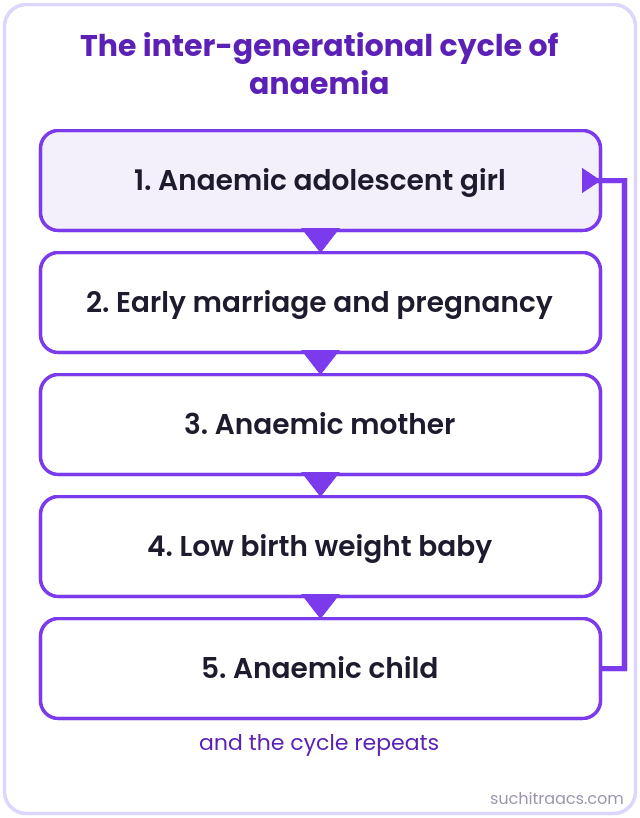
2. A life-cycle approach to tackle it
A life-cycle approach treats each stage of life as one linked chain. An anaemic girl often becomes an anaemic mother who gives birth to a low birth weight baby.
| Life stage | Action and scheme |
|---|---|
| Pregnancy and newborn | Follow the T4 strategy (Test, Treat, Talk, Track) and record haemoglobin on the JANANI portal. Give intravenous iron to severe cases and non-responders. Track low birth weight babies (0-6 months), added in June 2026 as the seventh beneficiary group of the Anemia Mukt Bharat Abhiyaan. |
| Children under 5 | Give biweekly iron-folic acid syrup to children aged 6-59 months. Serve fortified rice in anganwadi meals, which the Union Cabinet has continued till December 2028. |
| School children and adolescents | Give weekly iron-folic acid tablets. Deworm all children aged 1-19 on National Deworming Day, held on 10 February and 10 August. |
| Adolescent girls | Keep girls in school to delay marriage. Assam’s Nijut Moina pays girl students Rs 1,000 to Rs 2,500 a month from Class 11 to postgraduation. |
| Men and the elderly | Test adult men and people above 60 at Ayushman Arogya Mandirs and tea-garden hospitals. Treat them under the same Test, Treat, Talk, Track routine used for mothers. |
3. Way Forward
- Widen testing: The Health and Family Welfare Department, Assam, should test adult men and the elderly routinely, since Assam tops India for both adult and elderly men.
- Toilets in tea gardens: The Tea Tribes and Adivasi Welfare Department should fund toilets in labour lines to cut hookworm spread.
- Screen before iron: Test for HbE and thalassaemia first, as the National Sickle Cell Anaemia Elimination Mission (2023) does.
- Track every case: Follow each person on the JANANI, Rashtriya Bal Swasthya Karyakram (RBSK) and U-WIN portals, and let self-help groups spread the “Eating Right” message.
Conclusion: Assam’s anaemia is not just a shortage of iron tablets, since diet, infection, genes and poverty drive it across the whole of life. Only a tracked plan following every person from the newborn to the grandparent can stop it passing from mother to child.
Prepare with SuchitraACS
APSC CCE Foundation Programme₹24,999  APSC Prelims Crash Course 2027 (GS + CSAT)₹5,999
 APSC CCE Study Materials Package (Prelims + Mains)₹4,999