APSC Answer Writing (Daily) based on Assam Tribune – 27/11/2026
For APSC CCE and other Assam Competitive examinations aspirants, practicing Daily Answer Writing is vital. This blog covers the most important Main question and its model Answer from the Assam Tribune today (27-11-2026).
 Recommended courseAPSC Mains Answer Writing Program 2027₹4,999
Mains Answer Writing
From The Assam Tribune, 27 November 2026
Q. The ICMR-NIN SAMPADA survey (2023-25) shows that Assam has the highest anaemia prevalence in India among adult women, adult men and elderly men. What accounts for this persistent burden in the State? Suggest a life-cycle approach to tackle it. (250 words, 15 Marks)
Model answer
Introduction: Anaemia means the blood has too little haemoglobin to carry enough oxygen. The Indian Council of Medical Research-National Institute of Nutrition (ICMR-NIN) ran the SAMPADA survey (Survey for Assessment of Markers of Population Health, Activity, Diet, and Anthropometry) in 2023-25. It found 72.8 per cent of Assam’s women aged 20-59 anaemic, against 54.8 per cent nationally. Among adult men, Assam’s 46.8 per cent is more than double India’s 22 per cent.
1. What accounts for this persistent burden in the State
- Low-iron diet and the tea habit: Many poor households eat mostly rice with few pulses or greens. The ICMR-NIN Dietary Guidelines for Indians (2024) advise keeping tea and coffee about an hour away from meals, because tannins reduce iron absorption. Yet tea with meals is a common habit in tea-growing Assam.
- Worms and malaria: Hookworm causes slow blood loss and spreads through soil polluted by open defecation. Malaria destroys red blood cells and adds to the burden.
- Inherited blood disorders: A 1988 study of ten Assam communities found the haemoglobin E (HbE) gene at frequencies of 0.2 to 0.6 among Tibeto-Burman groups. Iron tablets do not correct anaemia caused by such inherited disorders.
- Tea-garden poverty: Low wages, hard manual work and poor sanitation in labour lines raise the risk of iron deficiency and worm infection.
- Early marriage: As per the National Family Health Survey (NFHS-6, 2023-24), 25.3 per cent of Assam’s women aged 20-24 married before 18. An early pregnancy drains iron from a girl who is still growing.
- Programme gaps: Anemia Mukt Bharat covered young children, adolescents, pregnant and lactating women and women of reproductive age. Adult men and the elderly, where Assam now tops India, fall outside it. Anaemia among Assam’s women aged 15-49 had already risen from 46 per cent (NFHS-4) to 65.9 per cent (NFHS-5, 2019-21).
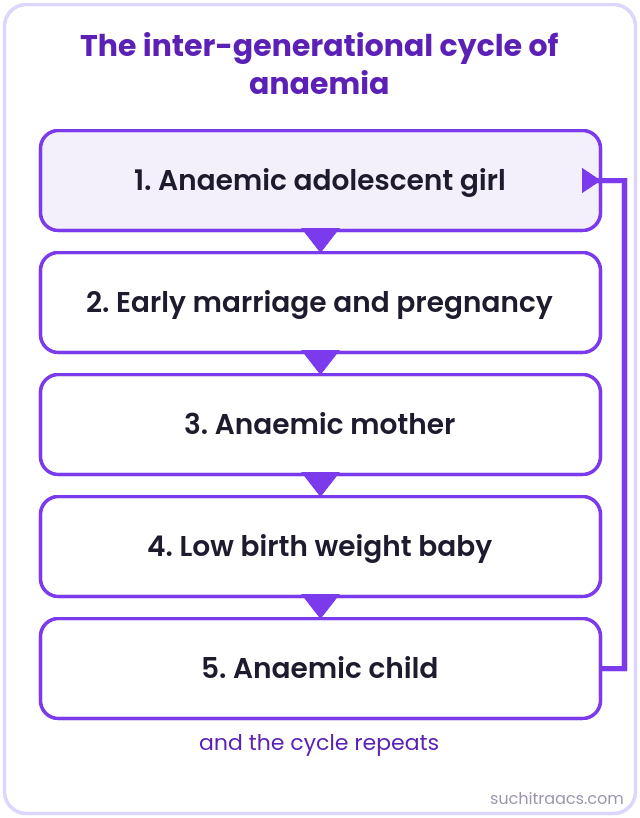
2. A life-cycle approach to tackle it
A life-cycle approach treats each stage of life as one linked chain. An anaemic girl often becomes an anaemic mother who gives birth to a low birth weight baby.
| Life stage | Action and scheme |
|---|---|
| Pregnancy and newborn | Follow the T4 strategy (Test, Treat, Talk, Track) and record haemoglobin on the JANANI portal. Give intravenous iron to severe cases and non-responders. Track low birth weight babies (0-6 months), added in June 2026 as the seventh beneficiary group of the Anemia Mukt Bharat Abhiyaan. |
| Children under 5 | Give biweekly iron-folic acid syrup to children aged 6-59 months. Serve fortified rice in anganwadi meals, which the Union Cabinet has continued till December 2028. |
| School children and adolescents | Give weekly iron-folic acid tablets. Deworm all children aged 1-19 on National Deworming Day, held on 10 February and 10 August. |
| Adolescent girls | Keep girls in school to delay marriage. Assam’s Nijut Moina pays girl students Rs 1,000 to Rs 2,500 a month from Class 11 to postgraduation. |
| Men and the elderly | Test adult men and people above 60 at Ayushman Arogya Mandirs and tea-garden hospitals. Treat them under the same Test, Treat, Talk, Track routine used for mothers. |
3. Way Forward
- Widen testing: The Health and Family Welfare Department, Assam, should test adult men and the elderly routinely, since Assam tops India for both adult and elderly men.
- Toilets in tea gardens: The Tea Tribes and Adivasi Welfare Department should fund toilets in labour lines to cut hookworm spread.
- Screen before iron: Test for HbE and thalassaemia first, as the National Sickle Cell Anaemia Elimination Mission (2023) does.
- Track every case: Follow each person on the JANANI, Rashtriya Bal Swasthya Karyakram (RBSK) and U-WIN portals, and let self-help groups spread the “Eating Right” message.
Conclusion: Assam’s anaemia is not just a shortage of iron tablets, since diet, infection, genes and poverty drive it across the whole of life. Only a tracked plan following every person from the newborn to the grandparent can stop it passing from mother to child.
Prepare with SuchitraACS
APSC Mains Answer Writing Program 2027₹4,999  APSC CCE Foundation Programme₹24,999
 APSC Mains Mentorship Program (MMP)₹9,999