White-bellied Heron and NE waterbirds: APSC Current Affairs Notes and MCQs
APSC CCE current affairs notes on White-bellied Heron and NE waterbirds, from The Assam Tribune of 27 November 2026, with 4 practice MCQs for Prelims.
 For working professionals and full-time aspirantsAPSC CCE Foundation Programme₹24,999
Current Affairs Notes
From The Assam Tribune, 27 November 2026
White-bellied Heron Sighting and the Fragile Waterbirds of Northeast Wetlands
Syllabus Mapping
- Prelims: GS Paper I (General issues on Environment and ecology, biodiversity; Geography of Assam; Current events of State/National importance).
- Mains: GS Paper III (Conservation, environmental pollution and degradation, Environmental Impact Assessment); GS Paper V (Assam: wildlife, protected areas and environmental issues of the State).
Why in News? Researchers of the Wildlife Institute of India recorded a rare White-bellied Heron on 12 November 2026 along the Lohit River in Arunachal Pradesh. The report also explained how wetland loss, hydropower projects and climate change threaten other rare waterbirds of the Northeast.
Current Context (The Trigger)
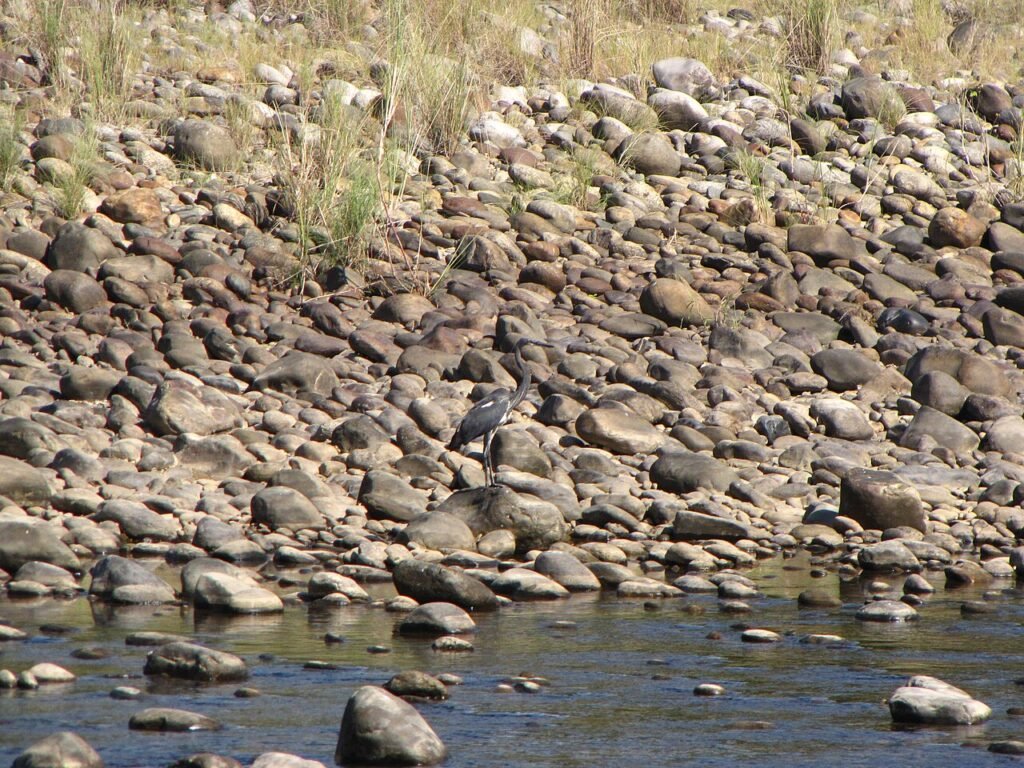
- The sighting: The Wildlife Institute of India (WII) recorded a White-bellied Heron (Ardea insignis) on 12 November 2026 along the Lohit River in Arunachal Pradesh.
- Tiny Indian population: India is thought to have fewer than 10 of these herons left in the wild. All of them are found only in undisturbed rivers and wetlands of Arunachal Pradesh and Assam.
- Global estimate: The whole species is put at 50 to 249 mature individuals. Studies call the population “extremely small and rapidly declining”.
- Past records in Assam: A heron was seen at Latajhar in Manas National Park and Tiger Reserve in 2021. Another was reported from Zomduar in Raimona National Park in 2022, and one along the Pekua River on 27 February 2023.
- Other waterbirds in the report: The article also covers the Black-necked Crane, the White-winged Wood Duck, the Spoon-billed Sandpiper and the Dunlin.
Core Concepts & Static GK
- White-bellied Heron: It is the second-largest living heron species. It depends on undisturbed rivers and lowland wetlands.
- Range: The bird occurs in very small numbers across Bhutan, Yunnan in China, northern Myanmar and Northeast India. It no longer survives in Nepal, where it is now extinct.
- EDGE bird: The heron is among the world’s top 100 EDGE birds. EDGE stands for Evolutionarily Distinct and Globally Endangered.
- IUCN status of the heron: The IUCN Red List places the White-bellied Heron in the Critically Endangered category. The paper also calls it Critically Endangered.
- Black-necked Crane: Grus nigricollis breeds on the Tibetan Plateau. Of the 15 crane species in the world, it is the only one that lives at high altitude.
- Black-necked Crane status: The IUCN Red List lists it as Near Threatened.
- White-winged Wood Duck: Asarcornis scutulata is called Deohanh in Assam. This large duck lives in thick tropical evergreen forest close to rivers and swamps.
Constitutional & Legal Framework
- Parent law: The Wild Life (Protection) Act, 1972 was amended by the Wild Life (Protection) Amendment Act, 2022. It is Act No. 18 of 2022 and received the President’s assent on 19 December 2022.
- Commencement: The Centre brought the 2022 amendment into force from 1 April 2023 through a notification dated 22 March 2023.
- Fewer schedules: The amendment cut the number of schedules from six to four. It reduced the schedules for specially protected animals to two, removed the vermin schedule and added a schedule for CITES-listed specimens.
- Schedule I birds: Part B (Birds) of Schedule I lists the White-bellied Heron, the Black-necked Crane and the White-winged Wood Duck. Schedule I gives the highest level of protection.
- Other schedules: Schedules I and II now cover wild animals, and Schedule III covers specified plants (earlier Schedule VI). Schedule IV covers species listed in the CITES Appendices, and a new Chapter VB regulates their international trade.
Institutional Machinery
- Wildlife Institute of India: WII researchers made the Lohit River sighting of the heron.
- Wildlife Trust of India: WTI carried out the recent survey of the White-winged Wood Duck in Assam and Arunachal Pradesh. Its preliminary estimate is only about 300 birds left in Northeast India.
- Namdapha Tiger Reserve: It was declared in 1983 as the 15th tiger reserve under Project Tiger. It lies in Changlang district of Arunachal Pradesh.
- Size of Namdapha: The reserve has a core area of 1,808 sq km and a buffer area of 177 sq km.
Reports, Indices & Data
- India count of heron: The paper gives fewer than 10 birds for India. The figure of 50 to 249 mature individuals is the estimate for the whole species.
- Wood Duck count: A preliminary WTI estimate puts the number at about 300 in Northeast India.
- Wood Duck status: The paper describes the White-winged Wood Duck as Endangered, which was its long-standing IUCN category. In the 2024 Red List update, based on a BirdLife International assessment, it was moved up to Critically Endangered, so Critically Endangered is its current status.
Assam & Northeast Linkages
- Heron sites: Assam records come from Manas National Park (2021), Raimona National Park (2022) and the Pekua River (2023). In Arunachal Pradesh, most sightings are from the Noa-Dihing, Lohit and Lahm river basins.
- Namdapha nests: Nesting sites were found along the Noa-Dihing, which flows through Namdapha Tiger Reserve. Sightings there are now rare because of disturbance and shifts in the river’s course.
- State bird of Assam: The Government of Assam declared the White-winged Wood Duck the State bird in 2003.
- Duck habitats: Key protected habitats are Dibru-Saikhowa, Dihing-Patkai and Nameri National Parks in Assam and Namdapha National Park in Arunachal Pradesh.
- Dibru-Saikhowa: Saving the Wood Duck was one of the main reasons the area got protected status. The park lies in Dibrugarh and Tinsukia districts.
- New national parks: Raimona (Kokrajhar district) and Dihing Patkai were notified as national parks in June 2021.
- Black-necked Crane in Arunachal: It winters in the Sangti Valley of West Kameng district. It has also been recorded in winter in the Zemithang Valley of Tawang.
- Lost visitors: Sivasagar district once had sightings of the Spoon-billed Sandpiper, but none have been recorded lately. The Dunlin is now rarely seen in the Subansiri wetlands of Lakhimpur district.
Prelims Trap Zones (Watch out for)
- Status Trap: The White-bellied Heron is Critically Endangered. The Black-necked Crane is only Near Threatened, not Endangered.
- Duck Status Trap: Many older notes, and today’s paper, call the White-winged Wood Duck Endangered. Its current IUCN category, since the 2024 update, is Critically Endangered.
- Schedule Trap: All three birds (heron, crane, wood duck) are in Schedule I of the Wild Life (Protection) Act, not Schedule II. Schedule IV is the CITES schedule, and plants are in Schedule III.
- Size Trap: The heron is the second-largest living heron, not the largest.
- Extinction Trap: The heron is extinct in Nepal, not in Bhutan, which is part of its present range.
- Number Trap: Fewer than 10 is the Indian count, while 50 to 249 mature individuals is the estimate for the whole species.
- Crane Trap: The Black-necked Crane breeds on the Tibetan Plateau and only winters in Arunachal Pradesh. It does not breed there.
- Place Trap: The Latajhar sighting was in Manas, and the Zomduar sighting was in Raimona.
Introduction
On 12 November 2026, Wildlife Institute of India researchers recorded a White-bellied Heron on the Lohit River, a bird with fewer than 10 individuals left in India. The sighting gives hope, but it also shows how the rivers, forests and wetlands of Assam and Arunachal Pradesh are losing their waterbirds. Saving the heron means saving the undisturbed river systems it needs.
Why These Waterbirds Matter
- Indicator of river health: The heron survives only in undisturbed river systems and wetlands. Its presence therefore signals a river that still works as a natural habitat.
- Global conservation value: The heron is among the world’s top 100 EDGE birds. Losing it would remove an evolutionarily distinct lineage from the planet.
- Protected area anchor: Nesting sites along the Noa-Dihing make Namdapha Tiger Reserve a vital habitat for the species. The reserve has 1,808 sq km of core area.
- Cultural value: The Buddhist Monpa tribes of Tawang and West Kameng revere the Black-necked Crane. This respect gives the bird a measure of local protection in its wintering valleys.
- State pride: The White-winged Wood Duck has been Assam’s State bird since 2003. Its fall to about 300 birds in Northeast India is a loss to the State’s identity.
- Reason for protected areas: Conserving the Wood Duck was among the main reasons for making Dibru-Saikhowa a protected area. A single species can thus shape the map of Assam’s national parks.
Causes of Decline
- Habitat loss: The heron is declining because lowland forests and wetlands are being lost and degraded. Studies expect this decline to continue in the near future.
- Direct pressure: Direct exploitation and disturbance also hurt the heron. Fishing and human movement along rivers can disturb nesting birds.
- River changes: Sightings along the Noa-Dihing have become scarce because of disturbance and shifts in the river’s course.
- Hydropower and infrastructure: Chinese infrastructure in Tibet and dams on rivers that rise on the Tibetan Plateau have badly damaged migratory bird habitats. Several wetlands have dried up as a result.
- Changed migration: Some species now go to other places because hydropower projects have left wetlands dry.
- Climate and human interference: Wetlands change naturally over time, but climate change and human activity have made this change much faster. The worst losses are in wetlands outside protected areas that waterbirds use only for part of the year.
Legal and Institutional Protection
| Level | Measure | Purpose and Impact |
|---|---|---|
| National law | Wild Life (Protection) Act, 1972, as amended in 2022 (in force from 1 April 2023) | Places the heron, the Black-necked Crane and the White-winged Wood Duck in Schedule I, the highest protection. |
| International trade | Schedule IV and Chapter VB of the amended Act | Covers species listed in the CITES Appendices and regulates their trade. |
| Protected areas | Dibru-Saikhowa, Dihing-Patkai and Nameri National Parks in Assam; Namdapha National Park in Arunachal Pradesh | Protect key habitats of the White-winged Wood Duck. |
| Tiger reserves | Namdapha (declared 1983, 15th Project Tiger reserve) | Gives forest and river protection to the Noa-Dihing nesting sites of the heron. |
| Research bodies | Wildlife Institute of India and Wildlife Trust of India | Record sightings and estimate numbers, which guide conservation. |
| New parks | Raimona and Dihing Patkai notified as national parks, June 2021 | Raise the legal status of Raimona, where a heron was reported in 2022. |
Challenges
- Very small populations: India has fewer than 10 herons and Northeast India about 300 Wood Ducks. At such low numbers, a single flood or poaching event can wipe out a local group.
- Wetlands outside protection: Large stretches of wetlands used by waterbirds outside protected areas are shrinking fast. Legal cover for parks does not reach them.
- Trans-boundary pressure: Infrastructure and hydropower in Tibet affect rivers that start on the Tibetan Plateau. India cannot control these decisions alone.
- Changing rivers: The shifting course of the Noa-Dihing has made heron sightings scarce. Natural and human-made river changes are hard to reverse.
- Data gaps: The heron’s global estimate is a wide range of 50 to 249 mature individuals. Many sources still give the Wood Duck’s older Endangered status, although the IUCN moved it to Critically Endangered in 2024.
- Disturbed nesting sites: Disturbance at nesting and roosting sites is a major reason for the Wood Duck’s decline. Wetlands in Dibru-Saikhowa where the Spot-billed Pelican once bred have now disappeared.
Way Ahead
- Protect river stretches: The Assam and Arunachal forest departments should treat the Noa-Dihing, Lohit and Lahm basins as priority heron habitat. They should regulate disturbance near nesting sites.
- Bring wetlands outside parks under care: State governments should map wetlands used by waterbirds outside protected areas and give them legal cover. These wetlands are disappearing the fastest.
- Regular monitoring: WII and the Wildlife Trust of India should run joint annual surveys of the heron, the Wood Duck and the Black-necked Crane. Better counts will narrow the wide population range.
- Check hydropower impact: Hydropower projects on Northeast rivers should face a bird and wetland impact assessment before approval. Dried-up wetlands show what poor planning costs.
- Work with Monpa communities: Forest departments should build on the Monpa reverence for the Black-necked Crane. Village-level crane watch programmes in the Sangti and Zemithang valleys can protect wintering birds.
- Cross-border cooperation: India should share survey data with Bhutan, Myanmar and China, the other range countries of the heron. Rivers and birds ignore borders.
Conclusion
A single heron on the Lohit shows that a few undisturbed rivers of the Northeast still work as a refuge for the rarest waterbirds. These birds will survive only if wetlands outside the parks, river courses and cross-border hydropower are managed as one connected system.
Asked in APSC
- APSC Prelims 2025: (answer in the MCQs below)
Match the following species (in List-I) with their correct conservation status (in List-II):
(List-I (Species)) – (List-II (IUCN Conservation Status))
a. One-horned rhinoceros (Rhinoceros unicornis) – 1. Endangered
b. White-winged duck (Asarcornis scutulata) – 2. Least concern
c. Golden langur (Trachypithecus geei) – 3. Critically endangered
d. Rhesus macaque (Macaca mulatta) – 4. Vulnerable
Select the correct match using the codes given below.- (A) a b c d – 1 4 2 3
- (B) a b c d – 2 1 3 4
- (C) a b c d – 4 3 1 2
- (D) a b c d – 3 1 4 2
All 500 APSC Prelims PYQs of CCE 2020 to 2025, with answers and explanations: practise free in the PYQ Explorer
APSC Prelims MCQs
Practice questions on this topic
Q1. Researchers of the Wildlife Institute of India recently recorded a White-bellied Heron along the Lohit River in Arunachal Pradesh. Consider the following statements about the species:
(i) It is listed as Critically Endangered on the IUCN Red List.
(ii) It is placed in Schedule II of the Wild Life (Protection) Act, 1972 as amended in 2022.
(iii) A heron was reported from the Latajhar area of Manas National Park and Tiger Reserve in 2021.
Which of the statements given above is/are correct?
- (a) (i) and (ii) only
- (b) (i) and (iii) only
- (c) (ii) and (iii) only
- (d) (i), (ii) and (iii)
Show answer
Answer: (b) Explanation: Statement (i) is correct because the IUCN Red List places the White-bellied Heron in the Critically Endangered category. Statement (iii) is correct because a heron was recorded at Latajhar in Manas in 2021. Statement (ii) is wrong because the heron is listed in Part B (Birds) of Schedule I of the amended Act. This gives the highest legal protection, not the lower Schedule II. So options (a), (c) and (d), which include statement (ii), are wrong. The 2022 amendment cut six schedules to four, and Schedule IV now covers CITES species. Value addition: the Zomduar sighting of 2022 was in Raimona National Park, and a heron was also seen along the Pekua River on 27 February 2023.
Q2. Match List-I (Species) with List-II (Place linked to it in the news):
| List-I (Species) | List-II (Place) |
|---|---|
| a. White-bellied Heron | 1. Sangti Valley |
| b. Black-necked Crane | 2. Dibru-Saikhowa National Park |
| c. White-winged Wood Duck | 3. Sivasagar district (past sightings) |
| d. Spoon-billed Sandpiper | 4. Noa-Dihing river |
Select the correct answer using the codes given below:
- (a) a-4, b-1, c-2, d-3
- (b) a-1, b-4, c-2, d-3
- (c) a-4, b-1, c-3, d-2
- (d) a-2, b-3, c-4, d-1
Show answer
Answer: (a) Explanation: The heron’s nesting sites were found along the Noa-Dihing, which flows through Namdapha Tiger Reserve, so a matches 4. The Black-necked Crane winters in the Sangti Valley of West Kameng, so b matches 1. Dibru-Saikhowa got protected status largely to conserve the White-winged Wood Duck, so c matches 2. The Spoon-billed Sandpiper was once sighted in Sivasagar, so d matches 3. Option (b) wrongly swaps the heron and the crane. Option (c) swaps the duck and the sandpiper. Option (d) gets all four pairs wrong. Value addition: the Black-necked Crane has also wintered in the Zemithang Valley of Tawang district.
Q3. Which one of the following statements about the Wild Life (Protection) Act, 1972 as amended in 2022 is NOT correct?
- (a) The amendment reduced the number of schedules from six to four.
- (b) Schedule IV deals with species listed in the CITES Appendices.
- (c) The White-bellied Heron and the Black-necked Crane are both in Schedule I.
- (d) The schedule for vermin was retained and renumbered as Schedule III.
Show answer
Answer: (d) Explanation: Statement (d) is not correct because the amendment removed the vermin schedule. The renumbered Schedule III now covers specified plants, which were earlier in Schedule VI. Statement (a) is correct as the Act moved from six schedules to four. Statement (b) is correct because Schedule IV is the new CITES schedule, which supports Chapter VB on international trade. Statement (c) is correct because Part B (Birds) of Schedule I lists both birds. Value addition: the amendment received assent on 19 December 2022 as Act No. 18 of 2022 and came into force on 1 April 2023.
Q4. The Black-necked Crane winters in India in the Sangti Valley, which lies in which district of Arunachal Pradesh?
- (a) Tawang
- (b) West Kameng
- (c) Changlang
- (d) Lower Dibang Valley
Show answer
Answer: (b) Explanation: The Sangti Valley is in West Kameng district, and the Buddhist Monpa tribes of the area revere the crane. Tawang is a tempting option because the crane has also wintered in the Zemithang Valley of Tawang, but Sangti itself is not there. Changlang is the district of Namdapha Tiger Reserve, home of the White-bellied Heron’s Noa-Dihing nesting sites. Lower Dibang Valley is not a wintering site named in the report. The bird breeds on the Tibetan Plateau and is the only high-altitude crane among the 15 species worldwide. Value addition: the IUCN Red List lists the Black-necked Crane as Near Threatened, and it is in Schedule I of the Indian Act.
PYQ (APSC Prelims 2025): Match the following species (in List-I) with their correct conservation status (in List-II):
(List-I (Species)) – (List-II (IUCN Conservation Status))
a. One-horned rhinoceros (Rhinoceros unicornis) – 1. Endangered
b. White-winged duck (Asarcornis scutulata) – 2. Least concern
c. Golden langur (Trachypithecus geei) – 3. Critically endangered
d. Rhesus macaque (Macaca mulatta) – 4. Vulnerable
Select the correct match using the codes given below.
- (A) a b c d – 1 4 2 3
- (B) a b c d – 2 1 3 4
- (C) a b c d – 4 3 1 2
- (D) a b c d – 3 1 4 2
Prepare with SuchitraACS
APSC CCE Foundation Programme₹24,999  APSC Prelims Crash Course 2027 (GS + CSAT)₹5,999
 APSC CCE Study Materials Package (Prelims + Mains)₹4,999