Public value cost budgeting in Assam: APSC Current Affairs Notes and MCQs
APSC CCE current affairs notes on Public value cost budgeting in Assam, from The Assam Tribune of 16 November 2026, with 4 practice MCQs for Prelims.
 For working professionals and full-time aspirantsAPSC CCE Foundation Programme₹24,999
Current Affairs Notes
From The Assam Tribune, 16 November 2026
Public Value Cost Statement for Assam’s Roads, Health and Flood Protection
Syllabus Mapping
- Prelims: GS Paper I (Current events of State/National importance; Indian Polity: constitutional provisions on the State budget; Indian Economy: budgeting and fiscal policy).
- Mains: GS Paper II (Governance: transparency, accountability and e-governance); GS Paper III (Indian Economy: government budgeting, infrastructure; Disaster management); GS Paper V (Assam: economy and development; flood and erosion problems of Assam).
Why in News? Economist Debdulal Thakur wrote an opinion piece in the Assam Tribune of 16 November 2026. He argues that Assam should publish a “Public Value Cost Statement” for rural roads, primary health care and flood protection. He wants budgets to show the cost of keeping a service running reliably, as well as the cost of building an asset.
Current Context (The Trigger)
- The proposal: The author suggests a modest Public Value Cost Statement. It would be published along with selected departmental performance reports.
- Three starting services: The pilot would cover rural roads, primary health care and flood protection.
- What it would report: Each service would show its annual expenditure, the services delivered and their unit cost. A simple reliability measure would be added, such as the number of days a road stayed passable or a health facility stayed open.
- Budget size quoted: The 2026-27 Assam budget projects an economy of Rs 8.71 lakh crore and an outlay of Rs 1.48 lakh crore, excluding debt repayments. The author stresses that these are budget projections, not achievements.
- Author: The writer is a Professor of Economics. He is Director of the Centre of Excellence in Public Policy, Sustainability and ESG Research at Alliance University, Bengaluru.
Core Concepts & Static GK
- Outlay, output and outcome: The Union Government’s Output Outcome Monitoring Framework 2026-27 defines these terms. The outlay is the money provided for a scheme in the Budget. An output is the direct, measurable product of scheme activities, often counted in physical units. An outcome is the overall result or quality improvement in the service delivered.
- Applying it to Assam: In the author’s examples, a repaired kilometre of road and a finished embankment are outputs. Less disruption to travel is an outcome. Losses avoided because of flood protection are also an outcome, but they need a credible baseline to measure.
- Life-cycle cost: This is the total cost of an asset over its whole life, including construction, routine maintenance and repairs. The author warns that a road that is cheap to build can turn costly when it has to be repaired again and again.
- Unit cost: This is the cost of delivering one unit of a service, such as one kilometre of road kept open or one consultation at a clinic. The author says unit costs must be “interpreted, not worshipped”, because geography changes the cost of the same service.
- Annualised cost formula suggested: For a road, the yearly cost should include building cost spread over its life, regular upkeep and repairs after floods. Then divide the total by the kilometres kept open through the whole year.
- Union Outcome Budget: Since 2017-18, the Centre has presented the outputs and outcomes of schemes in one consolidated Outcome Budget along with the Budget. From 2026-27 it is presented as the Output Outcome Monitoring Framework (OOMF). It covers 172 Central Sector and Centrally Sponsored Schemes with an outlay of Rs 500 crore or more.
Constitutional & Legal Framework
- Article 202: The Governor must cause a statement of the State’s estimated receipts and expenditure for each financial year to be laid before the State Legislature. This is called the “annual financial statement”.
- Separate showing of expenditure: The estimates must show separately the sums charged on the Consolidated Fund of the State and the other expenditure proposed from it. They must also separate expenditure on revenue account from other expenditure.
- Charged expenditure under Article 202(3): It includes the Governor’s emoluments and allowances, the salaries of the Speaker and Deputy Speaker, and debt charges. It also covers the salaries of High Court Judges and sums needed to satisfy a court judgment, decree or arbitral award.
- Article 203: Charged expenditure is not put to the vote of the Legislative Assembly, but it can be discussed. Other expenditure goes to the Assembly as demands for grants, which it may approve, refuse or reduce. A demand for a grant can be made only on the Governor’s recommendation.
- Link to the proposal: Article 202 asks only for estimates of receipts and expenditure. A Public Value Cost Statement would add service cost and reliability data on top of this, as a voluntary step.
Institutional Machinery
- Water Resources Department: According to the article, the department’s long-standing estimate puts 39.58 percent of Assam’s area in the flood-prone category.
- FinAssam: The article says Assam uses this system to prepare budgets online, release funds, report spending and manage public money.
- Assam Budget Manual: The author notes that the State’s own Budget Manual already provides for outcome budgeting.
- NRSC and ASDMA: The National Remote Sensing Centre (NRSC) of ISRO prepares the Flood Hazard Zonation Atlas of Assam. It does so with the Assam State Disaster Management Authority (ASDMA). The National Disaster Management Authority (NDMA) also took part in the latest edition.
- Independent validators: The author proposes that universities and local technical institutions help check the indicators.
Reports, Indices & Data
- Flood-prone share: As cited in the article, about 39.58 percent of Assam is flood-prone, against about 10.2 percent nationally.
- Area hit each year: The article cites historical data showing an average of 9.31 lakh hectares affected by floods every year. The author calls these structural exposures, not a measure of flooding in any recent year.
- Flood Hazard Atlas (1998-2023): NRSC’s latest atlas puts the cumulative flood-affected area of Assam at 27.08 lakh hectares over 1998 to 2023. It also estimates that 18.22 lakh hectares of crop-grown area is at risk of flood inundation.
- Atlas editions: NRSC released the first Flood Hazard Zonation Atlas of Assam in 2011 and updated it in 2015. The latest edition maps hazard for 173 circles across 35 districts.
- 2026-27 budget numbers: Projected Gross State Domestic Product (GSDP) is Rs 8,71,451 crore. Expenditure excluding debt repayment is Rs 1,48,029 crore. With Rs 8,685 crore of debt repayment, the total is Rs 1,56,715 crore.
- Capital outlay: Capital outlay is proposed at Rs 29,451 crore in 2026-27.
Assam & Northeast Linkages
- Fiscal deficit target: The 2026-27 Assam budget targets a fiscal deficit of 3 percent of GSDP. This works out to Rs 26,186 crore.
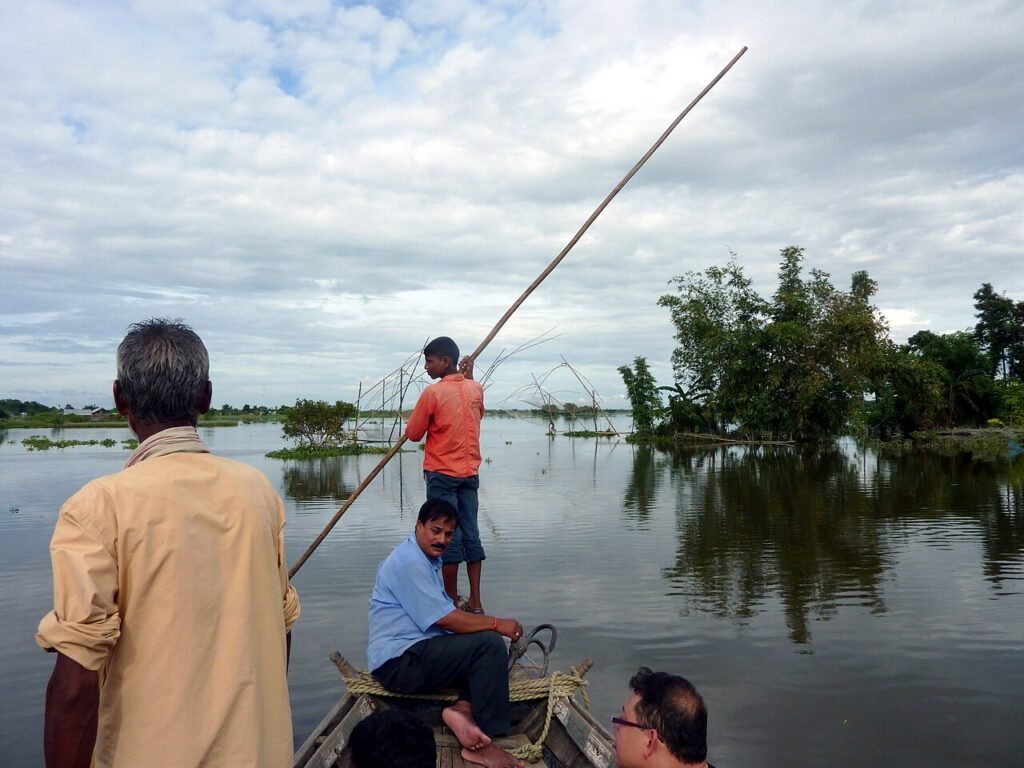
- Two districts, same Rs 100 crore: The author compares a district building new roads on stable ground with one that keeps repairing links broken by floods and erosion. The same spending does not give the same public value.
- Riverine health centres: A good health centre for thinly spread river-island villages may spend more per patient visit than a city centre. A higher cost there is not automatically waste.
- Equity safeguard: The author says cost figures should never be used to justify cutting services in remote areas.
Prelims Trap Zones (Watch out for)
- Output vs Outcome Trap: A completed embankment or a repaired kilometre of road is an output. Less disruption and avoided flood loss are outcomes.
- Percentage Trap: Assam’s flood-prone share is 39.58 percent. The national share is about 10.2 percent. Do not swap them.
- Annual-vs-Cumulative Trap: The 9.31 lakh hectares is an average area affected each year. The atlas figure of 27.08 lakh hectares is the cumulative flood-affected area over 1998 to 2023.
- Budget Size Trap: Rs 1.48 lakh crore is the outlay excluding debt repayment. Including debt repayment, the figure is about Rs 1.57 lakh crore.
- Article Trap: Article 202 is the annual financial statement of a State. Article 203 deals with the procedure in the State Legislature on the estimates.
- Charged Expenditure Trap: Charged expenditure on the State Consolidated Fund can be discussed but is not voted on.
- Name Trap: From 2026-27, the Union Outcome Budget is presented as the Output Outcome Monitoring Framework. It is a Union document; Assam’s outcome budgeting comes from its own Budget Manual.
Introduction
The 2026-27 Assam budget projects an economy of Rs 8.71 lakh crore and an outlay of Rs 1.48 lakh crore. An opinion piece in the Assam Tribune on 16 November 2026 asks a harder question. What will it cost to keep these assets working for five monsoons? About 39.58 percent of the land in Assam is flood-prone. So the cost of keeping a road, clinic or embankment working matters as much as the cost of building it.
Why Life-Cycle Cost Matters for Assam
- Geography changes cost: About 39.58 percent of Assam is flood-prone, against about 10.2 percent for India. So the same service costs more to deliver here than on stable ground.
- Repeated repair bills: A road that is cheap to build but breaks every monsoon makes the State pay again and again. Over its life, it can cost more than a better-designed road.
- Equal spending, unequal value: Two districts may each spend Rs 100 crore on roads. The one that keeps repairing flood damage will give its people far less new access.
- Fiscal space is tight: The 2026-27 budget targets a fiscal deficit of 3 percent of GSDP. With long-term cost data, a department can choose between repairing, upgrading or redesigning an asset, or building it again.
- Fairer comparison: Raw cost comparisons ignore service quality and geography. Reporting reliability, such as the days a road remained passable, gives a fairer picture.
- Democratic dividend: Clear data let residents ask why a repaired road failed again or why a funded clinic stayed shut. Departments working in hard conditions would also get credit, and not just those with the lowest costs.
What the Public Value Cost Statement Would Contain
- Three pilot services: Rural roads, primary health care and flood protection would come first.
- Basic data lines: Each service would show annual expenditure, clearly defined services provided and unit cost.
- Reliability measures: It would add the days a road stayed passable and the days a health facility functioned. For flood protection, it would count households protected against a specified flood risk.
- Roads calculation: Annualised construction, routine maintenance and flood repair costs are added up. The total is divided by the kilometres kept open all year.
- Health calculation: Staffing, supplies, transport and facility costs would be added together. The statement would also show opening days and key services delivered.
- Counted versus estimated: The statement must keep what the government can count apart from what it has to estimate. Avoided flood loss, for example, needs a credible baseline.
Comparative Assessment: Input, Output and Outcome
| Item | Type | How it is judged |
|---|---|---|
| Rupees spent on a scheme | Input (outlay) | Shown in the budget; treating it as an outcome gives attractive dashboards but weak evidence |
| A repaired kilometre of road | Output | Can be counted directly |
| A completed embankment | Output | Can be counted directly |
| Less travel disruption | Outcome | Needs reliability data such as days passable |
| Avoided losses from flooding | Outcome | Needs a credible baseline and careful assessment |
Challenges
- Weak baselines: Measuring avoided flood loss needs a credible baseline. The author admits that measurements are often incomplete.
- Misreading unit costs: A higher cost in a flood-prone district is not automatically waste. Ranking districts by the cheapest kilometre could punish the places that most need support.
- Risk of cutting remote services: Officials could misuse cost data to justify withdrawing services from remote areas.
- Mixing structural exposure with recent floods: The 39.58 percent and 9.31 lakh hectare figures are long-run estimates. They do not show flooding in any given recent year.
- Risk of another costly platform: The author warns that a simple exercise should not grow into one more expensive IT platform.
- Single-ratio thinking: Equity, resilience and quality are public goals in their own right. They cannot be reduced to one efficiency ratio.
Way Ahead
- Start small: The State government can publish the statement for rural roads, primary health care and flood protection with selected departmental performance reports.
- Compare by risk bands: The first pilot should compare wide bands of flood risk, not rank every district against the others.
- Track assets over years: Departments should follow assets for several years and record emergency repairs separately. They should also log service interruptions and explain unusually high costs.
- Use FinAssam and the Budget Manual: Existing systems should be linked more closely to the cost of a reliable service, and not just to the purchase of an asset.
- Use flood hazard maps: The NRSC atlas classifies flood hazard for 173 circles across 35 districts. Such hazard zones could help define the flood-risk bands used for fair comparison.
- Admit gaps honestly: The author would rather a department say “there’s a gap” than pretend to know when the data are incomplete.
- Independent validation: Universities and local technical institutions can help check the indicators.
Conclusion
Assam already tracks the money it spends through FinAssam and a Budget Manual that allows outcome budgeting. The next step is to ask what it costs to keep each public benefit running, while protecting equity for remote and flood-hit communities. A small, honest pilot on roads, health and flood protection would test the idea at low cost before any wider rollout.
APSC Prelims MCQs
Practice questions on this topic
Q1. Article 202 of the Constitution deals with the annual financial statement of a State. Consider the following statements:
(i) The Governor causes the statement of estimated receipts and expenditure to be laid before the State Legislature for every financial year.
(ii) The estimates must show separately the expenditure charged on the Consolidated Fund of the State and the other expenditure proposed from it.
(iii) Expenditure charged on the Consolidated Fund of the State is put to vote by the Legislative Assembly as demands for grants.
Which of the statements given above is/are correct?
- (a) (i) and (ii) only
- (b) (ii) and (iii) only
- (c) (i) and (iii) only
- (d) (i), (ii) and (iii)
Show answer
Answer: (a) Explanation: Statements (i) and (ii) are correct. Article 202(1) requires the Governor to lay the annual financial statement before the Legislature for each financial year. Article 202(2) requires charged expenditure and other expenditure to be shown separately. Statement (iii) is wrong because, under Article 203, charged expenditure can be discussed but is not submitted to the Assembly’s vote. Only the other expenditure goes to the Assembly as demands for grants, which it may approve, refuse or reduce. So option (a) is the key. Options (b), (c) and (d) all wrongly include (iii). Value addition: Article 202(3) lists charged items such as the Governor’s emoluments, debt charges and the salaries of High Court Judges.
Q2. An opinion piece on Assam’s finances discusses flood exposure. Consider the following statements:
(i) About 39.58 percent of Assam is estimated to be flood-prone, compared to about 10.2 percent nationally.
(ii) On past records, floods hit about 9.31 lakh hectares of Assam in an average year.
(iii) These figures measure the extent of flooding in the most recent year.
Which of the statements given above is/are correct?
- (a) (i) and (ii) only
- (b) (i) only
- (c) (ii) and (iii) only
- (d) (i), (ii) and (iii)
Show answer
Answer: (a) Explanation: Statements (i) and (ii) are correct. The article says the Water Resources Department’s long-standing estimate treats 39.58 percent of Assam as flood-prone, against about 10.2 percent for India. It also cites historical data showing an average of 9.31 lakh hectares affected each year. Statement (iii) is wrong. These are long-run structural exposure figures, and they do not show how much flooding occurred in any recent year. Option (b) wrongly leaves out (ii). Option (c) wrongly includes (iii) and leaves out (i). Option (d) wrongly includes (iii). Value addition: NRSC’s Flood Hazard Zonation Atlas puts Assam’s cumulative flood-affected area at 27.08 lakh hectares over 1998 to 2023.
Q3. Match List-I with List-II:
| List-I (Figure) | List-II (What it represents) |
|---|---|
| a. Rs 8.71 lakh crore | 1. Share of Assam’s area that is flood-prone |
| b. 39.58 percent | 2. Projected size of Assam’s economy in 2026-27 |
| c. 9.31 lakh hectares | 3. Fiscal deficit as a share of GSDP in the 2026-27 Assam budget |
| d. 3 percent | 4. Average area affected by floods annually |
Select the correct answer using the codes given below:
- (a) a-2, b-1, c-4, d-3
- (b) a-2, b-4, c-1, d-3
- (c) a-1, b-2, c-3, d-4
- (d) a-3, b-1, c-4, d-2
Show answer
Answer: (a) Explanation: The correct pairs are a-2, b-1, c-4 and d-3. Rs 8.71 lakh crore is the projected size of Assam’s economy in 2026-27. The figure of 39.58 percent is the share of Assam’s area that is flood-prone. The 9.31 lakh hectares is the historical average area affected by floods every year. The 3 percent is the fiscal deficit as a share of GSDP. Option (b) swaps the flood-prone share with the annual area. Option (c) mismatches all four pairs. Option (d) swaps the economy size with the deficit share. Value addition: the Rs 1.48 lakh crore outlay quoted in the article excludes debt repayment of Rs 8,685 crore.
Q4. In the Public Value Cost Statement proposed for Assam, a completed embankment is classified as:
- (a) an outcome
- (b) an output
- (c) an impact assessed through avoided losses
- (d) a reliability measure
Show answer
Answer: (b) Explanation: The author treats a completed embankment as an output. It is a physical product that can be counted directly, just like a repaired kilometre of road. Option (a) is wrong because an outcome is the result for people, such as less travel disruption. Option (c) is wrong because avoided flood losses are the outcome, and they need a credible baseline and careful assessment. Option (d) is wrong because reliability measures are items such as the days a road stayed passable or households protected against a specified flood risk. Value addition: from 2026-27, the Union Outcome Budget is presented as the Output Outcome Monitoring Framework. It covers 172 schemes with an outlay of Rs 500 crore or more.
Prepare with SuchitraACS
APSC CCE Foundation Programme₹24,999  APSC Prelims Crash Course 2027 (GS + CSAT)₹5,999
 APSC CCE Study Materials Package (Prelims + Mains)₹4,999