Geography and disaster education in Assam: APSC Current Affairs Notes and MCQs
APSC CCE current affairs notes on Geography and disaster education in Assam, from The Assam Tribune of 1 November 2026, with 4 practice MCQs for Prelims.
 Last batch for APSC CCE 2027 · starts 16 NovAPSC CCE Foundation Programme₹24,999
Current Affairs Notes
From The Assam Tribune, 1 November 2026
Geography as Disaster Literacy in Assam’s Schools
Syllabus Mapping
- Prelims: GS Paper I (Current events of State/National importance; Geography of Assam; Environment and ecology).
- Mains: GS Paper II (Issues relating to development and management of Social Sector/Services relating to Education); GS Paper III (Disaster and disaster management); GS Paper V (Geography, Governance and Disaster Management of Assam).
Why in News? An opinion article in the Assam Tribune of 1 November 2026 argues that geography should get a central place in Assam’s schools. The writer has worked as an external evaluator in Gunotsav. The writer wants teaching to move from rote learning to hands-on, local learning. Assam lives with floods, erosion and earthquakes.
Current Context (The Trigger)
- The writer’s view: Assam’s schools still treat geography as a subject to memorise. The writer wants it taught as part of daily life in a hazard-prone state.
- Classroom finding: In the schools the writer visited, geography came almost only from the textbook and the blackboard. Wall maps, atlases and globes were there but rarely used.
- Reform check: The writer credits the reforms under Education Minister Ranoj Pegu. These include Gunotsav in all districts, the merger of the two school boards, smart classrooms and announced transport support for tea garden children. But in the writer’s view, most of these work at the level of administration and digital infrastructure.
Core Concepts & Static GK
- Disaster literacy: The writer uses this term for geography teaching that helps students understand warnings. Such students can also question badly planned construction.
- Integrated social science: At the middle stage, NCERT now has one integrated social science textbook in place of separate history, geography and civics books. The writer warns that map reading, spatial reasoning and field observation may then get less attention.
- Skills of geography: Spatial thinking, reading data and fieldwork. It also introduces students to GIS and remote sensing.
Institutional Machinery
- Gunotsav: Assam’s school quality assessment programme, introduced in 2017. It grades government and provincialised schools on academic achievement, co-scholastic activities, infrastructure and community participation.
- Who runs it: Samagra Shiksha Assam conducts Gunotsav. The first phase ran in April 2017 in eight districts.
- NCF-SE 2023: Union Education Minister Dharmendra Pradhan released the National Curriculum Framework for School Education on 23 August 2023. It covers all four school stages: Foundational, Preparatory, Middle and Secondary.
Schemes & Initiatives
- NEP 2020: It replaces the 10+2 system with a 5+3+3+4 structure for ages 3-8, 8-11, 11-14 and 14-18. It brings the 3-6 age group under the school curriculum, which was not covered before.
- Experiential learning: The writer points out that NEP 2020 and NCF-SE 2023 both ask for experiential, inquiry-based learning rooted in local settings.
Reports, Indices & Data
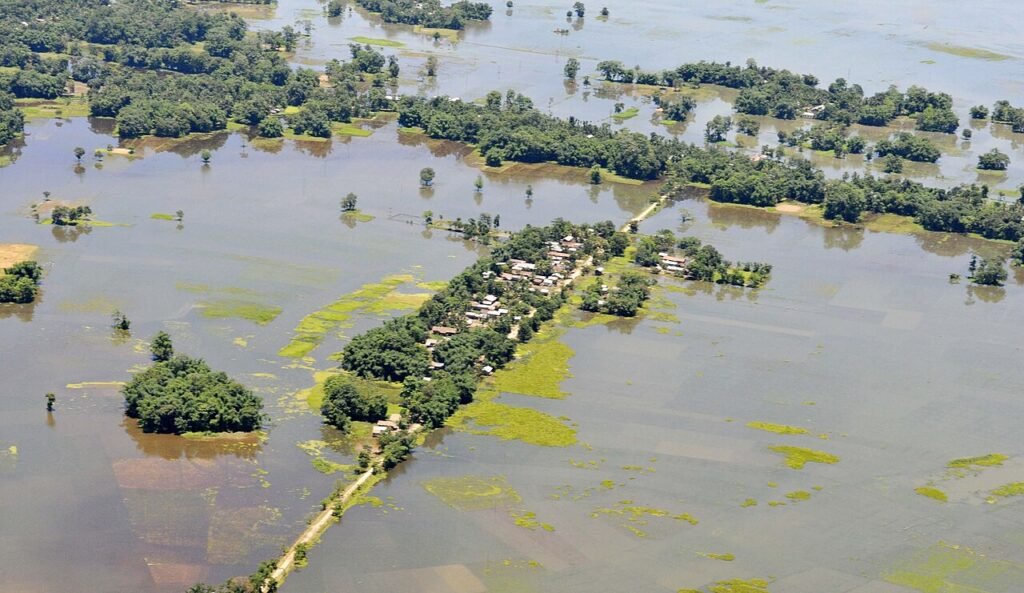
- Flood-prone Assam: As assessed by the Rashtriya Barh Ayog (National Flood Commission), about 39.58% of Assam’s land area is flood-prone. This is about 9.40% of India’s total flood-prone area.
Assam & Northeast Linkages
- Hazard setting: The writer lists the Brahmaputra and Barak rivers, heavy rain, young Himalayan slopes and frequent earthquakes. Together, these put the Northeast among India’s most disaster-prone regions. Assam has repeated floods and bank erosion, and Majuli keeps losing land.
- Biodiversity link: The writer places the region where the Himalayan and Indo-Burma biodiversity hotspots meet. Kaziranga, Manas and wetlands like Deepor Beel are the examples given.
- Local lives: A tea garden child can study plantation geography. A child from a char village can study how rivers behave. Local knowledge of rivers, soils and weather can then meet science.
Prelims Trap Zones (Watch out for)
- Year Trap: Gunotsav began in Assam in 2017. Do not mix it up with NEP 2020 or NCF-SE 2023.
- Date Trap: NEP 2020 was announced in July 2020. NCF-SE was released later, on 23 August 2023.
- Percentage Trap: 39.58% is the flood-prone share of Assam’s own land. 9.40% is Assam’s share of India’s total flood-prone area. Do not swap them.
- Textbook Trap: The integrated textbook replaced separate history, geography and civics books at the middle stage, not at every stage.
- Agency Trap: Gunotsav is run by Samagra Shiksha Assam, not by NCERT.
Introduction
In the monsoon, many schools in the Brahmaputra Valley double as relief camps, the writer notes. So geography in Assam is not just maps and capitals. It is a practical way to prepare children for floods, erosion and earthquakes.
Why Geography Matters in Assam
- Disaster literacy: A student who understands river shifts, embankment breaches and landslides can read warnings better. That student can also challenge badly planned construction.
- Environment and development: Geography shows how shrinking wetlands, encroachment and new infrastructure are linked.
- Society and politics: In Assam, social life is tied to land. For over a century, its politics has turned on land rights, evictions and migration. Taught well, geography helps students look at migration and homeland issues with balance.
- Skills: It builds spatial thinking, data skills and fieldwork. It also introduces GIS and remote sensing.
Challenges in the Classroom
- Rote teaching: Exams reward memorising, so practical work gets little room.
- Idle resources: Atlases, wall maps and globes are available but rarely used.
- Teacher constraints: Teachers are willing, but they lack materials and time for practical work.
- Integration risk: One combined social science book may weaken map reading and field observation, unless teachers guard them.
- Reform gap: Many reforms act on administration and digital tools. They may not change how a teacher explains rivers or weather.
Government Initiatives (National & Assam)
| Level | Initiative | Purpose & Impact |
|---|---|---|
| National | NEP 2020 | Replaces 10+2 with 5+3+3+4 (ages 3-18); brings ages 3-6 under the school curriculum |
| National | NCF-SE 2023 | Curriculum framework for all four school stages |
| National | NCERT integrated social science textbook | Replaces separate history, geography and civics books at the middle stage |
| Assam | Gunotsav | Quality assessment of schools, now in all districts |
| Assam | Merger of school boards, smart classrooms, transport support for tea garden children | Administrative and access reforms |
Way Ahead
- Use the tools: Make atlases, wall maps and globes part of every geography class.
- Field learning: Take students to an eroding riverbank or a wetland, as the writer suggests.
- Teacher support: Give teachers training, materials and time for practical work.
- Protect geography skills: Keep map reading and spatial work alive inside the integrated textbook.
- Local knowledge: Bring what communities know about rivers, soils and weather into lessons.
Conclusion
The writer argues that reforms work only when resources, training and time reach the classroom. For a flood-prone state, good geography teaching can be a low-cost step towards disaster preparedness.
Asked in APSC
- APSC Mains 2020, GS Paper 3 (15 marks): What are the points to be looked into in the preparation of management of a large earthquake? Describe the long-term measures to be taken in managing floods in North-East India.
APSC Prelims MCQs
Practice questions on this topic
Q1. Gunotsav is Assam’s school quality assessment programme. Consider the following statements:
(i) It assesses government and provincialised schools on academic achievement, co-scholastic activities, infrastructure and community participation.
(ii) It was introduced in 2017.
(iii) It is implemented by NCERT.
Which of the statements given above is/are correct?
- (a) (i) and (ii) only
- (b) (ii) and (iii) only
- (c) (i) only
- (d) (i), (ii) and (iii)
Show answer
Answer: (a) Explanation: Statements (i) and (ii) are correct; the first phase ran in April 2017 in eight districts. Gunotsav is a state programme conducted by Samagra Shiksha Assam, not by NCERT, so (iii) is wrong.
Q2. Match List-I with List-II:
| List-I | List-II |
|---|---|
| a. Gunotsav | 1. Curriculum framework for four stages of schooling |
| b. NCF-SE 2023 | 2. Assessed about 39.58% of Assam’s land as flood-prone |
| c. Integrated social science textbook | 3. School quality assessment programme of Assam |
| d. Rashtriya Barh Ayog | 4. Replaced separate history, geography and civics books at the middle stage |
Select the correct answer using the codes given below:
- (a) a-1, b-3, c-2, d-4
- (b) a-3, b-1, c-4, d-2
- (c) a-3, b-1, c-2, d-4
- (d) a-2, b-4, c-1, d-3
Show answer
Answer: (b) Explanation: Gunotsav is the school quality assessment (3). NCF-SE 2023 is the curriculum framework for the four stages (1). The integrated textbook replaced the three separate books (4). The Rashtriya Barh Ayog assessed about 39.58% of Assam’s land as flood-prone (2).
Q3. Which of the following statements is NOT correct?
- (a) NCF-SE 2023 covers the Foundational, Preparatory, Middle and Secondary stages.
- (b) As assessed by the Rashtriya Barh Ayog, about 39.58% of Assam’s land area is flood-prone.
- (c) NCERT has replaced separate history, geography and civics textbooks at the middle stage with an integrated social science textbook.
- (d) NCF-SE was released in July 2020, together with NEP 2020.
Show answer
Answer: (d) Explanation: NEP 2020 was announced in July 2020. NCF-SE came three years later: Union Education Minister Dharmendra Pradhan released it on 23 August 2023. Statements (a), (b) and (c) are correct.
Q4. Under the 5+3+3+4 school structure of NEP 2020, the final four-year stage corresponds to which age group?
- (a) 3-8 years
- (b) 8-11 years
- (c) 11-14 years
- (d) 14-18 years
Show answer
Answer: (d) Explanation: The four stages cover ages 3-8, 8-11, 11-14 and 14-18. The last stage, of four years, is 14-18. The 11-14 stage is only three years long.
Prepare with SuchitraACS
APSC CCE Foundation Programme₹24,999  APSC Prelims Crash Course 2027 (GS + CSAT)₹5,999
 APSC CCE Study Materials Package (Prelims + Mains)₹4,999