
APSC Answer Writing (Daily) based on Assam Tribune – 01/11/2026
For APSC CCE and other Assam Competitive examinations aspirants, practicing Daily Answer Writing is vital. This blog covers the most important Main question and its model Answer from the Assam Tribune today (01-11-2026).
 Last batch for APSC CCE 2027 · starts 16 NovAPSC CCE Foundation Programme₹24,999
Mains Answer Writing
From The Assam Tribune, 1 November 2026
Q. Assam’s crackdown on child marriage has led to thousands of arrests. Critically examine whether enforcement alone can end child marriage, and suggest an integrated approach involving education, women’s economic empowerment and health. (250 words, 15 marks)
Model answer
Introduction: The Prohibition of Child Marriage Act, 2006 treats a girl below 18 and a boy below 21 as a child. In Assam, NFHS-5 found that 31.8 per cent of women aged 20-24 married before 18, against 23.3 per cent for India.
1. Case for enforcement
- Strong law: Offences under the Act are cognizable and non-bailable. A man above 18 who marries a child faces up to two years’ rigorous imprisonment, a fine up to Rs 1 lakh, or both.
- Scale of the drive: The latest round has led to 565 arrests and 481 cases. Since February 2023, over 12,000 cases and over 11,000 arrests have been recorded.
- Deterrence: Police arrested grooms, relatives and religious functionaries who helped. This warns others.
2. Limits of enforcement alone
- Root causes stay: Some pockets of western Assam are backward, and girls there have poor access to schooling.
- Misdirected arrests: Arresting couples married years ago, who now have children, achieves little. Courts stepped in against such arrests.
- Social problem: A purely legal view misses the social roots.
- Health cost: Early marriage is linked to the State’s high infant and maternal mortality.
3. Integrated approach: education, empowerment, health
- Education: Educated girls are less likely to be married early. Assam’s Nijut Moina scheme gives girl students monthly financial help from higher secondary to postgraduate level, to reduce dropouts.
- Economic empowerment: Better income and status for women can cut early marriage further.
- Health outcomes: Delaying marriage supports efforts to reduce infant and maternal deaths.
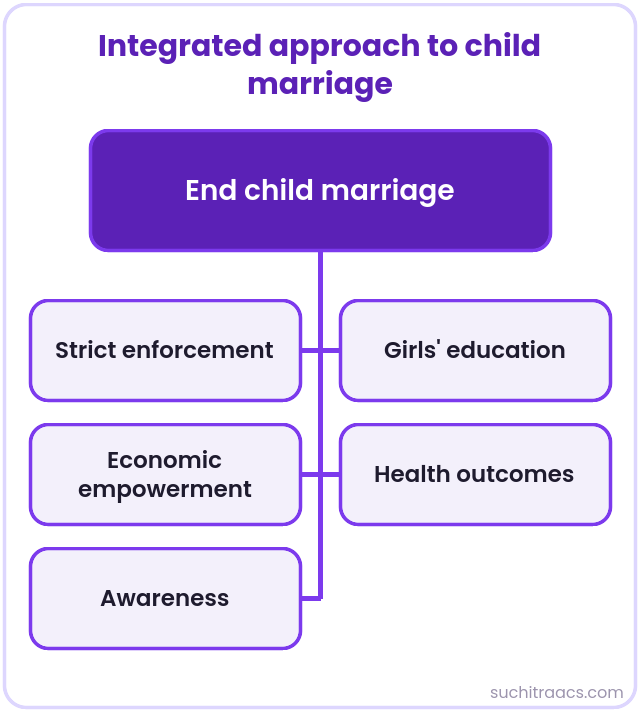
4. Way Forward
- Targeted enforcement: Act against new child marriages, not couples married years ago.
- Awareness: Spread information on the harm of early marriage.
- Prevention officers: Use Child Marriage Prohibition Officers, whose legal duty is to prevent such marriages.
- Focus areas: Prioritise girls’ schooling in the western Assam pockets.
Conclusion: Enforcement is needed, but it cannot work alone. Lasting change needs firm enforcement plus girls’ education and women’s empowerment.
Prepare with SuchitraACS
APSC CCE Foundation Programme₹24,999  APSC Mains Mentorship Programme (MMP)₹9,999
 APSC Prelims Crash Course 2027 (GS + CSAT)₹5,999



