APSC Current Affairs: Assam Tribune Notes with MCQs and Answer Writing (01/11/2026)
In this post
For APSC CCE and other Assam competitive exam aspirants, staying consistently updated with reliable current affairs is essential for success. This blog provides a well-researched analysis of the most important topics from The Assam Tribune dated 01 November 2026. Each issue has been carefully selected and explained to support both APSC Prelims and Mains preparation, ensuring alignment with the APSC CCE syllabus and the evolving trends of the examination.
 Last batch for APSC CCE 2027 · starts 16 NovAPSC CCE Foundation Programme₹24,999
Current Affairs Notes
From The Assam Tribune, 1 November 2026
Agarwood Export Point at Guwahati Airport
Open this topic as a separate page, with its MCQs →
Syllabus Mapping
- Prelims: GS Paper I (Current events of State/National importance; Assam Economy; General issues on Environment ecology, Bio-Diversity).
- Mains: GS Paper III (Indian Economy and issues relating to planning, mobilisation of resources, growth and development; Conservation); GS Paper V (Economy of Assam: Infrastructure and Resources; Bio-diversity and Environment of Assam).
Why in News? Union Commerce and Industry Minister Piyush Goyal made the announcement on Saturday, 31 October. According to the minister, the Centre has cleared LGBI Airport, Guwahati, as an export point for agarwood chips and agarwood oil. The approval came at Chief Minister Himanta Biswa Sarma’s request.
Current Context (The Trigger)
- The approval: Lokapriya Gopinath Bardoloi International (LGBI) Airport is now an approved export point for agarwood chips and agarwood oil.
- Who announced it: Piyush Goyal shared the news in a post on X.
- Expected gain: Growers, producers and exporters now have an export point inside the region. This should make it easier to sell agarwood products from Assam and the Northeast abroad.
- Recent trade: In October, Assam sent 123 kg of agarwood chips to Dubai. The state government called it a boost for the sector.
Core Concepts & Static GK
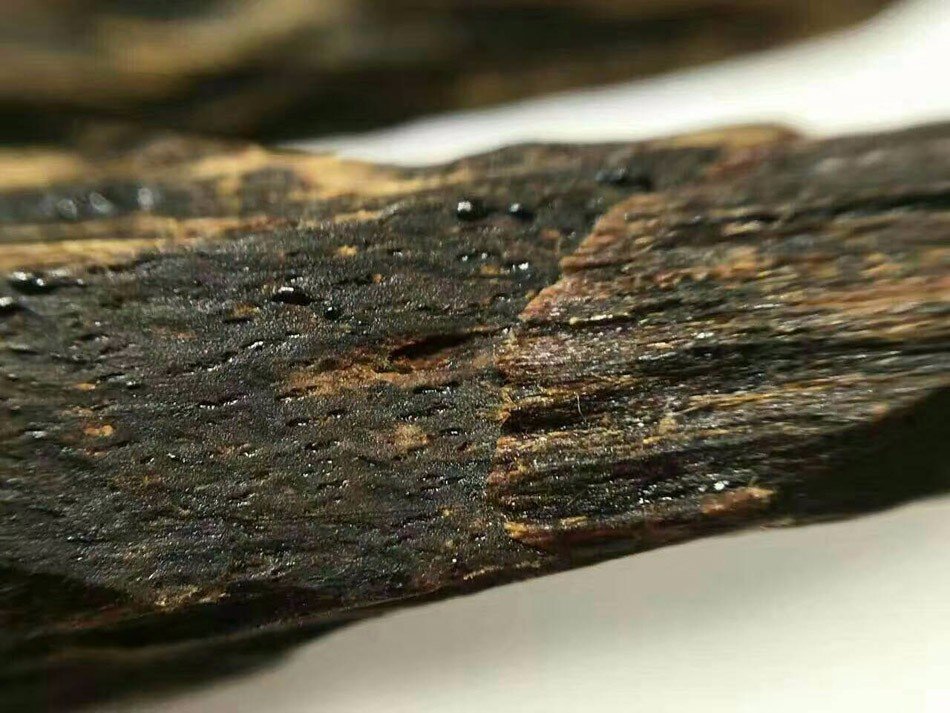
- Agarwood: A scented wood that forms inside trees of the genus Aquilaria. It goes into perfumes, incense sticks, essential oils and other traditional fragrances.
- Species in trade: India’s export rules name Aquilaria malaccensis for agar oil and for agarwood chips and powder. This species has been in Appendix II of CITES since 1995.
- CITES Appendix II: It lists species that may become threatened if trade is not controlled. Trade is allowed, but each export needs a CITES export permit.
Constitutional & Legal Framework
- Restricted export: A DGFT notification of 29 November 2021 moved agar oil and agarwood chips and powder from “Free” to “Restricted” export.
- Quota in 2021: The yearly limit was 25,000 kg for chips and powder and 1,500 kg for oil. It applies only to plantation-grown stock from outside forest areas.
- Higher quota from 2024: India’s CITES export quota rose to 151,080 kg a year for chips and powder and 7,050 kg a year for oil.
- Wild stock: The export quota for agarwood harvested from the wild is zero.
Institutional Machinery
- DGFT: The Directorate General of Foreign Trade issues the export licence for these restricted items.
- Forest Department: A state forest officer must certify that the stock came from a plantation registered with the state government.
- Botanical Survey of India: It prepared India’s Non-detriment Findings (NDF) study on agarwood for CITES. The Union Ministry of Environment, Forest and Climate Change commissioned it.
Reports, Indices & Data
- Review of Significant Trade: In 2023, CITES placed India under this review for Aquilaria malaccensis. Indonesia, Malaysia, Singapore and Thailand were also placed under it. India’s case has since been closed.
- Plantation base: The BSI study counted at least 139.89 million agarwood plants in non-forest areas of India.
Assam & Northeast Linkages
- Share of resources: The Chief Minister’s Office puts Assam’s share of India’s agarwood resources at about 81 per cent.
- Livelihoods: The Chief Minister said the industry supports more than 50,000 farmers and workers.
- State policy: Assam’s Industries and Commerce Department brought out the Assam Agarwood Promotion Policy, 2020. It came into force on 1 January 2021.
- Earlier shipment: In May 2026, about 112 kg of agarwood chips worth about Rs 2.35 crore went to Saudi Arabia and the UAE. The consignment left from the LGBI Airport cargo terminal after all statutory clearances.
Prelims Trap Zones (Watch out for)
- Genus Trap: Agarwood comes from Aquilaria, not from sandalwood (Santalum).
- Policy Trap: Agarwood exports are “Restricted”, not “Free” or “Prohibited”.
- CITES Trap: Aquilaria malaccensis is in Appendix II, not Appendix I.
- Announcer Trap: The Union Commerce and Industry Minister announced the approval, not the Assam government.
- Quantity Trap: The October export to Dubai was 123 kg of chips. The May shipment to Saudi Arabia and the UAE was a different one.
Introduction
Agarwood is a high-value product of the Northeast. Assam holds about 81 per cent of India’s agarwood resources. Each export needs a DGFT licence and a CITES permit, so paperwork and logistics matter as much as production.
Economic Rationale
- Export point at home: Exporters now have an approved export point within the region. Goyal called it a “massive logistical leap” for Assam and the Northeast.
- Livelihoods: The trade supports more than 50,000 farmers and workers.
- Market access: Recent shipments went to Dubai, Saudi Arabia and the UAE. This shows demand in Gulf markets.
Challenges
- Conservation: The species is in CITES Appendix II. Exports must come from plantations, as the wild quota is zero.
- Quota limits: Fixed yearly quotas cap how much India can sell abroad.
- Paperwork: Exporters need a forest department certificate of origin, a DGFT export licence and a CITES export permit.
- Small volumes: The October export to Dubai was only 123 kg.
Government Initiatives (National & Assam)
| Level | Initiative | Purpose & Impact |
|---|---|---|
| Centre | LGBI Airport approved as export point | Gives exporters an export point in the region |
| Centre | DGFT restricted-export regime with quotas | Allows controlled export of plantation-grown stock |
| Centre | Non-detriment Findings study by the Botanical Survey of India | Supported India’s case at CITES and the higher quota |
| Assam | Assam Agarwood Promotion Policy, 2020 | State policy to promote the agarwood sector, in force from 1 January 2021 |
Way Ahead
- Traceability: Track each plantation lot so buyers and CITES officials can check its origin.
- Faster permits: Bring DGFT and CITES clearances under one window at Guwahati.
- Farmer support: Expand nurseries and training so more growers can meet export rules.
- Value addition: Promote local oil and incense units so Assam exports finished goods, not only chips.
Conclusion
The new export point closes a logistics gap for Assam’s agarwood growers. Lasting gains will depend on legal, plantation-based trade that protects the species.
Child Marriage Crackdown and Women’s Empowerment
Open this topic as a separate page, with its MCQs →
Syllabus Mapping
- Prelims: GS Paper I (Indian Polity and Governance: Constitution, Public Policy, Rights issues; Economic and Social Development: Inclusion, Demographics, Social Sector Initiatives; Assam-related current events).
- Mains: GS Paper I (Role of women and women’s organization, population and associated issues); GS Paper II (Welfare schemes for vulnerable sections; laws, institutions and bodies for their protection; issues in Health and Education); GS Paper V (Political and Administrative System of Assam; Women and Children schemes in the Economy of Assam).
Why in News? An Assam Tribune editorial of 1 November 2026 discusses Assam’s latest statewide crackdown on child marriage. So far, this round has led to 565 arrests and 481 cases. The editorial argues that enforcement must go together with education and women’s empowerment.
Current Context (The Trigger)
- Latest drive: The latest crackdown has so far led to 565 arrests and 481 cases in various districts.
- Who was arrested: Grooms and alleged abettors were arrested. The abettors include family members and religious functionaries.
- Since February 2023: The editorial cites official data. The crackdown began in February 2023. Since then, more than 12,000 cases have been registered and over 11,000 arrests made.
- Editorial’s view: The drive should continue. But the law alone is not enough. Girls’ education must be a priority.
Core Concepts & Static GK
- Who is a child: Under the Act, a male who has not completed 21 years and a female who has not completed 18 years is a child. A child marriage is any marriage where either party is a child.
- Voidable, not void: A child marriage is voidable at the option of the party who was a child at the time. Only that party can file the petition for annulment in the district court.
- Time limit: The petition can be filed at any time. But it must be filed before the petitioner completes two years after attaining majority.
- Void in some cases: The marriage is void if the minor was enticed away from the lawful guardian, forced or tricked into leaving a place, or sold for marriage. It is also void if the minor is sold, trafficked or used for immoral purposes after the marriage (Section 12). A child marriage held against a court injunction is void from the start (Section 14).
Constitutional & Legal Framework
- Prohibition of Child Marriage Act, 2006: This is the central law. It replaced the Child Marriage Restraint Act, 1929. Section 2(a) defines a child. Section 3 makes child marriages voidable.
- Punishments: An adult male above eighteen who contracts a child marriage faces rigorous imprisonment up to two years, a fine up to one lakh rupees, or both (Section 9).
- Others who can be punished: This covers anyone who performs, conducts, directs or abets a child marriage. They face rigorous imprisonment up to two years and a fine up to one lakh rupees (Section 10). Parents, guardians and others who promote or permit it, or negligently fail to stop it, are also liable (Section 11).
- Women and imprisonment: Under Section 11, no woman can be punished with imprisonment.
- Nature of offence: Offences under the Act are cognizable and non-bailable (Section 15).
- Court injunction: A Judicial Magistrate of the first class or a Metropolitan Magistrate can stop a child marriage (Section 13). This applies when the marriage has been arranged or is about to take place.
Institutional Machinery
- Child Marriage Prohibition Officer (CMPO): The State Government appoints this officer by notification in the Official Gazette (Section 16).
- CMPO duties: The officer prevents child marriages and collects evidence for prosecution. The officer also counsels residents and creates awareness.
- CMPO and the court: The CMPO can move the court for orders, including an injunction. The CMPO can also move the court for annulment along with the child.
Schemes & Initiatives
- Bal Vivah Mukt Bharat: Union Minister for Women and Child Development Annapurna Devi launched this national campaign in New Delhi on 27 November 2024.
- Child Marriage Free Bharat Portal: It was launched with the campaign. Citizens can use it to report incidents, file complaints and get information about CMPOs across the country.
Reports, Indices & Data
- NFHS-5 in Assam: In Assam, 31.8 per cent of women aged 20-24 had married before 18. Assam’s NFHS-5 data carry the label 2019-20, and the editorial says the survey was done between 2019 and 2020.
- National comparison: The national figure in NFHS-5 is 23.3 per cent. The national survey as a whole ran over 2019-21.
- Earlier round: In NFHS-4 (2015-16), the Assam figure was 30.8 per cent. So the share rose slightly in NFHS-5.
Assam & Northeast Linkages
- Western Assam: The editorial says child marriage is especially common in some pockets of western Assam. It blames the backwardness of these areas and poor access to schooling for girls.
- Health link: In the editorial’s view, Assam’s high infant and maternal mortality is closely tied to early marriage.
- Courts: The editorial notes that courts stepped in against sweeping arrests of couples who had married years ago and now have children.
Prelims Trap Zones (Watch out for)
- Age Trap: Under the Act, a female is a child below 18 and a male below 21. Do not mix up the two.
- Void vs Voidable Trap: Child marriage is voidable at the option of the child party. It is not automatically void. It is void only in the cases in Section 12 and when held against an injunction (Section 14).
- Bail Trap: Offences are cognizable and non-bailable, not bailable.
- Survey Trap: The 31.8 per cent figure for Assam is from NFHS-5, not NFHS-4 (2015-16). NFHS-4 gave 30.8 per cent for Assam. The figure covers women aged 20-24 who married before 18.
- Women Trap: Section 11 bars a prison term for women. It does not exempt women from the fine.
Introduction
Assam has run a statewide crackdown on child marriage since February 2023. The Prohibition of Child Marriage Act, 2006 treats a female below 18 and a male below 21 as a child. The Assam Tribune editorial argues that arrests must be backed by education and women’s empowerment.
Why Enforcement Is Needed
- High prevalence: NFHS-5 found that 31.8 per cent of women aged 20-24 in Assam married before 18. The national figure is 23.3 per cent.
- Deterrence: The editorial expects the arrests of grooms and abettors to deter others. These abettors include family members and religious functionaries.
- Legal backing: The offences are cognizable and non-bailable. Magistrates can issue injunctions before a wedding takes place.
Limits of an Enforcement-Only Approach
- Past marriages: The editorial sees no point in acting against couples who married years ago and now live with their children.
- Court concern: It also notes that courts had stepped in against arrests it calls indiscriminate and irrational.
- Root causes remain: The editorial links the practice to poor access to education, especially for girls, in some pockets.
- Supreme Court guidance: On 18 October 2024, the Supreme Court issued guidelines on implementing the 2006 Act. It was a PIL filed by the NGO Society for Enlightenment and Voluntary Action. The Court said enforcement should not focus only on prosecution. It should also work to prevent the offence.
Education, Empowerment and Health Links
- Education: The editorial says a girl who is educated is less likely to be forced into early marriage.
- Economic empowerment: In its view, women’s economic empowerment can bring the numbers down further.
- Health outcomes: It ties child marriage to high infant and maternal mortality in Assam.
Government & Statutory Measures
| Level | Initiative | Purpose & Impact |
|---|---|---|
| Centre | Prohibition of Child Marriage Act, 2006 | Defines a child, sets punishments and gives the child party the right to seek annulment. |
| Centre | Bal Vivah Mukt Bharat (27 November 2024) | National campaign with a portal to report cases and find CMPOs. |
| State | Statewide crackdown (from February 2023) | More than 12,000 cases and over 11,000 arrests, as per official data cited by the editorial. |
| State | Child Marriage Prohibition Officers | Appointed by the State Government to prevent child marriages and spread awareness. |
Way Ahead
- Targeted enforcement: Keep acting against those who arrange fresh child marriages. As the editorial suggests, avoid arresting couples who married long ago.
- Information and advocacy: The editorial calls for steady public messaging on the harm of early marriage.
- Girls’ education first: The editorial wants the government to make education a priority, especially in backward pockets.
- Economic empowerment: Raise the status of women in vulnerable sections, for example through livelihood support.
- Use CMPOs and the portal: Make the CMPO the first point of contact for prevention and awareness. Publicise the Child Marriage Free Bharat Portal for reporting cases.
Conclusion
Arrests can deter, but they cannot change the conditions that push girls into early marriage. Lasting change needs schools, jobs and health care for women alongside the law.
Asked in APSC
- APSC Mains 2023, GS Paper 3 (10 marks): Describe briefly the salient features of the scheme ‘Mukhya Mantri Nijut Maina (MMNM)’ launched by the Government of Assam to eliminate child marriages.
- APSC Mains 2025, GS Paper 4 (20 marks): What do you mean by the term ‘women empowerment’? In India, women are revered in the form of goddesses—Durga as the embodiment of power (Shakti), Lakshmi as the goddess of wealth and prosperity, and Saraswati as the goddess of knowledge and learning. Yet, despite this deep cultural and religious reverence, issues such as female foeticide, gender discrimination and crime against women continue to remain alarmingly high, as reflected in government data. How do you explain this contradiction between the veneration of women in faith and their treatment in society? Discuss the underlying social, cultural, economic and institutional factors responsible for this dualism in belief and practice.
Paddy Procurement at MSP in Kharif Marketing Season 2026-27
Open this topic as a separate page, with its MCQs →
Syllabus Mapping
- Prelims: GS Paper I (Economic and Social Development; Current events of State/National importance).
- Mains: GS Paper III (Issues related to direct and indirect farm subsidies and minimum support prices; Public Distribution System; issues of buffer stocks and food security); GS Paper V (Economy of Assam: major agricultural issues; schemes for farmers).
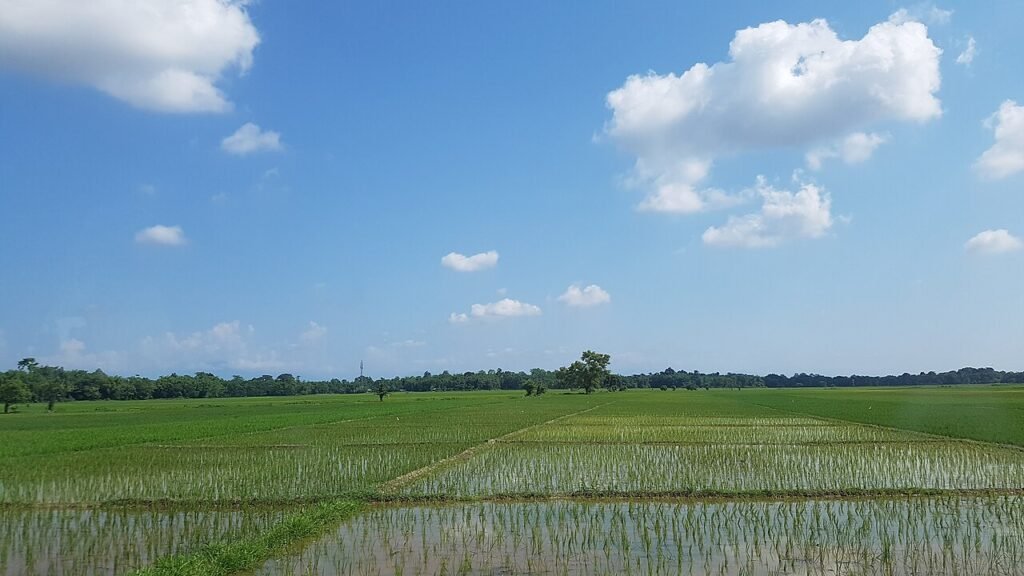
Why in News? Assam begins buying paddy for the first crop of Kharif Marketing Season (KMS) 2026-27 on 1 November 2026. On 31 October, Kaushik Rai, the State’s Minister for Food, Public Distribution and Consumer Affairs, held a video conference with the District Commissioners of all districts. He reviewed the preparations.
Current Context (The Trigger)
- Target: Assam aims to buy 8.49 lakh metric tonnes (LMT) of paddy. It will buy through 181 notified paddy procurement centres (PPCs).
- Price: The MSP for the season is Rs 2,441 per quintal. This is the Centre’s MSP for common paddy.
- State incentive: The minister said the State’s own incentive for paddy procurement will be announced at the next Cabinet meeting.
- Payment: The minister told officials to credit the MSP amount to farmers within one week of procurement.
- Decentralised system: In an earlier video conference, the minister spoke with MLAs and District Commissioners of Golaghat and Nagaon. They discussed whether the Decentralised Procurement (DCP) system can be brought to these districts soon.
Core Concepts & Static GK
- MSP 2026-27: The Cabinet Committee on Economic Affairs approved the MSP for 14 kharif crops for 2026-27 on 13 May 2026. Common paddy gets Rs 2,441 per quintal and Grade A gets Rs 2,461. Both are Rs 72 higher than last season.
- Cost rule: The Government says it fixes MSP at a level of at least 1.5 times the all-India weighted average cost of production.
- DCP: Under Decentralised Procurement, the State itself buys paddy and/or wheat on behalf of the Government of India. It stores the grain and distributes it under the Targeted Public Distribution System and welfare schemes. The scheme began in 1997-98.
- Centre’s role in DCP: The Centre meets the State’s procurement expenditure as per approved costs. Grain bought beyond the State’s own need is handed over to FCI for the central pool. States are encouraged to join but are not forced.
Institutional Machinery
- CACP: The Commission for Agricultural Costs and Prices is an attached office of the Ministry of Agriculture and Farmers Welfare. It recommends MSPs. The Government then fixes them.
- On the ground in Assam: The Agriculture Department has posted its officers as PPC managers. The minister asked District Commissioners to attach two more staff to each PPC.
- Monitoring committees: Local MLAs head the PPC Monitoring Committees. These committees are to meet every fortnight.
- AFCSCL: The Managing Director of the Assam Food and Civil Supplies Corporation Limited will review progress every week. The minister will review it every month.
Assam & Northeast Linkages
- DCP in new districts: Golaghat and Nagaon are being studied for the DCP system.
- Farmer outreach: District Commissioners must meet all registered farmers and the monitoring committees. They will explain the procurement process and its benefits.
- Field visits: The minister asked District Commissioners, ADCs (Agriculture) and ADCs (Supply) to visit the PPCs regularly.
Prelims Trap Zones (Watch out for)
- Grade Trap: Rs 2,441 per quintal is the MSP of common paddy. Grade A paddy is Rs 2,461.
- Head Trap: PPC Monitoring Committees are headed by local MLAs, not by District Commissioners.
- Review Trap: The AFCSCL Managing Director reviews weekly. The minister reviews monthly.
- Unit Trap: The target is 8.49 lakh metric tonnes, not 8.49 lakh quintals.
- Body Trap: CACP only recommends MSP. The Government decides it.
Introduction
MSP is the price at which the Government stands ready to buy a crop from farmers. It protects growers when market prices fall. In Assam, the test is whether farmers can reach a procurement centre and get paid quickly.
Importance of MSP Procurement
- Income support: A known buying price gives a paddy grower a floor when market rates are low.
- Food security: Under DCP, the State uses the grain it buys for TPDS and welfare schemes.
- Local benefit: DCP was started to extend MSP benefits to local farmers and to make procurement and the PDS more efficient.
Challenges / Operational Bottlenecks
- Manpower: The minister asked for two extra staff at each PPC to ensure enough hands at the centres.
- Timely payment: The one-week deadline for MSP credit needs quick checks and fund flow at every centre.
- Farmer awareness: Farmers need to know the procedure. That is why District Commissioners must hold meetings with registered farmers.
- Supervision: With 181 centres, regular field visits and fortnightly committee meetings are needed to sort out problems.
Government Initiatives (National & Assam)
| Level | Initiative | Purpose & Impact |
|---|---|---|
| Centre | MSP for 14 kharif crops, 2026-27 | Paddy at Rs 2,441 (common) and Rs 2,461 (Grade A) per quintal |
| Centre | Decentralised Procurement (since 1997-98) | State buys, stores and distributes; Centre meets approved costs |
| Assam | 181 PPCs, 8.49 LMT target | Procurement for the first crop from 1 November 2026 |
| Assam | MLA-led PPC Monitoring Committees | Fortnightly review and farmer outreach |
| Assam | MSP credit within one week | Timely payment to farmers |
Way Ahead
- Extend DCP: Try DCP in Golaghat and Nagaon first. Widen it if storage and payment work well.
- Prompt payment: Track the one-week payment rule and publish delays.
- Early incentive: Announce the State incentive soon, so farmers know the full price before they sell.
- Active committees: Make sure the MLA-led committees meet every fortnight and act on complaints.
Conclusion
A good MSP helps only when farmers can sell and get paid on time. Assam’s reviews, monitoring committees and the DCP plan are steps in that direction.
Asked in APSC
- APSC Mains 2023, GS Paper 3 (10 marks): Explain the relationship among government procurement operations, minimum support prices (MSPs) and the creation of buffer stocks in the context of Assam.
Geography as Disaster Literacy in Assam’s Schools
Open this topic as a separate page, with its MCQs →
Syllabus Mapping
- Prelims: GS Paper I (Current events of State/National importance; Geography of Assam; Environment and ecology).
- Mains: GS Paper II (Issues relating to development and management of Social Sector/Services relating to Education); GS Paper III (Disaster and disaster management); GS Paper V (Geography, Governance and Disaster Management of Assam).
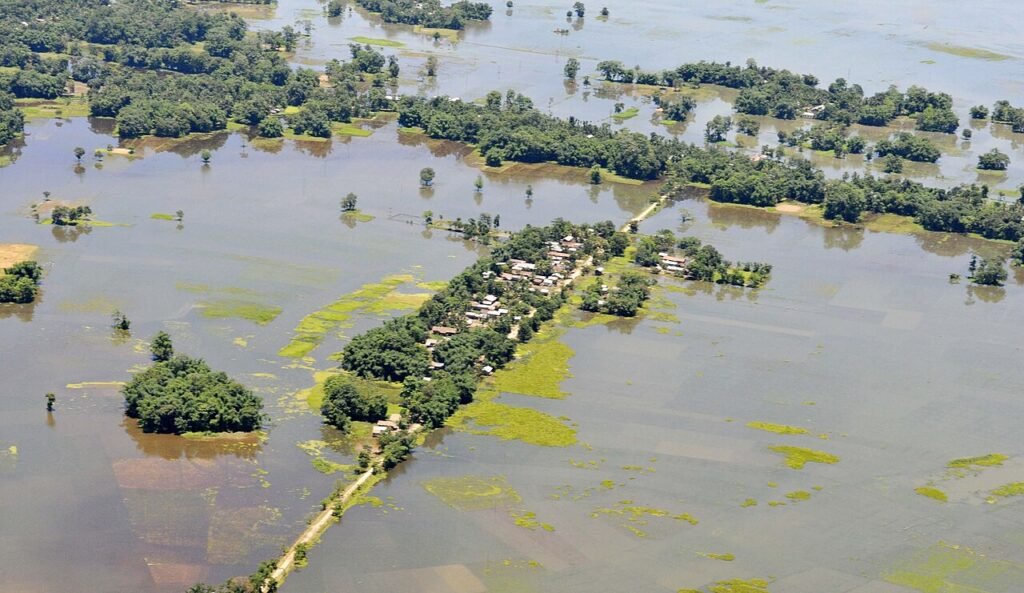
Why in News? An opinion article in the Assam Tribune of 1 November 2026 argues that geography should get a central place in Assam’s schools. The writer has worked as an external evaluator in Gunotsav. The writer wants teaching to move from rote learning to hands-on, local learning. Assam lives with floods, erosion and earthquakes.
Current Context (The Trigger)
- The writer’s view: Assam’s schools still treat geography as a subject to memorise. The writer wants it taught as part of daily life in a hazard-prone state.
- Classroom finding: In the schools the writer visited, geography came almost only from the textbook and the blackboard. Wall maps, atlases and globes were there but rarely used.
- Reform check: The writer credits the reforms under Education Minister Ranoj Pegu. These include Gunotsav in all districts, the merger of the two school boards, smart classrooms and announced transport support for tea garden children. But in the writer’s view, most of these work at the level of administration and digital infrastructure.
Core Concepts & Static GK
- Disaster literacy: The writer uses this term for geography teaching that helps students understand warnings. Such students can also question badly planned construction.
- Integrated social science: At the middle stage, NCERT now has one integrated social science textbook in place of separate history, geography and civics books. The writer warns that map reading, spatial reasoning and field observation may then get less attention.
- Skills of geography: Spatial thinking, reading data and fieldwork. It also introduces students to GIS and remote sensing.
Institutional Machinery
- Gunotsav: Assam’s school quality assessment programme, introduced in 2017. It grades government and provincialised schools on academic achievement, co-scholastic activities, infrastructure and community participation.
- Who runs it: Samagra Shiksha Assam conducts Gunotsav. The first phase ran in April 2017 in eight districts.
- NCF-SE 2023: Union Education Minister Dharmendra Pradhan released the National Curriculum Framework for School Education on 23 August 2023. It covers all four school stages: Foundational, Preparatory, Middle and Secondary.
Schemes & Initiatives
- NEP 2020: It replaces the 10+2 system with a 5+3+3+4 structure for ages 3-8, 8-11, 11-14 and 14-18. It brings the 3-6 age group under the school curriculum, which was not covered before.
- Experiential learning: The writer points out that NEP 2020 and NCF-SE 2023 both ask for experiential, inquiry-based learning rooted in local settings.
Reports, Indices & Data
- Flood-prone Assam: As assessed by the Rashtriya Barh Ayog (National Flood Commission), about 39.58% of Assam’s land area is flood-prone. This is about 9.40% of India’s total flood-prone area.
Assam & Northeast Linkages
- Hazard setting: The writer lists the Brahmaputra and Barak rivers, heavy rain, young Himalayan slopes and frequent earthquakes. Together, these put the Northeast among India’s most disaster-prone regions. Assam has repeated floods and bank erosion, and Majuli keeps losing land.
- Biodiversity link: The writer places the region where the Himalayan and Indo-Burma biodiversity hotspots meet. Kaziranga, Manas and wetlands like Deepor Beel are the examples given.
- Local lives: A tea garden child can study plantation geography. A child from a char village can study how rivers behave. Local knowledge of rivers, soils and weather can then meet science.
Prelims Trap Zones (Watch out for)
- Year Trap: Gunotsav began in Assam in 2017. Do not mix it up with NEP 2020 or NCF-SE 2023.
- Date Trap: NEP 2020 was announced in July 2020. NCF-SE was released later, on 23 August 2023.
- Percentage Trap: 39.58% is the flood-prone share of Assam’s own land. 9.40% is Assam’s share of India’s total flood-prone area. Do not swap them.
- Textbook Trap: The integrated textbook replaced separate history, geography and civics books at the middle stage, not at every stage.
- Agency Trap: Gunotsav is run by Samagra Shiksha Assam, not by NCERT.
Introduction
In the monsoon, many schools in the Brahmaputra Valley double as relief camps, the writer notes. So geography in Assam is not just maps and capitals. It is a practical way to prepare children for floods, erosion and earthquakes.
Why Geography Matters in Assam
- Disaster literacy: A student who understands river shifts, embankment breaches and landslides can read warnings better. That student can also challenge badly planned construction.
- Environment and development: Geography shows how shrinking wetlands, encroachment and new infrastructure are linked.
- Society and politics: In Assam, social life is tied to land. For over a century, its politics has turned on land rights, evictions and migration. Taught well, geography helps students look at migration and homeland issues with balance.
- Skills: It builds spatial thinking, data skills and fieldwork. It also introduces GIS and remote sensing.
Challenges in the Classroom
- Rote teaching: Exams reward memorising, so practical work gets little room.
- Idle resources: Atlases, wall maps and globes are available but rarely used.
- Teacher constraints: Teachers are willing, but they lack materials and time for practical work.
- Integration risk: One combined social science book may weaken map reading and field observation, unless teachers guard them.
- Reform gap: Many reforms act on administration and digital tools. They may not change how a teacher explains rivers or weather.
Government Initiatives (National & Assam)
| Level | Initiative | Purpose & Impact |
|---|---|---|
| National | NEP 2020 | Replaces 10+2 with 5+3+3+4 (ages 3-18); brings ages 3-6 under the school curriculum |
| National | NCF-SE 2023 | Curriculum framework for all four school stages |
| National | NCERT integrated social science textbook | Replaces separate history, geography and civics books at the middle stage |
| Assam | Gunotsav | Quality assessment of schools, now in all districts |
| Assam | Merger of school boards, smart classrooms, transport support for tea garden children | Administrative and access reforms |
Way Ahead
- Use the tools: Make atlases, wall maps and globes part of every geography class.
- Field learning: Take students to an eroding riverbank or a wetland, as the writer suggests.
- Teacher support: Give teachers training, materials and time for practical work.
- Protect geography skills: Keep map reading and spatial work alive inside the integrated textbook.
- Local knowledge: Bring what communities know about rivers, soils and weather into lessons.
Conclusion
The writer argues that reforms work only when resources, training and time reach the classroom. For a flood-prone state, good geography teaching can be a low-cost step towards disaster preparedness.
Asked in APSC
- APSC Mains 2020, GS Paper 3 (15 marks): What are the points to be looked into in the preparation of management of a large earthquake? Describe the long-term measures to be taken in managing floods in North-East India.
News in Short
- Proton beam therapy centre: On 31 October, the Assam government signed an agreement with IBA Particle Therapy India Pvt Ltd to set up a proton beam therapy centre in Guwahati. It will be India’s first proton therapy facility set up by a state government.
- Buddha relics in Arunachal: Relics of Lord Shakyamuni Buddha from the National Museum, New Delhi, were unveiled at Tawang Monastery on 31 October. They returned to Arunachal Pradesh after 13 years. During the 20-day exposition (31 October to 21 November), they will be shown in West Kameng and Namsai districts.
- Arunachal Buddhist Confederation: Chief Minister Pema Khandu announced this body to bring the State’s Mahayana and Theravada Buddhist communities onto one platform. Agadhamma, chief monk of the Namsai Pariyatti Sasana Buddhist Vihara, is its first president.
- Kendriya Grihmantri Dakshata Padak: The Union Home Ministry started this medal in 2024. It honours excellence in special operations, investigation, intelligence and forensic science. For 2026, 490 personnel received it, including 23 Assam Police officials.
- RELIEF for exporters: RELIEF stands for Resilience and Logistics Intervention for Export Facilitation. It runs under the Rs 25,060-crore Export Promotion Mission. It shields exporters from high freight costs, higher insurance premiums and shipping disruptions in the Gulf and West Asia. The commerce ministry has set up a six-member committee to improve its uptake.
- Manipur SoO pact: On 31 October, a large rally in Imphal demanded the scrapping of the Suspension of Operations (SoO) agreement with Kuki armed groups. The Centre and the Manipur government signed this tripartite pact in 2008 with two Kuki umbrella groups, the United People’s Front and the Kuki National Organisation. It was extended from time to time and expired on 24 September this year.
- Bullet train north corridor: Railway Minister Ashwini Vaishnaw said the Prime Minister has approved the north corridor of the bullet train project. It will link Delhi, Agra, Kanpur, Lucknow, Ayodhya, Varanasi, Prayagraj, Patna and Siliguri, and extend to Guwahati.
- IMF on India: The IMF projects India’s growth at 7 per cent for both FY2026-27 and FY2027-28. It says the rupee should be India’s “first line of defence” against the energy shock.
APSC Prelims MCQs
Practice questions on the topics above
Topic 1: Agarwood Export Point at Guwahati Airport
Q1. The Centre has approved Lokapriya Gopinath Bardoloi International Airport in Guwahati as an export point for agarwood products. Consider the following statements:
(i) The approval covers agarwood chips and agarwood oil.
(ii) It was announced by the Union Commerce and Industry Minister.
(iii) Agarwood is formed in trees of the genus Santalum.
Which of the statements given above is/are correct?
- (a) (i) only
- (b) (iii) only
- (c) (i) and (ii) only
- (d) (i), (ii) and (iii)
Show answer
Answer: (c) Explanation: Statements (i) and (ii) are correct. Statement (iii) is wrong because agarwood forms in trees of the genus Aquilaria. Santalum is the sandalwood genus.
Q2. India regulates the export of agarwood products. Consider the following statements:
(i) Agar oil and agarwood chips and powder were moved from the “Free” to the “Restricted” export category in November 2021.
(ii) India’s annual export quota for agarwood chips and powder was raised from 25,000 kg to 151,080 kg.
(iii) A non-zero export quota exists for wild-harvested agarwood.
How many of the statements given above are correct?
- (a) Only one
- (b) Only two
- (c) All three
- (d) None
Show answer
Answer: (b) Explanation: Statements (i) and (ii) are correct. Statement (iii) is wrong because the export quota for wild-harvested agarwood is zero. Only plantation-grown stock can be exported.
Q3. Match List-I with List-II:
| List-I | List-II |
|---|---|
| a. Genus of the agarwood tree | 1. Restricted |
| b. CITES listing of Aquilaria malaccensis | 2. Aquilaria |
| c. Export policy status of agar oil since November 2021 | 3. 1,500 kg a year |
| d. Annual export quota for agar oil set in 2021 | 4. Appendix II |
Select the correct answer using the codes given below:
- (a) a-2, b-4, c-1, d-3
- (b) a-2, b-1, c-4, d-3
- (c) a-4, b-2, c-1, d-3
- (d) a-2, b-4, c-3, d-1
Show answer
Answer: (a) Explanation: Agarwood comes from Aquilaria (a-2). The species is in CITES Appendix II (b-4). Its export is Restricted (c-1). The 2021 quota for agar oil was 1,500 kg a year (d-3). It was later raised to 7,050 kg.
Q4. Which international convention lists Aquilaria malaccensis, the agarwood species in trade, in its Appendix II?
- (a) Convention on Biological Diversity
- (b) CITES
- (c) Ramsar Convention
- (d) Convention on Migratory Species
Show answer
Answer: (b) Explanation: CITES controls international trade in wild species and lists Aquilaria malaccensis in Appendix II, so exports need permits. The CBD, Ramsar and CMS deal with biodiversity, wetlands and migratory animals.
Topic 2: Child Marriage Crackdown and Women’s Empowerment
Q5. An Assam Tribune editorial cited NFHS-5 data on child marriage. Consider the following statements:
(i) NFHS-5 found that 31.8 per cent of women aged 20-24 in Assam were married before turning 18.
(ii) NFHS-5 was conducted in 2015-16.
(iii) The national figure for the same indicator in NFHS-5 is 23.3 per cent.
Which of the statements given above is/are correct?
- (a) (i) only
- (b) (i) and (iii) only
- (c) (ii) and (iii) only
- (d) (i), (ii) and (iii)
Show answer
Answer: (b) Explanation: NFHS-5 ran over 2019-21, and Assam’s data carry the label 2019-20. So (ii) is wrong. 2015-16 is the period of the earlier round, NFHS-4. The Assam figure of 31.8 per cent and the national figure of 23.3 per cent are both correct.
Q6. Match List-I with List-II:
| List-I (Section of the Prohibition of Child Marriage Act, 2006) | List-II (Provision) |
|---|---|
| a. Section 3 | 1. Appointment of Child Marriage Prohibition Officers |
| b. Section 9 | 2. Child marriage voidable at the option of the child party |
| c. Section 13 | 3. Magistrate’s injunction against an arranged child marriage |
| d. Section 16 | 4. Punishment for a male adult marrying a child |
Select the correct answer using the codes given below:
- (a) a-2, b-4, c-3, d-1
- (b) a-2, b-3, c-4, d-1
- (c) a-4, b-2, c-3, d-1
- (d) a-2, b-4, c-1, d-3
Show answer
Answer: (a) Explanation: Section 3 makes the marriage voidable. Section 9 punishes the adult male. Section 13 lets a magistrate issue an injunction. Section 16 provides for Child Marriage Prohibition Officers. The other codes swap these pairs.
Q7. Which one of the following statements about the Prohibition of Child Marriage Act, 2006 is NOT correct?
- (a) A child marriage is voidable at the option of the party who was a child at the time of the marriage.
- (b) Offences under the Act are cognizable and non-bailable.
- (c) A woman who promotes or permits a child marriage can be sentenced to rigorous imprisonment.
- (d) A Judicial Magistrate of the first class can issue an injunction against a child marriage about to be solemnised.
Show answer
Answer: (c) Explanation: Section 11 punishes those who promote or permit a child marriage. But it says no woman shall be punished with imprisonment. She can still be fined. Statements (a), (b) and (d) match Sections 3, 15 and 13.
Q8. Who can file a petition in the district court to annul a child marriage under the Prohibition of Child Marriage Act, 2006?
- (a) Any member of the public who learns of the marriage
- (b) Only the contracting party who was a child at the time of the marriage
- (c) Only the Child Marriage Prohibition Officer
- (d) Only the parents of the child party
Show answer
Answer: (b) Explanation: Section 3 allows the petition only from the party who was a child at the time of the marriage. If that party is still a minor, the petition goes through a guardian or next friend along with the Child Marriage Prohibition Officer. So the CMPO assists, but cannot file alone.
Topic 3: Paddy Procurement at MSP in Kharif Marketing Season 2026-27
Q9. Assam’s paddy procurement for Kharif Marketing Season 2026-27 (first crop) begins on 1 November 2026. Consider the following statements:
(i) The State has set a target of 8.49 lakh metric tonnes through 181 notified paddy procurement centres.
(ii) The MSP of Rs 2,441 per quintal is for common paddy.
(iii) The Managing Director of AFCSCL will review progress every month.
Which of the statements given above is/are correct?
- (a) (i) and (ii) only
- (b) (ii) and (iii) only
- (c) (i) and (iii) only
- (d) (i), (ii) and (iii)
Show answer
Answer: (a) Explanation: Statements (i) and (ii) are correct. Grade A paddy has a higher MSP of Rs 2,461. Statement (iii) is wrong because the AFCSCL Managing Director reviews every week. The minister reviews every month.
Q10. Assertion (A): Under the Decentralised Procurement Scheme, grain bought beyond a State’s own need is handed over to FCI for the central pool. Reason (R): The Decentralised Procurement Scheme began in 1997-98.
- (a) Both A and R are true and R is the correct explanation of A
- (b) Both A and R are true but R is not the correct explanation of A
- (c) A is true but R is false
- (d) A is false but R is true
Show answer
Answer: (b) Explanation: Both statements are true. The scheme did begin in 1997-98, but its start year does not explain why the surplus goes to FCI. The surplus goes to the central pool because the State buys on behalf of the Government of India and keeps only what it needs for TPDS and welfare schemes.
Q11. Which body recommends Minimum Support Prices of mandated crops to the Government of India?
- (a) NITI Aayog
- (b) Food Corporation of India
- (c) Commission for Agricultural Costs and Prices
- (d) Central Warehousing Corporation
Show answer
Answer: (c) Explanation: CACP, an attached office of the Ministry of Agriculture and Farmers Welfare, recommends MSPs. The Government then fixes them. FCI buys and stores grain for the central pool, and CWC provides warehousing. NITI Aayog does not recommend MSPs.
Q12. At his review of 31 October 2026, the Assam minister directed that the MSP amount be credited to farmers within what period of procurement?
- (a) 24 hours
- (b) Three days
- (c) Fifteen days
- (d) One week
Show answer
Answer: (d) Explanation: The direction was to credit the MSP within one week of procurement. Fifteen days is a trap: it matches the fortnightly meetings of the PPC Monitoring Committees, not the payment rule.
Topic 4: Geography as Disaster Literacy in Assam’s Schools
Q13. Gunotsav is Assam’s school quality assessment programme. Consider the following statements:
(i) It assesses government and provincialised schools on academic achievement, co-scholastic activities, infrastructure and community participation.
(ii) It was introduced in 2017.
(iii) It is implemented by NCERT.
Which of the statements given above is/are correct?
- (a) (i) and (ii) only
- (b) (ii) and (iii) only
- (c) (i) only
- (d) (i), (ii) and (iii)
Show answer
Answer: (a) Explanation: Statements (i) and (ii) are correct; the first phase ran in April 2017 in eight districts. Gunotsav is a state programme conducted by Samagra Shiksha Assam, not by NCERT, so (iii) is wrong.
Q14. Match List-I with List-II:
| List-I | List-II |
|---|---|
| a. Gunotsav | 1. Curriculum framework for four stages of schooling |
| b. NCF-SE 2023 | 2. Assessed about 39.58% of Assam’s land as flood-prone |
| c. Integrated social science textbook | 3. School quality assessment programme of Assam |
| d. Rashtriya Barh Ayog | 4. Replaced separate history, geography and civics books at the middle stage |
Select the correct answer using the codes given below:
- (a) a-1, b-3, c-2, d-4
- (b) a-3, b-1, c-4, d-2
- (c) a-3, b-1, c-2, d-4
- (d) a-2, b-4, c-1, d-3
Show answer
Answer: (b) Explanation: Gunotsav is the school quality assessment (3). NCF-SE 2023 is the curriculum framework for the four stages (1). The integrated textbook replaced the three separate books (4). The Rashtriya Barh Ayog assessed about 39.58% of Assam’s land as flood-prone (2).
Q15. Which of the following statements is NOT correct?
- (a) NCF-SE 2023 covers the Foundational, Preparatory, Middle and Secondary stages.
- (b) As assessed by the Rashtriya Barh Ayog, about 39.58% of Assam’s land area is flood-prone.
- (c) NCERT has replaced separate history, geography and civics textbooks at the middle stage with an integrated social science textbook.
- (d) NCF-SE was released in July 2020, together with NEP 2020.
Show answer
Answer: (d) Explanation: NEP 2020 was announced in July 2020. NCF-SE came three years later: Union Education Minister Dharmendra Pradhan released it on 23 August 2023. Statements (a), (b) and (c) are correct.
Q16. Under the 5+3+3+4 school structure of NEP 2020, the final four-year stage corresponds to which age group?
- (a) 3-8 years
- (b) 8-11 years
- (c) 11-14 years
- (d) 14-18 years
Show answer
Answer: (d) Explanation: The four stages cover ages 3-8, 8-11, 11-14 and 14-18. The last stage, of four years, is 14-18. The 11-14 stage is only three years long.
Mains Answer Writing
One exam-style question with a model answer
Q. Assam’s crackdown on child marriage has led to thousands of arrests. Critically examine whether enforcement alone can end child marriage, and suggest an integrated approach involving education, women’s economic empowerment and health. (250 words, 15 marks)
Model answer
Introduction: The Prohibition of Child Marriage Act, 2006 treats a girl below 18 and a boy below 21 as a child. In Assam, NFHS-5 found that 31.8 per cent of women aged 20-24 married before 18, against 23.3 per cent for India.
1. Case for enforcement
- Strong law: Offences under the Act are cognizable and non-bailable. A man above 18 who marries a child faces up to two years’ rigorous imprisonment, a fine up to Rs 1 lakh, or both.
- Scale of the drive: The latest round has led to 565 arrests and 481 cases. Since February 2023, over 12,000 cases and over 11,000 arrests have been recorded.
- Deterrence: Police arrested grooms, relatives and religious functionaries who helped. This warns others.
2. Limits of enforcement alone
- Root causes stay: Some pockets of western Assam are backward, and girls there have poor access to schooling.
- Misdirected arrests: Arresting couples married years ago, who now have children, achieves little. Courts stepped in against such arrests.
- Social problem: A purely legal view misses the social roots.
- Health cost: Early marriage is linked to the State’s high infant and maternal mortality.
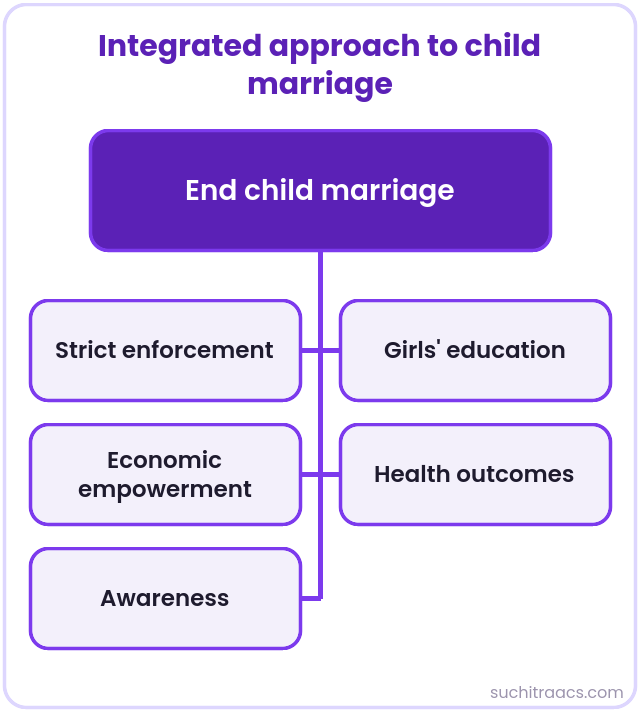
3. Integrated approach: education, empowerment, health
- Education: Educated girls are less likely to be married early. Assam’s Nijut Moina scheme gives girl students monthly financial help from higher secondary to postgraduate level, to reduce dropouts.
- Economic empowerment: Better income and status for women can cut early marriage further.
- Health outcomes: Delaying marriage supports efforts to reduce infant and maternal deaths.
4. Way Forward
- Targeted enforcement: Act against new child marriages, not couples married years ago.
- Awareness: Spread information on the harm of early marriage.
- Prevention officers: Use Child Marriage Prohibition Officers, whose legal duty is to prevent such marriages.
- Focus areas: Prioritise girls’ schooling in the western Assam pockets.
Conclusion: Enforcement is needed, but it cannot work alone. Lasting change needs firm enforcement plus girls’ education and women’s empowerment.
Prepare with SuchitraACS
APSC CCE Foundation Programme₹24,999  APSC Prelims Crash Course 2027 (GS + CSAT)₹5,999
 APSC CCE Study Materials Package (Prelims + Mains)₹4,999