Demwe Lower hydro project on Lohit River: APSC Current Affairs Notes and MCQs
APSC CCE current affairs notes on Demwe Lower hydro project on Lohit River, from The Assam Tribune of 25 November 2026, with 4 practice MCQs for Prelims.
 For working professionals and full-time aspirantsAPSC CCE Foundation Programme₹24,999
Current Affairs Notes
From The Assam Tribune, 25 November 2026
Demwe Lower Hydroelectric Project on the Lohit River and the Forest Clearance Dispute
Syllabus Mapping
- Prelims: GS Paper I (General issues on Environment ecology, Bio-Diversity and Climate Change; Current events of State/National importance).
- Mains: GS Paper III (Conservation, environmental pollution and degradation, environmental impact assessment); GS Paper V (Bio-diversity, Environment, Security and Disaster Management of Assam; Major Development Projects).
Why in News? In a letter dated 23 November 2026, 69 former bureaucrats asked the Union Environment Ministry to scrap the proposed Demwe Lower Hydroelectric Project. The project would produce 1,750 megawatt (MW) of power. It is planned on the Lohit river in Arunachal Pradesh. Copies went to the Arunachal Pradesh Chief Minister and the Standing Committee of the National Board for Wildlife (SC-NBWL).
Current Context (The Trigger)
- The letter: The former officials want the project dropped. They cite its effect on the area’s ecology, its geography and local communities. The letter is dated 23 November.
- Who signed: A total of 69 former bureaucrats signed it. They include Najeeb Jung, a former Lieutenant Governor of Delhi. Another signatory is Prakriti Srivastava, a former principal chief conservator of forests in Kerala.
- Land and trees: The project needs 1,416 hectares (ha) of forest land to be diverted. About 1,590 ha would go under water. Around 43,000 trees would be felled in an evergreen rainforest that the letter calls highly sensitive.
- A long-running push: The letter says different governments have pursued the project since 2011. It adds that local resistance has continued for years.
- Wildlife concerns: The letter says the project threatens the critically endangered white-bellied heron. It also warns that tiger habitat across Kamlang, Namdapha and the proposed Dibang Tiger Reserve would be broken up.
Core Concepts & Static GK
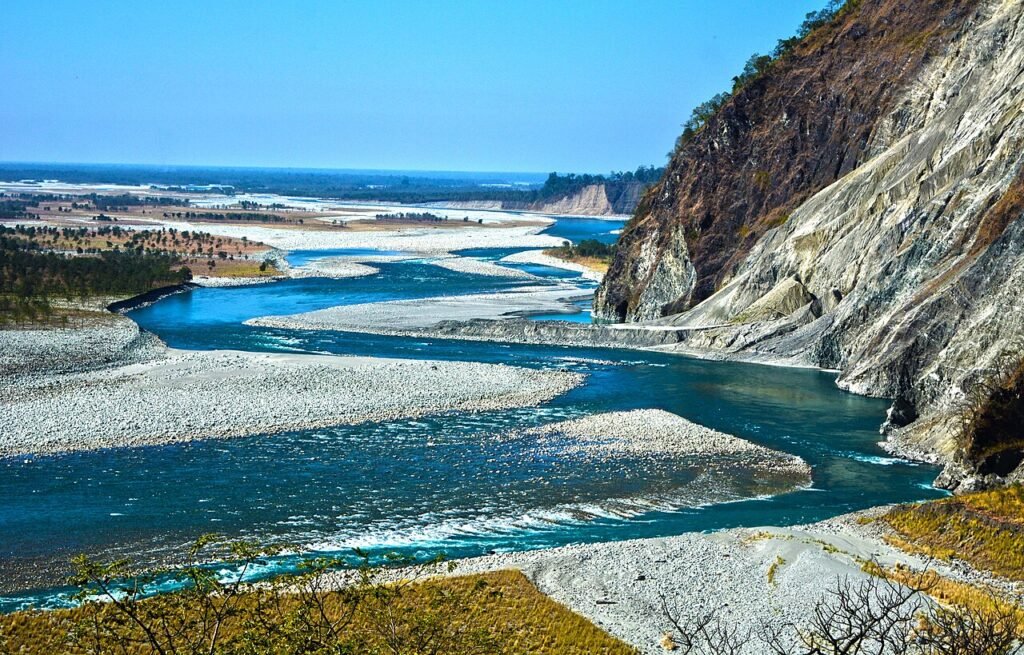
- Run-of-the-river project: The Environment Ministry describes Demwe Lower as a run-of-the-river project. A dam sits on the river. A power house at the dam toe uses the channelled water and releases it back into the same river.
- Project size on record: The project was first conceived as a single-stage 3,000 MW scheme with a full reservoir level of 490 m. That level would have submerged parts of Kamlang Wildlife Sanctuary. The level was lowered to 424.8 m, which gave the present 1,750 MW.
- Dam and river: The proposed dam is 163.12 m high and lies across the Lohit river in Lohit district. Downstream, the river course widens as the Siang, Dibang and Lohit converge.
- Distance rule: The site lies 8.5 to 9.3 km (aerial distance) from the nearest point of Kamlang Wildlife Sanctuary. Under Supreme Court orders, a project within 10 km of a sanctuary boundary needs review by the SC-NBWL.
- Forest diversion: Forest diversion means using forest land for a non-forest purpose such as a dam. The proposal covers 1,415.92 ha for diversion. This is made up of 1,408.30 ha for surface use and 7.62 ha for underground use.
Constitutional & Legal Framework
- Standing Committee (Section 5B): Section 5B of the Wild Life (Protection) Act, 1972 lets the National Board for Wildlife constitute a Standing Committee. The Committee exercises the powers and duties that the Board delegates to it.
- Who sits on it: The Committee has the Vice-Chairperson, the Member-Secretary and not more than ten members. The Vice-Chairperson nominates these members from the National Board. Section 5B was inserted by Act 16 of 2003.
- National Green Tribunal route: The 2012 approval was challenged before the National Green Tribunal (NGT). The Tribunal’s southern bench suspended the forest clearance on 24 October 2017.
- Forest Rights Act: The appellants alleged a violation of the Scheduled Tribes and Other Traditional Forest Dwellers (Recognition of Forest Rights) Act, 2006. This was an allegation in the appeal, not a finding of the Tribunal.
Institutional Machinery
- SC-NBWL referral: The Arunachal Pradesh government sent the proposal to the SC-NBWL because the site is within 10 km of Kamlang Wildlife Sanctuary. The State Board for Wildlife had already recommended it.
- Forest Advisory Committee: This committee recommended forest clearance on 20 May 2010. It attached a condition. No other hydropower project on the Lohit river would be considered without a study of cumulative impact.
- Expert site visit: The SC-NBWL took up the project at its 23rd meeting on 14 October 2011. It sent Dr Asad Rahmani and the Chief Wildlife Warden of Arunachal Pradesh to assess the likely impacts on site.
- Experts against the dam: According to the letter, all non-official expert members rejected the dam, while official members stayed silent. The Ministry’s memo records that non-official members backed Dr Rahmani’s report rejecting the proposal at the 24th meeting on 13 December 2011.
- Minister’s approval: The Ministry’s office memorandum of 11 February 2012 recommended the project on behalf of the SC-NBWL. It issued with the approval of the Minister of State (Independent Charge) for Environment and Forests, who chaired the Committee.
Reports, Indices & Data
- Rahmani report: Dr Rahmani’s report pointed to a lack of data and a need for further studies. The Ministry’s memo records this point.
- Flow swings: Experts worried about daily swings in the dam’s water release during peak power hours. The memo puts the range at 70 to 1,729 cumecs (cubic metres per second).
- Energy claims on file: The 2012 memo projects clean energy of about 6,322 to 9,592 million units a year. It also claims about 50 million tonnes of carbon dioxide would be avoided each year.
- Forest area figures: The memo lists 490.53 ha of forest for submergence, plus 1,415.92 ha for diversion. The letter’s figures differ: 1,416 ha diverted and about 1,590 ha submerged.
Assam & Northeast Linkages
- Downstream Assam: Below the dam site, the river runs for about 105 km before it reaches Dibru-Saikhowa National Park in Assam. So the dam’s operation matters for river habitats in Assam.
- Chapori grasslands: Non-official members argued that water-level changes would harm the chapori (river island) grasslands downstream. They named the habitats of the Bengal Florican and the Asiatic Wild Buffalo.
- Tribal and sacred sites: The Mishmi and other tribes, indigenous groups and environmentalists mobilised to protect the sacred Parashuram Kund. Parashuram Kund is a Hindu pilgrimage centre in the lower reaches of the Lohit river in Lohit district.
- Kamlang Tiger Reserve: Kamlang Wildlife Sanctuary is now a tiger reserve in the south-eastern part of Lohit district. Its headquarters is at Wakro.
- Tiger habitat links: The letter links the project to Kamlang, Namdapha and the proposed Dibang Tiger Reserve. All three lie in Arunachal Pradesh.
Prelims Trap Zones (Watch out for)
- Site trap: The dam is not inside Kamlang Wildlife Sanctuary. It lies 8.5 to 9.3 km away. That is within the 10 km limit that brings in the SC-NBWL.
- Capacity trap: The present proposal is 1,750 MW, not 3,000 MW. The 3,000 MW figure was the original single-stage plan.
- Who cleared it: The 2012 wildlife clearance came from the then environment minister. It went against the non-official expert members, according to the letter.
- NGT trap: In 2017 the Tribunal suspended the dam’s approvals. It did not cancel the project for all time.
- Study timing trap: The 2012 memo asked IIT Roorkee to study ecological and cumulative impacts. These studies were to run alongside construction, not before it.
- Species trap: The white-bellied heron is Critically Endangered on the IUCN (International Union for Conservation of Nature) Red List. It is not Endangered or Vulnerable.
Introduction
On 23 November 2026, 69 former officials asked the Centre to scrap the 1,750 MW Demwe Lower Hydroelectric Project on the Lohit river. Governments have pursued it since 2011, but the National Green Tribunal suspended its approvals in 2017. The dispute tests how India balances Northeast hydropower against rainforest, rare species and tribal rights. It matters for Assam because the river flows on to Dibru-Saikhowa National Park.
Why the Project Draws Support: Energy Rationale
- Clean power claim: The 2012 Environment Ministry memo calls Demwe Lower a “green power project”. It projects carbon-free energy of about 6,322 to 9,592 million units a year.
- Emission saving: The memo expects about 50 million tonnes of carbon dioxide to be avoided each year. It also claims a saving of 230 lakh litres of diesel a year.
- Design changes: The reservoir level was lowered from 490 m to 424.8 m so that no part of Kamlang sanctuary would go under water. That cut the project from 3,000 MW to 1,750 MW.
- Run-of-the-river layout: The project uses a dam and a dam-toe power house, and returns water to the same river. Supporters see this as less damaging than a large storage reservoir.
- No homes lost: The memo says no human homesteads would be lost during or after the project. It also says the water-spread area would be managed as a protected area.
- Support from the State: The State Board for Wildlife recommended the project. Arunachal Pradesh’s representatives answered every point in the expert report that rejected it.
Ecological and Social Concerns
- Forest loss: The letter says the project needs 1,416 ha of forest land and would submerge about 1,590 ha. Around 43,000 trees would be felled in highly sensitive evergreen rainforest.
- Rare heron: The letter says the project threatens the critically endangered white-bellied heron. A 2025 Zoological Survey of India study calls Namdapha the heron’s only known breeding location in India.
- Tiger habitat: The letter warns that tiger habitat across Kamlang, Namdapha and the proposed Dibang Tiger Reserve would be fragmented. Connectivity between these areas would also suffer.
- Downstream risk: The non-official experts cited catastrophic downstream risks to endangered wildlife, says the letter. The memo records their fear of flow swings between 70 and 1,729 cumecs during peak hours.
- Assam’s river islands: These experts said water-level changes would harm chapori grasslands. They named the habitats of the Bengal Florican and the Asiatic Wild Buffalo. The memo also records a claim that the dam would fragment Gangetic Dolphin habitat downstream.
- Tribal and cultural stakes: Mishmi and other tribal groups have campaigned to save the holy site of Parashuram Kund and the river ecosystems further downstream. The appellants before the Tribunal also alleged a violation of the Forest Rights Act, 2006.
Legal and Procedural Issues in the Clearance
| Stage | What happened | Issue raised |
|---|---|---|
| 2010 | The dam got initial environmental clearance. The Forest Advisory Committee recommended forest clearance on 20 May 2010. | The Committee asked for a cumulative impact study before any other Lohit project is considered. |
| October to December 2011 | The project came before the SC-NBWL at its 23rd and 24th meetings. | All non-official expert members rejected the dam, while official members stayed silent, says the letter. |
| 2012 | The then environment minister granted wildlife clearance through the memo of 11 February 2012. | The letter says this went against majority expert opinion. |
| 2017 | The National Green Tribunal suspended the dam’s approvals. | According to the letter, the Tribunal ruled that the minister acted unlawfully by overriding the experts’ unanimous objections. |
| Procedural basis | Reports say the clearance was suspended because it was not given through due procedure. | Under Supreme Court orders, projects within 10 km of a sanctuary need SC-NBWL clearance. |
Challenges
- Weak expert voice: Official members stayed silent and non-official experts were overruled, says the letter. That damages the credibility of the clearance process. The 2017 suspension shows such a gap can be challenged in court.
- Cumulative impact: The Forest Advisory Committee asked for a study of the combined effect of hydropower projects on the Lohit. Judging one dam alone can hide the damage from many dams on one river.
- Study after approval: The 2012 memo let IIT Roorkee’s impact studies run alongside construction. So the evidence would arrive after the decision, not before it.
- Data gaps: The Rahmani report pointed to a lack of data and a need for further studies. Decisions taken without baseline data on fish, birds and river flow are hard to defend later.
- Delay and uncertainty: Governments have pursued the project since 2011, and it still has no settled clearance. Long disputes raise costs and keep local communities unsure about their land.
- Community consent: Local resistance has continued for years, according to the letter. Without the trust of the Mishmi and other tribes, even a legally cleared project can stall on the ground.
- Downstream Assam: The Lohit reaches Assam’s Dibru-Saikhowa National Park 105 km below the site. Yet the clearance was handled by Arunachal Pradesh and the Centre, which makes river-basin planning harder.
Way Ahead
- Cumulative impact study: The Environment Ministry should commission a basin-wide study of the Lohit before it decides on this dam. This follows the condition the Forest Advisory Committee set in May 2010.
- Studies before construction: The IIT Roorkee impact studies named in the 2012 memo should finish before any work begins. Mitigation can then be planned on evidence, not guesswork.
- Respect expert advice: The SC-NBWL should record reasons whenever it overrules its non-official experts. According to the letter, the Tribunal found in 2017 that a minister cannot simply override them.
- Wildlife safeguards first: The Wildlife Institute of India or a similar body should map heron, tiger and river habitats along the Lohit. The letter names the heron and the Kamlang-Namdapha-Dibang tiger area as being at risk.
- Consent of local tribes: The State government should hold documented consultations with the Mishmi and other tribes, including on Parashuram Kund. Forest-dwellers’ rights under the Forest Rights Act, 2006 must be settled first.
- Open public record: The Environment Ministry should publish all expert reports, minutes and forest diversion details online. The 2012 memo shows that such papers exist and shape the decision.
- Assam in the loop: The Centre should involve the Assam government and river experts. This applies when it reviews upstream dams on rivers that flow into Assam. Flow swings could reach Dibru-Saikhowa National Park, 105 km downstream.
Conclusion
Demwe Lower shows that a green-power label does not settle a dispute over rainforest, rare species and tribal rights. A fair decision needs a basin-wide study, open expert reasoning and local consent. Only then can Arunachal Pradesh gain power without harming the rivers and forests that Assam also depends on.
APSC Prelims MCQs
Practice questions on this topic
Q1. The Standing Committee of the National Board for Wildlife (SC-NBWL) reviews projects near protected areas. Consider the following statements:
(i) The Standing Committee is constituted by the National Board under Section 5B of the Wild Life (Protection) Act, 1972.
(ii) It consists of the Vice-Chairperson, the Member-Secretary and not more than ten members nominated by the Vice-Chairperson from the National Board.
(iii) It is a statutory body created under the National Green Tribunal Act, 2010.
Which of the statements given above is/are correct?
- (a) (i) and (ii) only
- (b) (ii) and (iii) only
- (c) (i) only
- (d) (i), (ii) and (iii)
Show answer
Answer: (a) Explanation: Section 5B of the Wild Life (Protection) Act, 1972 lets the National Board constitute a Standing Committee. The Committee uses powers the Board delegates to it, so statement (i) is correct. The same section fixes its makeup as the Vice-Chairperson, the Member-Secretary and up to ten nominated members. So statement (ii) is also correct. Statement (iii) is wrong because the Committee comes from the wildlife law, not the National Green Tribunal Act, 2010. The Tribunal is a separate body that heard the challenge to the Demwe clearance. Hence (b), (c) and (d) fail. Value addition: Section 5B was inserted into the Act by Act 16 of 2003.
Q2. The proposed Demwe Lower Hydroelectric Project in Arunachal Pradesh has been in the news. Consider the following statements:
(i) The National Green Tribunal suspended the project’s approvals in 2017.
(ii) The dam site lies inside the Kamlang Wildlife Sanctuary.
(iii) The project is of the run-of-the-river type with a dam-toe power house.
Which of the statements given above is/are correct?
- (a) (i) only
- (b) (ii) and (iii) only
- (c) (i) and (iii) only
- (d) (i), (ii) and (iii)
Show answer
Answer: (c) Explanation: Statement (i) is correct. The National Green Tribunal suspended the dam’s approvals in 2017, after the then minister had overridden the independent experts. Statement (iii) is correct because the Environment Ministry’s 2012 memo describes a run-of-the-river project with a power house at the dam toe. Statement (ii) is wrong. The site lies 8.5 to 9.3 km from the nearest point of Kamlang Wildlife Sanctuary. It is outside the sanctuary but within the 10 km limit that sends projects to the Standing Committee. So (a), (b) and (d) fail. Value addition: the reservoir level was lowered from 490 m to 424.8 m to avoid submerging any part of the sanctuary.
Q3. Match List-I with List-II (figures relating to the Demwe Lower Hydroelectric Project):
| List-I (Item) | List-II (Figure) |
|---|---|
| a. Capacity now proposed | 1. 1,750 MW |
| b. Capacity first conceived as a single-stage project | 2. 3,000 MW |
| c. Forest land to be diverted, as per the former officials’ letter | 3. 1,416 hectares |
| d. Trees likely to be felled, as per the letter | 4. 43,000 |
Select the correct answer using the codes given below:
- (a) a-2, b-1, c-3, d-4
- (b) a-1, b-2, c-3, d-4
- (c) a-1, b-2, c-4, d-3
- (d) a-2, b-1, c-4, d-3
Show answer
Answer: (b) Explanation: The present proposal is a 1,750 MW project, so a matches 1. The Environment Ministry’s 2012 memo says it was first conceived as a single-stage project of 3,000 MW, so b matches 2. The letter of 23 November says 1,416 hectares of forest land is to be diverted, so c matches 3. It also says around 43,000 trees would be felled, so d matches 4. Codes (a) and (d) swap the two capacities. Code (c) swaps the hectare and tree figures. Only (b) is fully correct. Value addition: the Ministry’s own memo gives a different split, with 490.53 hectares of forest for submergence and 1,415.92 hectares for diversion.
Q4. The white-bellied heron was named in the former officials’ letter against the Demwe Lower project. What is its status on the IUCN Red List?
- (a) Vulnerable
- (b) Endangered
- (c) Near Threatened
- (d) Critically Endangered
Show answer
Answer: (d) Explanation: The white-bellied heron has been listed as Critically Endangered on the IUCN Red List since 2007. Its global population is very small and falling fast, so (d) is correct. The letter also calls it critically endangered. Option (b), Endangered, is the most likely trap. The heron was in that category before it was uplisted in 2007. Option (a), Vulnerable, and option (c), Near Threatened, are lower categories and understate the risk. Value addition: a 2025 Zoological Survey of India study in the journal Oryx looked at the heron’s breeding. It calls Namdapha Tiger Reserve in Arunachal Pradesh the heron’s only known breeding location in India.
Prepare with SuchitraACS
APSC CCE Foundation Programme₹24,999  APSC Prelims Crash Course 2027 (GS + CSAT)₹5,999
 APSC CCE Study Materials Package (Prelims + Mains)₹4,999