Bherjan-Borajan-Padumoni Eco-Sensitive Zone: APSC Current Affairs Notes and MCQs
APSC CCE current affairs notes on Bherjan-Borajan-Padumoni Eco-Sensitive Zone, from The Assam Tribune of 5 November 2026, with 4 practice MCQs for Prelims.
 For working professionals and full-time aspirantsAPSC CCE Foundation Programme₹24,999
Current Affairs Notes
From The Assam Tribune, 5 November 2026
Eco-Sensitive Zone around Bherjan-Borajan-Padumoni Wildlife Sanctuary
Syllabus Mapping
- Prelims: GS Paper I (General issues on Environment and ecology, biodiversity; Current events of State/National importance).
- Mains: GS Paper III (Conservation, environmental pollution and degradation, environmental impact assessment); GS Paper V (Environment and biodiversity of Assam).
Why in News? On 4 November 2026, the Union Environment Ministry issued a draft notification. It proposes a uniform one-kilometre Eco-Sensitive Zone (ESZ) around the Bherjan-Borajan-Padumoni Wildlife Sanctuary in Tinsukia district. It has invited objections and suggestions from people likely to be affected.
Current Context (The Trigger)
- The proposal: The Centre proposed a uniform one-kilometre ESZ around the sanctuary in Tinsukia district. The aim is to protect the area’s biodiversity and regulate development around the protected area.
- Legal route: The Ministry of Environment, Forest and Climate Change (MoEFCC) issued a draft notification under the Environment (Protection) Act, 1986. It asked the public to send objections and suggestions.
- Balance sought: Officials said the plan tries to balance conservation with the livelihood needs of people living around the sanctuary. Development is to stay within a regulated ecological framework.
- Zonal Master Plan: Assam must prepare a Zonal Master Plan within two years of the final notification appearing in the official Gazette.
- Land-use rule: The draft says forests, farmland, horticultural areas, parks and recreation spaces should not be turned into large housing, commercial or industrial projects. Some activities for local needs may still be allowed with safeguards and approvals.
- Allowed with approval: These include strengthening existing roads, basic civic facilities, non-polluting small-scale and cottage industries, and local ecotourism amenities such as homestays.
Core Concepts & Static GK
- Eco-Sensitive Zone: An ESZ is an area around a national park or wildlife sanctuary where certain activities are prohibited or regulated. The 2011 guidelines describe it as a “shock absorber” for the protected area.
- Transition idea: The 2011 guidelines also treat an ESZ as a transition zone. It lies between an area of high protection and an area of lesser protection.
- No fixed width: The 2011 guidelines keep the width flexible and specific to each protected area. As a general principle it can go up to 10 km, as provided in the Wildlife Conservation Strategy-2002. The width need not be uniform on all sides.
- Origin of 10 km: The Indian Board for Wildlife adopted the Wildlife Conservation Strategy-2002 on 21 January 2002. Several States objected that a 10 km zone would cover towns and cities.
- Site-specific shift: The National Board for Wildlife decided on 17 March 2005 that ESZ limits should be site specific. It also said ESZ rules should mainly regulate activities rather than ban them.
- Activity classes: The 2011 guidelines prohibit commercial mining, sawmills, polluting industries and major hydroelectric projects. Tree felling and new hotels or resorts are regulated. Ongoing agriculture, rainwater harvesting and organic farming are permitted.
Constitutional & Legal Framework
- Environment (Protection) Act, 1986: The Centre notifies ESZs under Section 3 of the Act read with Rule 5 of the Environment (Protection) Rules, 1986.
- What Rule 5(1) weighs: Before restricting industries in an area, the Centre may consider its biological diversity, pollutant limits and environmentally compatible land use. Nearness to a sanctuary or national park is also a listed factor.
- 2011 guidelines: The Environment Ministry issued the guidelines for declaring ESZs around national parks and sanctuaries on 9 February 2011.
- Supreme Court, 3 June 2022: In the T. N. Godavarman Thirumulpad case, the Court directed a minimum one-kilometre ESZ around every national park and wildlife sanctuary.
- Supreme Court, 26 April 2023: A bench of Justices B. R. Gavai, Vikram Nath and Sanjay Karol modified this order on the Union’s application. The one-kilometre rule does not apply where MoEFCC has issued a draft or final ESZ notification or has received a proposal. The Court said ESZ areas “cannot be uniform” and will be specific to each protected area.
- Mining: The same order said mining is not permitted inside national parks and sanctuaries or within one kilometre of their boundaries.
- Safeguards in the process: Objections to a draft can be filed within 60 days of its Gazette publication. The 2023 order also said a final notification takes effect only 30 days after issue. Aggrieved persons can approach the Supreme Court directly.
Institutional Machinery
- MoEFCC: The Ministry issues the draft and final notifications after the State sends its proposal.
- State proposal: The State prepares the ESZ proposal and forwards it to MoEFCC for processing and notification.
- Local committee: The 2011 guidelines suggest a committee of the Wildlife Warden, an ecologist, a local self-government official and a Revenue Department official. It suggests the extent of the ESZ and how to manage it.
- Expert Committee: Before a final notification, the proposal goes to an Expert Committee. The Supreme Court noted in 2023 that it is drawn from 13 organisations.
- Monitoring Committee: ESZ notifications set up a monitoring committee. For the ESZ around Orang National Park in Assam, the Deputy Commissioner chairs it.
- Line departments: The Zonal Master Plan is drawn up with several departments. These are environment and forests, agriculture, revenue, tourism, urban development, rural development, irrigation and flood control, and public works.
Assam & Northeast Linkages
- Location: The sanctuary lies in Tinsukia district of Upper Assam.
- Declaration: The State government declared the three forests together as a wildlife sanctuary on 13 October 1999, mainly to protect the region’s primates.
- Three patches: The sanctuary covers 7.21 sq km in three separate forests: Bherjan (1.06 sq km), Borajan (1.76 sq km) and Padumoni (4.39 sq km).
- Forest types: It holds remnants of Assam Valley Tropical Wet Evergreen Forest, Eastern Seasonal Swamp Forest and Assam alluvial plains semi-evergreen forests.
- Plants: Mekai, Morhal, hingori, uriam and tezpat are among the species found here.
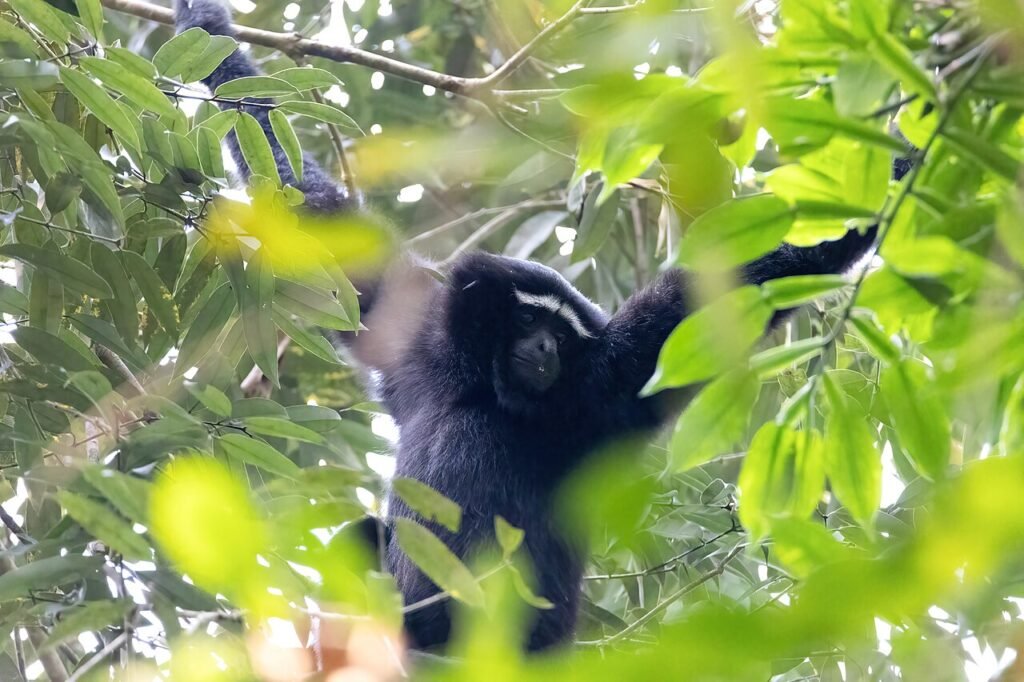
- Animals: The hoolock gibbon, pigtailed macaque, Assamese macaque, capped langur, stump-tailed macaque, leopard, golden jackal, wild pig and barking deer live here. Birds include the lesser adjutant stork, crested serpent eagle, hill myna and green magpie.
- Hoolock gibbon: It is the only ape found in India. It is listed in Schedule I of the Wildlife (Protection) Act, 1972, as amended in 2022.
- All five primates protected: All appear in Schedule I of the amended Act. They are the Hoolock Gibbon, Assamese Macaque, Capped Langur, Northern Pig-tailed Macaque and Stump-tailed Macaque.
Prelims Trap Zones (Watch out for)
- Act Trap: The draft ESZ notification is under the Environment (Protection) Act, 1986, not the Wildlife (Protection) Act, 1972.
- Who declared it: The State government declared the sanctuary on 13 October 1999. The ESZ is proposed by the Centre.
- Width Trap: The proposed ESZ is a uniform one kilometre. The 2011 guidelines allow up to 10 km, and the Supreme Court said ESZs are protected-area specific.
- Timeline Trap: The Zonal Master Plan is due within two years of the final notification, not the draft.
- Objection window: Objections to a draft ESZ notification can be filed within 60 days of its Gazette publication, not 30 days. The 30 days is the waiting period before a final notification takes effect.
- Draft is not final: The rules apply only after the final notification is published in the Gazette.
Introduction
The Centre has proposed a uniform one-kilometre Eco-Sensitive Zone around a sanctuary of just 7.21 sq km in Tinsukia. Small forest patches like these sit close to farmland and settlements, so pressure from outside reaches them quickly. The ESZ tests whether Assam can protect its primates without shutting out the people who live next to them.
Why an ESZ is Needed
- Tiny, split habitat: The sanctuary is only 7.21 sq km and is broken into three patches. Pressure on the edges can quickly harm the whole population.
- Primate protection: The sanctuary was created mainly to protect primates. It holds the hoolock gibbon and four other primate species, all listed in Schedule I of the Wildlife (Protection) Act, 1972.
- Buffer function: The zone will work as a protective ring. Industry, commerce, tourism and changes in land use there will be banned or controlled to reduce harm to the sanctuary.
- Rare forest types: Remnants of Assam Valley Tropical Wet Evergreen Forest and Eastern Seasonal Swamp Forest survive here. These types are hard to replace once cleared.
- Bird habitat: The lesser adjutant stork, hill myna and other birds use the sanctuary. A buffer limits disturbance at its edges.
Features of the Draft Framework
- Uniform width: One kilometre all around gives a simple, clear boundary. It also equals the minimum width the Supreme Court set in June 2022.
- Public consultation: The draft invites objections and suggestions from people likely to be affected.
- Zonal Master Plan: Assam must prepare it within two years of the final notification. It will be made with local communities and departments such as agriculture, revenue, tourism and irrigation and flood control.
- Land-use mapping: The plan will mark forests, farmland, settlements, water bodies and horticultural areas.
- Restoration measures: It will include steps to restore ecology, manage watersheds, conserve groundwater and protect soil and moisture.
- Tourism control: A Tourism Master Plan based on the carrying capacity of the ESZ will govern tourism activities.
Challenges
- Livelihood anxiety: Farmers and small traders near the boundary may fear loss of land use or income. The draft allows activities for local needs only with safeguards and approvals.
- Fragmented forest: Three separate patches mean a one-kilometre ring may still leave gaps for animal movement between them. This is an analysis point, not a figure from the draft.
- Weak enforcement: Rules need staff and regular checks. A monitoring committee can work only if it meets often and acts on violations.
- Plan delay: A two-year window for the Zonal Master Plan can slip if departments do not coordinate.
- Uniform width: The Supreme Court said in 2023 that ESZs are protected-area specific. A single one-kilometre figure may be too thin on some sides and too wide on others.
- Legal clarity: The Supreme Court order of June 2022 was modified in April 2023, so officials and residents need clear guidance on which rules apply.
Way Ahead
- Genuine hearings: The Ministry and the Tinsukia administration should hold village-level hearings and answer objections in writing. This builds trust before the final notification.
- Early master plan: The Assam Forest Department should start the Zonal Master Plan well before the two-year deadline, with a single nodal officer.
- Livelihood support: The State can link ESZ households to existing horticulture schemes, such as the Centrally-sponsored Mission for Integrated Development of Horticulture. Homestays and other ecotourism work can add income for local people.
- Habitat links: The Forest Department should study planting native trees in gaps between Bherjan, Borajan and Padumoni so primates can move safely.
- Monitoring: The monitoring committee should meet regularly and publish a yearly note on violations.
- Review of width: After the first plan, the State should check whether the one-kilometre width protects the gibbon population and revise it if needed. The Supreme Court allows protected-area-specific zones.
Conclusion
The proposed ESZ gives a small but important primate refuge a legal buffer. Its success will depend less on the one-kilometre line. It will depend more on the Zonal Master Plan, honest consultation with nearby villagers and steady enforcement by Assam’s forest staff.
Asked in APSC
- APSC Mains 2025, GS Paper 5 (10 marks): Explain the significance of eco-sensitive zones (ESZs) and animal corridors connecting Kaziranga National Park & Tiger Reserve to the Karbi Anglong Hills.
APSC Prelims MCQs
Practice questions on this topic
Q1. The Centre has issued a draft notification for an Eco-Sensitive Zone (ESZ) around the Bherjan-Borajan-Padumoni Wildlife Sanctuary in Tinsukia. Consider the following statements:
(i) The draft proposes a uniform one-kilometre ESZ around the sanctuary.
(ii) The draft is issued under the Wildlife (Protection) Act, 1972.
(iii) Assam must prepare a Zonal Master Plan within two years of the final notification.
Which of the statements given above is/are correct?
- (a) (i) and (iii) only
- (b) (i) and (ii) only
- (c) (ii) and (iii) only
- (d) (i), (ii) and (iii)
Show answer
Answer: (a) Explanation: Statements (i) and (iii) are correct. The draft proposes a uniform one-kilometre zone, and Assam has two years from the final Gazette notification to prepare the Zonal Master Plan. Statement (ii) is wrong. The Ministry of Environment, Forest and Climate Change issued the draft under the Environment (Protection) Act, 1986, not the Wildlife (Protection) Act, 1972. That is why options (b), (c) and (d), which include (ii), are wrong. Value addition: ESZs are notified under Section 3 of the Environment (Protection) Act read with Rule 5 of the Environment (Protection) Rules, 1986. Rule 5(1) lets the Centre weigh an area’s biological diversity and its nearness to a sanctuary or national park.
Q2. Which of the following statements about the Bherjan-Borajan-Padumoni Wildlife Sanctuary is NOT correct?
- (a) It lies in Tinsukia district of Assam.
- (b) The State government declared it a sanctuary on 13 October 1999.
- (c) It was declared a sanctuary under the Environment (Protection) Act, 1986.
- (d) It holds the hoolock gibbon and the capped langur.
Show answer
Answer: (c) Explanation: Statement (c) is not correct. Wildlife sanctuaries are declared under the Wildlife (Protection) Act, 1972. The Environment (Protection) Act, 1986 is the law under which the Centre notifies the Eco-Sensitive Zone around the sanctuary, so the two laws are often confused. Statement (a) is correct because the sanctuary is in Tinsukia district. Statement (b) is correct because the State government declared the three forests a sanctuary on 13 October 1999. Statement (d) is correct because the hoolock gibbon and the capped langur are among its prominent fauna. Value addition: the hoolock gibbon is the only ape found in India. It and the capped langur are both in Schedule I of the Wildlife (Protection) Act, 1972, as amended in 2022.
Q3. In June 2022 the Supreme Court directed a minimum Eco-Sensitive Zone of what width around every national park and wildlife sanctuary?
- (a) 500 metres
- (b) One kilometre
- (c) Five kilometres
- (d) Ten kilometres
Show answer
Answer: (b) Explanation: On 3 June 2022, in the T. N. Godavarman Thirumulpad case, the Court directed a minimum ESZ of one kilometre from the boundary. Option (a) is a trap: 500 metres applied only to subsisting activities around Jamua Ramgarh Wildlife Sanctuary. Option (c) is not a figure in the order. Option (d) is also a trap. The 2011 guidelines and the Wildlife Conservation Strategy-2002 speak of up to 10 km, but that is an upper general principle, not the Court’s minimum. On 26 April 2023 the Court modified the order, so the one-kilometre rule does not apply to ESZs with draft or final notifications. Value addition: the 2023 order bars mining within one kilometre of a sanctuary or national park boundary.
Prepare with SuchitraACS
APSC CCE Foundation Programme₹24,999  APSC Prelims Crash Course 2027 (GS + CSAT)₹5,999
 APSC CCE Study Materials Package (Prelims + Mains)₹4,999