APSC Current Affairs: Assam Tribune Notes with MCQs and Answer Writing (10/11/2026)
In this post
For APSC CCE and other Assam competitive exam aspirants, staying consistently updated with reliable current affairs is essential for success. This blog provides a well-researched analysis of the most important topics from The Assam Tribune dated 10 November 2026. Each issue has been carefully selected and explained to support both APSC Prelims and Mains preparation, ensuring alignment with the APSC CCE syllabus and the evolving trends of the examination.
 For working professionals and full-time aspirantsAPSC CCE Foundation Programme₹24,999
Current Affairs Notes
From The Assam Tribune, 10 November 2026
Hill-Cutting along the Assam-Meghalaya Border and Around Guwahati
Open this topic as a separate page, with its MCQs →
Syllabus Mapping
- Prelims: GS Paper I (General issues on Environment, ecology and biodiversity; Disaster management; Geography of Assam; Current events of State/National importance).
- Mains: GS Paper III (Environmental pollution and degradation, conservation; Disaster and disaster management); GS Paper V (Environment and natural resources of Assam; Flood and erosion problems of Assam).
Why in News? An Assam Tribune editorial of 10 November 2026 warns about unscientific earth-cutting on the hills at Jorabat and Khanapara on the Assam-Meghalaya border. It also flags cutting inside the Amchang elephant corridor and eco-sensitive zone, and at Rani and North Guwahati. It links the cutting to flash floods, landslides and the flooding of NH-37, and says the government is looking the other way.
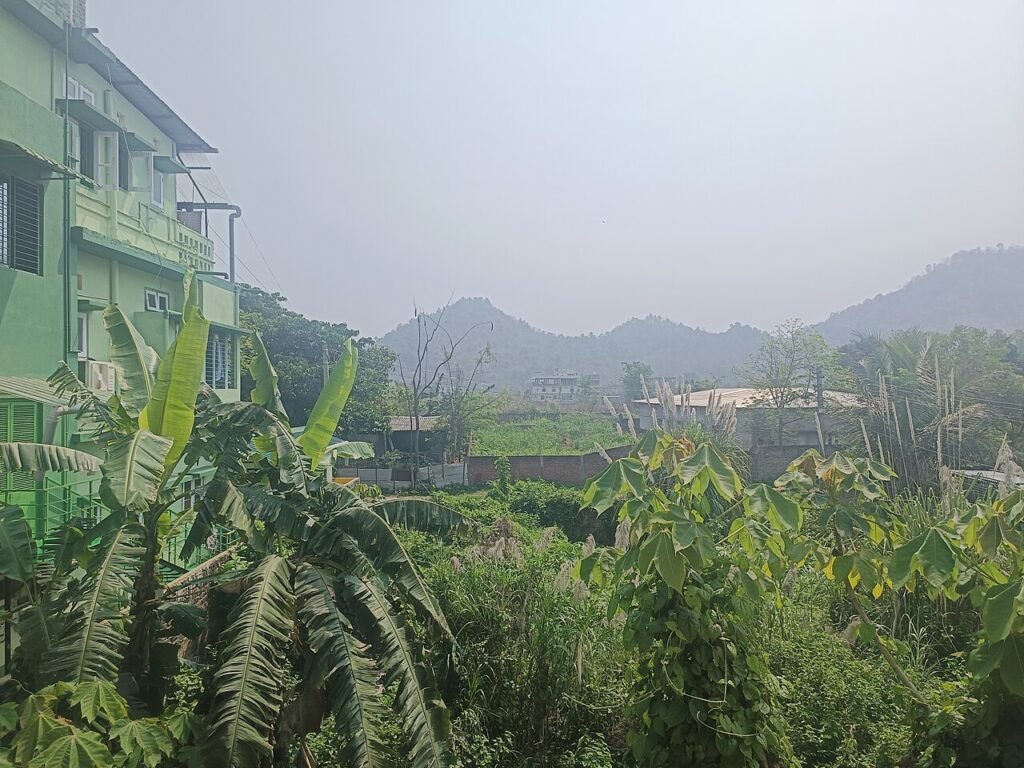
Current Context (The Trigger)
- Border hills: The editorial calls the rampant earth-cutting on the hills of the Jorabat and Khanapara border areas, near Ribhoi district of Meghalaya, a serious concern. It says most of the cutting is on the Meghalaya side.
- NH-37 flooding: Even one heavy spell of rain now floods a long stretch of NH-37 at Jorabat. This breaks road links on a highway the paper calls Assam’s lifeline.
- Amchang corridor: The paper says digging and removal of earth from the hills go on inside the Amchang elephant corridor and eco-sensitive zone. Operators used JCB excavators and dumpers and even blocked a natural water body.
- Rani and North Guwahati: The editorial calls hill earth-cutting around Guwahati illegal and says some small hills have disappeared completely. It names Rani and North Guwahati and alleges a tacit understanding between the earth-cutting mafia and the Forest Department, police and district administration.
- Blame game: The paper points out that the Assam government blames Meghalaya for the loss of the Jorabat hills. Yet it ignores similar cutting on the Assam side.
Core Concepts & Static GK
- Hill-cutting: It means cutting or levelling a hill slope to make space for buildings or roads, or to sell the soil. The editorial links it to slope denudation (loss of the protective soil and tree cover), which leaves steep, unstable slopes open to monsoon rain.
- Artificial flood: Water fills streets because loose soil and silt clog the drains, not because a river overflows. Prof Parag Phukan, a Gauhati University geologist, said sediment from bare hills in Meghalaya’s Ri Bhoi district runs onto the Khanapara-Jorabat highway and blocks the drains.
- Mylliem Reserve Forest: A 2025 report on the Jorabat floods places the three main clusters of hill-cutting damage inside the Mylliem Reserve Forest in Ri Bhoi.
- Eco-sensitive zone (ESZ): It is a belt around a national park or sanctuary where activities are controlled. The Environment Ministry issued guidelines in 2011 with an indicative list of activities to be prohibited, regulated or promoted.
- What an ESZ bans: Most ESZ activities are regulated, not banned. Commercial mining, stone quarrying and crushing units are among the few activities on the prohibited list.
- Amchang Wildlife Sanctuary: It lies on the eastern limit of Guwahati city and covers 78.64 sq km. The Centre’s ESZ notification says it consists of the Amchang, South Amchang and Khanapara reserve forests.
Constitutional & Legal Framework
- Environment (Protection) Act, 1986: The Environment Ministry declares ESZs using its powers under section 3 of this Act. Its ESZ page cites section 3(v) for this purpose.
- Amchang ESZ notification: The Centre notified the Amchang ESZ by S.O. 1817(E) of 7 May 2017. The zone covers 109.99 sq km. It extends from 170 metres to 8.1 km around the sanctuary. There is no ESZ on the west side because of the Cantonment area.
- Hill slopes in the ESZ: The same notification bars construction on steep hill slopes or slopes with a high degree of erosion. It also prohibits new and existing mining, stone quarrying and crushing units, except for the domestic needs of local residents.
- Disaster Management Act, 2005: The Kamrup Metropolitan District Commissioner used this Act for a monsoon ban on hill cutting and earth filling. The order ran from 1 May to 31 October 2026.
- Section 162, BNSS: The Dimoria co-district administration issued an order under Section 162 of the Bharatiya Nagarik Suraksha Sanhita to prohibit the cutting of hillocks. The State reported this in its affidavit in the High Court.
- Assam building byelaws: The State told the High Court about the Assam Unified Building Construction (Regulation) Byelaws, 2022 (amended in 2024). They aim to ensure slope stability and limit soil erosion.
Institutional Machinery
- Gauhati High Court: It has been hearing PIL/14/2024, North East Eco Development Society v. State of Assam, on hill cutting, encroachments and waterlogging in Guwahati.
- District administration: The Kamrup Metropolitan monsoon order was issued by the District Commissioner, who is also chairman of the District Disaster Management Authority.
- GMDA and GMC: The order bars earth cutting in or around Guwahati for construction. Prior permission is needed from the Guwahati Metropolitan Development Authority or the Guwahati Municipal Corporation.
- ESZ Monitoring Committee: The 2017 Amchang notification set up a Monitoring Committee chaired by the Deputy Commissioner, Kamrup (Metro). The Divisional Forest Officer, Kamrup East Division, is one of its members.
- Forest Department: According to the State’s 2025 affidavit, the department has seized 53 vehicles and 56,700 cubic metres of earth cut from hills.
Schemes & Initiatives
- Drainage project: The Assam government announced a Rs 1,459 crore GIS-based Storm Water Drainage and Urban Flood Management Project for Guwahati.
- Basin split: About Rs 958 crore of it is for the Bharalu Basin and Rs 500 crore for the Bahini Basin.
- Drainage master plan: In March 2025, the State told the High Court that a GIS-based Comprehensive Drainage Master Plan was being prepared. The consultant had submitted a revised Inception Report on 26 December 2024.
- Satellite alarm: The Kamrup Metropolitan administration began talks with the Assam State Space Application Centre for a system that raises an alarm when hill cutting happens.
Assam & Northeast Linkages
- Hotspots in Dimoria: The State’s affidavit named the outlying parts of the Chandrapur and Sonapur circles in Dimoria co-district as having the most hill-cutting cases.
- Flooded colonies: The 2024 PIL named Anil Nagar, Nabin Nagar, Panjabari and Hatigaon among the areas that suffer artificial flooding after heavy rain.
- Silsako Beel: One report says this wetland shrank from nearly 450 acres to about 80 acres by 2021 because of encroachment and unplanned construction.
- Waterlogging in 2026: More than 50 Guwahati localities reportedly had severe waterlogging after a few pre-monsoon spells in April 2026.
Prelims Trap Zones (Watch out for)
- Highway Trap: The editorial names NH-37 at Jorabat. Do not swap it with another highway number in a question on this editorial.
- Law Trap: The Kamrup Metropolitan monsoon ban on hill cutting was issued under the Disaster Management Act, 2005, and not under the Wildlife (Protection) Act. It ran from 1 May to 31 October 2026, so it had already lapsed when the editorial appeared.
- ESZ Trap: An ESZ is not a no-activity zone. Most activities are regulated, and only a short list, such as commercial mining and stone quarrying, is prohibited.
- 10 km Trap: The ministry’s page does not set a binding 10 km ESZ for every sanctuary. It says only that the Wildlife Conservation Strategy, 2002 recommended notifying lands within 10 km as eco-fragile zones. Amchang’s actual ESZ runs from 170 metres to 8.1 km.
- Court Trap: The Gauhati High Court has so far asked for reports and action. The bench observed that encroachments and hill cutting lead to artificial floods and landslides. Do not call it a final judgment banning hill cutting.
- Area Trap: Amchang Wildlife Sanctuary covers 78.64 sq km, while its eco-sensitive zone covers 109.99 sq km. Do not mix up the two figures. It is a sanctuary, not a national park.
Introduction
On 10 November 2026, an Assam Tribune editorial gave a warning. One heavy shower can now put NH-37 at Jorabat under water, because the hills above it are being cut away. The cutting happens on both sides of the Assam-Meghalaya border and around Guwahati itself. It is a test of whether Assam can protect its gateway city from man-made floods and landslides.
Causes of Hill-Cutting
- Construction demand: The editorial blames years of hill-cutting and loss of slope cover for building work. A growing city needs flat plots, so hills become the cheapest source of land.
- Earth trade: The Forest Department seized 56,700 cubic metres of earth cut from hills, which shows that soil is being sold as a commodity. The Kamrup Metropolitan order also banned transporting or using earth from illegal cutting.
- Collusion: The editorial alleges a tacit understanding between the earth-cutting mafia and the Forest Department, police and district administration at Rani and North Guwahati. This kind of protection makes enforcement weak.
- Official development: The paper says government authorities themselves have felled trees “in the name of so-called development”. A State that clears hills for its own projects finds it hard to stop private operators.
- Cross-border cutting: Experts link the Jorabat floods to forest loss in Meghalaya’s Ri Bhoi district, where Google Maps shows three large clusters of degradation. Assam cannot regulate land that lies in another State.
- Weak planning control: The High Court’s amicus curiae told the bench in May 2025 that regulations exist but are not strictly followed. The rule is there, but the checking is not.
Impact on Environment and People
- Highway disruption: NH-37 at Jorabat goes under water after one burst of rain, and traffic between Guwahati and the rest of the region stops.
- Loss of life: A report of 28 August 2025 says a flash flood in the Jorabat area swept away one man. Hundreds of vehicles, including ambulances, were stuck for hours.
- Silt in drains: Sediment from bare slopes washes onto the road and clogs drains, so water has nowhere to go. This is why people call such floods artificial.
- Elephant corridor: The editorial says excavation inside the Amchang corridor and eco-sensitive zone puts elephant movement at risk. The 2017 ESZ notification lists the elephant, leopard, hoolock gibbon and Chinese pangolin among the sanctuary’s principal animals.
- Lost water bodies: The editorial reports that a natural water body was blocked in the Amchang area. Silsako Beel, a wetland in Guwahati, reportedly shrank from nearly 450 acres to about 80 acres by 2021.
- Landslide risk: The Gauhati High Court bench noted in March 2025 that encroachments and hill cutting lead to artificial floods and landslides. The Amchang ESZ notification itself bars construction on steep slopes or slopes with a high degree of erosion.
- Urban flooding: More than 50 Guwahati localities reportedly saw severe waterlogging in April 2026. The 2024 PIL listed Anil Nagar, Nabin Nagar, Panjabari and Hatigaon as flood-hit.
Government & Statutory Measures
| Level | Initiative | Purpose & Impact |
|---|---|---|
| District (Kamrup Metropolitan) | Monsoon ban under the Disaster Management Act, 2005, from 1 May to 31 October 2026 | Stopped hill cutting and earth filling in hilly terrain, water bodies and low-lying areas, and asked departments to cancel permissions in landslide-prone areas. |
| Dimoria co-district | Order under Section 162 of the BNSS to prohibit cutting of hillocks | Targets the Chandrapur and Sonapur circles, where most cases were reported. |
| State (Housing and Urban Affairs) | Assam Unified Building Construction (Regulation) Byelaws, 2022, amended 2024 | Seeks slope stability, less soil erosion and protection of ecological integrity. |
| State (Planning) | Guwahati Master Plan 2025 eco-sensitive zones | The State says no development is permitted in the zones it has marked as eco-sensitive. |
| State (Urban flood) | Rs 1,459 crore Storm Water Drainage and Urban Flood Management Project | Modernises drains, adds automated pumping stations at Bharalumukh and covers the Bharalu and Bahini basins. |
| Union (Environment Ministry) | Amchang ESZ notification, S.O. 1817(E), 7 May 2017 | Notifies a 109.99 sq km zone around the sanctuary, bans mining and quarrying, and bars construction on steep or eroding slopes. |
Challenges
- Enforcement gap: The High Court amicus said in May 2025 that hill cutting was still going on despite regulations. Orders on paper do not stop JCBs on the ground.
- Complicity: The editorial alleges that Forest, police and district officials look away at Rani and North Guwahati. A rule cannot work if its enforcers are compromised.
- Inter-State problem: The Meghalaya side of Jorabat is outside Assam’s control, and a geologist says Meghalaya has made no arrangement for silt trapping. The editorial adds that the Assam government has done little beyond blaming Meghalaya.
- Late planning: The drainage master plan was still being prepared in March 2025, with the revised Inception Report dated 26 December 2024. Meanwhile the floods return each monsoon.
- Seasonal rules: The district ban covered only 1 May to 31 October 2026. Cutting can restart in the dry months and weaken slopes before the next rains.
- Shrinking wetlands: Wetlands such as Silsako Beel have shrunk sharply, so the city has less natural space to hold rain water.
Way Ahead
- Year-round ban: The Kamrup Metropolitan administration should make the monsoon ban permanent, because the 2026 order lapsed on 31 October 2026. A permanent ban removes the dry-season window for cutting.
- Satellite watch: The Assam State Space Application Centre alarm system under discussion should be completed so that new cuts are detected quickly. Officials can then act in the same week, not after the damage.
- Accountability for officials: The State should fix personal responsibility on the range officer and police station in whose area a hill is cut. The editorial’s charge of collusion needs an independent inquiry.
- Joint Assam-Meghalaya action: The two State governments should survey the border hills together and agree on silt traps and slope protection in Ri Bhoi. The Jorabat flood problem cannot be solved by one side.
- Protect the Amchang corridor: The Forest Department should stop all excavation in the Amchang corridor and eco-sensitive zone and restore the blocked water body. The 2017 ESZ notification already prohibits mining and stone quarrying there.
- Map no-build slopes: The 2017 notification asks for a Zonal Master Plan that marks hill slopes where no construction is allowed. The State should publish this map and use it for every building permission near Amchang.
- Finish drainage works: The Rs 1,459 crore drainage project should be completed with open public reports on progress. Hills and drains must be treated as one system.
Conclusion
Guwahati’s floods and landslides are partly a result of choices made on its hills. The laws, court orders and drainage money are in place, but the editorial shows that enforcement on both sides of the border remains the weak link. Assam will save its gateway city only when a cut hill carries a real penalty for the person who allowed it.
Asked in APSC
- APSC Mains 2025, GS Paper 2 (15 marks): Comment on the occurrence of urban flooding in Guwahati city. What would you attribute this disaster to? Elaborate on the extent to which this hydrometeorological disaster can be attributed to climate change or unplanned urban development. What are the global best practices to address this issue?
Post-Diwali Air Quality in the Northeast and the Reliability of AQI Monitoring
Open this topic as a separate page, with its MCQs →
Syllabus Mapping
- Prelims: GS Paper I (General issues on Environment ecology, Bio-Diversity and Climate Change; Current events of State/National importance).
- Mains: GS Paper III (Environmental pollution and degradation; conservation); GS Paper V (Assam: environmental issues and governance in the State).
Why in News? The Central Pollution Control Board (CPCB) bulletin of 4 pm on Monday, 9 November, put most monitored Northeastern cities in the satisfactory or moderate bands after Diwali. The Assam-side station at Byrnihat was the exception, with a poor AQI of 243. On the same day, reports from Delhi said many monitoring stations went offline on Diwali night. This raised doubts about the AQI data itself.
Current Context (The Trigger)
- CPCB bulletin: The bulletin, released at 4 pm on Monday, averaged readings over the previous 24 hours. Most Northeastern cities in it stayed in the satisfactory or moderate categories.
- Byrnihat split: The Assam-side station at Byrnihat recorded an AQI of 243 (poor), with PM2.5 as the prominent pollutant. The Meghalaya-side station recorded only 66 (satisfactory), with PM10 as the prominent pollutant.
- Guwahati average: Guwahati’s AQI stood at 149 (moderate). Its main pollutants were PM2.5 and carbon monoxide (CO), and the city figure averages all four of its stations.
- Guwahati hotspots: On Monday evening (5 pm), the Railway Colony area in Bamunimaidam read 201 (poor). The station near LGBI airport read 259. On 7 November, a day before Diwali, the city average was only 94 (satisfactory).
- Other Northeastern cities: Nagaon recorded 160 and Nalbari 168 (both moderate), while Sivasagar recorded 80 (satisfactory). Naharlagun scored 112, Shillong 84 and Kohima 63. Aizawl scored 23 and was the lone Northeastern city in the “good” band.
- Missing cities: Agartala and Imphal were left out of the bulletin because they did not have enough monitoring data. Gangtok was also not listed.
- Delhi data gap: This was Delhi’s worst Diwali for air in five years. At 1 am on Monday, 36 of its 59 stations had no data, so only 23 were reporting.
- Guwahati noise: The Pollution Control Board said noise at all three of its monitoring sites was higher than last year. The sites were Rehabari (residential), Panbazar (silence zone) and Ganeshguri (commercial).
Core Concepts & Static GK
- National AQI: Prime Minister Narendra Modi launched the National Air Quality Index in New Delhi on 6 April 2015. It turns complex air data into one number, one colour and one health message.
- Eight pollutants: The index covers eight pollutants. These are PM10, PM2.5, nitrogen dioxide, sulphur dioxide, carbon monoxide, ozone, ammonia and lead.
- Six categories: The bands are Good (0-50), Satisfactory (51-100), Moderately polluted (101-200), Poor (201-300), Very Poor (301-400) and Severe (401-500). The daily bulletin uses the short label “Moderate” for the third band.
- Health meaning: A “good” reading means minimal impact. A “poor” reading may cause breathing discomfort on prolonged exposure. A “severe” reading may affect the breathing of even healthy people.
- PM2.5: These are particles 2.5 micrometres or smaller in diameter. They are fine enough to reach deep inside the lungs.
- Prominent pollutant: The CPCB bulletin gives each city one 24-hour AQI value and names its “prominent pollutant”. So nearby cities can show different pollutants, as Kohima (sulphur dioxide) and Naharlagun (PM2.5) did.
- Two kinds of stations: Manual stations run under the National Air Quality Monitoring Programme (NAMP), which the CPCB began in 1984-85. Real-time readings come from Continuous Ambient Air Quality Monitoring Stations (CAAQMS).
- Network size: A 2025 report of the Centre for Science and Environment (CSE) counted 562 CAAQMS in 294 cities and towns as of 1 May 2025. It said only 15 per cent of India’s people live within 10 km of a real-time monitor.
Constitutional & Legal Framework
- Air Act, 1981: Parliament passed the Air (Prevention and Control of Pollution) Act under Article 253 of the Constitution. It came into force on 16 May 1981 and applies to the whole of India.
- Stockholm link: The Act carries out decisions of the UN Conference on the Human Environment held at Stockholm in June 1972. Article 48A, on protecting the environment, was added to the Constitution in 1976.
- Noise in the Air Act: A 1987 amendment added the words “including noise” to the Act’s definition of an air pollutant. So noise above safe limits counts as air pollution under this law.
- Noise Rules, 2000: The Noise Pollution (Regulation and Control) Rules, 2000 were notified on 14 February 2000. They were framed under the Environment (Protection) Act, 1986, not under the Air Act.
- Day limits: The Schedule to the Noise Rules fixes day limits of 75 dB(A) for industrial areas, 65 for commercial, 55 for residential and 50 for silence zones.
- Night limits: The night limits are 70 dB(A) for industrial, 55 for commercial, 45 for residential and 40 for silence zones. Day time is 6 am to 10 pm, and night time is 10 pm to 6 am.
- Firecracker rule: A 2010 amendment inserted Rule 5A into the Noise Rules. Its sub-rule (2) says sound-emitting firecrackers shall not be burst in a silence zone or during night time.
- Two-hour window: A Board official in Guwahati said Supreme Court and National Green Tribunal guidelines require States to notify a fixed two-hour window for firecrackers during festivals.
Institutional Machinery
- CPCB: The CPCB lays down national ambient air quality standards under the Air Act. It also issues the daily national AQI bulletin.
- State Pollution Control Board: The State Board grants consent to industries in air pollution control areas. The Pollution Control Board in Guwahati tracked Diwali noise at a residential, a silence and a commercial site.
- Silence zone: Under the Noise Rules, a silence zone is an area of not less than 100 metres around hospitals, educational institutions and courts. The competent authority declares it.
- Complaints: Under the Noise Rules, a person can complain to the authority if noise exceeds the area’s standard by 10 dB(A) or more. The authority may be a District Magistrate, Police Commissioner or another designated officer.
- Independent watchers: The CSE and the Centre for Research on Energy and Clean Air (CREA) tracked Delhi’s station data. CREA found that more than 20 stations did not report between midnight and 2 am.
Schemes & Initiatives
- NCAP: The Ministry of Environment, Forest and Climate Change launched the National Clean Air Programme (NCAP) in January 2019. It covers 131 cities (non-attainment and million-plus cities) in 24 States and Union Territories.
- NCAP target: The first goal was a 20-30 per cent cut in particulate matter by 2024, over the 2017 baseline. The target was later revised. It is now a cut in PM10 of up to 40 per cent, or meeting the national standard of 60 micrograms per cubic metre, by 2025-26.
- City Action Plans: All 131 NCAP cities have prepared City Action Plans. Urban local bodies implement them against sources such as road dust, vehicles and domestic fuel.
- Non-attainment cities: These are cities that failed to meet the National Ambient Air Quality Standards for five years in a row. NCAP cities have also set up grievance portals and emergency response systems.
Reports, Indices & Data
- CREA ranking, 2023: CREA studied 227 cities and placed Byrnihat (Meghalaya) first in India for 2023. Its annual average PM10 was 301 micrograms per cubic metre, and Delhi ranked eighth.
- Byrnihat in 2024-25: A CREA analysis reported by Down To Earth in April 2025 put Byrnihat’s average PM10 for 2024-25 at 200 micrograms per cubic metre. Delhi was the highest at 206.
- WHO yardstick: The same analysis said Byrnihat’s March 2025 PM2.5 average of 160 micrograms per cubic metre was more than ten times the WHO daily guideline of 15.
- Monitoring gap: A CSE analysis of July 2023 found that only 12 per cent of India’s 4,041 census cities and towns had air quality monitoring.
- Delhi on 9 November: By Monday at 4 pm the city average had eased to 344, down from 376 on Diwali day. Bawana (396) and Burari (393) were the worst stations.
Assam & Northeast Linkages
- Assam’s NCAP cities: Guwahati, Nagaon, Nalbari, Sibsagar (Sivasagar) and Silchar are Assam’s five cities under NCAP. Four of them (all except Silchar) appeared in the 9 November bulletin.
- Two Byrnihat stations: Byrnihat appears twice in the bulletin, once for the Assam-side station and once for the Meghalaya-side station. The readings were 243 and 66.
- Silence zone readings: Panbazar in Guwahati is a monitored silence zone. Its Diwali noise reading was higher than last year.
- Data gaps in the region: Agartala and Imphal had too little data to be rated on 9 November. Gangtok was also not listed.
Prelims Trap Zones (Watch out for)
- Category trap: An AQI of 243 is “poor” (201-300), not “very poor” and not “moderately polluted”. Guwahati’s 149 is “moderate” (101-200).
- Pollutant count trap: The National AQI uses eight pollutants, not six. PM10 and PM2.5 are counted separately, and ammonia and lead are included.
- Parent law trap: The Noise Rules, 2000 come under the Environment (Protection) Act, 1986, not the Air Act. The Air Act brought noise into its definition only through the 1987 amendment.
- Year trap: The Air Act is from 1981 and the Noise Rules from 2000. The firecracker sub-rule came in 2010, the National AQI in 2015 and the NCAP in 2019.
- Night time trap: Night time under the Noise Rules is 10 pm to 6 am, not 8 pm to 6 am. The silence zone limit is 50 dB(A) by day and 40 by night.
- Dominant pollutant trap: PM2.5 led on the Assam side of Byrnihat and PM10 on the Meghalaya side. Kohima’s prominent pollutant was sulphur dioxide.
- Good category trap: Aizawl, not Shillong or Kohima, was the only Northeastern city rated “good”, with an AQI of 23.
Introduction
The CPCB bulletin of 9 November showed a split picture in the Northeast, with Aizawl at 23 and the Assam-side Byrnihat station at 243. On the same night, Delhi lost data from 36 of its 59 stations at the peak of Diwali smog. Together, the two reports show that clean air policy depends on how well we measure the air.
Causes and Impact of Post-Diwali Pollution
- Firecracker bursts: In Guwahati, crackers went off late into the night in areas such as Pandu, MG Road and Hatigaon. Some were burst on busy roads and even on the Kumar Bhaskar Varma Setu, which put road users at risk.
- Weak enforcement: A Ganeshguri resident told the paper she saw no green crackers and nobody checking people. Her account suggests that local policing was thin on festival night.
- Industrial hotspots: The Assam-side reading of 243 at Byrnihat was far above the 66 on the Meghalaya side. CREA had ranked Byrnihat (Meghalaya) India’s most polluted city in 2023, with PM10 at 301 micrograms per cubic metre.
- Health burden: The CPCB advisory says long exposure at moderate levels can trouble people with lung disease, asthma or heart disease. At poor levels, most people may feel breathing discomfort.
- Long-term harm: Delhi pulmonologist Dr Ankit Bhatia said short exposure can cause acute infections and hospital stays for asthma and lung patients. He said exposure over many days or years can reduce lung function.
- Noise and animals: Owners said their pets trembled and hid indoors. Elderly residents lost sleep. The Board recorded higher noise than last year at all three Guwahati sites.
Operational Bottlenecks in AQI Monitoring
- Offline stations: In Delhi, just one station was silent at 7 pm on Sunday. The count rose to 23 by 11 pm and to 36 by 1 am on Monday.
- Peak-hour blackout: The stations went quiet exactly when firecracker use peaked. Anumita Roychowdhury, executive director of CSE, called this “data eclipse” inexplicable for the country’s densest network.
- Partial averages: Only 47 stations reported at 4 pm on Monday, with 40 “very poor” and seven “poor”. So the city average of 344 came from an incomplete network.
- Official versus private data: Experts flagged large gaps between government readings and those of private agencies. The private figures showed most of Delhi-NCR in a much worse state.
- Thin coverage in the Northeast: Agartala and Imphal had too little data to appear in the 9 November bulletin, and Gangtok was also missing. People in these capitals got no official daily rating.
- Averages hide hotspots: Guwahati’s 149 is an average of four stations. Yet Bamunimaidam read 201 and the LGBI airport station 259 on the same evening.
Government & Statutory Measures
| Level | Initiative | Purpose & Impact |
|---|---|---|
| National | National AQI (2015) | Gives the public one number and six colour-coded categories based on eight pollutants. |
| National | Air Act, 1981 | Sets up the Pollution Control Boards, allows air pollution control areas and consent for industries, and has counted noise within the meaning of air pollutant since the 1987 amendment. |
| National | National Clean Air Programme (2019) | Targets a PM10 cut of up to 40 per cent, or the national standard, by 2025-26 in 131 cities through City Action Plans. |
| National | Noise Pollution Rules, 2000 (amended 2010) | Fix zone-wise day and night noise limits and bar sound-emitting crackers in silence zones and at night. |
| Assam | NCAP City Action Plans | Guwahati, Nagaon, Nalbari, Sibsagar and Silchar carry out local clean air plans through their urban local bodies. |
| Assam | Pollution Control Board noise monitoring | Measures festival noise at residential, silence and commercial sites in Guwahati and compares it with the previous year. |
Challenges
- Data gaps at peak hours: If stations fail in the worst hours, health alerts cannot be timed right. Ms Roychowdhury said live data should have guided health alerts and emergency steps.
- Trust deficit: Gaps between official and private readings led experts to question government data. Delhi minister Kapil Mishra asked the media for a list of the non-working stations and promised action.
- Uneven coverage: A CSE analysis of 2023 found that only 12 per cent of India’s census cities and towns had air quality monitoring. In the Northeast, even Agartala and Imphal lacked enough data on 9 November.
- Weak civic enforcement: The Noise Rules bar sound-emitting crackers after 10 pm and in silence zones. Yet Guwahati residents reported crackers until the early morning, and noise rose at the Panbazar silence zone.
- Unexplained gaps at Byrnihat: The two Byrnihat stations differed by 177 points on the same day. The bulletin does not explain the gap, so the source of the pollution needs a proper study.
- Monitoring behind funding: A CREA analysis reported in April 2025 said 28 NCAP cities still lacked continuous monitoring stations. A city cannot judge its clean air plan if it cannot measure its own air.
Way Ahead
- Uptime audits: The CPCB and State Boards should publish station-wise uptime after each festival. CSE noted that Delhi’s network already has operation and maintenance contracts, so long outages should carry penalties.
- Backup power and repair teams: Every station needs backup power, spare sensors and quick repair teams for peak nights. Delhi’s outages grew hour by hour on Diwali night, which shows the need.
- Wider Northeast coverage: The Centre and the State governments should add real-time stations in Agartala, Imphal and Gangtok. This would bring these capitals into the daily bulletin.
- Byrnihat joint study: The Assam and Meghalaya Pollution Control Boards should study the Byrnihat belt together. Shared data and common inspections would show why the two stations differ so sharply.
- Festival rules in Guwahati: The Board, the district administration and the police should enforce the notified two-hour window and the Noise Rules with mobile teams. They should also promote green crackers well before Diwali.
- Open data and health advice: The CPCB should release raw station data along with the bulletin. Assam’s district health officials should issue advisories for asthma and heart patients on poor-air days.
Conclusion
The Northeast largely escaped the worst of this Diwali, but Byrnihat and parts of Guwahati still slipped into the poor band. Delhi’s outage shows that clean air plans fail when the network goes dark at the worst hour. Reliable, real-time and open data must come first, because air that is not measured cannot be managed.
COP31 Climate Conference at Antalya
Open this topic as a separate page, with its MCQs →
Syllabus Mapping
- Prelims: GS Paper I (General issues on Environment and Ecology; Current events of national and international importance; International organisations and conventions).
- Mains: GS Paper III (Environment: climate change, conservation, disaster management). GS Paper II (Important international institutions, agencies and fora); GS Paper V (Assam syllabus: floods, environment and climate issues of Assam and the Northeast).
Why in News? On Monday, 9 November 2026, UN Climate Change Executive Secretary Simon Stiell spoke at the opening plenary of COP31 at Antalya in Turkiye. He warned about the heat crisis, glacial lake outburst floods in the Himalayas and a “super El Nino”. He urged countries to use the summit to speed up practical climate solutions.
Current Context (The Trigger)
- Opening plenary: Stiell addressed the opening plenary of the 31st Conference of the Parties (COP31) at Antalya on 9 November 2026.
- Three warnings: He named the rising heat crisis, glacial lake outburst floods (GLOFs) in the Himalayan region and a “super El Nino” as growing threats.
- Fairness theme: He said the vulnerable pay the highest price and that “profound injustice” threatens solidarity. He wanted fairness at the heart of the global move to clean energy and climate resilience.
- Fossil fuel shock: Stiell said swinging fossil fuel prices this year caused a global shock. Household bills rose and inflation spread.
- Renewables saving: He said renewable energy saved the world about half a trillion dollars in 2025. It saved another USD 265 billion in the first six months of 2026.
- Money worry: He cautioned that the conference is short of funds while its tasks keep growing. Countries will need serious budget talks over the next six months.
Core Concepts & Static GK
- UNFCCC: The United Nations Framework Convention on Climate Change was adopted in 1992, the year of the Rio Earth Summit. It came into force on 21 March 1994.
- COP: The Conference of the Parties is the supreme decision-making body of the Convention. The first COP met at Berlin in 1995.
- Membership: The UNFCCC lists 198 Parties to the Convention (197 states and one regional economic integration organisation, the European Union).
- Paris Agreement: It was adopted at COP21 on 12 December 2015 and entered into force on 4 November 2016.
- Temperature goal: Article 2 aims to hold warming “well below” 2 degrees Celsius above pre-industrial levels. It also asks countries to pursue efforts to limit it to 1.5 degrees Celsius.
- NDCs: A Nationally Determined Contribution is a country’s own climate pledge. Every Party must communicate one every five years.
- El Nino: It is a warming of sea-surface temperatures in the central and eastern Pacific Ocean. It shifts air circulation patterns, and IMD says most of India tends to get less monsoon rain in El Nino years.
- GLOF: A glacial lake outburst flood happens when a lake suddenly breaks out. The lake is held back by a moraine (loose rock and debris left by a glacier) or by ice. It sends a surge of water, rock and debris downstream.
Institutional Machinery
- UNFCCC secretariat: It is based in Bonn, Germany. Under Article 4.12 of the Paris Agreement, it keeps the public registry of NDCs.
- Executive Secretary: Simon Stiell of Grenada was appointed by the UN Secretary-General in August 2022. He succeeded Patricia Espinosa of Mexico.
- COP31 leadership: Turkiye hosts COP31 at Antalya and holds the COP Presidency. Its environment minister, Murat Kurum, is the COP31 President.
- Australia’s role: Australia is President of Negotiations, with “exclusive authority in relation to the negotiations”. Climate Change and Energy Minister Chris Bowen fills the role. This deal was agreed at COP30 in Belem, Brazil.
- NDMA: The National Disaster Management Authority (NDMA) issued national guidelines on the management of GLOFs in October 2020.
Schemes & Initiatives
- India’s NDC (2031-2035): The Union Cabinet approved it on 25 March 2026 for communication to the UNFCCC. It aims to cut the emissions intensity of GDP by 47 per cent from 2005 levels by 2035.
- Clean power target: The NDC targets a 60 per cent share of non-fossil sources in installed electricity capacity by 2035. India had reached 52.57 per cent by February 2026.
- Carbon sink: The NDC aims for a carbon sink of 3.5 to 4.0 billion tonnes of CO2 equivalent through forest and tree cover by 2035.
- Net zero: The NDC is aligned with India’s long-term goal of net-zero emissions by 2070.
- GLOF programme: In 2024 the Centre approved the NDMA’s Rs 150 crore National GLOF Risk Mitigation Programme for Himachal Pradesh, Uttarakhand, Sikkim and Arunachal Pradesh.
Assam & Northeast Linkages
- Assam SAPCC 2.0: The updated State Action Plan on Climate Change covers 2021 to 2030. It updates the first plan of 2015.
- Nodal body: The Assam Climate Change Management Society is the nodal agency. The Environment, Forest and Climate Change Department is the nodal department.
- Flood and erosion baseline: Assam’s Water Resources Department puts the flood-prone area at 31.05 lakh hectares, about 39.58 per cent of the state. Rivers have eroded 4.27 lakh hectares since 1950.
- Arunachal lakes: The NDMA has identified 27 high-risk glacial lakes in Arunachal Pradesh. In August 2024, expert teams went to six of them in Tawang and Dibang Valley districts.
- Mago Chu basin: A study found glacial lakes in this Brahmaputra headwater zone in western Arunachal rose from 15 in 1988 to 29 in 2017.
- NE and El Nino: The India Meteorological Department (IMD) notes that northeast India is an exception to the El Nino pattern. It often gets above-average rain in El Nino years.
Prelims Trap Zones (Watch out for)
- Host vs negotiator: Turkiye hosts COP31 and holds the Presidency. Australia is President of Negotiations. Do not call Australia the host or a co-president, because Kurum has said the two are not co-presidents.
- Year trap: The UNFCCC was adopted in 1992 but came into force in 1994. The Paris Agreement was adopted in 2015 but came into force in 2016.
- Who runs the secretariat: Stiell is the Executive Secretary of the UNFCCC secretariat. He is not the COP President and not the UN Secretary-General.
- El Nino and NE India: El Nino is linked to weak monsoon rain over most of India. IMD notes the Northeast as an exception and says El Nino is not the only factor.
- GLOF is not a normal flood: A GLOF comes from the sudden breach of a glacial lake, not from heavy rain alone. Rain or a landslide may only trigger the breach.
- NDC target type: India’s 47 per cent target is a cut in emissions intensity per unit of GDP. It is not a cut in total emissions.
Introduction
On 9 November 2026, the UN’s climate chief told COP31 delegates at Antalya that “global heating is already costing the Earth”. He singled out Himalayan glacial lake floods and a “monster” El Nino. These are not distant risks for Assam, because its rivers begin in the same mountains and its monsoon depends on the same oceans.
Causes and Impact: Why Heat, GLOFs and El Nino Matter
- Heat crisis: Stiell listed rising heat among the main threats to communities worldwide. Hotter summers raise health risks, strain power grids and cut farm output.
- Himalayan lakes: Warming melts glaciers and fills lakes behind weak moraine walls. A sudden breach can send a flood far downstream.
- Sikkim 2023: In early October 2023, a GLOF from South Lhonak Lake swept away the 1,200 MW Teesta III dam. Reports blamed the high toll on the lack of an early warning system and weak dam safety.
- Arunachal basin: Studies of the Mago Chu basin, a headwater zone of the Brahmaputra, show glacial lakes rose from 15 in 1988 to 29 by 2017. More lakes upstream mean more risk for the plains of Assam.
- El Nino and monsoon: IMD’s April 2026 forecast expected below-normal monsoon rain, about 92 per cent of the long period average. It cited the expected development of El Nino conditions.
- Cost of fossil dependence: Stiell said this year’s fossil fuel price swings pushed up household costs and inflation. Poor families feel such shocks the most.
India’s Role & Strategic Significance
- Climate target setter: India’s NDC for 2031 to 2035 promises a 47 per cent cut in emissions intensity from 2005 levels. It gives India a concrete position at COP31.
- Clean power record: Non-fossil sources made up 52.57 per cent of India’s installed power capacity by February 2026. This supports India’s claim that developing countries can deliver.
- Net-zero 2070: India links its NDC to a net-zero goal for 2070. This keeps its long-term path tied to its development needs.
- Voice on fairness: Stiell said fairness must be at the heart of the clean energy shift. This matches India’s long-standing call for support to vulnerable and developing countries.
- Himalayan stakeholder: India shares the Himalayan risk that Stiell raised. Its mountain states, such as Sikkim and Arunachal Pradesh, already face GLOF threats.
Government Initiatives (National & Assam)
- NDMA GLOF guidelines: Released in October 2020, they guide ministries and states on preparedness, prevention, mitigation and response. They explain how to identify dangerous lakes from field data, past events and satellite radar.
- Lowering lake levels: The guidelines suggest controlled breaching, pumping or siphoning out water, or a tunnel through the moraine to cut lake volume.
- Land-use rules: They call for rules on construction and land-use planning in GLOF-prone zones. They also want trained local people, who are often the first responders.
- Sikkim weather stations: In September 2023, NDMA-led teams installed two solar-powered automated weather stations at South Lhonak and Shako Cho lakes. The South Lhonak unit stopped sending data days before the October flood.
- National GLOF programme: The Rs 150 crore National GLOF Risk Mitigation Programme covers four Himalayan states. Arunachal Pradesh’s share is Rs 45 crore.
- India’s NDC: The 2031 to 2035 NDC sets a 3.5 to 4.0 billion tonne carbon sink target through forest and tree cover.
- Assam SAPCC 2.0: The plan for 2021 to 2030 includes a district-level vulnerability assessment of climate, exposure and adaptive capacity. It is run by the Assam Climate Change Management Society.
Challenges
- Shrinking budget: Stiell warned that the climate process faces money limits even as its tasks grow. A weaker secretariat can slow technical support to poor countries.
- Climate justice gap: Stiell said the vulnerable pay the highest price. Poor countries and mountain communities have added little to emissions but face the worst floods.
- Split presidency: Turkiye holds the Presidency and Australia leads the negotiations. Kurum says the final decision lies with the Turkish presidency, while Bowen says his role covers the draft texts. This could slow decisions at a tense summit.
- Warning system gaps: The South Lhonak weather station failed days before the 2023 flood, and the lake had no early warning system. Remote lakes in Arunachal, above 11,000 feet, are even harder to monitor.
- Forecast uncertainty: IMD says El Nino is not the only factor behind monsoon rain. Other factors, such as the Indian Ocean Dipole and Eurasian snow cover, also matter, so planners cannot rely on one signal.
- Unprotected flood plains: Assam’s Water Resources Department says only about 16.50 lakh hectares of its 31.05 lakh hectares of flood-prone land has reasonable protection. A GLOF surge would add to an already heavy flood load.
Way Ahead
- Fund the process: Parties should agree a stable budget for the UNFCCC secretariat in the budget talks Stiell has called for. This keeps negotiations and technical support running.
- Back adaptation finance: India should press at COP31 for funds that reach vulnerable communities, in line with Stiell’s call for fairness.
- Monitor every high-risk lake: The NDMA and state disaster authorities should extend weather stations and sensors to all 27 high-risk lakes in Arunachal. The South Lhonak failure shows that stations also need regular upkeep.
- Warn downstream: The Assam State Disaster Management Authority should link Arunachal lake alerts to district warnings along Brahmaputra tributaries. Commentators have urged a full GLOF risk assessment for Assam.
- Enforce land-use rules: Mountain states should follow the NDMA guidelines on building and land use in GLOF-prone zones. This cuts the number of people and assets in the flood path.
- Fund the Assam plan: The Environment, Forest and Climate Change Department should tie SAPCC 2.0 actions to clear budgets. The district vulnerability assessment can guide where money goes first.
- Deliver the NDC: The Centre should keep growing non-fossil capacity from 52.57 per cent towards the 60 per cent target for 2035.
Conclusion
Stiell’s speech shows that climate talks are now about floods, heat and prices that people already face. For Assam, the answer lies in better warning systems for Himalayan lakes, a funded state climate plan and firm support for fair global finance.
AI in Education and Responsible AI Governance
Open this topic as a separate page, with its MCQs →
Syllabus Mapping
- Prelims: GS Paper I (Current events of national and international importance; General issues on Science and Technology; Current events of State importance).
- Mains: GS Paper III (Science and Technology: developments and applications in everyday life). GS Paper II (Governance, policies and interventions for development). GS Paper V (Assam: language, education, flood management and agriculture).
Why in News? An opinion article by Dr Debajyoti Goswami in The Assam Tribune (page 6, 10 November 2026) argues that AI must serve human welfare. It says this needs inclusive education and responsible governance. It uses “rift” for the risks and inequalities of AI. It uses “shift” for the changes people and institutions must make. It also suggests an AI research roadmap for Assam.
Current Context (The Trigger)
- Rift: The author uses this word for the dangers that come with AI. These include unequal access, loss of jobs, misuse of private data, unethical outcomes, false information and too much dependence on machines.
- Shift: This word stands for the changes that society must make. The list covers inclusive AI education, reskilling, new jobs, accountable governance and real human-AI teamwork.
- Seven priorities: The author lists AI literacy, AI that adds to human work, fairness and privacy, and coherent policy. The other three are protecting independent thought, reflecting local languages and cultures, and caring for energy and environment.
- HUMANITY Framework: The article proposes eight linked principles. They are Human values, Universal access, Meaningful education, Adaptive employment, Nurturing inclusion, Innovation with responsibility, Transparent governance, and Yielding shared benefits.
- Assam roadmap: The author wants a coordinated AI research roadmap for Assam. It would cover Assamese and other regional languages, disaster management and agriculture.
Core Concepts & Static GK
- Human-centred AI: The article says AI should be judged by whether it advances human dignity, equality and well-being. What machines can do is not the only test.
- OECD AI Principles: The Organisation for Economic Co-operation and Development (OECD) adopted them in May 2019 and updated them in May 2024. The OECD website lists 47 adherents.
- Five OECD values: The first is inclusive growth, sustainable development and well-being. The second is human rights and democratic values, including fairness and privacy. The others are transparency and explainability; robustness, security and safety; and accountability.
- OECD advice to governments: There are five recommendations. They are investing in AI research and development, an inclusive AI ecosystem, an interoperable governance and policy environment, human capacity for labour market transition, and international co-operation.
- UNESCO Recommendation: All 193 UNESCO member states adopted the Recommendation on the Ethics of Artificial Intelligence in November 2021. UNESCO’s chief called it the first global normative framework on AI ethics.
- Digital divide: This is the gap between people who have affordable internet, devices and skills and those who do not. The article warns that AI may widen it if rural and disadvantaged groups are left out.
Constitutional & Legal Framework
- DPDP Act, 2023: The Digital Personal Data Protection Act, 2023 is India’s data protection law. It matters for AI because many AI systems use personal data.
- DPDP Rules, 2025: According to the Press Information Bureau (PIB), the Government notified the Rules on 14 November 2025. They give a phased compliance period of eighteen months.
- Children’s data: Processing a child’s personal data needs verifiable consent from a parent or guardian. The Rules allow checks through identity details already held or through authorised tokens such as Digital Locker.
- Breach notice: A data fiduciary must tell affected people about a breach without delay. A detailed report must reach the Data Protection Board within 72 hours.
Institutional Machinery
- IndiaAI Independent Business Division: It implements the IndiaAI Mission. It works under the Digital India Corporation (DIC) of the Ministry of Electronics and Information Technology (MeitY).
- AI Governance Group (AIGG): The India AI Governance Guidelines recommend this group to coordinate national AI policy. A Technology and Policy Expert Committee (TPEC) would give it expert advice.
- IndiaAI Safety Institute: The guidelines ask that it get enough resources. It would do research, draft safety standards and testing methods, and guide regulators and industry.
- Data Protection Board of India: The DPDP Rules, 2025 set up a fully digital Board with four members. Citizens can file and track complaints online.
Schemes & Initiatives
- IndiaAI Mission: The Union Cabinet approved it on 7 March 2024 with an outlay of Rs 10,371.92 crore. Its compute pillar aims at 10,000 or more Graphics Processing Units (GPUs), built through public-private partnership.
- Seven components: Compute Capacity, Innovation Centre, Datasets Platform, Application Development Initiative, FutureSkills, Startup Financing, and Safe and Trusted AI.
- BharatGen: PIB calls it the first government-supported national initiative for sovereign foundational AI models in Indian languages. It runs under the National Mission on Interdisciplinary Cyber-Physical Systems (NM-ICPS) of the Department of Science and Technology, with IIT Bombay as lead institution.
- BHASHINI: BHASHa INterface for India is the AI-based language platform of the National Language Translation Mission, launched in 2022. The Digital India BHASHINI Division under the Digital India Corporation implements it.
Reports, Indices & Data
- Publication share: Quoting the UNESCO Science Report 2021, the article says India’s share of the world’s AI and robotics research papers in 2019 was 18.1%. It puts China at 20.1% and the European Union at 25.2%.
- What the numbers mean: The author says publication volume alone does not prove leadership. Advanced models, computing power and commercial products are separate tests.
- India AI Readiness Assessment Report 2026: The article says this report draws attention to research capacity, governance, fair transitions for workers and AI that puts people first. MeitY and UNESCO ran the consultations for India’s AI Readiness Assessment under UNESCO’s Readiness Assessment Methodology.
- IndiaAI progress: A PIB backgrounder of February 2026 says over 38,000 GPUs have been onboarded under the IndiaAI Mission. It also says the AIKosh platform hosts more than 9,500 datasets and 273 sectoral models.
Assam & Northeast Linkages
- Assamese in BharatGen: On 2 September 2025, two Guwahati-based groups signed an agreement with BharatGen at IIT Bombay. They are the Nanda Talukdar Foundation and the Assam Jatiya Bidyalay Educational and Socio-Economic Trust. Their digitised Assamese material will help BharatGen add the language.
- BHASHINI-AISF MoU: On 22 June 2026, the Digital India BHASHINI Division and the Assam Innovation & Startup Foundation (AISF) signed an MoU. It covers language technology, Generative AI, and BHASHINI translation tools on official platforms in Assamese and other local languages.
- AISF status: AISF is a Section 8 company under the Department of Innovation, Incubation and Start-ups, Government of Assam. The MoU works under the BHASHINI Rajyam initiative and also supports language data collection through Bhashadaan.
- Guwahati consultation: PIB says MeitY held consultations on the draft DPDP Rules in seven cities, including Guwahati. In total 6,915 inputs were received.
- Local use cases: The article names flood forecasting and erosion monitoring as areas where AI can help Assam. It also mentions farming, health care and climate resilience.
Prelims Trap Zones (Watch out for)
- Year Trap: The OECD AI Principles were adopted in 2019 and updated in May 2024. Do not link them to 2021, which is the year of the UNESCO Recommendation.
- Body Trap: The 2021 AI ethics Recommendation is from UNESCO, not the OECD. All 193 UNESCO member states adopted it.
- Status Trap: UNESCO’s text is a Recommendation, not a treaty. Each member state applies it at its own level and reports on progress.
- Number Trap: The IndiaAI Mission outlay is Rs 10,371.92 crore and the original GPU target is 10,000 or more. The figure of over 38,000 GPUs is the number onboarded by February 2026, not the Cabinet target.
- Agency Trap: BharatGen runs under the Department of Science and Technology’s NM-ICPS, led by IIT Bombay. BHASHINI is a MeitY platform under the National Language Translation Mission.
- Stage Trap: National Education Policy (NEP) 2020 introduces coding activities in the Middle Stage (Grades 6 to 8). Mathematics and computational thinking get emphasis from the Foundational Stage itself.
Introduction
On 10 November 2026 an opinion piece in The Assam Tribune asked a simple question. Should AI be judged by what machines can do, or by what it does for people? The author’s answer is that AI must reduce the “rift” of inequality and risk and manage the “shift” in skills and jobs. For Assam, with its flood-prone districts and many language communities, this question is practical, not abstract.
Understanding the Rift and the Shift
- Unequal access: Without affordable internet and computing, rural learners cannot use AI tools. The article warns that this will widen existing digital divides.
- Job displacement: AI can take over routine tasks. The article asks for reskilling, upskilling and transition support so that workers can move to new roles.
- Privacy and fairness: AI used in education, health, jobs and public services needs human oversight. The author says responsibility for big decisions must stay clear.
- Misinformation and dependence: Leaning too much on machines can weaken independent thought, creativity and judgement. The author wants critical thinking and ethical reasoning taught along with technical skill.
- Global anchor: UNESCO’s 2021 Recommendation prohibits AI systems used for social scoring and mass surveillance. This shows that the world has started to name risks it will not accept.
Inclusive AI Education
- AI literacy: The article wants AI literacy in school, college and university education. It also wants practical training for rural and disadvantaged communities.
- NEP 2020 base: Para 4.23 of NEP 2020 lists digital literacy, coding and computational thinking among skills all students should learn. Para 4.24 names Artificial Intelligence among contemporary subjects to be introduced at relevant stages.
- Coding in schools: Para 4.25 says mathematics and computational thinking will get more emphasis from the Foundational Stage. It adds that coding activities will be introduced in the Middle Stage (Grades 6 to 8).
- Higher education role: The author wants Higher Educational Institutions (HEIs) to teach AI and machine learning, along with data literacy and the ethics of AI. Faculty development and interdisciplinary research should support this.
- Human teaching: The article says teaching and mentoring must keep their human value, even when teachers use AI tools.
- Skills pipeline: The IndiaAI FutureSkills component aims to increase AI courses at undergraduate, master’s and PhD levels. It also plans Data and AI Labs in Tier 2 and Tier 3 cities.
Governance and Regulation
- International base: The OECD principles stress transparency, safety and accountability. The UNESCO text stresses human rights, diversity and inclusion. The article calls these a foundation for balance.
- India’s guidelines: MeitY released the India AI Governance Guidelines on 5 November 2025 under the IndiaAI Mission. They have four parts: seven sutras, recommendations across six pillars, an action plan, and practical guidelines.
- The seven sutras: Trust is the Foundation; People First; Innovation over Restraint; Fairness and Equity; Accountability; Understandable by Design; and Safety, Resilience and Sustainability.
- Action plan: In the short term the guidelines call for AIGG and TPEC, India-specific risk frameworks and public awareness programmes. In the medium term they call for a national AI incidents database and regulatory sandboxes in high-risk areas.
- Use existing laws: MeitY Secretary S. Krishnan said the focus is on using existing laws wherever possible. The action plan keeps new laws for the long term, to cover emerging risks.
- Data protection link: The DPDP Rules, 2025 require verifiable parental consent for children’s data and a detailed breach report to the Board within 72 hours.
- Balanced policy: The author says governments should set safeguards against misuse without blocking useful research and innovation.
Challenges
- Compute gap: The article says India has limited access to advanced computing. The IndiaAI Mission targeted 10,000 or more GPUs, and PIB reported over 38,000 onboarded by February 2026.
- Data quality: The author lists the shortage of high-quality datasets as a challenge. Data in regional languages such as Assamese is thinner, and poor data can build bias into AI tools.
- Research to product: The author notes that India still finds it hard to turn research into its own models, patents and products that sell. A high publication count does not solve this.
- Research funding: The article calls for steady funding for teachers, PhD scholars and student innovators. Without steady support, long research projects lose continuity.
- Digital divide in Assam: Learners in remote areas may lack devices and data plans. Without affordable access, AI education will reach only a few.
- Environmental cost: The article asks AI work to account for energy use and environmental effects. Large models need heavy computing, which uses a lot of power.
Way Ahead
- Curriculum: The Ministry of Education and Assam’s education departments should build AI literacy into school and college courses. NEP 2020 already provides the route through computational thinking and coding.
- Language AI: The Government of Assam and AISF should use the BHASHINI MoU and BharatGen’s Assamese work to offer citizen services in Assamese and other local languages.
- Disaster and farm use: Assam’s universities and departments should build AI tools for flood warnings, riverbank erosion tracking and farming, as the article suggests.
- Workforce transition: Industry should retrain employees and share productivity gains fairly. Government should support workers through the change, as the author recommends.
- Safe data: Researchers should use open-source tools and datasets that protect privacy and reflect Assam’s diverse communities. This must follow the DPDP Act and Rules.
- Measure outcomes: The article says progress should be judged by what it does for society, and not only by technical results. Assessments like the India AI Readiness Assessment can help track this.
Conclusion
AI will help Assam and India only if access, skills and safeguards grow together. The tools now exist, from the IndiaAI Mission and BHASHINI to the new data protection rules. The real test is whether a farmer in Dhemaji or a student in Dhubri can actually use them.
News in Short
- Sonowal Kachari and Mising Autonomous Council polls: Elections to both councils are due on 30 November. Dibrugarh’s additional district magistrate banned arms, sharp weapons and sticks at public gatherings from 9 November. The order is under Section 163 of the Bharatiya Nagarik Suraksha Sanhita (BNSS), 2023. Police and security forces on election duty are exempt.
- Aizawl Sustainable Urban Transport Project (ASUTP): Mizoram Chief Minister Lalduhoma chaired a meeting on this Rs 414.04-crore project, proposed with Asian Development Bank help. Phase one is planned for 2027-28 to 2030-31. It covers electric vehicle (EV) charging stations, three junction upgrades and regional terminals at Muallungthu, Sihhmui and Bungbangla.
- Buddha relics in Bomdila: The relics of Shakyamuni Buddha reached Thubchog Gatsel Ling Monastery, Bomdila, on 8 November for a public exposition till 13 November. They came from Tawang, where they were on display from 31 October to 8 November.
- TTAADC land rights committee: Tipra Motha founder Pradyot Kishore Manikya Debbarma welcomed a new land rights committee in the Tripura Tribal Areas Autonomous District Council (TTAADC) area. The committee has one month to give its recommendations. The TTAADC covers nearly two-thirds of Tripura’s area. It works under the Sixth Schedule (Article 244(2)), which covers tribal areas of Assam, Meghalaya, Tripura and Mizoram.
- India-EU and Horizon Europe: India and the European Union (EU) finished talks on India’s association with Horizon Europe, the EU’s flagship research and innovation programme. The programme runs from 2021 to 2027. It is the EU’s main research funding programme.
- i-CAS-Halal for Egypt: The Directorate General of Foreign Trade (DGFT) extended the transition period from nine to twelve months. This is for mandatory India Conformity Assessment Scheme (i-CAS)-Halal certification of specified meat exports to Egypt. The extra time is to finish onboarding and accrediting Egyptian Halal certification bodies.
- Pralay missile: The Defence Research and Development Organisation (DRDO) flight-tested the quasi-ballistic missile Pralay on 5 November 2026. The test was from Dr APJ Abdul Kalam Island off Odisha, as part of user evaluation trials. Pralay is a surface-to-surface missile with a range of 150-500 km. Its maiden test was on 22 December 2021.
APSC Prelims MCQs
Practice questions on the topics above
Topic 1: Hill-Cutting along the Assam-Meghalaya Border and Around Guwahati
Q1. The Gauhati High Court is hearing a public interest litigation on hill cutting in Guwahati. Consider the following statements:
(i) The petition is titled North East Eco Development Society v. State of Assam.
(ii) The bench observed that encroachments and hill cutting lead to artificial floods and landslides.
(iii) The court has permanently banned all construction in Guwahati.
Which of the statements given above is/are correct?
- (a) (i) and (ii) only
- (b) (ii) and (iii) only
- (c) (i) only
- (d) (i), (ii) and (iii)
Show answer
Answer: (a) Explanation: Statement (i) is correct because the PIL (PIL/14/2024) was filed by the North East Eco Development Society against the State of Assam. Statement (ii) is correct because, in March 2025, the bench said that encroachments and hill cutting lead to artificial floods and landslides. Statement (iii) is wrong because the court has only asked the State to report on its measures against hill cutting and flooding. The amicus curiae only suggested a pause of at least three years on hill-cutting and building permissions in low-lying areas. The court has not ordered it. So options (b), (c) and (d) are wrong. Value addition: The State told the court that a GIS-based Comprehensive Drainage Master Plan for Guwahati was being prepared.
Q2. The Kamrup Metropolitan District Administration issued a monsoon order against hill cutting in 2026. Consider the following statements:
(i) It was issued under the Disaster Management Act, 2005.
(ii) The restriction period runs from 1 May to 31 October 2026.
(iii) It was signed by the Commissioner of the Guwahati Municipal Corporation.
How many of the statements given above are correct?
- (a) Only one
- (b) Only two
- (c) All three
- (d) None
Show answer
Answer: (b) Explanation: Statements (i) and (ii) are correct. The order rests on the Disaster Management Act, 2005, and it covers the period from 1 May to 31 October 2026. Statement (iii) is wrong because the order came from the District Commissioner of Kamrup Metropolitan, not the municipal commissioner. The District Commissioner also chairs the District Disaster Management Authority. So only two statements are correct, and options (a), (c) and (d) are wrong. The order bans hill cutting and earth filling in hilly terrain, water bodies and low-lying areas. Value addition: It also says that earth cutting in or around Guwahati for construction needs prior permission. This must come from the Guwahati Metropolitan Development Authority or the Guwahati Municipal Corporation.
Q3. Match List-I with List-II:
| List-I | List-II |
|---|---|
| a. Area of Amchang Wildlife Sanctuary | 1. Rs 1,459 crore |
| b. Period of the Kamrup Metropolitan monsoon ban on hill cutting in 2026 | 2. Environment (Protection) Act, 1986 |
| c. Act under which the Centre notifies eco-sensitive zones | 3. 78.64 sq km |
| d. Cost of the Guwahati Storm Water Drainage and Urban Flood Management Project | 4. 1 May to 31 October |
Select the correct answer using the codes given below:
- (a) a-3, b-4, c-1, d-2
- (b) a-4, b-3, c-2, d-1
- (c) a-3, b-4, c-2, d-1
- (d) a-1, b-2, c-3, d-4
Show answer
Answer: (c) Explanation: The 2017 eco-sensitive zone notification gives the area of Amchang Wildlife Sanctuary as 78.64 sq km, so a matches 3. The Kamrup Metropolitan monsoon ban on hill cutting ran from 1 May to 31 October 2026, so b matches 4. The Centre notifies eco-sensitive zones under section 3 of the Environment (Protection) Act, 1986, so c matches 2. The Guwahati drainage and urban flood project is worth Rs 1,459 crore, so d matches 1. Option (a) swaps c and d, option (b) swaps a and b, and option (d) gets every pair wrong. Value addition: The Amchang eco-sensitive zone itself covers 109.99 sq km, larger than the sanctuary.
Q4. According to the Centre’s eco-sensitive zone notification, Amchang Wildlife Sanctuary on the eastern edge of Guwahati consists of which of the following reserve forests?
- (a) Amchang, South Amchang and Khanapara
- (b) Garbhanga, Rani and Amchang
- (c) Khanapara, Mylliem and Amchang
- (d) Sonapur, Chandrapur and South Amchang
Show answer
Answer: (a) Explanation: The 2017 notification (S.O. 1817(E)) says the sanctuary consists of the Amchang, South Amchang and Khanapara reserve forests and covers 78.64 sq km. Option (b) is wrong because Garbhanga and Rani are not among the three reserve forests named; Rani appears in today’s editorial only as a hill-cutting hotspot. Option (c) is wrong because Mylliem Reserve Forest lies in Meghalaya’s Ri Bhoi district, where hill cutting feeds the Jorabat floods. Option (d) is wrong because Sonapur and Chandrapur are revenue circles of Dimoria co-district with many hill-cutting cases. Value addition: The notification names the hoolock gibbon, Chinese pangolin, leopard and elephant among the sanctuary’s principal animals.
Topic 2: Post-Diwali Air Quality in the Northeast and the Reliability of AQI Monitoring
Q5. The Central Pollution Control Board publishes the National Air Quality Index (AQI) bulletin. In its 9 November 2026 bulletin, the Assam-side Byrnihat station read 243 and Guwahati read 149. Consider the following statements:
(i) The National AQI covers eight pollutants, including ammonia and lead.
(ii) An AQI of 243 falls in the “moderately polluted” category.
(iii) An AQI of 149 falls in the “moderately polluted” category.
Which of the statements given above is/are correct?
- (a) (i) and (ii) only
- (b) (ii) and (iii) only
- (c) (i) and (iii) only
- (d) (i), (ii) and (iii)
Show answer
Answer: (c) Explanation: Statement (i) is correct. The National AQI uses eight pollutants: PM10, PM2.5, nitrogen dioxide, sulphur dioxide, carbon monoxide, ozone, ammonia and lead. Statement (iii) is correct, because the moderately polluted band is 101-200 and Guwahati’s 149 lies inside it. Statement (ii) is wrong. A reading of 243 lies in the 201-300 band, which is “poor”, and the newspaper also called Byrnihat’s reading poor. Options (a), (b) and (d) all include statement (ii), so they are wrong. Value addition: Prime Minister Narendra Modi launched the National AQI on 6 April 2015. Its other bands are good (0-50), satisfactory (51-100), very poor (301-400) and severe (401-500).
Q6. Match List-I with List-II according to the ambient noise standards (day time limits) under the Noise Pollution (Regulation and Control) Rules, 2000:
| List-I (Area) | List-II (Day limit) |
|---|---|
| a. Silence zone | 1. 75 dB(A) |
| b. Residential area | 2. 65 dB(A) |
| c. Commercial area | 3. 55 dB(A) |
| d. Industrial area | 4. 50 dB(A) |
Select the correct answer using the codes given below:
- (a) a-4, b-3, c-2, d-1
- (b) a-3, b-4, c-1, d-2
- (c) a-4, b-3, c-1, d-2
- (d) a-3, b-4, c-2, d-1
Show answer
Answer: (a) Explanation: The Schedule to the Rules fixes day limits of 50 dB(A) for silence zones, 55 for residential areas, 65 for commercial areas and 75 for industrial areas. So the correct match is a-4, b-3, c-2, d-1. Option (d) swaps the silence zone and residential limits. Option (c) swaps the commercial and industrial limits. Option (b) makes both mistakes. In Guwahati, the Pollution Control Board monitored Diwali noise at Rehabari (residential), Panbazar (silence zone) and Ganeshguri (commercial). Value addition: the night limits are 40, 45, 55 and 70 dB(A) in the same order. Day time runs from 6 am to 10 pm.
Q7. Which of the following statements about the legal framework for air and noise pollution in India is NOT correct?
- (a) The Noise Pollution (Regulation and Control) Rules, 2000 were framed under the Environment (Protection) Act, 1986.
- (b) A 1987 amendment of the Air (Prevention and Control of Pollution) Act, 1981 added the words “including noise” to the definition of an air pollutant.
- (c) Under the Noise Rules, as amended in 2010, sound-emitting firecrackers shall not be burst in a silence zone or during night time.
- (d) Under the Noise Rules, night time means the period from 8 pm to 6 am.
Show answer
Answer: (d) Explanation: Statement (d) is not correct. The Noise Rules define night time as 10 pm to 6 am and day time as 6 am to 10 pm. Statement (a) is correct. The Centre notified the Rules on 14 February 2000 using its powers under the Environment (Protection) Act, 1986, not the Air Act. Statement (b) is correct, since the 1987 amendment brought noise into the Air Act’s definition. Statement (c) is correct, as Rule 5A(2), inserted in 2010, bars sound-emitting crackers in silence zones and at night. Value addition: a silence zone is an area of at least 100 metres around hospitals, educational institutions and courts.
Q8. In the CPCB bulletin of 9 November 2026, which Northeastern city was the only one to fall in the “good” air quality category?
- (a) Shillong
- (b) Kohima
- (c) Aizawl
- (d) Naharlagun
Show answer
Answer: (c) Explanation: Aizawl, the capital of Mizoram, recorded an AQI of 23. This lies in the “good” band of 0-50, and no other Northeastern city in the bulletin reached it. Shillong scored 84 and Kohima 63, so both fall in the satisfactory band of 51-100. Kohima’s prominent pollutant was sulphur dioxide. Naharlagun in Arunachal Pradesh scored 112, which is moderate, with PM2.5 as the prominent pollutant. Value addition: a “good” reading means minimal health impact. Agartala and Imphal were left out of this bulletin because they lacked enough monitoring data.
Topic 3: COP31 Climate Conference at Antalya
Q9. COP31 is being held at Antalya in Turkiye with an unusual leadership arrangement. Consider the following statements:
(i) Turkiye hosts the conference and holds the COP Presidency.
(ii) Australia is the President of Negotiations for COP31.
(iii) The Executive Secretary of the UNFCCC is elected by the Conference of the Parties through a vote.
Which of the statements given above is/are correct?
- (a) (i) and (ii) only
- (b) (ii) and (iii) only
- (c) (i) only
- (d) (i), (ii) and (iii)
Show answer
Answer: (a) Explanation: Statement (i) is correct. At COP30 in Belem, it was agreed that Turkiye would host COP31 in Antalya and hold the Presidency. Statement (ii) is correct. Australia is President of Negotiations with “exclusive authority in relation to the negotiations”, and Minister Chris Bowen fills the role. Statement (iii) is wrong. The UN Secretary-General appointed Simon Stiell in August 2022 after consulting the COP through its Bureau, so there was no vote by the COP. Option (b) wrongly includes (iii), option (c) leaves out the true statement (ii), and option (d) includes the false one. Value addition: Turkiye’s environment minister Murat Kurum is the COP31 President, and Stiell was reappointed for a second three-year term in 2025.
Q10. Arrange the following events in chronological order:
(i) Adoption of the Paris Agreement
(ii) Entry into force of the UNFCCC
(iii) Entry into force of the Paris Agreement
(iv) First Conference of the Parties at Berlin
Select the correct answer using the code given below:
- (a) (ii), (iv), (i), (iii)
- (b) (iv), (ii), (i), (iii)
- (c) (ii), (iv), (iii), (i)
- (d) (ii), (i), (iv), (iii)
Show answer
Answer: (a) Explanation: The UNFCCC came into force on 21 March 1994, so (ii) comes first. The first COP met at Berlin in 1995, so (iv) follows. The Paris Agreement was adopted on 12 December 2015, which is event (i). It entered into force on 4 November 2016, which is event (iii). The sequence is (ii), (iv), (i), (iii). Option (b) puts the first COP before the Convention took effect, which could not happen. Option (c) places entry into force of the Paris Agreement before its adoption, which is impossible. Option (d) puts the 2015 Paris adoption before the 1995 Berlin COP. Value addition: the Kyoto Protocol was adopted at COP3 on 11 December 1997 and came into force on 16 February 2005.
Q11. Which of the following is the nodal agency for the Assam State Action Plan on Climate Change (SAPCC) 2.0, which covers 2021 to 2030?
- (a) Assam State Disaster Management Authority
- (b) Assam Climate Change Management Society
- (c) Brahmaputra Board
- (d) Pollution Control Board, Assam
Show answer
Answer: (b) Explanation: The Assam Climate Change Management Society is the nodal agency for SAPCC 2.0, with the Environment, Forest and Climate Change Department as the nodal department. Option (a) is wrong. The Assam State Disaster Management Authority is the state body under the Disaster Management Act, 2005, chaired by the Chief Minister. Option (c) is wrong. The Brahmaputra Board is a statutory body under the Brahmaputra Board Act, 1980. It prepares master plans for flood, erosion and drainage control. Option (d) is wrong because the Pollution Control Board, Assam was set up in 1975 under the Water Act, 1974 to control pollution. Value addition: the first Assam SAPCC came in 2015.
Q12. India’s updated Nationally Determined Contribution for 2031 to 2035 aims to reduce which of the following by 47 per cent from 2005 levels by 2035?
- (a) Total greenhouse gas emissions of the country
- (b) Per capita carbon dioxide emissions
- (c) Emissions intensity of GDP
- (d) Coal consumption in the power sector
Show answer
Answer: (c) Explanation: The Union Cabinet approved the NDC in March 2026. Its headline target is a 47 per cent cut in the emissions intensity of GDP, which means emissions per unit of economic output, measured against 2005. Option (a) is wrong because India has not promised an absolute cut in total emissions. Option (b) is wrong because the NDC does not set a per capita target. Option (d) is wrong because the NDC does not fix a coal consumption cut. Instead, it sets a share of non-fossil power capacity. Value addition: the same NDC aims for 60 per cent non-fossil installed capacity by 2035, up from 52.57 per cent in February 2026. It ties into India’s net-zero goal for 2070.
Topic 4: AI in Education and Responsible AI Governance
Q13. What outlay did the Union Cabinet approve for the IndiaAI Mission on 7 March 2024?
- (a) Rs 1,037.19 crore
- (b) Rs 10,371.92 crore
- (c) Rs 1,03,719.2 crore
- (d) Rs 5,000 crore
Show answer
Answer: (b) Explanation: The Union Cabinet chaired by the Prime Minister approved the IndiaAI Mission on 7 March 2024 with a budget outlay of Rs 10,371.92 crore. So (b) is correct. Option (a) moves the decimal point and gives one-tenth of the real figure. Option (c) is ten times the real figure. Option (d) is a round number that does not appear in the approval. The Mission is implemented by the IndiaAI Independent Business Division under the Digital India Corporation, and it has seven components. Value addition: the Cabinet set a compute target of 10,000 or more GPUs, and a PIB backgrounder of February 2026 says over 38,000 GPUs have been onboarded.
Q14. Consider the following statements about international AI frameworks:
(i) The OECD AI Principles were adopted in 2019 and updated in May 2024.
(ii) The UNESCO Recommendation on the Ethics of Artificial Intelligence was adopted by all 193 member states in November 2021.
(iii) The UNESCO Recommendation is a legally binding treaty that all member states must ratify and enforce.
Which of the statements given above is/are correct?
- (a) (i) and (ii) only
- (b) (ii) and (iii) only
- (c) (i) only
- (d) (i), (ii) and (iii)
Show answer
Answer: (a) Explanation: Statement (i) is correct because the OECD says its AI Principles were adopted in May 2019 and updated in May 2024. Statement (ii) is correct because all 193 UNESCO member states adopted the Recommendation in November 2021. Statement (iii) is wrong. A Recommendation is not a treaty and needs no ratification; each state applies it at its own level and reports on progress. So only (i) and (ii) are correct. Option (b) and option (d) wrongly include (iii), and option (c) leaves out (ii). Value addition: the UNESCO text prohibits AI systems used for social scoring and mass surveillance, and the OECD Principles now have 47 adherents.
Q15. BharatGen is building AI models for Indian languages, and Assamese groups have joined it. Consider the following statements about BharatGen:
(i) It is described as the first government-supported national initiative to develop sovereign foundational AI models for Indian languages.
(ii) It is implemented as a project under the National Mission on Interdisciplinary Cyber-Physical Systems (NM-ICPS) of the Department of Science and Technology.
(iii) Its lead institution is IIT Madras.
Which of the statements given above is/are correct?
- (a) (i) only
- (b) (i) and (ii) only
- (c) (ii) and (iii) only
- (d) (i), (ii) and (iii)
Show answer
Answer: (b) Explanation: A Lok Sabha reply of August 2025 describes BharatGen as the first government-supported national initiative for sovereign foundational AI models suited to Indian languages. So (i) is correct. The same reply says it is a project under the NM-ICPS of the Department of Science and Technology, so (ii) is correct. Statement (iii) is wrong because IIT Bombay is the lead institution and hosts the project. IIT Madras is a partner that works on speech models. So option (b) is the key, while (a) leaves out (ii) and options (c) and (d) wrongly include (iii). Value addition: in September 2025 two Guwahati-based groups signed an agreement with BharatGen to add Assamese using digitised Assamese material.
Q16. Which of the following is NOT one of the seven guiding principles (sutras) of the India AI Governance Guidelines released by MeitY in November 2025?
- (a) Trust is the Foundation
- (b) Accountability
- (c) Data Localisation First
- (d) Safety, Resilience and Sustainability
Show answer
Answer: (c) Explanation: The seven sutras are these: Trust is the Foundation, People First, Innovation over Restraint, Fairness and Equity, Accountability, Understandable by Design, and Safety, Resilience and Sustainability. Options (a), (b) and (d) appear in this list. They are real sutras, so they cannot be the answer. “Data Localisation First” is not a sutra, so (c) is the key to this NOT question. The guidelines were released on 5 November 2025 under the IndiaAI Mission. They recommend an AI Governance Group, a Technology and Policy Expert Committee and more resources for the IndiaAI Safety Institute. Value addition: MeitY Secretary S. Krishnan said the focus remains on using existing laws wherever possible.
Mains Answer Writing
One exam-style question with a model answer
Q. Unscientific hill-cutting in and around Guwahati and along the Assam-Meghalaya border has become a serious environmental concern. Explain its main drivers and its causal links with flash floods and landslides. Suggest measures to regulate it. (250 words, 15 marks)
Model answer
Introduction: In March 2025, the Gauhati High Court told the Assam government that “rampant hill cutting must be checked and stopped” in and around Guwahati. Yet the hills at Jorabat, Khanapara, Rani and North Guwahati are still being cut. One heavy shower now floods National Highway 37 (NH-37) at Jorabat.
1. Main drivers of unscientific hill-cutting
- Urban expansion: Guwahati is growing in every direction, and builders level slopes for flat plots. Years of cutting for construction have left steep, unstable faces on the Jorabat hills.
- Demand for filling earth: Earth cut from hills is used to fill water bodies and low-lying plots. The Kamrup (Metro) monsoon order of 2026 barred both hill cutting and earth filling.
- Weak enforcement and collusion: Operators use excavators and dumpers even inside the Amchang elephant corridor. The editorial alleges that the earth-cutting mafia works with the quiet consent of forest, police and district officials.
- Laws on paper only: The Assam Hill Land and Ecological Sites (Protection and Management) Act, 2006 already bars earth cutting that damages a hill in a notified area. By June 2025 the Forest Department had seized 53 vehicles and 56,700 cubic metres of earth cut from the hills. Yet the cutting goes on.
- Inter-state blame game: Much of the Jorabat cutting is on the Meghalaya side, in the Mylliem Reserve Forest of Ri-Bhoi district. Assam often blames Meghalaya, but cutting also goes on, on the Assam side.
2. Causal links with flash floods and landslides
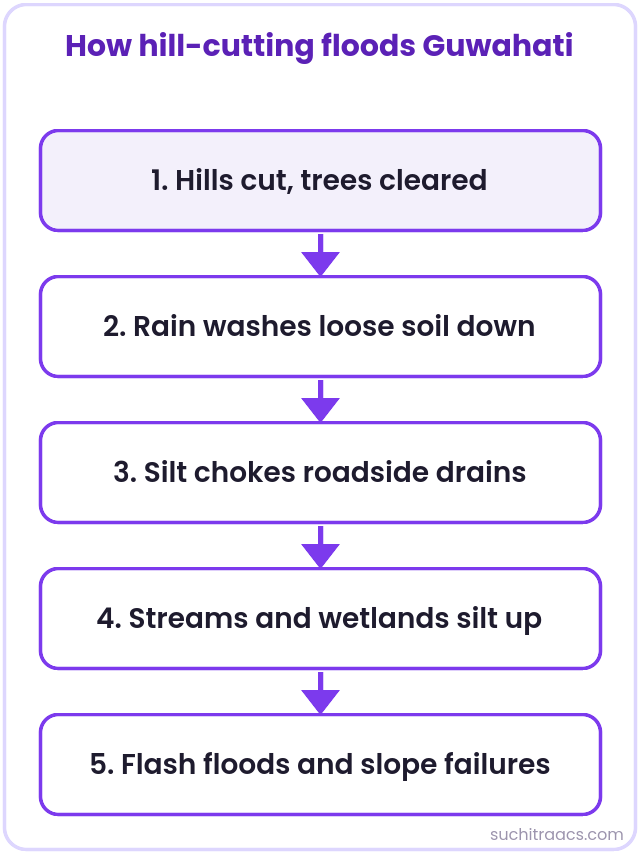
| Link | How it works | Example |
|---|---|---|
| Loss of green cover | Bare slopes cannot hold rain, so water rushes down fast. | Clearing in the Mylliem Reserve Forest near Jorabat has left the slopes without tree cover. |
| Silt in drains | Each shower washes loose soil into roadside drains and chokes them within minutes. | NH-37 at Jorabat goes under water after a single spell of heavy rain. |
| Streams and wetlands silt up | Silt fills streams and wetlands, so they spill over sooner. | The Basistha-Bahini system starts in the Meghalaya hills, and silt from those hills has harmed Deepor Beel, a Ramsar site since 2002. |
| Unstable cut slopes | Vertical cuts and loose fill weaken when soaked, and slide. | Landslides killed four people in Kamrup (Metro) on 30-31 May 2025. A North Eastern Space Applications Centre (NESAC) survey named cut-and-fill slopes as a risk factor. |
| Blocked natural drainage | Filling closes natural water bodies, so rainwater has nowhere to go. | Operators near Amchang have cut into the hills and blocked a natural water body. |
3. Measures to regulate hill-cutting (Way Forward)
- Notify and map every hill: Assam should notify all Guwahati hills under the 2006 Act. The Assam State Disaster Management Authority (ASDMA) should map landslide-prone zones, as the NESAC survey advised.
- Satellite alarms: The Kamrup (Metro) administration and the Assam State Space Application Centre should finish the satellite alarm for illegal cuts. They began discussing it in 2025.
- Fix accountability: Forest, police and district officials should answer for cutting in their areas. Cutting near the Amchang Wildlife Sanctuary (78.64 sq km), also an elephant corridor, should be treated as a wildlife offence.
- Joint Assam-Meghalaya action: The two states settled the Khanapara-Pilangkata area in their boundary pact of 29 March 2022. They should now jointly plan the Jorabat-Khanapara hills, with silt traps and upstream replanting.
- Safe building rules: The Guwahati Metropolitan Development Authority (GMDA) should approve slope buildings only after a slope-stability check. Retaining walls, soil nailing and drains should be compulsory on cut slopes.
Conclusion: Guwahati’s flash floods and landslides are largely man-made, because they begin on the hills that are being cut. The laws already exist, so strict enforcement and joint Assam-Meghalaya action on the hills will help more than new city drains.
Prepare with SuchitraACS
APSC CCE Foundation Programme₹24,999  APSC Prelims Crash Course 2027 (GS + CSAT)₹5,999
 APSC Prelims PYQ Book 2020-2025 (PDF)₹199See the book