
APSC Answer Writing (Daily) based on Assam Tribune – 10/11/2026
For APSC CCE and other Assam Competitive examinations aspirants, practicing Daily Answer Writing is vital. This blog covers the most important Main question and its model Answer from the Assam Tribune today (10-11-2026).
 For working professionals and full-time aspirantsAPSC CCE Foundation Programme₹24,999
Mains Answer Writing
From The Assam Tribune, 10 November 2026
Q. Unscientific hill-cutting in and around Guwahati and along the Assam-Meghalaya border has become a serious environmental concern. Explain its main drivers and its causal links with flash floods and landslides. Suggest measures to regulate it. (250 words, 15 marks)
Model answer
Introduction: In March 2025, the Gauhati High Court told the Assam government that “rampant hill cutting must be checked and stopped” in and around Guwahati. Yet the hills at Jorabat, Khanapara, Rani and North Guwahati are still being cut. One heavy shower now floods National Highway 37 (NH-37) at Jorabat.
1. Main drivers of unscientific hill-cutting
- Urban expansion: Guwahati is growing in every direction, and builders level slopes for flat plots. Years of cutting for construction have left steep, unstable faces on the Jorabat hills.
- Demand for filling earth: Earth cut from hills is used to fill water bodies and low-lying plots. The Kamrup (Metro) monsoon order of 2026 barred both hill cutting and earth filling.
- Weak enforcement and collusion: Operators use excavators and dumpers even inside the Amchang elephant corridor. The editorial alleges that the earth-cutting mafia works with the quiet consent of forest, police and district officials.
- Laws on paper only: The Assam Hill Land and Ecological Sites (Protection and Management) Act, 2006 already bars earth cutting that damages a hill in a notified area. By June 2025 the Forest Department had seized 53 vehicles and 56,700 cubic metres of earth cut from the hills. Yet the cutting goes on.
- Inter-state blame game: Much of the Jorabat cutting is on the Meghalaya side, in the Mylliem Reserve Forest of Ri-Bhoi district. Assam often blames Meghalaya, but cutting also goes on, on the Assam side.
2. Causal links with flash floods and landslides
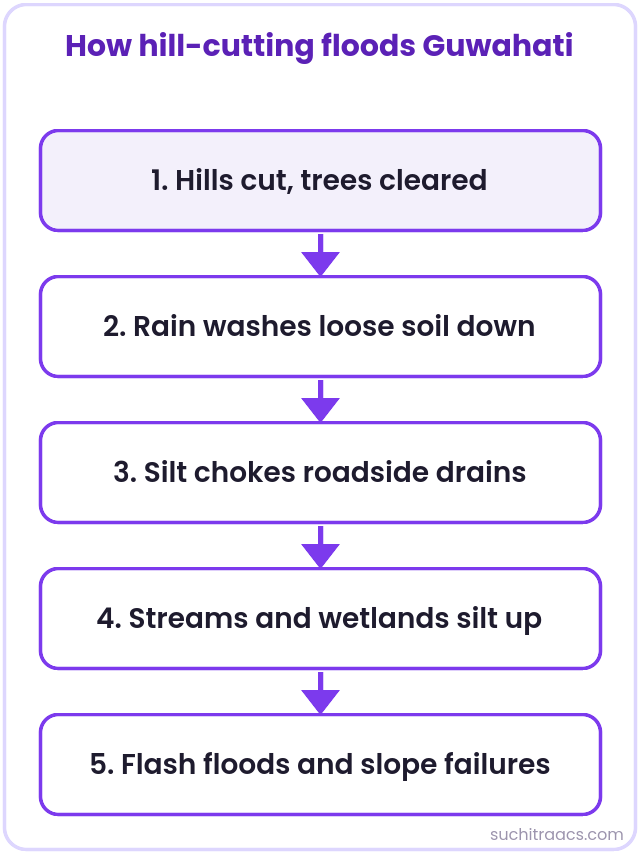
| Link | How it works | Example |
|---|---|---|
| Loss of green cover | Bare slopes cannot hold rain, so water rushes down fast. | Clearing in the Mylliem Reserve Forest near Jorabat has left the slopes without tree cover. |
| Silt in drains | Each shower washes loose soil into roadside drains and chokes them within minutes. | NH-37 at Jorabat goes under water after a single spell of heavy rain. |
| Streams and wetlands silt up | Silt fills streams and wetlands, so they spill over sooner. | The Basistha-Bahini system starts in the Meghalaya hills, and silt from those hills has harmed Deepor Beel, a Ramsar site since 2002. |
| Unstable cut slopes | Vertical cuts and loose fill weaken when soaked, and slide. | Landslides killed four people in Kamrup (Metro) on 30-31 May 2025. A North Eastern Space Applications Centre (NESAC) survey named cut-and-fill slopes as a risk factor. |
| Blocked natural drainage | Filling closes natural water bodies, so rainwater has nowhere to go. | Operators near Amchang have cut into the hills and blocked a natural water body. |
3. Measures to regulate hill-cutting (Way Forward)
- Notify and map every hill: Assam should notify all Guwahati hills under the 2006 Act. The Assam State Disaster Management Authority (ASDMA) should map landslide-prone zones, as the NESAC survey advised.
- Satellite alarms: The Kamrup (Metro) administration and the Assam State Space Application Centre should finish the satellite alarm for illegal cuts. They began discussing it in 2025.
- Fix accountability: Forest, police and district officials should answer for cutting in their areas. Cutting near the Amchang Wildlife Sanctuary (78.64 sq km), also an elephant corridor, should be treated as a wildlife offence.
- Joint Assam-Meghalaya action: The two states settled the Khanapara-Pilangkata area in their boundary pact of 29 March 2022. They should now jointly plan the Jorabat-Khanapara hills, with silt traps and upstream replanting.
- Safe building rules: The Guwahati Metropolitan Development Authority (GMDA) should approve slope buildings only after a slope-stability check. Retaining walls, soil nailing and drains should be compulsory on cut slopes.
Conclusion: Guwahati’s flash floods and landslides are largely man-made, because they begin on the hills that are being cut. The laws already exist, so strict enforcement and joint Assam-Meghalaya action on the hills will help more than new city drains.
Prepare with SuchitraACS
APSC CCE Foundation Programme₹24,999  APSC Mains Mentorship Programme (MMP)₹9,999
 APSC Prelims Crash Course 2027 (GS + CSAT)₹5,999


