Chandubi wildlife sanctuary proposal: APSC Current Affairs Notes and MCQs
APSC CCE current affairs notes on Chandubi wildlife sanctuary proposal, from The Assam Tribune of 22 November 2026, with 4 practice MCQs for Prelims.
 For working professionals and full-time aspirantsAPSC CCE Foundation Programme₹24,999
Current Affairs Notes
From The Assam Tribune, 22 November 2026
Chandubi Sanctuary Proposal and Human-Elephant Conflict in Kamrup
Syllabus Mapping
- Prelims: GS Paper I (General issues on Environment, ecology and biodiversity; Current events of State/National importance).
- Mains: GS Paper III (Conservation, environmental pollution and degradation; Disaster and conflict management); GS Paper V (Assam syllabus: wildlife, forests and environment of Assam).
Why in News? In a report from Amingaon dated 21 November 2026, wildlife enthusiasts and local residents backed a sanctuary in the Chandubi forest landscape. They said it could ease the growing man-elephant conflict in the Kamrup West and East Kamrup Forest divisions. They want the State to revive a proposal that has been pending for nearly 17 years.
Current Context (The Trigger)
- Demand for sanctuary: Local people and conservationists want the Chandubi forest landscape declared a wildlife sanctuary as a long-term answer to man-elephant conflict. The affected areas fall under the Kamrup West and East Kamrup Forest divisions.
- Pending since 2009: A proposal to make three Reserve Forests under the Kamrup West Forest Division a wildlife sanctuary was submitted in 2009. The then Divisional Forest Officer of the division sent it, and it has stayed pending since.
- Area figures: The proposed sanctuary covered 9,328 hectares after leaving out 1,731 hectares of human settlements. Settlements named include Rajapara-I, Rajapara-II, Jaramukhuria and Hatigarh.
- Crop and house losses: Elephant depredation is reaching more and more areas. Herds damage crops and houses and even raid paddy kept in granaries.
- Campaign voices: Debojit Rabha, assistant finance secretary of the All Rabha Students’ Union (ARSU), has led the campaign for sanctuary status for several years. Wildlife enthusiast Prasanna Kumar Goswami and farmer Jiten Kalita also backed the demand.
Core Concepts & Static GK
- Section 18 route: Under Section 18 of the Wild Life (Protection) Act, 1972, the State Government notifies its intention to constitute a sanctuary. This route covers areas outside reserve forests and territorial waters, and a Collector then inquires into rights under Sections 19 to 25.
- Section 26A route: Section 26A, inserted by the Wild Life (Protection) Amendment Act, 1991, covers the final notification of a sanctuary’s limits. For an area inside a reserve forest, the State can declare a sanctuary directly under Section 26A(1)(b).
- Management of sanctuaries: Under Section 33, the Chief Wild Life Warden controls, manages and maintains all sanctuaries. After the 2022 amendment, this must follow management plans prepared under central government guidelines.
- National park: Section 35 of the Act deals with the declaration of national parks. Rules are stricter there: Section 35(7) bans livestock grazing in a national park, while Section 33(d) lets the warden regulate grazing in a sanctuary.
- Elephant status: The Asian elephant is listed in Schedule I of the Wild Life (Protection) Act, 1972, which gives the highest protection.
- National Heritage Animal: The Government of India declared the elephant the National Heritage Animal in 2010.
Institutional Machinery
- Project Elephant: The Government of India launched Project Elephant in 1992 as a centrally sponsored scheme. It gives technical and financial help to elephant range States.
- Elephant Reserves: Elephant Reserves are the basic management units under Project Elephant. They can include protected areas, reserved forests, plantations and eco-sensitive zones.
- State Government and warden: The State Government issues the sanctuary notification under the Act. The Chief Wild Life Warden then manages the sanctuary under its management plan.
- Forest division: The Chandubi proposal came from the Divisional Forest Officer of Kamrup West. Divisional Forest Officers head forest divisions, so the idea started at the field level.
Reports, Indices & Data
- Assam elephant count 2024: The Elephant Population Estimation 2024 counted 5,828 elephants in Assam. Chief Minister Himanta Biswa Sarma released the report in early January 2025.
- Earlier count: The previous statewide figure was 5,719 in 2017, so the count rose by 109.
- Human deaths: Lok Sabha replies list Assam’s human deaths from elephant attacks as 75, 91, 63, 80 and 74 from 2019-20 to 2023-24. That adds up to 383 lives in five years.
Assam & Northeast Linkages
- Three Reserve Forests: The proposal covers Borduar, Mayang Hill and Mataikhar Reserve Forests under the Kamrup West Forest Division.
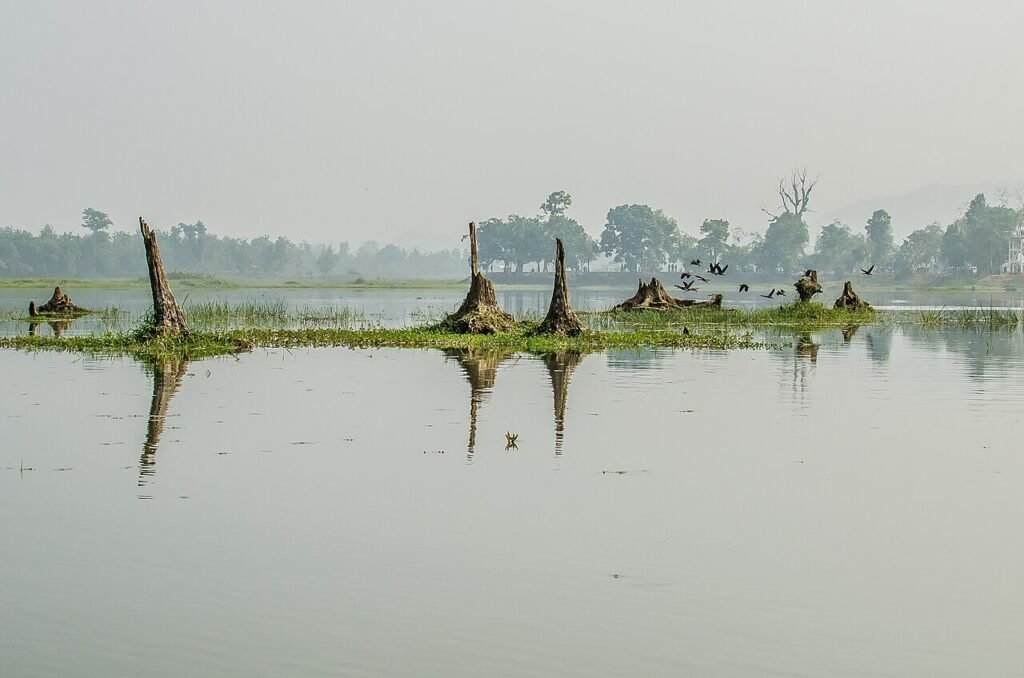
- Varied habitat: These forests hold woodlands, wetlands, rivers and hill forests. Sal and teak stands and wide shrubland make up the main vegetation.
- Wildlife present: Barking deer and sambar live there, along with leopards, leopard cats and the highly endangered clouded leopard.
- Primates: The forests support hoolock gibbon, capped langur, slow loris, Assamese macaque and rhesus macaque.
Prelims Trap Zones (Watch out for)
- Number trap: The proposal covers three Reserve Forests, not four or five. The names are Borduar, Mayang Hill and Mataikhar.
- Year trap: The proposal dates to 2009, so it has been pending for nearly 17 years. It is not a recent proposal.
- Area trap: The 9,328 hectares figure is after excluding 1,731 hectares of settlements. Do not read 9,328 as the gross area.
- Status trap: Chandubi is only a proposed sanctuary. It is not yet notified, and it is not a national park.
- Source trap: The 2009 proposal came from the Divisional Forest Officer of Kamrup West, not from the Union ministry.
- Section trap: A sanctuary inside a reserve forest is declared directly under Section 26A. The Section 18 intention notice applies to areas outside reserve forests.
Introduction
On 21 November 2026, residents and conservationists near Amingaon renewed their demand for sanctuary status for the Chandubi forest landscape. The proposal for three Reserve Forests has waited since 2009, while elephant raids on farms keep rising. Assam holds 5,828 elephants as per the 2024 estimate, so the way the State handles habitat and conflict matters for farmers and wildlife alike.
Underlying Drivers of the Conflict
- Long-distance movement: Elephants travel far in search of food. On the way they enter fields and villages, which puts the livelihood of thousands of farmers at risk.
- Weak surveillance: Debojit Rabha says the forest has suffered from poor surveillance and protection over the years. A degraded habitat pushes animals outward.
- Poaching: Residents on the forest edge named poaching as one factor behind the conflict.
- Attractive crops: Herds damage crops and houses and raid stored paddy. Easy food near settlements draws them back.
- Ineffective old methods: Goswami says conventional preventive measures are working less well each year as the conflict grows.
- Rising population: Assam’s elephant count grew from 5,719 in 2017 to 5,828 in 2024. More animals now share a limited habitat.
Importance of the Chandubi Landscape
- Varied ecology: The three Reserve Forests combine woodlands, wetlands, rivers and hill forests. Such variety supports many species.
- Red List species: Several species found here figure on the International Union for Conservation of Nature (IUCN) Red List.
- Prey base: Barking deer and sambar give leopards, leopard cats and the highly endangered clouded leopard natural prey.
- Primate refuge: Hoolock gibbon, capped langur, slow loris, Assamese macaque and rhesus macaque all live in these forests.
- Vegetation cover: Rabha says the sal and teak forests and shrubland deserve a higher conservation status. Legal protection would help them recover.
- Elephant refuge: Conservationists argue that a safe, quiet habitat would keep herds inside the forest. That would mean fewer visits to villages.
Challenges
- Long delay: The 2009 proposal has stayed pending for nearly 17 years. Residents complain of neglect by successive governments.
- Settlements close by: The proposal excluded 1,731 hectares of villages such as Rajapara-I and Hatigarh. People living so close mean contact with elephants will continue.
- Fixed boundaries: Since the 2003 amendment, Section 26A(3) lets a sanctuary’s boundaries change only on the recommendation of the National Board for Wild Life. So the boundary around the villages must be drawn right the first time.
- Heavy human toll: Assam recorded 75, 91, 63, 80 and 74 human deaths from elephants from 2019-20 to 2023-24. Any plan must save lives first.
- Surveillance gap: The forest has lacked an effective monitoring system for years. A notification alone will not stop encroachment or poaching.
- Short-term fixes: Jiten Kalita says the government relies on temporary deterrents. He wants a comprehensive strategy instead.
Way Ahead
- Revive the file: The Assam Forest Department should take up the 2009 proposal again and update its boundaries. Since the area lies inside Reserve Forests, the State can then notify it directly under Section 26A.
- Consult the villages: The department should hold meetings with excluded settlements such as Rajapara-I, Rajapara-II, Jaramukhuria and Hatigarh before notification. Early agreement avoids disputes later.
- Management plan: The Chief Wild Life Warden should approve a plan under Section 33 that covers patrolling, habitat repair and community roles.
- Strong patrolling: Anti-poaching camps and regular surveillance should be set up. This answers the lack of protection that Rabha pointed out.
- Protect farmers: Quick compensation and crop protection for villages along the edge would build local support. This goes beyond temporary deterrents.
- Use the data: The 2024 elephant estimate should feed into an elephant conservation plan for Kamrup, following the Union environment ministry’s framework for such plans.
Conclusion
A sanctuary will not end elephant raids alone, but it can give herds a protected home and the forest a legal shield. The State should pair a quick notification with surveillance, village consultation and fair compensation. Only then will farmers near Chandubi see real relief.
Asked in APSC
- APSC Mains 2025, GS Paper 5 (10 marks): Explain the anthropogenic and environmental drivers of human-wildlife conflict in Assam. Suggest community-based strategies to mitigate the conflict.
APSC Prelims MCQs
Practice questions on this topic
Q1. A proposal to declare Reserve Forests in the Chandubi landscape as a wildlife sanctuary has been pending in Assam. Consider the following statements:
(i) The proposal was submitted in 2009 by the then Divisional Forest Officer of the Kamrup West Forest Division.
(ii) The proposed sanctuary covered 9,328 hectares after excluding 1,731 hectares of human settlements.
(iii) The proposal covers four Reserve Forests of the Kamrup East Forest Division.
Which of the statements given above is/are correct?
- (a) (i) and (ii) only
- (b) (ii) and (iii) only
- (c) (i) only
- (d) (i), (ii) and (iii)
Show answer
Answer: (a) Explanation: Statements (i) and (ii) match the newspaper report. The 2009 proposal came from the then Divisional Forest Officer of Kamrup West, and the 9,328 hectares figure is net of 1,731 hectares of settlements. Statement (iii) is wrong on two counts. The proposal covers three Reserve Forests, namely Borduar, Mayang Hill and Mataikhar, and they lie under the Kamrup West Forest Division, not Kamrup East. So option (b) and option (d) fail because they include (iii), and option (c) fails because it leaves out the correct statement (ii). Value addition: the area lies inside Reserve Forests. So the State can declare the sanctuary directly under Section 26A(1)(b) of the Wild Life (Protection) Act, 1972.
Q2. Match List-I with List-II (Wild Life (Protection) Act, 1972):
| List-I (Section) | List-II (Subject) |
|---|---|
| a. Section 18 | 1. Declaration of national parks |
| b. Section 26A | 2. Notification of intention to constitute a sanctuary outside reserve forests |
| c. Section 33 | 3. Final notification declaring an area as a sanctuary |
| d. Section 35 | 4. Control and management of sanctuaries by the Chief Wild Life Warden |
Select the correct answer using the codes given below:
- (a) a-2, b-3, c-4, d-1
- (b) a-3, b-2, c-4, d-1
- (c) a-2, b-3, c-1, d-4
- (d) a-4, b-2, c-3, d-1
Show answer
Answer: (a) Explanation: Section 18 lets the State Government notify its intention to constitute a sanctuary in an area outside reserve forests and territorial waters. Section 26A, inserted in 1991, covers the final notification declaring an area a sanctuary. Section 33 gives the Chief Wild Life Warden control and management of sanctuaries, now under management plans. Section 35 deals with national parks. Option (b) swaps Sections 18 and 26A. Option (c) swaps Sections 33 and 35. Option (d) gets only Section 35 right and mismatches the other three. Value addition: Section 35(7) bans livestock grazing in a national park, while Section 33(d) lets the warden regulate grazing in a sanctuary.
Q3. Which one of the following statements about the proposed Chandubi wildlife sanctuary is NOT correct?
- (a) It involves three Reserve Forests under the Kamrup West Forest Division.
- (b) The proposal was submitted in 2009.
- (c) The proposal was submitted by the Union Ministry of Environment, Forest and Climate Change.
- (d) Settlements such as Rajapara-I and Jaramukhuria were excluded from the proposed area.
Show answer
Answer: (c) Explanation: Statement (c) is incorrect. The proposal was submitted by the then Divisional Forest Officer of the Kamrup West Forest Division. He is a State forest official, not a Union ministry officer. Statement (a) is correct because Borduar, Mayang Hill and Mataikhar lie in Kamrup West. Statement (b) is correct because the proposal dates to 2009 and has stayed pending since. Statement (d) is correct because the area excludes 1,731 hectares of settlements, including Rajapara-I, Rajapara-II, Jaramukhuria and Hatigarh. Value addition: under the Wild Life (Protection) Act, 1972, it is the State Government that notifies a sanctuary.
Q4. In which year did the Government of India declare the elephant the National Heritage Animal?
- (a) 1992
- (b) 2008
- (c) 2010
- (d) 2012
Show answer
Answer: (c) Explanation: The Union environment ministry declared the elephant the National Heritage Animal in October 2010. The Elephant Task Force had recommended this status in its report that year. The year 1992, option (a), is a trap because it is when Project Elephant was launched, not when the heritage status was given. Options (b) and (d) are nearby years with no such declaration. The question links to the Chandubi story because safe elephant habitat is central to reducing conflict. Value addition: the Asian elephant is listed in Schedule I of the Wild Life (Protection) Act, 1972, which gives it the highest legal protection.
Prepare with SuchitraACS
APSC CCE Foundation Programme₹24,999  APSC Prelims Crash Course 2027 (GS + CSAT)₹5,999
 APSC Prelims PYQ Book 2020-2025 (PDF)₹199See the book