Dibru-Saikhowa oil drilling plea: APSC Current Affairs Notes and MCQs
APSC CCE current affairs notes on Dibru-Saikhowa oil drilling plea, from The Assam Tribune of 4 November 2026, with 4 practice MCQs for Prelims.
 Last batch for APSC CCE 2027 · starts 16 NovAPSC CCE Foundation Programme₹24,999
Current Affairs Notes
From The Assam Tribune, 4 November 2026
Oil India’s Extended Reach Drilling Plea for Dibru-Saikhowa National Park
Syllabus Mapping
- Prelims: GS Paper I (General issues on Environment, ecology and biodiversity; Current events of State/National importance).
- Mains: GS Paper III (Conservation, environmental pollution and degradation, Environmental Impact Assessment; Energy resources); GS Paper V (Assam: environment, natural resources and development issues).
Why in News? On 3 November 2026, the Supreme Court asked the Ministry of Petroleum and Natural Gas and the Assam government to respond. The plea was filed by Oil India Limited (OIL). OIL wants the Court to overturn the Centre’s refusal of its Extended Reach Drilling (ERD) proposal. The proposal aims to reach oil and gas beneath Dibru-Saikhowa National Park. The case will be taken up after 17 November.
Current Context (The Trigger)
- Bench and notice: A bench of Chief Justice Surya Kant and Justices Joymalya Bagchi and V Mohana sought replies. The replies are due from the petroleum ministry and the Assam government.
- Urgency argued: Senior advocate Rakesh Dwivedi, who represents OIL, told the bench the matter was extremely urgent. He said the company has been unable to explore for oil in the area.
- Reserve claim: He told the bench that the area close to the park is estimated to hold 3 per cent of all of India’s hydrocarbon reserves.
- Drilling plan: According to counsel, the drilling would go below 4,000 metres and would not harm the park’s plants and animals.
- Court’s hint: The bench said it may allow the exploration based on a research and development (R&D) report prepared by the authorities. The Ministry of Environment, Forest and Climate Change (MoEFCC) is one of them.
- Earlier step: On 2 September, the bench had let OIL take back an earlier interlocutory application. OIL could then come back with a new plea against the rejection.
- Land involved: The plea is about a 0.069-hectare patch of forest land in Tinsukia district that OIL wants for the project.
Core Concepts & Static GK
- Extended Reach Drilling: The term was first used in the early 1980s. It meant directional wells whose horizontal reach is at least twice their true vertical depth. Today the oilfield glossary of SLB also counts some very deep wells with a lower ratio as ERD wells.
- How OIL uses it: OIL says ERD means drilling from pads set up outside the protected area. The wells then reach oil and gas reservoirs several kilometres below the surface.
- OIL’s version: OIL says its drilling infrastructure would stay outside the park, while the wells target deposits about 3,500 to 4,000 metres below it.
- Mining versus drilling: OIL argues that oil and gas work is governed by its own legal and regulatory framework. So, it says, ERD cannot be treated as conventional mining.
- Forest law name: After the 2023 amendment, the Forest (Conservation) Act, 1980 has a new name. It is now the Van (Sanrakshan Evam Samvardhan) Adhiniyam, 1980 (Act 69 of 1980).
Constitutional & Legal Framework
- 2023 amendment: The Forest (Conservation) Amendment Bill, 2023, was passed by the Lok Sabha on 26 July 2023. The Rajya Sabha passed it on 2 August 2023.
- New rules: The Van (Sanrakshan Evam Samvardhan) Rules, 2023, notified on 29 November 2023, came into force on 1 December 2023. They replaced the Forest (Conservation) Rules, 2022.
- Section 2 route: OIL wants the Court to direct the Centre to approve non-forestry use of the land under section 2(1)(ii) of the Adhiniyam.
- 2023 Supreme Court order: On 26 April 2023, a bench of Justices B.R. Gavai, Vikram Nath and Sanjay Karol modified its 3 June 2022 order. It held that mining is not allowed inside a national park or wildlife sanctuary, or in a one-km belt around it.
- Clarification: On 28 April 2023, the Court clarified that mining is also barred inside a notified eco-sensitive zone. This holds even where the zone runs beyond one km from the boundary.
- The case file: OIL’s earlier interlocutory application was filed in the long-running T.N. Godavarman Thirumulpad v. Union of India case of 1995 (Writ Petition (Civil) 202 of 1995).
Institutional Machinery
- Forest Advisory Committee (FAC): OIL challenges the decision of this MoEFCC committee and the ministry’s later refusal of approval.
- Dates under challenge: OIL wants the MoEFCC order of 2 August 2024 and the minutes of the FAC meeting of 4 July 2024 set aside.
- Advisory Committee rules: Under the Van Rules, 2023, an Advisory Committee advises the Centre on approvals under section 2(1). The Director General of Forests in the MoEFCC chairs it.
- National Board for Wildlife: OIL says the proposal had been recommended by the Standing Committee of the National Board for Wildlife (NBWL).
- Statutory basis: Sections 5A and 5B were added to the Wildlife (Protection) Act, 1972 by an amendment of 2002. Section 5A makes the Prime Minister chairperson of the NBWL. Section 5B lets the Board form a Standing Committee of the Vice-Chairperson, the Member-Secretary and up to ten members.
- Respondents: The Court asked the Ministry of Petroleum and Natural Gas and the Assam government for replies.
Assam & Northeast Linkages
- Location: The MoEFCC lists the Dibru-Saikhowa Biosphere Reserve (1997, 765 sq km) as part of Dibrugarh and Tinsukia districts of Assam.
- Shrinking park: A 2024 PTI report cited Assam Forest Department records. It said 2023 satellite images show the park reduced to about 216.53 sq km from its declared 340 sq km. Erosion by the Brahmaputra caused most of this loss.
- Project site: The proposed drilling is from the Baghjan Petroleum Mining Lease (PML) in the Tinsukia Wildlife Division.
- Eco-sensitive zone: A January 2020 notification fixed the zone’s width at zero to 8.7 km, varying along the park boundary.
- Environmental clearance: OIL says a May 2020 environmental clearance let it drill and test for hydrocarbons at seven sites under the park. Drilling in forest areas still needed separate prior approval.
- High Court stay: In December 2020, the Gauhati High Court stayed the environmental clearance for these seven projects. Petitioners said the court was prima facie satisfied that OIL had not done a biodiversity impact assessment.
Prelims Trap Zones (Watch out for)
- Who rejected it: The refusal came from the MoEFCC after the Forest Advisory Committee’s decision, not from the petroleum ministry.
- Area of land: The forest land in question is 0.069 hectares, not 0.69 or 69 hectares.
- Depth figures: OIL gives 3,500 to 4,000 metres as the target depth. Counsel spoke of going below 4,000 metres. Do not mix the two.
- Judgment year: The mining ban order is dated 26 April 2023 and modified an order of 3 June 2022. The year 1995 belongs to the Godavarman case, and 2017 is the year of the earlier orders OIL relies on.
- Zone width: The park’s eco-sensitive zone varies from zero to 8.7 km in width; it is not a uniform 1 km.
- Park versus reserve: The 765 sq km biosphere reserve was declared in 1997. Its 340 sq km core became a national park only in 1999.
Introduction
On 3 November 2026, the Supreme Court issued notice on Oil India’s plea to drill sideways beneath Dibru-Saikhowa National Park. The case tests whether a technology that leaves the surface untouched can be treated differently from mining in a protected area. For Assam, it puts national energy needs against a fragile floodplain park and the memory of the 2020 Baghjan blowout.
Why the Company Presses the Case
- Energy argument: At the September hearing, Rakesh Dwivedi told the Court that the project was vital for the country’s energy requirements.
- Reserve estimate: Counsel put the hydrocarbon reserves near the park at an estimated 3 per cent of India’s total.
- Surface footprint: “The pipeline is being laid outside the park,” Dwivedi said in September. He added that it goes 4,000 metres down and then runs horizontally.
- Technology claim: An ERD well can reach far to the side of its surface pad. So OIL says it can tap reservoirs under the park while keeping its drilling infrastructure outside.
- Earlier permissions: OIL points to Supreme Court orders of 2017 and to a recommendation of the Standing Committee of the NBWL.
- Environmental clearance: It also holds a May 2020 clearance for seven locations, though forest areas still needed separate approval.
Legal Questions Before the Court
- Is ERD mining? OIL says oil and gas work is not conventional mining and has its own legal framework.
- The Centre’s reading: OIL says the authorities wrongly applied the 26 April 2023 judgment to its proposal.
- Scope of the 2023 ban: The Court barred mining inside national parks and sanctuaries and in a one-km belt around them.
- Forest law angle: Even the tiny diversion of 0.069 hectares needs Central approval under section 2(1)(ii) of the Van Adhiniyam.
- Procedural history: On 2 September, the Court let OIL withdraw the earlier application and gave it freedom to file a new petition.
- Court’s openness: The bench said it may allow the work based on an R&D report from the authorities, the MoEFCC among them.
Ecological Stakes
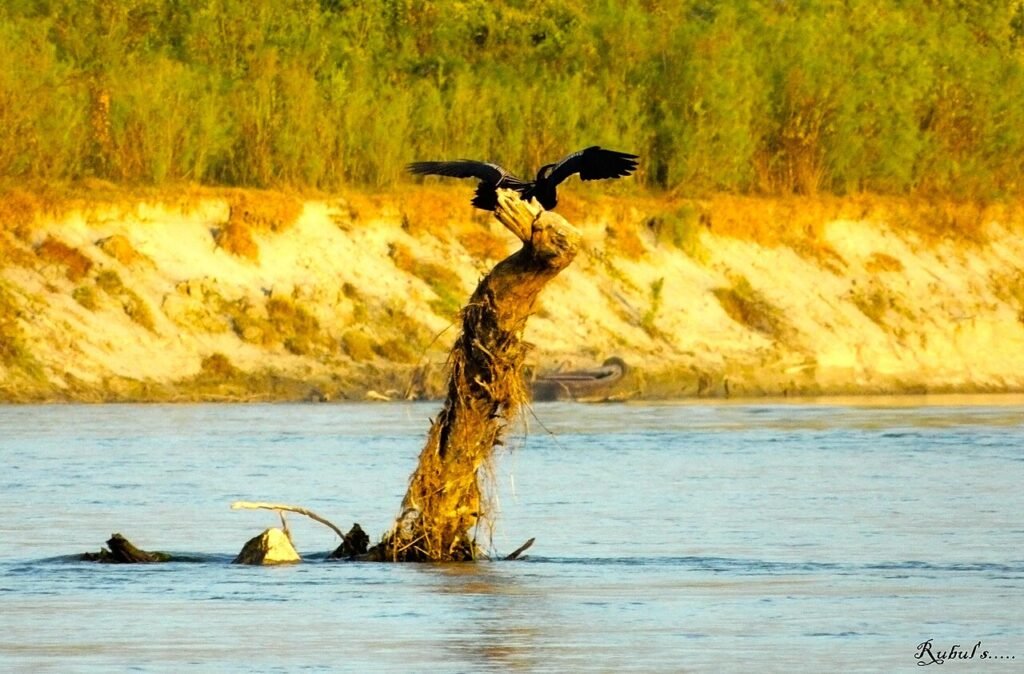
- Rare habitat: The BirdLife Key Biodiversity Area factsheet says the area has the largest salix (willow) swamp forest in north-eastern India.
- Bird value: The same factsheet lists important birds such as the white-winged duck, black-breasted parrotbill and marsh babbler.
- Special species: Assam Tourism says the park was set up mainly to protect the white-winged wood duck. It is also known for its feral horses and the Gangetic river dolphin.
- Protection layers: The area became a biosphere reserve in 1997, and its 340 sq km core became a national park in 1999.
- Erosion pressure: Assam Forest Department records cited by PTI show that more than 36 per cent of the park eroded in about 25 years. About 216.53 sq km was left in 2023.
- Buffer rules: The January 2020 eco-sensitive zone is up to 8.7 km wide in places and zero in others.
- Court scrutiny of assessment: In 2020, the Gauhati High Court halted the seven projects over the question of a missing biodiversity impact assessment.
The Baghjan Shadow
- Blowout: A blowout hit OIL’s Baghjan-5 well in Tinsukia on 27 May 2020. A fire broke out at the well on 9 June 2020.
- Nearness to the park: Down To Earth reported that Dibru-Saikhowa National Park and the Maguri-Motapung wetland were less than one km from the site.
- Penalty: On 25 June 2020, the National Green Tribunal (NGT) told OIL to deposit Rs 25 crore for the damage caused.
- Expert verdict: An NGT-appointed committee headed by Justice B.P. Katakey submitted a preliminary report on 24 July 2020. It said the blowout and fire could have been prevented.
- Missing consents: The committee found that OIL lacked the consents to establish and operate. These are required under the Water Act, 1974 and the Air Act, 1981.
- Spill impact: Oil spillage severely affected a six-km radius around the well. Bird density and diversity fell sharply within one km.
Challenges
- Proving no harm: Counsel’s claim that drilling will not harm the park’s plants and animals still has to be tested against independent studies.
- Precedent risk: A ruling that ERD is not mining could encourage similar proposals beneath other national parks.
- Accident risk: Baghjan showed that one well accident can severely affect an area six km around the site.
- Compliance record: The 2020 committee found OIL lacked mandatory Water Act and Air Act consents at Baghjan.
- Assessment gaps: The Gauhati High Court stayed the seven projects in 2020 over the missing biodiversity impact assessment.
- A park already shrinking: The park has lost more than a third of its declared area to Brahmaputra erosion. So any extra stress falls on a smaller habitat.
- Energy need: Any limit on drilling has a cost for national energy supply, which counsel called vital.
Way Ahead
- Independent study: The bench may rely on an R&D report prepared by the authorities. The MoEFCC should make sure this report is prepared by neutral experts and made public.
- Clear legal line: The Supreme Court can state whether sub-surface drilling from outside the boundary falls within its 2023 mining ban.
- Strict conditions: Any approval should carry binding safeguards, like the 2017 orders that allowed ERD subject to conditions.
- Safety audit: OIL should pass an independent well-control audit, given the lapses found after Baghjan.
- Local monitoring: The Assam Forest Department and the Tinsukia Wildlife Division can monitor pads on the park fringe.
- Open disclosure: Data on depth, pad locations and monitoring should be published so that residents of Tinsukia can check compliance.
Conclusion
The dispute is narrow in land (0.069 hectares) but wide in principle. A sound outcome will rest on independent evidence that sub-surface drilling leaves the park intact, with Baghjan as the benchmark for safety. Energy security and a biosphere reserve can coexist only under verified, enforceable conditions.
APSC Prelims MCQs
Practice questions on this topic
Q1. The Supreme Court recently heard a plea by Oil India Limited on drilling beneath Dibru-Saikhowa National Park. Consider the following statements:
(i) The plea challenges a Forest Advisory Committee decision and the refusal that followed.
(ii) Oil India says the drilling pads would stay outside the national park.
(iii) The order under challenge dated 2 August 2024 was passed by the Ministry of Petroleum and Natural Gas.
Which of the statements given above is/are correct?
- (a) (i) and (ii) only
- (b) (ii) and (iii) only
- (c) (i) only
- (d) (i), (ii) and (iii)
Show answer
Answer: (a) Explanation: Statements (i) and (ii) are correct. Oil India questions both what the Forest Advisory Committee decided and the Environment Ministry’s later refusal to approve use of 0.069 hectares in Tinsukia. It also says its pads and other drilling equipment would sit outside the park, with wells reaching deposits 3,500 to 4,000 metres below. Statement (iii) is wrong because the 2 August 2024 order came from the Ministry of Environment, Forest and Climate Change, not the petroleum ministry. The Court has only asked the petroleum ministry to respond. Option (b) wrongly includes (iii) and drops (i), option (c) leaves out (ii), and option (d) includes (iii). Value addition: the Forest Advisory Committee’s meeting of 4 July 2024 is also under challenge.
Q2. Dibru-Saikhowa lies in Upper Assam. Consider the following statements about it:
(i) It was declared a Biosphere Reserve in 1997.
(ii) Its core area became a national park in 1999.
(iii) It lies entirely within Dibrugarh district.
Which of the statements given above is/are correct?
- (a) (i) only
- (b) (i) and (ii) only
- (c) (ii) and (iii) only
- (d) (i), (ii) and (iii)
Show answer
Answer: (b) Explanation: Statements (i) and (ii) are correct. The Environment Ministry lists Dibru-Saikhowa as a Biosphere Reserve designated in 1997 with an area of 765 sq km. Its 340 sq km core was declared a national park in 1999. Statement (iii) is wrong because the reserve covers parts of two districts, Dibrugarh and Tinsukia. The drilling land in the news is in Tinsukia. Option (a) ignores the 1999 national park status, option (c) accepts the false district claim, and option (d) accepts all three. Value addition: Assam Forest Department records cited by PTI in 2024 show Brahmaputra erosion has cut the park to about 216.53 sq km.
Q3. Match List-I with List-II (events in the Oil India case):
| List-I (Event) | List-II (Date) |
|---|---|
| a. Supreme Court judgment barring mining within 1 km of national parks and sanctuaries | 1. 4 July 2024 |
| b. Forest Advisory Committee meeting under challenge | 2. 2 August 2024 |
| c. Environment Ministry order refusing approval | 3. 26 April 2023 |
| d. Environmental clearance for seven locations, as claimed by Oil India | 4. May 2020 |
Select the correct answer using the codes given below:
- (a) a-3, b-1, c-2, d-4
- (b) a-3, b-2, c-1, d-4
- (c) a-4, b-1, c-2, d-3
- (d) a-1, b-3, c-4, d-2
Show answer
Answer: (a) Explanation: The correct pairs are a-3, b-1, c-2 and d-4. The Supreme Court’s order barring mining inside national parks and sanctuaries and in a one-km belt around them is dated 26 April 2023. The Forest Advisory Committee met on 4 July 2024, and the Environment Ministry’s refusal order followed on 2 August 2024. Oil India says it got environmental clearance in May 2020. Option (b) swaps the committee meeting and the ministry order, which is the main trap. Options (c) and (d) pair the 2023 judgment or the 2020 clearance with the wrong events. Value addition: the Eco-Sensitive Zone notification for the park was issued in January 2020, a few months before the clearance.
Q4. According to Oil India’s plea, which body had recommended its Extended Reach Drilling proposal for Dibru-Saikhowa National Park?
- (a) National Tiger Conservation Authority
- (b) Forest Advisory Committee
- (c) Standing Committee of the National Board for Wildlife
- (d) Central Zoo Authority
Show answer
Answer: (c) Explanation: Oil India says the Standing Committee of the National Board for Wildlife recommended its proposal. It adds that the Supreme Court then allowed sub-surface extraction, subject to environmental and wildlife conditions. The Forest Advisory Committee in option (b) is the body whose decision Oil India is now challenging, so it is the trap. The National Tiger Conservation Authority and the Central Zoo Authority are not named in the plea. Value addition: the National Board for Wildlife is set up under section 5A of the Wildlife (Protection) Act, 1972. The Prime Minister is its chairperson. Its Standing Committee comes under section 5B, and both sections were added by a 2002 amendment.
Prepare with SuchitraACS
APSC CCE Foundation Programme₹24,999  APSC Prelims Crash Course 2027 (GS + CSAT)₹5,999
 APSC CCE Study Materials Package (Prelims + Mains)₹4,999