
Free for every APSC aspirant · no sign-up
APSC CSAT PYQs with Answers Prelims GS Paper II, CCE 2020 to 2025, with worked solutions
All 400 questions of the last five APSC Prelims CSAT papers, including the 2026 question paper (CCE 2025): reasoning, maths, passages, data and decision making, each with the answer and a step-by-step solution. CSAT is qualifying: you need 33% to have your GS Paper I marks counted.
You took your vehicle to an approved pollution testing centre. The executive at the centre fed the required data to his computer, came out of the kiosk and took front and back photographs of your vehicle. He then went back to his computer and surprisingly, handed over the PUCC to you without actually testing the emission. Needless to say, all data shown in the PUCC were within permissible limits. What will you do?
- AYou nonchalantly pay the required amount and leave the centre
- BYou pay the required amount, praise the executive for his cost cutting efforts and leave the centre
- CYou admonish the centre executive and make him do a real emission test and then pay the required amount
- DYou pay the required amount, and leave the centre but report the entire matter to the District Transport Office for necessary action
Show answer and explanationHide answer
Answer(D) You pay the required amount, and leave the centre but report the entire matter to the District Transport Office for necessary action
Explanation
Principle: do not be part of a wrong act, and report malpractice to the authority that can stop it. Issuing a PUC certificate without testing defeats the law on vehicle emissions. The District Transport Office licenses and supervises these centres, so reporting to it can stop the practice at this centre for all vehicles, not only yours.
- (A) pay and leave nonchalantly: wrong. It accepts a fraud that harms public health and the law.
- (B) pay and praise the executive for cost cutting: wrong. It rewards wrongdoing.
- (C) admonish the executive and make him do a real test: weaker. Your vehicle is tested properly, but the centre will keep cheating others; a citizen also has no power to discipline the centre.
- (D) pay and report the matter to the District Transport Office: correct. It uses the proper channel to stop the malpractice for everyone.
For future exams
- Corruption or malpractice questions: the best answer reports to the authority that supervises the wrongdoer (here, the transport department), not a private scolding.
Micro topic Fake emission test ethical responseChapter Decision Making
You are carrying about 3 kg in excess of the luggage allowance for your upcoming flight to your ancestral place. You have packed your bag with presents for relatives and friends. You plan to plead with the check-in executive in the airport to overlook the excess luggage and waive the charge for it. In the check-in counter, the executive behind the desk seems to ignore your plea and hands over a paper note which mentions the amount to be paid. You got annoyed and wanted to argue your case further. Then you noticed that the executive is wearing a tag which says that he can neither hear nor speak. What will you do?
- AYou will give a thumbs up to the executive and pay for the excess baggage with a smile
- BYou will withdraw from the counter and move to the adjacent one
- CYou will pay for the excess baggage, but will lodge a complaint to the airline for employing a person with disability as a check-in executive
- DYou will create a scene as your pleas were not being heard
Show answer and explanationHide answer
Answer(A) You will give a thumbs up to the executive and pay for the excess baggage with a smile
Explanation
Principle: follow the rules, and treat a person with disability with dignity and empathy. The 3 kg is really over the allowance, so the charge is valid and you should pay it. The executive is only doing his job; he cannot hear your plea, so arguing serves no purpose. A thumbs up and a smile communicate politely without words and accept the rule gracefully.
- (A) Thumbs up and pay with a smile: correct. It accepts a valid charge and respects the executive by using a sign he can understand.
- (B) Move to the adjacent counter: wrong. It is an attempt to shop for a softer executive to escape a valid charge, and it quietly rejects the executive because of his disability.
- (C) Pay but complain about employing a person with disability: wrong. The executive did his job correctly. A complaint like this is discriminatory and goes against the spirit of equal opportunity for persons with disabilities.
- (D) Create a scene: wrong. The charge is lawful, and shouting at a person who cannot hear is both useless and humiliating for him.
For future exams
- Situational questions on persons with disability: pick the option that treats them as equal, capable workers; reject any option that pities, avoids or complains about them.
- When a rule is fair (a real excess-baggage charge), the best option accepts it calmly; pleading for a waiver or protesting is never the model answer.
Micro topic Dealing with disabled check-in staffChapter Decision Making
You are leading a group of professionals to prepare a digital twin of an industrial township. The project involves extensive fieldwork as well as AI assisted computing. Also, the project should be completed within a given timeline. What will you do? (i) The team will be in constant touch with one another through social media (ii) The entire team will assemble in the company conference room every morning to take stock of the situation till the project is over (iii) Some of the team members will be allowed to work from home, if justified by the nature of the job (iv) No team member will be allowed to work from home. Select the correct answer from the codes given below.
- A(i) and (iii)
- B(i) and (iv)
- C(ii) and (iv)
- DOnly (iv)
Show answer and explanationHide answer
Answer(A) (i) and (iii)
Explanation
Principle: get the work done on time with smart coordination and sensible flexibility. The project mixes fieldwork and AI-based computing, so team members are spread out and some work can be done from any desk. Constant contact through digital channels (i) keeps everyone coordinated. Allowing work from home where the job justifies it (iii) lets the computing staff work efficiently, while field staff stay on the ground.
- (i) Constant touch through social media: suitable. A dispersed team needs quick, continuous communication.
- (ii) Daily morning meeting in the conference room till the end: not suitable. Field staff would have to travel back to office every day, wasting time on a time-bound project.
- (iii) Work from home if the nature of the job justifies it: suitable. AI-assisted computing can be done remotely; the condition 'if justified' keeps it controlled.
- (iv) No work from home at all: not suitable. A blanket ban ignores the nature of the work and adds no value.
- So (i) and (iii) are right: code (A). Codes (B), (C) and (D) all include (iv), and (C) also includes (ii).
For future exams
- For team-management questions, prefer options that match the method to the nature of the work (field vs desk); reject blanket rules such as 'no one may' or 'everyone must, every day'.
- Code shortcut: once you rule out (iv), every code except (A) is gone.
Micro topic Team coordination for digital twin projectChapter Decision Making
You are the head of the civil administration of a subdivisional town. Without much of a warning, the town and its neighbouring locations were ravaged by a cloudburst. You and your team is working tirelessly in the field as well as in the control room. While you were busy in the control room, a few people from the media approached you to enquire about the loss of life and property and the administration's response to it. What will you do?
- AYou will brief the media persons with the latest data and inform them of the relief and rehabilitation works currently being undertaken
- BYou will refuse to talk to the media persons as you are extremely busy and tell them that your office will issue a press note by the evening
- CYou will refuse to talk to the media persons as you are extremely busy and you will assign a junior person from your office to brief them
- DYou will refuse to talk to the media persons as you are extremely busy and reprimand them for disturbing the relief and rehabilitation works
Show answer and explanationHide answer
Answer(A) You will brief the media persons with the latest data and inform them of the relief and rehabilitation works currently being undertaken
Explanation
Principle: transparency and public communication during a disaster. The public and the victims' families need correct information quickly; a short, factual briefing by the head of administration stops rumours and panic and builds trust in the relief effort. It also helps relief, because the media can spread helpline numbers and instructions. A brief briefing takes only a few minutes away from the control room.
- (A) Brief the media with latest data and relief works: correct. It gives accurate, official information at once and keeps the public informed.
- (B) Refuse and promise a press note by evening: wrong. In a fast-moving disaster, a delay of hours lets rumours and wrong figures spread.
- (C) Refuse and send a junior to brief: wrong. A junior may not have the latest consolidated data, and wrong figures on deaths and losses can cause harm; the head of administration is the right person to speak.
- (D) Refuse and reprimand the media: wrong. The media is a partner in disaster communication; scolding them damages trust and is unprofessional.
For future exams
- In disaster-management questions, the model answer usually combines action on the ground with honest, timely information to the public through the media.
- Options that end with 'refuse' or 'reprimand' are almost never the best choice for a public servant.
Micro topic Briefing media after cloudburstChapter Decision Making
You are the leader of a team working on a certain project. On a certain issue pertaining to the project, opinion is divided among the team members on the steps to be taken. What will you do?
- AYou will impose your idea
- BYou will consult each member of the team regarding the best way forward and then approve one of the suggestions coming from the team members
- CYou will pick up a few alternative ideas and allow voting among the team members to select one
- DYou will consult your seniors in the institution, go through some case studies, and then select the most appropriate approach to the problem. You will acquaint the team members with your solution to the problem and then implement it
Show answer and explanationHide answer
Answer(D) You will consult your seniors in the institution, go through some case studies, and then select the most appropriate approach to the problem. You will acquaint the team members with your solution to the problem and then implement it
Answer-key note: Error in question (key defensible)
This is an opinion-based question with two defensible answers. APSC provisional key: (D), an evidence-based decision taken after consulting seniors and case studies, explained to the team. Our writer and checker first chose (B), consulting every team member and approving one of their ideas, which is the participative-leadership view. (D) is defensible because the leader decides on merit, uses institutional expertise and owns the decision, so we print the key's answer. In the APSC exam, mark (D).
Explanation
Principle: an informed, accountable decision by the leader. When the team is divided, the leader should not just impose a personal idea or hand the choice to a vote. Option (D) gathers expert advice (seniors) and evidence (case studies), picks the most suitable approach on merit, explains it to the team, and then implements it. The leader takes responsibility for the decision and the team knows the reasons. This is the reading APSC's key takes.
- (A) Impose your idea: wrong. It is autocratic, ignores everyone's knowledge and is not based on evidence.
- (B) Consult each member, then approve one of their suggestions: defensible but limited. It is participative, but the choice is restricted to ideas from an already divided team, and no outside expertise or evidence is used.
- (C) Put a few ideas to a vote: weaker. A vote decides by numbers, not merit, and the leader escapes responsibility for the outcome.
- (D) Consult seniors, study case studies, choose the best approach, explain it to the team, implement: correct as per APSC key. Decision on merit and evidence, owned by the leader, with the team told the reasons.
Key note: This is an opinion-based question with two defensible answers. APSC provisional key: (D), an evidence-based decision taken after consulting seniors and case studies, explained to the team. Our writer and checker first chose (B), consulting every team member and approving one of their ideas, which is the participative-leadership view. (D) is defensible because the leader decides on merit, uses institutional expertise and owns the decision, so we print the key's answer. In the APSC exam, mark (D).
For future exams
- In APSC decision-making items, options that use expert advice, evidence and proper institutional channels, and keep responsibility with the officer, are often keyed as best.
- Keywords that signal a weak option: impose, vote to avoid responsibility, ignore.
Micro topic Resolving disagreement in teamChapter Decision Making
Generic medicines are many times cheaper than the branded varieties and they are effective alternatives to the branded ones. As a civil servant, you wish to popularize the generic medicines, especially among the economically challenged section of the population in the town where you are currently posted. What will you do?
- AOrganize awareness meetings
- BDistribute pamphlets
- CCreate awareness through social media
- DAll of the above
Show answer and explanationHide answer
Answer(D) All of the above
Explanation
Principle: reach every section of the target group through more than one channel. Economically weaker people differ in literacy and in access to smartphones. Meetings reach people face to face and allow questions; pamphlets reach those who can read and keep the information; social media reaches younger and connected people quickly. Using all three together gives the widest reach.
- (A) Awareness meetings only: incomplete. Useful, but they reach only those who attend.
- (B) Pamphlets only: incomplete. They miss people who cannot read.
- (C) Social media only: incomplete. Many poor families have limited internet access, so this alone misses the main target group.
- (D) All of the above: correct. The three methods cover each other's gaps.
For future exams
- In awareness-campaign questions, a combined, multi-channel approach is usually the best answer, unless one listed option is harmful or unlawful.
- Check every single option first: if each one is useful and none is wrong, 'All of the above' is the answer.
Micro topic Popularising generic medicinesChapter Decision Making
You have planned a vacation and you have decided to fly to the destination. But, despite having a confirmed air ticket, you were denied boarding by the airline staff on the pretext that the flight is overbooked; however, you were offered boarding in the next available flight same day. What will you do?
- AYou will vehemently and loudly protest, and sit on a Dharna in the airport itself and come back home after some time
- BYou will express extreme displeasure but will take their offer for the next flight
- CYou will express extreme displeasure but will take their offer for the next flight and later, describe your unpleasant experience with the airline in your social media account
- DYou will vehemently and loudly protest, reject the offer for the next flight and book fresh ticket in a different airline and later, describe your unpleasant experience with the airline concerned in your social media account
Show answer and explanationHide answer
Answer(C) You will express extreme displeasure but will take their offer for the next flight and later, describe your unpleasant experience with the airline in your social media account
Answer-key note: Error in question (key defensible)
This is an opinion-based question with two defensible answers. APSC provisional key: (C). Our writer and checker first chose (B), which stops at taking the next flight. (C) adds a lawful, peaceful step: sharing the experience online, which informs other consumers and puts pressure on the airline. It is a fair reading, so we print the key's answer. (A) and (D) are clearly wrong because they are overreactions. In the APSC exam, mark (C).
Explanation
Principle: a calm, practical response plus lawful accountability. Being denied boarding on a confirmed ticket is a real grievance, so expressing displeasure is fair. Taking the same-day flight solves the problem with least loss of time and money and without a scene. Later sharing the experience online is a lawful, peaceful way to hold the airline accountable and to warn other consumers. Option (C) does all three; this is APSC's key.
- (A) Loud protest, dharna, go back home: wrong. It disturbs the airport, gains nothing and wastes the trip.
- (B) Express displeasure and take the next flight: defensible. It solves the problem calmly, but the grievance is not taken any further, so the airline faces no accountability.
- (C) Express displeasure, take the next flight, later share the experience on social media: correct as per APSC key. Practical, peaceful, and adds consumer awareness.
- (D) Loud protest, reject the offer, buy a new ticket elsewhere, post online: wrong. Emotional overreaction that costs extra money and time.
Key note: This is an opinion-based question with two defensible answers. APSC provisional key: (C). Our writer and checker first chose (B), which stops at taking the next flight. (C) adds a lawful, peaceful step: sharing the experience online, which informs other consumers and puts pressure on the airline. It is a fair reading, so we print the key's answer. (A) and (D) are clearly wrong because they are overreactions. In the APSC exam, mark (C).
For future exams
- Under DGCA's Civil Aviation Requirement (Section 3, Series M, Part IV), a passenger denied boarding against a confirmed ticket is entitled to compensation unless the airline gives an alternate flight within one hour of the original departure; a written complaint to the airline (and the AirSewa portal) is the formal channel.
- In consumer-grievance items, reject protest, dharna and costly overreaction; prefer the option that solves the problem calmly and still keeps the grievance on record.
Micro topic Response to overbooked flightChapter Decision Making
Consider the following statements and conclusions : Statements : 1. All engineers are mathematicians. 2. Some mathematicians are logicians. 3. No logician is a poet. Conclusions : (i) Some mathematicians are not poets. (ii) Some engineers are not poets. (iii) No engineer is a poet. Which conclusion (conclusions) follows (follow) from the statements?
- AOnly (i) and (ii)
- BOnly (ii)
- COnly (iii)
- DAll of the above
Show answer and explanationHide answer
Answer(A) Only (i) and (ii)
Answer-key note: Error in question (key defensible)
The question is flawed: by strict syllogism rules only conclusion (i) follows, and no option reads 'Only (i)'. Conclusion (ii) 'Some engineers are not poets' does not follow, because engineers may all be mathematicians who are not logicians, and those can be poets. APSC provisional key: (A) Only (i) and (ii). (A) is the closest option, since it is the only one that includes (i) and excludes the false (iii); so we print (A). In the APSC exam, mark (A).
Explanation
1. Some mathematicians are logicians, and no logician is a poet, so those mathematicians are not poets: (i) 'Some mathematicians are not poets' follows.
2. All engineers are mathematicians, but engineers may all be among the mathematicians who are not logicians, and those can be poets. So (ii) 'Some engineers are not poets' and (iii) 'No engineer is a poet' are only possibilities; they are not a complementary pair either.
3. Strictly, only (i) follows, and no option says 'Only (i)'.
4. (A) is the only option that contains (i) and leaves out (iii); it is the closest answer and APSC's key.
- (A) Only (i) and (ii): closest answer and APSC key. (i) follows; (ii) is only possible.
- (B) Only (ii): wrong. It leaves out (i), which certainly follows.
- (C) Only (iii): wrong. 'No engineer is a poet' is not certain; engineers have no link with logicians.
- (D) All of the above: wrong. (iii) does not follow, and (ii) is only possible.
Key note: The question is flawed: by strict syllogism rules only conclusion (i) follows, and no option reads 'Only (i)'. Conclusion (ii) 'Some engineers are not poets' does not follow, because engineers may all be mathematicians who are not logicians, and those can be poets. APSC provisional key: (A) Only (i) and (ii). (A) is the closest option, since it is the only one that includes (i) and excludes the false (iii); so we print (A). In the APSC exam, mark (A).
For future exams
- Rule: 'Some A are B' + 'No B is C' gives 'Some A are not C', but it says nothing about a smaller group inside A (here engineers).
- When no option matches exactly, pick the option that has every conclusion that surely follows and none that is surely false.
Micro topic Conclusions on engineers and poetsChapter Syllogism
The following Venn diagram shows, out of 200 people, how many own smartphones, laptops and tablets. What is the number of people who own both smartphones and laptops?
- A120
- B60
- C50
- D30
Show answer and explanationHide answer
Answer(C) 50
Explanation
1. From the figure, the Smartphones–Laptops overlap has two parts: 30 (smartphones and laptops only) and 20 (all three: smartphones, laptops and tablets).
2. People who own both smartphones and laptops = 30 + 20 = 50.
3. The 20 who own all three also own both smartphones and laptops, so they must be counted. Answer: 50.
- (A) 120: wrong. It is the total smartphone owners (60 + 10 + 20 + 30), not the overlap with laptops.
- (B) 60: wrong. 60 is the number who own only smartphones.
- (C) 50: correct. 30 (smartphones and laptops only) + 20 (all three) = 50.
- (D) 30: wrong. It counts only 'smartphones and laptops only' and leaves out the 20 who own all three.
For future exams
- 'Both A and B' = the full A ∩ B region = (A and B only) + (all three). 'Only A and B' leaves out the centre.
- The regions in this figure add up to 190, so 10 of the 200 people own none of the three devices.
Micro topic Smartphone and laptop overlapChapter Venn Diagrams
Pointing to a boy, Dipankar says, "His mother is the daughter-in-law of my mother's mother." How is Dipankar related to the boy?
- AFather
- BUncle
- CCousin
- DBrother
Show answer and explanationHide answer
Answer(C) Cousin
Explanation
1. Dipankar's mother's mother is his maternal grandmother.
2. Her daughter-in-law is the wife of her son, that is, the wife of Dipankar's maternal uncle. (Dipankar's own mother is her daughter, not daughter-in-law.)
3. The boy's mother is this aunt, so the boy is the son of Dipankar's maternal uncle.
4. So Dipankar is the boy's cousin.
- (A) Father: wrong. Dipankar's wife would be the daughter-in-law of Dipankar's own mother, not of his mother's mother.
- (B) Uncle: wrong. Dipankar and the boy are in the same generation (both grandchildren of the same grandmother).
- (C) Cousin: correct. The boy is the son of Dipankar's maternal uncle.
- (D) Brother: wrong. Dipankar's mother is the grandmother's daughter, not her daughter-in-law, so the boy is not his brother.
For future exams
- Daughter-in-law = son's wife. A woman's own daughter is never her daughter-in-law; this rules out "brother" here.
- Count generations: if two people share the same grandparent and are not siblings, they are cousins.
Micro topic Blood relation puzzleChapter Blood Relations
A cube is painted on all its faces and then cut into 27 smaller cubes. How many smaller cubes will have exactly 3 faces painted?
- A6
- B8
- C12
- D24
Show answer and explanationHide answer
Answer(B) 8
Explanation
1. 27 small cubes means each edge is cut into 3 parts (), so .
2. A small cube has 3 painted faces only if it sits at a corner of the big cube.
3. A cube always has 8 corners, whatever is ().
4. So 8 small cubes have exactly 3 faces painted.
- (A) 6: wrong. 6 is the number of cubes with exactly one face painted when : .
- (B) 8: correct. Only the 8 corner cubes have three painted faces.
- (C) 12: wrong. 12 is the number with exactly two faces painted: (one middle cube on each of the 12 edges).
- (D) 24: wrong. 24 is not a count for any painted-face type here; painted cubes plus 1 unpainted centre cube = 27.
For future exams
- For an painted cube: 3 faces = 8; 2 faces = ; 1 face = ; no face = . Check: these always add to .
Micro topic Cube with three painted facesChapter Cubes
In a room full of 100 people, 99% are right-handed. How many right-handed people have to leave the room to make that percentage 98%?
- A1
- B2
- C25
- D50
Show answer and explanationHide answer
Answer(D) 50
Explanation
1. 99% of 100 = 99 right-handed, so 1 person is not right-handed.
2. Only right-handed people leave, so the 1 non-right-handed person stays.
3. For right-handed people to be 98%, the other person must be 2% of the room. 4. 1 = 2% of total, so total = 50.
5. People who leave = .
- (A) 1: wrong. If 1 leaves, 98 of 99 are right-handed = 98.99%, still about 99%.
- (B) 2: wrong. If 2 leave, 97 of 98 are right-handed = 98.98%. This is the common slip of treating 99% to 98% as a 1-person change.
- (C) 25: wrong. If 25 leave, 74 of 75 are right-handed = 98.67%.
- (D) 50: correct. 49 right-handed out of 50 people = 98%.
For future exams
- Trick: fix the group that does not change (here the 1 non-right-handed person) and find the new total from its new percentage.
- Check an option by putting it back: .
Micro topic Right-handed people leaving roomChapter Percentage
What combination of alphanumeric characters should occupy the vacant space of the given table?
- A25X
- B20X
- C1X
- D1Z
Show answer and explanationHide answer
Answer(B) 20X
Explanation
1. Read the table (checked on the printed page): row 1 = 1Y, 4Z, 7X; row 2 = 10Z, (blank), 50Y; row 3 = 3Z, 2Y, 1X.
2. Numbers, column by column: . Column 1: . Column 3: .
3. Column 2: .
4. Letters: each row has X, Y and Z once (row 1: Y, Z, X; row 3: Z, Y, X). Row 2 has Z and Y, so the blank takes X.
5. The blank is 20X.
- (A) 25X: wrong. The letter is right, but 25 fits no rule in the table; , not 25.
- (B) 20X: correct. , and X is the only letter missing from row 2.
- (C) 1X: wrong. The letter fits, but 1 does not follow the square rule; it only copies the cell 1X.
- (D) 1Z: wrong. Z is already in row 2, and 1 does not fit the number rule.
For future exams
- In number tables, test rows and columns; common rules are sum, product, and sum of squares of the two outer cells.
- When a cell has a number and a letter, solve the two parts separately; the letter part alone removes option (D) here.
Micro topic Missing entry in alphanumeric tableChapter Alphanumeric Series
Which letter of the English alphabet should occupy the blank space in the given horizontal table?
- AL
- BK
- CI
- DE
Show answer and explanationHide answer
Answer(B) K
Explanation
1. Write the position of each letter: W = 23, S = 19, Q = 17, M = 13.
2. The gaps are , , , so the next gap is .
3. , and the 11th letter is K.
4. Check: 23, 19, 17, 13, 11 are also the prime numbers in falling order, so both rules give K.
- (A) L: wrong. L = 12, a gap of from M (13); the pattern needs . Comes from taking just the letter before M.
- (B) K: correct. K = 11 continues the gaps , , , and the falling prime series 23, 19, 17, 13, 11.
- (C) I: wrong. I = 9 needs a gap of from M; that repeats the last-but-one gap and breaks the , alternation.
- (D) E: wrong. E = 5 needs a gap of ; nothing in the series supports it.
For future exams
- Shortcut: learn letter positions with EJOTY (E = 5, J = 10, O = 15, T = 20, Y = 25), then count one or two steps from the nearest anchor.
- In letter series, always test two things: the gaps between positions, and whether the positions themselves form a known set (primes, squares, odd numbers).
Micro topic Missing letter in seriesChapter Alphabet Series
In this sequence, what number would logically come next? 2, 4, 8, 4, 6, 5, 9, 4, ____
- A6
- B8
- C4
- D3
Show answer and explanationHide answer
Answer(D) 3
Answer-key note: Official key wrong
APSC provisional key: (C) 4. Our answer: (D) 3. Why: in groups of three the sums are 14 and 15, so the next group must add to 16, giving 9 + 4 + 3 = 16. With 4 the sums would be 14, 15, 17, which breaks the pattern, and we found no other simple rule (differences, alternate terms, products, grid columns) that gives 4. In the exam, mark (D) 3, the answer the logic supports; note that APSC's provisional key showed (C), and the final key may keep it.
APSC provisional key: C · Answer here: DExplanation
1. Split the series into groups of three: (2, 4, 8), (4, 6, 5), (9, 4, __).
2. Group sums: 2 + 4 + 8 = 14 and 4 + 6 + 5 = 15. The sums go up by 1.
3. So the third group must add to 16: 9 + 4 + ? = 16, so ? = 3.
4. Answer: 3.
- (A) 6: wrong. 9 + 4 + 6 = 19, not 16.
- (B) 8: wrong. 9 + 4 + 8 = 21, not 16.
- (C) 4: wrong. 9 + 4 + 4 = 17; the sums would go 14, 15, 17, which is not a steady pattern. No simple rule (differences, alternate terms, group sums or products, grid columns) gives 4.
- (D) 3: correct. 9 + 4 + 3 = 16 continues the group sums 14, 15, 16.
Key note: APSC provisional key: (C)
4. Our answer: (D)
3. Why: in groups of three the sums are 14 and 15, so the next group must add to 16, giving 9 + 4 + 3 = 16. With 4 the sums would be 14, 15, 17, which breaks the pattern, and we found no other simple rule (differences, alternate terms, products, grid columns) that gives 4. In the exam, mark (D) 3, the answer the logic supports; note that APSC's provisional key showed (C), and the final key may keep it.
For future exams
- When a series jumps up and down with no clear step, try groups of 2 or 3 and look at the sum or product of each group.
- Other checks to try: alternate terms (odd and even places) and differences between terms.
Micro topic Missing number in seriesChapter Number Series
From the given set of 5 numbers, identify the odd number out : 5712, 9211, 4307, 2309, 7512
- A9211
- B4307
- C2309
- D7512
Show answer and explanationHide answer
Answer(C) 2309
Explanation
1. Split each number into its first two digits and its last two digits.
2. Rule: first digit + second digit = the number formed by the last two digits.
3. 5712: . 9211: . 4307: (07). 7512: . All fit.
4. 2309: , but the last two digits are 09.
5. So 2309 breaks the rule and is the odd one out.
- (A) 9211: wrong. , which matches its last two digits.
- (B) 4307: wrong. , which matches its last two digits (07).
- (C) 2309: correct. , but its last two digits are 09.
- (D) 7512: wrong. , which matches its last two digits.
For future exams
- For odd-number-out with 4-digit numbers, first test a link between the first two digits and the last two (sum, difference, product); then try digit sum, repeated digits, divisibility.
- Check: 2309 is also the only prime in the set (, ; 5712 and 7512 are even), which supports the same answer.
Micro topic Odd number outChapter Odd One Out
Consider the statement and the conclusions given below : Statement : As compared to the earlier times, the weather forecasts issued by the meteorological department are fairly accurate. Conclusions : (i) In recent times, the meteorological department has hired some highly qualified individuals. (ii) The science of meteorology has made great advances in recent years. Choose the correct option.
- AOnly conclusion (i) follows
- BOnly conclusion (ii) follows
- CBoth conclusion (i) and conclusion (ii) follow
- DNeither conclusion (i) nor conclusion (ii) follows
Show answer and explanationHide answer
Answer(B) Only conclusion (ii) follows
Explanation
1. The statement says forecasts are now fairly accurate compared with earlier times.
2. Better forecasts point to progress in the science and methods of meteorology (better data, models and instruments), so (ii) follows as the natural reading.
3. Nothing in the statement mentions staff or hiring, so (i) is a guess.
4. Hence only (ii) follows.
- (A) Only (i): wrong. Hiring of qualified people is not mentioned; accuracy could improve with the same staff using better methods.
- (B) Only (ii): correct. Improved forecast accuracy over time is best explained by advances in meteorology.
- (C) Both: wrong. (i) brings in a new fact (recruitment) that the statement does not support.
- (D) Neither: wrong in the standard key, because (ii) is the direct reason implied by 'as compared to earlier times'.
For future exams
- A conclusion must come from the statement itself; any new fact (who was hired, how much money was spent) usually does not follow.
- When a statement compares 'now' with 'earlier times', the general cause (progress in the field) is usually accepted, a specific cause is not.
Micro topic Forecast accuracy conclusionsChapter Statement & Conclusion
Consider the following statements in respect of the two distance travelled vs. time graphs for one-dimensional motion of objects :
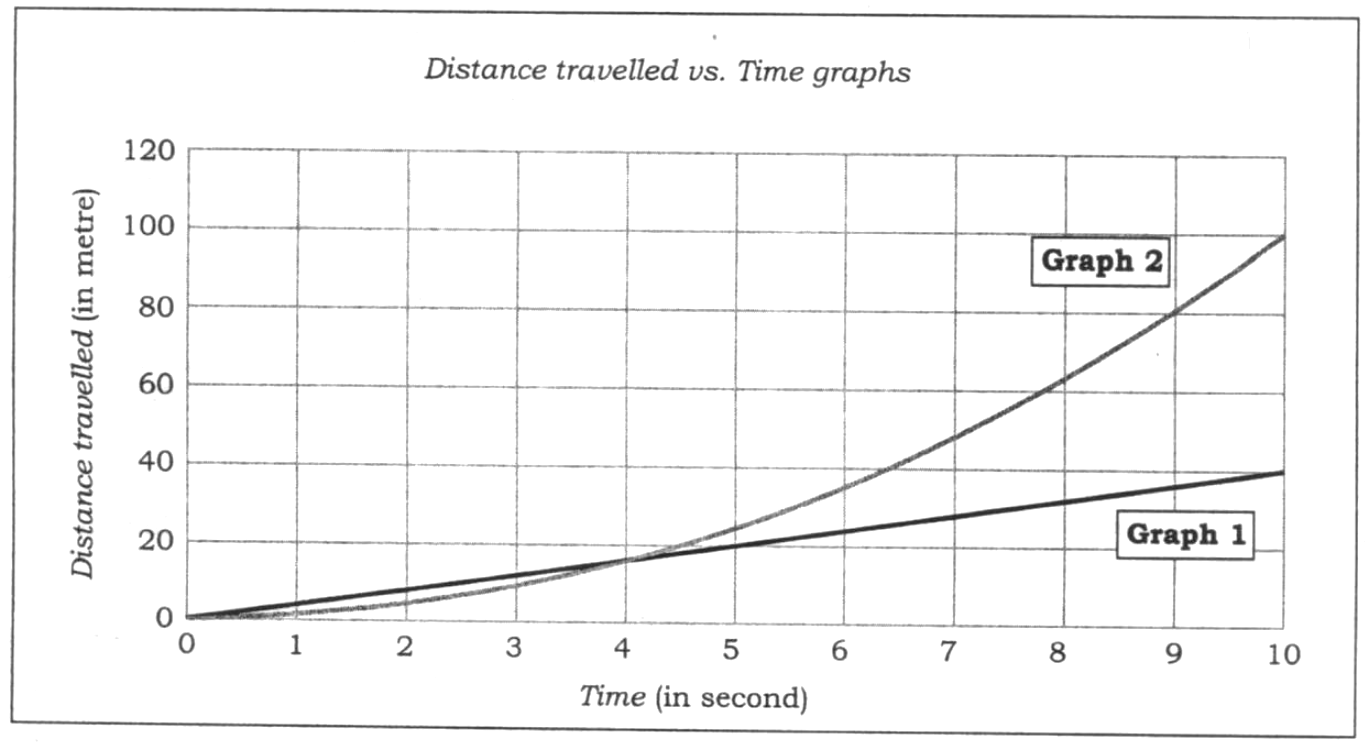
(i) Graph 1 describes a uniform motion.
(ii) Graph 2 describes a uniform circular motion.
(iii) Graph 1 describes a motion with a constant speed of 4 m/s.
(iv) Graph 2 describes a motion with a variable speed.
Select the correct statement (statements) using the codes given below.
- AOnly (i)
- B(i) and (ii)
- COnly (i) and (iii)
- D(i), (iii) and (iv)
Show answer and explanationHide answer
Answer(D) (i), (iii) and (iv)
Explanation
1. Graph 1 is a straight line through the origin, so equal distances are covered in equal times: uniform motion, statement (i) true.
2. Its slope gives the speed: it passes about 15-16 m at 4 s, i.e. about 4 m/s, which is what statement (iii) intends.
3. Graph 2 is a curve that gets steeper (about 16 m at 4 s, about 97 m at 10 s), so its speed keeps increasing: variable speed, statement (iv) true.
4. The motion is one-dimensional, and uniform circular motion has constant speed, which would give a straight distance-time line, not a curve, so (ii) is false.
5. True set = (i), (iii), (iv): option (D).
- (A) Only (i): wrong. It leaves out (iv), which is clearly true because the slope of Graph 2 keeps increasing.
- (B) (i) and (ii): wrong. (ii) is false: the question is about one-dimensional motion, and a curved distance-time graph means changing speed, while uniform circular motion has constant speed.
- (C) Only (i) and (iii): wrong. It leaves out (iv), which is true.
- (D) (i), (iii) and (iv): correct. Graph 1 is uniform motion at about 4 m/s; Graph 2 has variable (increasing) speed.
For future exams
- Distance-time graph rule: straight sloping line = uniform speed (speed = slope = distance / time); curve bending upward = speed increasing; flat line = object at rest.
- In uniform circular motion the speed is constant but the direction (and so the velocity) changes every moment, so it is accelerated motion.
Micro topic Distance-time graph interpretationChapter Science & Tech
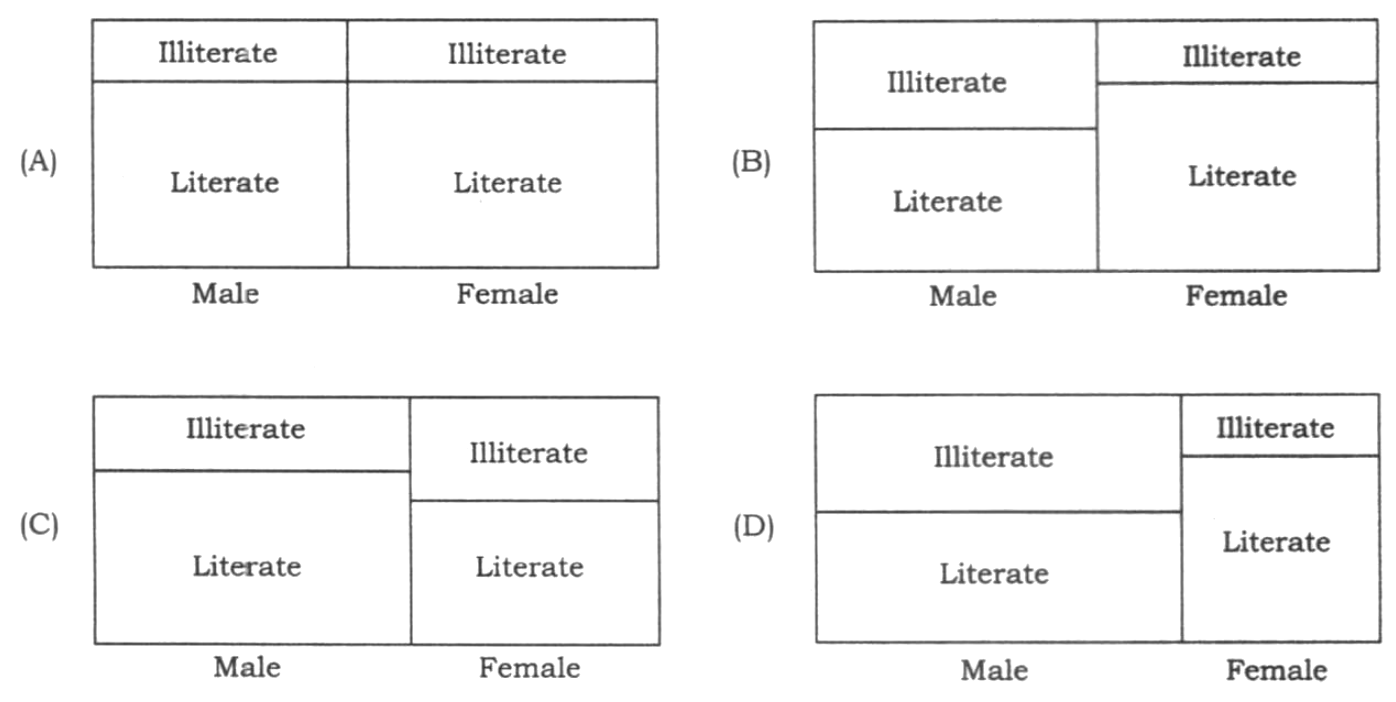
In the figures below, the outer box represents the population of Assam as per 2011 Census. Its left subdivision represents the male population while the right one represents the female population. The male and female boxes are further subdivided topwise and bottomwise to represent the illiterate and literate population of the respective sexes. Which one of the following is closest to the actual data?
- ADiagram (A) in the figure above
- BDiagram (B) in the figure above
- CDiagram (C) in the figure above
- DDiagram (D) in the figure above
Show answer and explanationHide answer
Answer(C) Male box wider with a thin Illiterate band; Female box narrower with a taller Illiterate band
Explanation
Census 2011 gives Assam 3,12,05,576 people: 1,59,39,443 males and 1,52,66,133 females (sex ratio 958; females 48.92 percent of the total). So the Male box must be slightly wider than the Female box. Literacy was 77.85 percent for males and 66.27 percent for females, so a larger share of females are illiterate and the Female box needs the taller Illiterate band. Only figure (C) shows both features.
- (A) wrong. It draws the Male box narrower than the Female box and gives both sexes the same thin Illiterate band, but males outnumber females (sex ratio 958) and female literacy (66.27 percent) is well below male literacy (77.85 percent).
- (B) wrong. The two boxes are about equal in width, and it gives males the taller Illiterate band, the opposite of the data.
- (C) correct. Male box wider; Male Illiterate band thinner than the Female Illiterate band, matching male literacy 77.85 percent vs female 66.27 percent.
- (D) wrong. It makes the Male box far too wide (about two-thirds of the total) and gives males a much taller Illiterate band than females, the reverse of the census data.
For future exams
- Census literacy rates are worked out on the population aged 7 and above (Assam 2011: 72.19 percent), so children aged 0-6 are left out of the rate.
- Assam 2011: the gender gap in literacy was about 11.6 percentage points (male 77.85 minus female 66.27); the sex ratio was 958 females per 1,000 males.
Micro topic Assam 2011 census literacy by sexChapter Assam Geography
Consider the statement and the conclusions given below : Statement : All members of the Chowdhury family of Junagarh are honest. Deepika is an honest girl. Conclusions : (i) Deepika lives in Junagarh. (ii) All honest persons are girls. Choose the correct option.
- AOnly conclusion (i) follows
- BOnly conclusion (ii) follows
- CBoth conclusion (i) and conclusion (ii) follow
- DNeither conclusion (i) nor conclusion (ii) follows
Show answer and explanationHide answer
Answer(D) Neither conclusion (i) nor conclusion (ii) follows
Explanation
1. The statement says: every member of the Chowdhury family of Junagarh is honest. It does not say that every honest person is from that family.
2. Deepika is honest, but she may or may not be a member of that family, and the statement says nothing about where she lives, so (i) does not follow.
3. One honest girl does not make all honest persons girls; family members can be honest men, so (ii) does not follow.
4. Neither follows.
- (A) Only (i): wrong. 'All family members are honest' cannot be reversed to 'all honest people are family members', so Deepika's home is unknown.
- (B) Only (ii): wrong. One example (Deepika) cannot prove a rule about all honest persons.
- (C) Both: wrong. Neither conclusion is supported.
- (D) Neither: correct. Both conclusions go beyond the statement.
For future exams
- 'All A are B' does not mean 'All B are A': all family members are honest, but not all honest people are family members.
- A single case never proves a universal ('all') conclusion.
Micro topic Family honesty conclusionsChapter Statement & Conclusion
What APSC asks in CSAT
Questions by area, CCE 2020 to 2025
400 questions from 5 papers of 80 each. Tap an area to see its questions.
Papers and syllabus
FAQ
APSC CSAT PYQs: questions students ask
Which APSC CSAT papers are included?
General Studies Paper II (CSAT) of the APSC CCE Prelims 2020, 2022, 2023, 2024 and 2025: 80 questions from each paper, 400 in all. The question numbers follow the booklets CCE 2020 Series C, CCE 2022 Series D, CCE 2023 Series A, CCE 2024 Series A, CCE 2025 Series A. The CCE 2025 paper, held in 2026, is the one students call the 2026 CSAT paper.
Is CSAT qualifying in APSC Prelims?
Yes. CSAT (Paper II) has 80 questions for 200 marks. It is qualifying: you need 33% in it, and only then are your GS Paper I marks counted for the Mains merit list.
Which CSAT topics does APSC ask most?
Across the five papers: Logical Reasoning & Mental Ability (132), Basic Numeracy (78), Comprehension (73). Use the area filter or the bars above to practise one area at a time.
Are the answers official?
Answers follow the APSC answer key (CCE 2022: final key; the other papers: the APSC provisional key, the only Paper II key we have for those exams). 21 questions carry an answer-key note: where the key was wrong or the question had an error, the note under the answer explains which answer to mark and why.
How do I practise CSAT here?
Choose an area, a paper or a question type, then switch to Practise: one question at a time, tap an option and see at once whether you are right, with the worked solution. Your record stays only in this browser on this device.