
Free for every APSC aspirant · no sign-up
APSC CSAT PYQs with Answers Prelims GS Paper II, CCE 2020 to 2025, with worked solutions
All 400 questions of the last five APSC Prelims CSAT papers, including the 2026 question paper (CCE 2025): reasoning, maths, passages, data and decision making, each with the answer and a step-by-step solution. CSAT is qualifying: you need 33% to have your GS Paper I marks counted.
Consider the following statements in respect of the two distance travelled vs. time graphs for one-dimensional motion of objects :
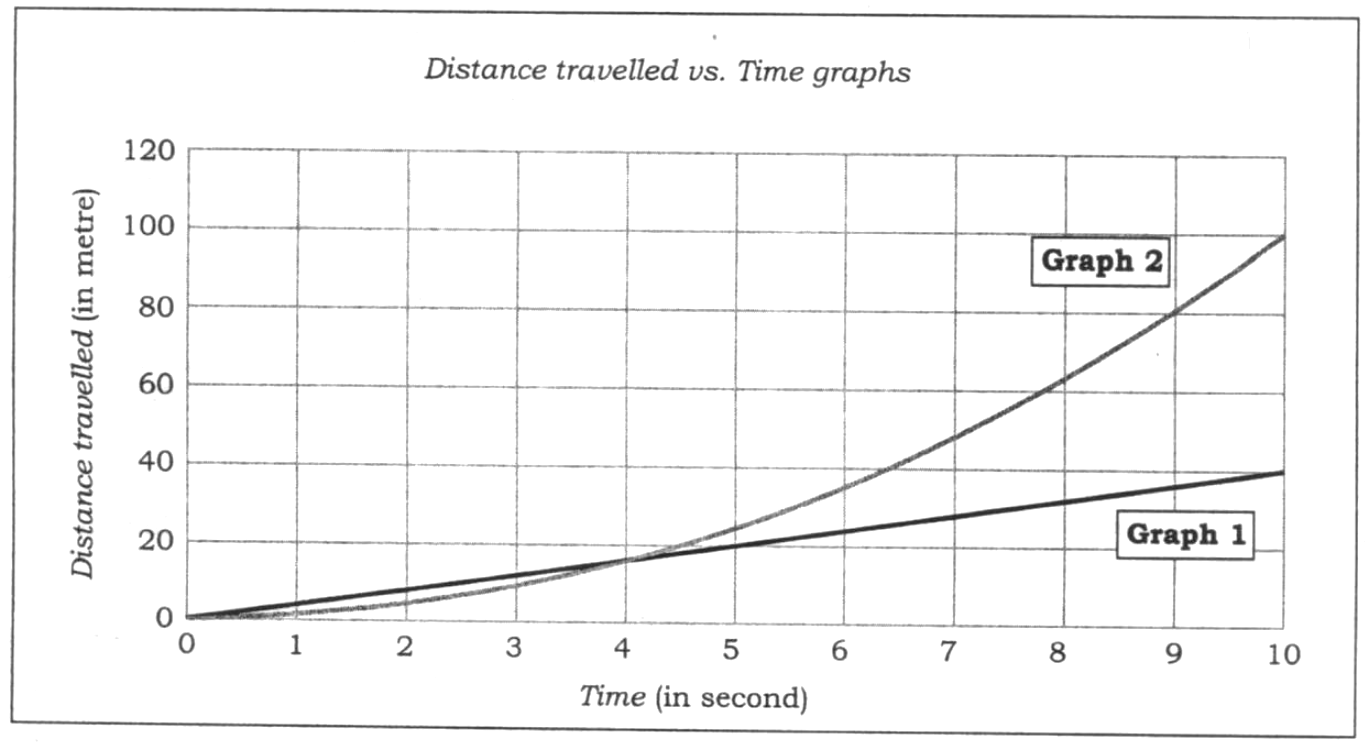
(i) Graph 1 describes a uniform motion.
(ii) Graph 2 describes a uniform circular motion.
(iii) Graph 1 describes a motion with a constant speed of 4 m/s.
(iv) Graph 2 describes a motion with a variable speed.
Select the correct statement (statements) using the codes given below.
- AOnly (i)
- B(i) and (ii)
- COnly (i) and (iii)
- D(i), (iii) and (iv)
Show answer and explanationHide answer
Answer(D) (i), (iii) and (iv)
Explanation
1. Graph 1 is a straight line through the origin, so equal distances are covered in equal times: uniform motion, statement (i) true.
2. Its slope gives the speed: it passes about 15-16 m at 4 s, i.e. about 4 m/s, which is what statement (iii) intends.
3. Graph 2 is a curve that gets steeper (about 16 m at 4 s, about 97 m at 10 s), so its speed keeps increasing: variable speed, statement (iv) true.
4. The motion is one-dimensional, and uniform circular motion has constant speed, which would give a straight distance-time line, not a curve, so (ii) is false.
5. True set = (i), (iii), (iv): option (D).
- (A) Only (i): wrong. It leaves out (iv), which is clearly true because the slope of Graph 2 keeps increasing.
- (B) (i) and (ii): wrong. (ii) is false: the question is about one-dimensional motion, and a curved distance-time graph means changing speed, while uniform circular motion has constant speed.
- (C) Only (i) and (iii): wrong. It leaves out (iv), which is true.
- (D) (i), (iii) and (iv): correct. Graph 1 is uniform motion at about 4 m/s; Graph 2 has variable (increasing) speed.
For future exams
- Distance-time graph rule: straight sloping line = uniform speed (speed = slope = distance / time); curve bending upward = speed increasing; flat line = object at rest.
- In uniform circular motion the speed is constant but the direction (and so the velocity) changes every moment, so it is accelerated motion.
Micro topic Distance-time graph interpretationChapter Science & Tech
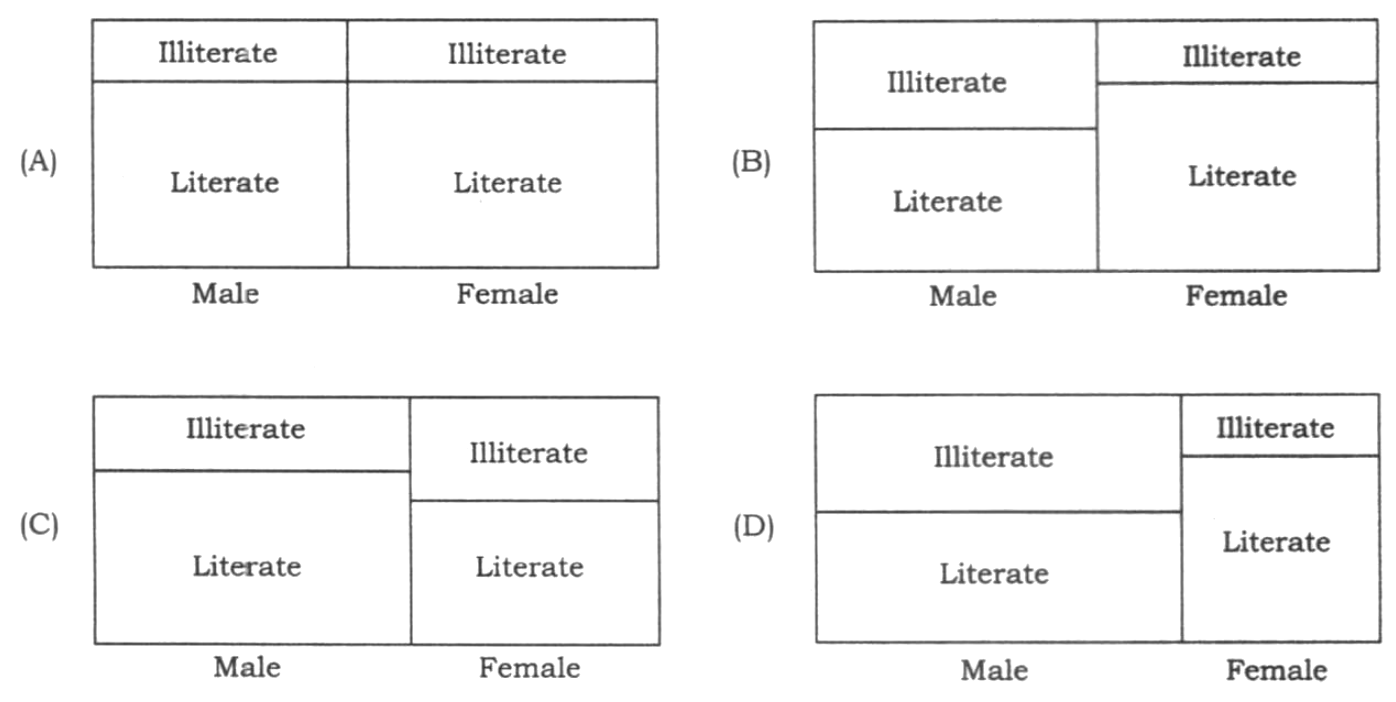
In the figures below, the outer box represents the population of Assam as per 2011 Census. Its left subdivision represents the male population while the right one represents the female population. The male and female boxes are further subdivided topwise and bottomwise to represent the illiterate and literate population of the respective sexes. Which one of the following is closest to the actual data?
- ADiagram (A) in the figure above
- BDiagram (B) in the figure above
- CDiagram (C) in the figure above
- DDiagram (D) in the figure above
Show answer and explanationHide answer
Answer(C) Male box wider with a thin Illiterate band; Female box narrower with a taller Illiterate band
Explanation
Census 2011 gives Assam 3,12,05,576 people: 1,59,39,443 males and 1,52,66,133 females (sex ratio 958; females 48.92 percent of the total). So the Male box must be slightly wider than the Female box. Literacy was 77.85 percent for males and 66.27 percent for females, so a larger share of females are illiterate and the Female box needs the taller Illiterate band. Only figure (C) shows both features.
- (A) wrong. It draws the Male box narrower than the Female box and gives both sexes the same thin Illiterate band, but males outnumber females (sex ratio 958) and female literacy (66.27 percent) is well below male literacy (77.85 percent).
- (B) wrong. The two boxes are about equal in width, and it gives males the taller Illiterate band, the opposite of the data.
- (C) correct. Male box wider; Male Illiterate band thinner than the Female Illiterate band, matching male literacy 77.85 percent vs female 66.27 percent.
- (D) wrong. It makes the Male box far too wide (about two-thirds of the total) and gives males a much taller Illiterate band than females, the reverse of the census data.
For future exams
- Census literacy rates are worked out on the population aged 7 and above (Assam 2011: 72.19 percent), so children aged 0-6 are left out of the rate.
- Assam 2011: the gender gap in literacy was about 11.6 percentage points (male 77.85 minus female 66.27); the sex ratio was 958 females per 1,000 males.
Micro topic Assam 2011 census literacy by sexChapter Assam Geography
Directions for Q1 and Q2HideShow
Make in India campaign was launched in New Delhi on 25th of September in 2014. It is an initiative to make a call to the top business investors all across the world to invest in India. It is a big opportunity to all the investors to set up their business in any field in the country. This plan has very attractive proposals for the foreign companies to set up manufacturing powerhouses in India. Make in India campaign launched by the Indian government focuses on building the effective physical infrastructure as well as improving the market of digital network in the country to make it a global hub for business (ranging from satellites to submarines, cars to softwares, pharmaceuticals to ports, paper to power, etc.). The symbol, derived from National Emblem of India, of this initiative is a giant lion having many wheels, indicating peaceful progress, a vibrant future, courage, strength, tenacity and wisdom.
This campaign focuses on creating a number of valuable and honoured jobs as well as skill enhancement in almost 25 sectors for improving the status of youths of the country. The sectors involved are automobiles, chemicals, IT & BPM, aviation, pharmaceuticals, construction, electrical machinery, food processing, defence manufacturing, space, textiles, garments, ports, leather, media and entertainment, wellness, tourism and hospitality, railways, automobile components, renewable energy, mining, biotechnology, roads and highways, electronic systems and thermal power.
The successful implementation of this plan will help in the creation of 100 smart cities project and affordable housing in India. The main objective is to ensure solid growth and valuable employment creation in the country with the help of top investors. It will benefit both parties, the investors and our country. The Government of India has created a dedicated help team and an online portal (makeinindia.com) for the easy and effective communication of investors.
What is the main objective of the ‘Make in India’ campaign?
- AThe main objective is to ensure growth and valuable employment creation in the country with the help of top investors
- BThe main objective is to ensure solid growth and valuable employment creation in the country with the help of top investors
- CThe main objective is to ensure solid growth and valuable employment creation in the country with the help of investors
- DThe main objective is to ensure solid growth and valuable employment creation in the country with the help of foreign investors
Show answer and explanationHide answer
Answer(B) The main objective is to ensure solid growth and valuable employment creation in the country with the help of top investors
Explanation
The passage says: 'The main objective is to ensure solid growth and valuable employment creation in the country with the help of top investors.' Option (B) copies this sentence exactly. Each other option changes one word.
- (A) ...growth... with the help of top investors: wrong. It drops the word 'solid' that the passage uses.
- (B) ...solid growth... with the help of top investors: correct. It matches the passage word for word.
- (C) ...solid growth... with the help of investors: wrong. It drops 'top'; the passage speaks of top investors.
- (D) ...solid growth... with the help of foreign investors: wrong. The passage says 'top investors', not 'foreign investors'.
For future exams
- Make in India was launched on 25 September 2014 under Prime Minister Narendra Modi; the Ministry of Commerce and Industry is the key ministry.
- Its stated targets were manufacturing growth of 12-14% a year, 100 million additional manufacturing jobs by 2022, and a 25% share of manufacturing in GDP (target year later moved to 2025).
- The original initiative focused on 25 sectors.
Micro topic Make in India objectiveChapter Economy
Same directions as aboveHideShow
Make in India campaign was launched in New Delhi on 25th of September in 2014. It is an initiative to make a call to the top business investors all across the world to invest in India. It is a big opportunity to all the investors to set up their business in any field in the country. This plan has very attractive proposals for the foreign companies to set up manufacturing powerhouses in India. Make in India campaign launched by the Indian government focuses on building the effective physical infrastructure as well as improving the market of digital network in the country to make it a global hub for business (ranging from satellites to submarines, cars to softwares, pharmaceuticals to ports, paper to power, etc.). The symbol, derived from National Emblem of India, of this initiative is a giant lion having many wheels, indicating peaceful progress, a vibrant future, courage, strength, tenacity and wisdom.
This campaign focuses on creating a number of valuable and honoured jobs as well as skill enhancement in almost 25 sectors for improving the status of youths of the country. The sectors involved are automobiles, chemicals, IT & BPM, aviation, pharmaceuticals, construction, electrical machinery, food processing, defence manufacturing, space, textiles, garments, ports, leather, media and entertainment, wellness, tourism and hospitality, railways, automobile components, renewable energy, mining, biotechnology, roads and highways, electronic systems and thermal power.
The successful implementation of this plan will help in the creation of 100 smart cities project and affordable housing in India. The main objective is to ensure solid growth and valuable employment creation in the country with the help of top investors. It will benefit both parties, the investors and our country. The Government of India has created a dedicated help team and an online portal (makeinindia.com) for the easy and effective communication of investors.
An outcome of the ‘Make in India’ campaign is
- Amanufacturing hubs in neighbouring countries
- Bto focus only on digitalisation
- Ccreation of smart cities in India
- Dto lay down strict and rigid guidelines to start a business
Show answer and explanationHide answer
Answer(C) creation of smart cities in India
Explanation
The passage says the successful implementation of the plan 'will help in the creation of 100 smart cities project and affordable housing in India'. So the creation of smart cities is the outcome it names. The other options are not in the passage or go against it.
- (A) Manufacturing hubs in neighbouring countries: wrong. The campaign invites companies to set up manufacturing powerhouses in India, not in other countries.
- (B) To focus only on digitalisation: wrong. The passage says it focuses on physical infrastructure as well as the digital network, across about 25 sectors.
- (C) Creation of smart cities in India: correct. The passage says it will help create the 100 smart cities project and affordable housing.
- (D) Strict and rigid guidelines to start a business: wrong. The passage speaks of attractive proposals, a dedicated help team and an online portal to make investing easy.
For future exams
- Make in India was launched on 25 September 2014 under Prime Minister Narendra Modi.
- One of its targets was a 25% share of manufacturing in GDP (first by 2022, later moved to 2025). Ten years on, the share was about where it had been in 2013-14 (roughly 16-17% by different estimates), so the target was not met.
- The initiative began with 25 sectors; its 'Make in India 2.0' phase covers 27 sectors.
Micro topic Make in India outcomeChapter Economy
Choose the correct pair in which the words bear a general relationship.
- AAssam : Palash
- BKerala : Lotus
- CGujarat : Marigold
- DManipur : Glory Lily
Show answer and explanationHide answer
Answer(C) Gujarat : Marigold
Explanation
The pairs link a state with its state flower. The marigold (Tagetes erecta, Gujarati 'Galgota') is the state flower of Gujarat. In each of the other pairs the flower belongs to a different state.
- (A) Assam : Palash: wrong. Assam's state flower is the Foxtail Orchid (Kopou phul), as listed on the Assam government's state symbols page. Palash (Butea monosperma) is the state flower of Jharkhand, Madhya Pradesh and Uttar Pradesh.
- (B) Kerala : Lotus: wrong. Kerala's state flower is the Golden Shower (Kanikonna, Cassia fistula), the flower used for Vishu Kani. The lotus is the state flower of Haryana and Karnataka.
- (C) Gujarat : Marigold: correct. Marigold (Tagetes erecta) is Gujarat's state flower.
- (D) Manipur : Glory Lily: wrong. Manipur's state flower is the Shirui (Siroi) Lily (Lilium mackliniae), declared in 1989. The Glory Lily (Gloriosa superba) is the state flower of Tamil Nadu.
For future exams
- Assam's other state symbols: State Tree Hollong (Dipterocarpus macrocarpus), State Animal one-horned rhinoceros, State Bird White-winged wood duck (Deo haah), State Dance Bihu Dance.
- The Shirui Lily grows only on the Shirui Hills of Ukhrul district, Manipur; the state holds a Shirui Lily Festival to promote it.
Micro topic State symbol general relationshipChapter General Knowledge
Given below are two statements labeled as Assertion (A) and Reason (R) : Assertion (A) : Diamonds are used for cutting glass. Reason (R) : Diamond has high refractive index. Which of the following options is correct?
- AA is true but R is false
- BA is false but R is true
- CBoth A and R are true and R is the correct explanation of A
- DBoth A and R are true and R is not the correct explanation of A
Show answer and explanationHide answer
Answer(D) Both A and R are true and R is not the correct explanation of A
Explanation
Diamond is the hardest natural material (10 on the Mohs scale), so its sharp edge can scratch and cut glass, which is much softer. Diamond also has a high refractive index (about 2.42), but that is an optical property: it explains the sparkle (brilliance) of a cut diamond, not its use in cutting glass.
- A: true. Diamond-tipped tools are used to cut glass because diamond is the hardest natural substance (Mohs hardness 10); a harder material scratches a softer one.
- R: true. Diamond's refractive index is about 2.42 (2.417 for sodium light), which is high.
- R does not explain A: cutting depends on hardness, which comes from carbon atoms held tightly by strong covalent bonds in a rigid network. Refractive index only tells how much light bends and explains the brilliance of a cut diamond. So the code is (D).
For future exams
- Hardness is measured on the Mohs scale (made by Friedrich Mohs in 1812): a harder mineral scratches a softer one; diamond is 10, the top of the scale.
- Diamond's high refractive index and dispersion make a cut diamond look brighter and more colourful than glass cut the same way.
Micro topic Diamond used for cutting glassChapter Science & Tech
Arrange the following rulers in a meaningful order :
1. Queen Victoria
2. Swargadeo Rudra Singha
3. Chhatrapati Shivaji Maharaj
4. Emperor Bahadur Shah Zafar
5. Czar Nicholas II
Choose the correct answer.
- A3, 2, 4, 1, 5
- B1, 2, 3, 4, 5
- C3, 2, 5, 1, 4
- D3, 5, 1, 4, 2
Show answer and explanationHide answer
Answer(A) 3, 2, 4, 1, 5
Explanation
The 'meaningful order' is the time order (chronology) of the rulers. Chhatrapati Shivaji Maharaj (born 1630, crowned 1674, died 1680) comes first. Swargadeo Rudra Singha ruled the Ahom kingdom from 1696 to 1714. Emperor Bahadur Shah Zafar (born 1775) was the last Mughal emperor (1837 to 1857). Queen Victoria (born 1819) reigned from 1837 to 1901. Czar Nicholas II of Russia (born 1868) reigned from 1894 to 1917. By birth year and by the end of rule the order is 3, 2, 4, 1, 5.
- (A) 3, 2, 4, 1, 5: correct. Shivaji (died 1680), Rudra Singha (died 1714), Bahadur Shah Zafar (rule ended 1857), Queen Victoria (died 1901), Nicholas II (rule ended 1917).
- (B) 1, 2, 3, 4, 5: wrong. It puts Queen Victoria (19th century) before Shivaji and Rudra Singha (17th and early 18th century).
- (C) 3, 2, 5, 1, 4: wrong. It puts Nicholas II (1894 to 1917) before Victoria and Bahadur Shah Zafar, who both began to rule in 1837.
- (D) 3, 5, 1, 4, 2: wrong. It puts Rudra Singha (1696 to 1714) last, after rulers of the 19th and 20th centuries.
For future exams
- Rudra Singha (Sukhrungphaa) ruled 1696 to 1714; the Rudreswar Temple in North Guwahati marks the place where he died, and his son Pramatta Singha built it in 1749.
- Bahadur Shah Zafar became emperor on 28 September 1837 and his rule ended on 21 September 1857, during the Revolt of 1857.
- Queen Victoria took the title Empress of India on 1 May 1876.
Micro topic Chronological order of rulersChapter General Knowledge
What APSC asks in CSAT
Questions by area, CCE 2020 to 2025
400 questions from 5 papers of 80 each. Tap an area to see its questions.
Papers and syllabus
FAQ
APSC CSAT PYQs: questions students ask
Which APSC CSAT papers are included?
General Studies Paper II (CSAT) of the APSC CCE Prelims 2020, 2022, 2023, 2024 and 2025: 80 questions from each paper, 400 in all. The question numbers follow the booklets CCE 2020 Series C, CCE 2022 Series D, CCE 2023 Series A, CCE 2024 Series A, CCE 2025 Series A. The CCE 2025 paper, held in 2026, is the one students call the 2026 CSAT paper.
Is CSAT qualifying in APSC Prelims?
Yes. CSAT (Paper II) has 80 questions for 200 marks. It is qualifying: you need 33% in it, and only then are your GS Paper I marks counted for the Mains merit list.
Which CSAT topics does APSC ask most?
Across the five papers: Logical Reasoning & Mental Ability (132), Basic Numeracy (78), Comprehension (73). Use the area filter or the bars above to practise one area at a time.
Are the answers official?
Answers follow the APSC answer key (CCE 2022: final key; the other papers: the APSC provisional key, the only Paper II key we have for those exams). 21 questions carry an answer-key note: where the key was wrong or the question had an error, the note under the answer explains which answer to mark and why.
How do I practise CSAT here?
Choose an area, a paper or a question type, then switch to Practise: one question at a time, tap an option and see at once whether you are right, with the worked solution. Your record stays only in this browser on this device.