
Free for every APSC aspirant · no sign-up
APSC CSAT PYQs with Answers Prelims GS Paper II, CCE 2020 to 2025, with worked solutions
All 400 questions of the last five APSC Prelims CSAT papers, including the 2026 question paper (CCE 2025): reasoning, maths, passages, data and decision making, each with the answer and a step-by-step solution. CSAT is qualifying: you need 33% to have your GS Paper I marks counted.
Study the given pie charts and answer the question : [Pie chart 1, Sources of Funds for the School: Government 12%, Internal Sources 15%, Donations 35%, NGOs 38%. Pie chart 2, Use of Funds by the School: Payment 11%, Reserved 33%, School Maintenance 30%, Scholarship 26%.] If the scholarship has to be paid out of the donations fund, then what is the percentage of donations fund used for this purpose? The entire funds that the school gets from different sources is Rs 10 lakhs.
- A75.25%
- B74.29%
- C72.15%
- D80.25%
Show answer and explanationHide answer
Answer(B) 74.29%
Explanation
1. Total funds = ₹10 lakh.
2. Donations = 35% of 10 lakh = ₹3.5 lakh (first pie chart).
3. Scholarship = 26% of 10 lakh = ₹2.6 lakh (second pie chart).
4. Share of donations used = . Answer: 74.29%.
- (A) 75.25%: wrong. It would need scholarship of about ₹2.63 lakh; is 74.29%, not 75.25%.
- (B) 74.29%: correct. .
- (C) 72.15%: wrong. Close in size but does not match .
- (D) 80.25%: wrong. It would need scholarship to be about 28% of total funds, not 26%.
For future exams
- Shortcut: both pie charts are on the same base (₹10 lakh), so the rupee amounts are not needed; simply divide the two percentages: .
- Quick estimate: is a little under 75% (), which leaves only 74.29%.
Micro topic Pie chart percentage of fundsChapter Data Interpretation
Looking up towards the sky, David realized that the vast majority of swans flying above are blue in colour. Which of the following can David logically conclude?
- AThere is a blue swan.
- BThere is a white swan.
- CNot everything that is blue is a swan.
- DNone of the above conclusions is satisfactory
Show answer and explanationHide answer
Answer(A) There is a blue swan.
Explanation
1. David sees that the vast majority of the swans flying above are blue.
2. A 'vast majority' of a group cannot be zero, so at least one swan he saw is blue.
3. So he can conclude that there is a blue swan.
4. Nothing is said about the colour of the remaining swans or about other blue things.
- (A) There is a blue swan: correct. If most of the swans are blue, at least one blue swan exists.
- (B) There is a white swan: wrong. The colour of the remaining swans is not given; white is never mentioned.
- (C) Not everything that is blue is a swan: wrong. It may be true in real life, but the statement says nothing about blue things other than swans.
- (D) None of the above is satisfactory: wrong. (A) follows directly from the statement.
For future exams
- In logic questions, answer only from the given statement, not from general knowledge (real swans are not blue, but that does not matter here).
- 'Most', 'majority' and 'some' all guarantee at least one member; 'most' tells us nothing definite about the rest.
Micro topic Inference from majority of swansChapter Logical Reasoning
Rohit has a few cricket trophies that he placed in three different display boxes—Left, Centre and Right. Each box has space for two trophies. The Ranji is kept in the Right box. Nayudu and Premier are in the next one near the box with World. The Vizzy is kept in the Left box. The World is in the same box as Vizzy. In which box should he place the Champions?
- ARight box
- BCentre box
- CLeft box
- DAll are already full
Show answer and explanationHide answer
Answer(A) Right box
Explanation
1. Each box holds two trophies, so there are six places in all.
2. Vizzy is in the Left box, and World is with Vizzy, so Left has Vizzy and World (full).
3. Nayudu and Premier are in the box next to the box with World. The only box next to Left is Centre, so Centre has Nayudu and Premier (full).
4. Right has Ranji and one empty place.
5. So Champions goes in the Right box.
- (A) Right box: correct. Right has only Ranji, so one place is free.
- (B) Centre box: wrong. Centre is full with Nayudu and Premier.
- (C) Left box: wrong. Left is full with Vizzy and World.
- (D) All are already full: wrong. Five trophies are placed in six spaces, so one space (in Right) is free.
For future exams
- Method: place the fixed items first (Ranji, Vizzy), then the linked items (World with Vizzy), then the relative ones ('next to').
- Count spaces against items: 3 boxes x 2 = 6 spaces, 5 trophies placed, so exactly one space is left.
Micro topic Trophy box arrangementChapter Logical Reasoning
“Doramian students were right in 1995 to stage protests demanding that the university education should be made free.” Which of the following assumptions is not required for acceptance of the above situation?
- ACitizens of Doramy have the freedom to stage protests.
- BUniversities of Doramy are not fully state funded, and hence they charge fee from students.
- CDoramian universities accept enrollment of students from other countries.
- DStudents of Doramy were not happy that the university education in their country was not free.
Show answer and explanationHide answer
Answer(C) Doramian universities accept enrollment of students from other countries.
Explanation
1. The claim is that Doramian students were right to protest in 1995 for free university education.
2. For this to make sense, students must be able to protest (A), university education must not have been free, so fees were charged (B), and students must have been unhappy about it (D).
3. Whether foreign students can enrol has nothing to do with whether Doramian students were right to demand free education.
4. So (C) is the assumption that is not required.
- (A) Citizens of Doramy have the freedom to stage protests: required. Calling a protest 'right' assumes protest is a permitted way to raise a demand.
- (B) Universities are not fully state funded and charge fees: required. A demand to make education free makes sense only if it was not already free.
- (C) Universities accept foreign students: not required, so this is the answer. The admission of foreign students has no link to the demand for free education.
- (D) Students were unhappy that education was not free: required. The protest itself shows this dissatisfaction.
For future exams
- An assumption is an unstated idea that must be true for the statement to make sense. Test it by negation: if denying the option breaks the statement, it is required.
- Here, denying (C) (no foreign students) leaves the statement unchanged, so (C) is not a required assumption.
Micro topic Assumption in an argumentChapter Logical Reasoning
In a sale, the following lots are to be placed :
| Lot | Brand | Product | Price (INR) |
|---|---|---|---|
| 1 | Maximus | Filter | 10,000 |
| 2 | Desdem | Fryer | 7,000 |
| 3 | Romulus | Filter | 6,000 |
| 4 | Ignis | Heater | 4,500 |
| 5 | Florice | Fryer | 17,500 |
If the lots are placed by product, then by brand, in alphabetical order, then what would be the price of buying one item from the lot placed at the fourth position and one item from the lot placed at the second position?
- AINR 21,500
- BINR 17,500
- CINR 23,500
- DINR 24,500
Show answer and explanationHide answer
Answer(C) INR 23,500
Explanation
1. Sort by product in alphabetical order: Filter, Fryer, Heater.
2. Within each product, sort by brand: Filter: Maximus, Romulus. Fryer: Desdem, Florice. Heater: Ignis.
3. Positions: 1 Maximus Filter (10,000), 2 Romulus Filter (6,000), 3 Desdem Fryer (7,000), 4 Florice Fryer (17,500), 5 Ignis Heater (4,500).
4. Fourth + second = 17,500 + 6,000 = INR 23,500.
- (A) INR 21,500: wrong. No two lots in the table add up to 21,500; the right pair is 17,500 + 6,000.
- (B) INR 17,500: wrong. This is the price of the fourth lot (Florice) only, without adding the second lot.
- (C) INR 23,500: correct. Florice Fryer (17,500) + Romulus Filter (6,000).
- (D) INR 24,500: wrong. This is 17,500 + 7,000, which wrongly takes Desdem Fryer (position 3) as the second lot.
For future exams
- Multi-level sorting: sort fully by the first key (product), and use the second key (brand) only to break ties inside each group.
- Compare alphabetically letter by letter: Filter (F-i) comes before Fryer (F-r); Desdem (D) before Florice (F).
Micro topic Sorting lots by product and brandChapter Logical Reasoning
Based on the question, “In a developing nation like ours, should the Government be engaging more in space exploration research?”, identify which of the following is a weak argument.
- ANo, the money spent on these programmes can be used to increase the funding for education and health care, which would increase quality of life of our country's population.
- BYes, the findings and results of these space exploration programmes have been successfully applied to industry and agriculture, thereby boosting our economy in general.
- CYes, space exploration research being frontier area of research has provided a boost to our military strength.
- DNo, our country has spent too much already, and any further expense would hardly provide any marginal advantage.
Show answer and explanationHide answer
Answer(D) No, our country has spent too much already, and any further expense would hardly provide any marginal advantage.
Explanation
1. A strong argument is directly linked to the question and gives a real, important reason. A weak one is vague, unsupported or only an opinion.
2. (A) gives a clear trade-off: the money could go to education and health, which raises quality of life. Strong.
3. (B) gives a real economic benefit: results used in industry and agriculture. Strong.
4. (C) gives a concrete strategic benefit: space research helps defence. Strong.
5. (D) only says 'too much has been spent' and claims, with no reason, that more spending gives hardly any advantage. It is a bare opinion, so it is the weak argument.
- (A) No, money can go to education and health: strong. It shows a real opportunity cost for a developing nation.
- (B) Yes, results applied to industry and agriculture: strong. It names a definite benefit to the economy.
- (C) Yes, boost to military strength: strong. National security is a valid and important reason.
- (D) No, spent too much already, no marginal advantage: weak, so this is the answer. 'Too much' is vague, and the claim of no further benefit is not backed by any reason.
For future exams
- Strong vs weak arguments: an argument is weak if it is vague, an opinion without a reason, only loosely related to the question, or ignores a clear benefit.
- Both 'Yes' and 'No' arguments can be strong; judge the reason, not the side.
Micro topic Identifying a weak argumentChapter Logical Reasoning
While visiting another planet, our forefathers learnt that 1. Jhummaliya means manpower 2. Plutojhumma means superman 3. Jhummahusa means mankind. In that planet, which of the following words could possibly mean ‘kindhearted’?
- AHusabling
- BPlutoliya
- CHusapluto
- DHusajhumma
Show answer and explanationHide answer
Answer(A) Husabling
Explanation
1. 'Jhumma' is common to all three words, and 'man' is common to all three meanings, so jhumma = man.
2. Then liya = power (Jhummaliya = manpower), pluto = super (Plutojhumma = superman) and husa = kind (Jhummahusa = mankind).
3. The word order follows English: the first part of the English word comes first. 4. 'Kindhearted' = kind + hearted, so it must start with husa and have a new part (not jhumma, liya or pluto) for 'hearted'.
5. Only Husabling fits: husa = kind, bling = hearted.
- (A) Husabling: correct. Husa = kind, and 'bling' is a new part that can stand for 'hearted'.
- (B) Plutoliya: wrong. Pluto = super and liya = power, so it means 'superpower'; it has no 'kind'.
- (C) Husapluto: wrong. Husa = kind but pluto = super, so it would mean 'kind-super', not 'kindhearted'.
- (D) Husajhumma: wrong. Husa = kind and jhumma = man, so it would mean 'kindman'; 'hearted' is not 'man'.
For future exams
- Method: find the part common to two coded words and the word common to their meanings; they match. Then remove known parts to decode the rest. An option that reuses an already-decoded part for a new meaning is wrong.
Micro topic Decoding alien language wordChapter Coding-Decoding
Identify the best suitable choice of words to complete the following sentence : “A _____ cannot exist without _____.”
- Ahorse; saddle
- Bcountry; king
- Cbottle; beverage
- Dchampion; winning
Show answer and explanationHide answer
Answer(D) champion; winning
Explanation
1. The sentence needs a pair in which the first thing cannot exist at all without the second.
2. A champion is, by definition, one who has won (a contest or title); without winning there is no champion.
3. In the other pairs the first thing can exist without the second.
4. So the answer is (D).
- (A) horse; saddle: wrong. A horse exists without a saddle; the saddle is only an accessory for riding.
- (B) country; king: wrong. Many countries have no king (India is a republic); a country does not need a monarch to exist.
- (C) bottle; beverage: wrong. An empty bottle is still a bottle; the beverage is only its content.
- (D) champion; winning: correct. Winning is part of the very meaning of 'champion', so a champion cannot exist without winning.
For future exams
- Shortcut for 'X cannot exist without Y': test each pair by imagining X with no Y. If X still exists (empty bottle, unsaddled horse, kingless country), reject it. Only a necessary, defining link survives.
- Similar pairs: 'author; writing', 'parent; child', 'winner; contest'.
Micro topic Sentence completion word pairChapter Vocabulary & Idioms
Four entities—rhino (Kaziranga), tea (Jorhat), silk (Sualkuchi) and tiger (Manas) are linked to four persons—Priya, Raju, Sumi and Tora. Priya avoids animals, Raju loves fabrics, Sumi studies plants, and Tora tracks wildlife. Who is linked to silk?
- APriya
- BRaju
- CSumi
- DTora
Show answer and explanationHide answer
Answer(B) Raju
Explanation
1. Silk (Sualkuchi) is a fabric; Sualkuchi is a silk-weaving village.
2. Raju loves fabrics, so Raju is linked to silk.
3. The other clues fit other entities: Sumi studies plants, so she fits tea (Jorhat); Tora tracks wildlife, so he fits rhino (Kaziranga) or tiger (Manas).
- (A) Priya: wrong. Her clue (avoids animals) says nothing about fabrics.
- (B) Raju: correct. Silk is a fabric, and Raju loves fabrics.
- (C) Sumi: wrong. She studies plants, which fits tea, not silk.
- (D) Tora: wrong. He tracks wildlife, which fits rhino or tiger.
For future exams
- Method: match each person's clue to the one entity that fits it best; start with clues that have only one possible match (fabrics to silk, plants to tea).
Micro topic Linking persons to entitiesChapter Logical Reasoning
If all Zinks are Winks and no Winks are Pinks, then which of the following statements must be true?
- ASome Zinks are Pinks.
- BNo Zinks are Pinks.
- CAll Pinks are Zinks.
- DSome Winks are not Pinks.
Show answer and explanationHide answer
Answer(B) No Zinks are Pinks.
Explanation
1. All Zinks are inside Winks.
2. No Wink is a Pink, so the Winks circle and the Pinks circle do not touch.
3. Zinks sit inside Winks, so they cannot touch Pinks either.
4. Hence 'No Zinks are Pinks' must be true.
- (A) Some Zinks are Pinks: wrong. This is the opposite of the valid conclusion; Zinks are inside Winks, which are fully separate from Pinks.
- (B) No Zinks are Pinks: correct. All Z are W + No W is P gives No Z is P.
- (C) All Pinks are Zinks: wrong. Pinks and Zinks have no common member at all.
- (D) Some Winks are not Pinks: not the intended answer. It only restates statement 2 in a weaker form (true if Winks exist) and does not link Zinks with Pinks as the question expects.
For future exams
- Rule: 'All A are B' + 'No B is C' gives 'No A is C' (and so also 'Some C are not A').
- In two-statement syllogisms, the asked conclusion usually links the two end terms (here Zinks and Pinks).
Micro topic Syllogism: Zinks, Winks, PinksChapter Syllogism
In a certain village, every person is either a knight or a knave. Knights always speak the truth and knaves always lie. Two villagers, A and B, make the following statements : • A says, “B is a knave.” • B says, “A and I are both knaves.” What are A and B?
- AA is a knight, B is a knave
- BA is a knave, B is a knight
- CBoth are knights
- DBoth are knaves
Show answer and explanationHide answer
Answer(A) A is a knight, B is a knave
Explanation
1. Start with B. B says, "A and I are both knaves." 2. If B were a knight, this true statement would make B a knave. That is impossible, so B is a knave.
3. A knave lies, so "both are knaves" is false. Since B is a knave, A must be a knight.
4. Check A: A says "B is a knave", which is true, and a knight tells the truth. Everything fits. So A is a knight and B is a knave.
- (A) A is a knight, B is a knave: correct. It is the only case where both statements fit the speakers' types.
- (B) A is a knave, B is a knight: wrong. A knight B cannot call himself a knave.
- (C) Both are knights: wrong. B, as a knight, would be telling the truth while calling himself a knave, which is impossible.
- (D) Both are knaves: wrong. Then B's statement "A and I are both knaves" would be true, but a knave cannot say a true thing.
For future exams
- Shortcut: a person who says "I am a knave" (alone or with others in an AND statement) cannot be a knight, so start with that person.
- Test each option against both statements; a single contradiction removes the option.
Micro topic Knights and knaves puzzleChapter Logical Reasoning
In a certain village, two-thirds of the villagers own bicycles, one-fourth of the villagers grow vegetables, one-fifth of the villagers are employed and three-fourths of the villagers are above 30 years of age. Which one of the following statements must certainly be true?
- AAll villagers who own bicycles are employed.
- BSome villagers who are above 30 years of age own bicycles.
- COne-third of the villagers who grow vegetables own bicycles.
- DHalf of the villagers who are employed grow vegetables.
Show answer and explanationHide answer
Answer(B) Some villagers who are above 30 years of age own bicycles.
Explanation
1. Bicycle owners = of the village; people above .
2. Together , which is more than the whole village .
3. So the two groups must overlap by at least of the village.
4. Hence some people above 30 surely own bicycles. Answer (B).
- (A) All bicycle owners are employed: wrong. Bicycle owners are but the employed are only , so all owners cannot be employed.
- (B) Some villagers above 30 own bicycles: correct. , so the groups must overlap (at least of the village).
- (C) One-third of vegetable growers own bicycles: wrong. Nothing fixes this share; since , no overlap is forced, and the share could be anything from none to all.
- (D) Half of the employed grow vegetables: wrong. , so the two groups may not overlap at all; no exact share is forced.
For future exams
- Rule: two groups that are fractions a and b of the same whole must overlap when ; the least overlap is .
- "Must be true" questions: reject any option that gives an exact share (one-third, half, all) unless the data force it.
Micro topic Must-be-true fraction statementsChapter Logical Reasoning
In a group of 100 people, 60 like milk tea, 50 like green tea and 20 like neither. How many people like both milk tea and green tea?
- A10
- B20
- C30
- D40
Show answer and explanationHide answer
Answer(C) 30
Explanation
1. People who like at least one tea = (neither) .
2. Use .
3. , so .
4. Check: only milk tea 30, only green tea 20, both 30, neither 20; total .
- (A) 10: wrong. With 10 in both, at least one tea would be , leaving 0 for 'neither', not 20.
- (B) 20: wrong. This is the 'neither' number, not the overlap; it would give 90 people liking at least one tea.
- (C) 30: correct. like at least one, and neither .
- (D) 40: wrong. It would give only 70 liking at least one tea, so 30 would like neither, not 20.
For future exams
- Two-set rule: . Here .
- Quick check: the overlap can never be more than the smaller set (50) and never less than (here ).
Micro topic Two-set overlap countChapter Sets
What replaces the blank box with a question mark in it?
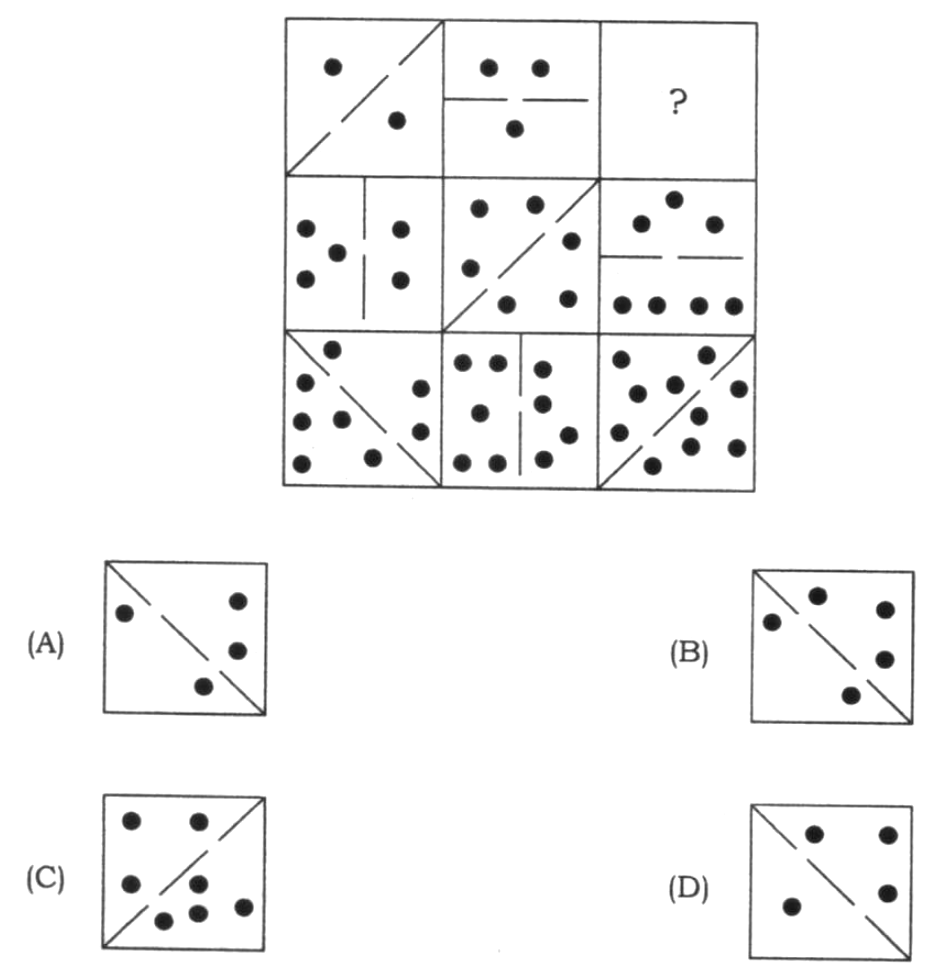
- ADiagram (A) in the figure above
- BDiagram (B) in the figure above
- CDiagram (C) in the figure above
- DDiagram (D) in the figure above
Show answer and explanationHide answer
Answer(D) the box with a \ diagonal, 3 dots above the line (upper-right) and 1 dot below it (lower-left)
Explanation
1. Read the 9 boxes row by row. Dot totals: 2, 3, ?, 5, 6, 7, 8, 9, 10, so the missing box has 4 dots.
2. The dividing line turns clockwise each step: /, —, ?, |, /, —, \, |, /. So the missing box has a \ diagonal.
3. Within each row one side of the line keeps the same number of dots and the other side grows by 1: row 2 has 3 dots fixed on one side and 2, 3, 4 on the other; row 3 has 5 fixed and 3, 4, 5; row 1 has 1 fixed and 1, 2, so the third box needs 1 on the fixed side and 3 on the other.
4. Option (D) has a \ line with 3 dots in the upper-right half and 1 dot in the lower-left half. Answer: (D).
- (A) wrong: it has the \ line and 4 dots, but they are split 2 and 2, not 3 and 1.
- (B) wrong: it has 5 dots; the series needs 4.
- (C) wrong: it has a / line and 7 dots; the series needs a \ line and 4 dots.
- (D) correct: \ line, 4 dots split 3 (upper-right) and 1 (lower-left), which fits the count, the line rotation and the row pattern.
For future exams
- In figure grids, check three things one by one: count of elements, rotation of lines, and position or split of elements.
- When two options pass the count and rotation tests (here A and D), the split of dots on each side decides it.
Micro topic Dice pattern missing figureChapter Non-verbal Reasoning
As an administrator of a city, you received a complaint from a lady that a stranger has rented a house in her neighbourhood and he looks very suspicious. She has never seen him around earlier. He has a strange behaviour and goes out during night at odd hours. People who come to meet him also appear to be of the same type. She is apprehensive that this man might be engaged in some terrorist activities. In such a situation, what would you do?
- AGo to the house and ask the suspected person to give his personal details
- BAsk the lady, who complained, for more details and then act accordingly
- CTell her to keep calm and stop being apprehensive
- DDo nothing because you have no evidence about any unlawful activities of the man
Show answer and explanationHide answer
Answer(B) Ask the lady, who complained, for more details and then act accordingly
Explanation
Principle: take every complaint seriously, but act on facts, not on suspicion alone. The lady's fear is based only on the man's odd hours and visitors, which is not proof of any crime. As administrator you should first gather details from her and then, if there is a real basis, act through the proper channel (for example, the police). This respects both public safety and the man's rights.
- (A) go to the house and ask him for personal details: wrong. Confronting him on mere suspicion is premature, may alert him if he is really a criminal, and may harass an innocent person; checking is the police's job.
- (B) ask the lady for more details and then act accordingly: correct. It takes the complaint seriously and builds facts before any action.
- (C) tell her to keep calm and stop being apprehensive: wrong. It dismisses a possible security concern without checking.
- (D) do nothing because there is no evidence: wrong. An administrator must look into a security complaint; lack of evidence is a reason to verify, not to ignore.
For future exams
- Security-complaint questions: the best answer usually verifies the facts and then involves the proper agency (police); avoid both overreaction (confronting the suspect) and inaction.
Micro topic Handling suspicious neighbour complaintChapter Decision Making
You are in charge of a time-bound infrastructure project in a remote place. During the project review meeting, you find that the project is likely to be delayed on account of lack of cooperation from the team members. In such a situation, you would
- Aask for replacement of team members
- Blook into the reasons for non-cooperation from the team members and try to mitigate them
- Cwarn the team members for their lack of cooperation
- Dask for extension of the project on some pretext
Show answer and explanationHide answer
Answer(B) look into the reasons for non-cooperation from the team members and try to mitigate them
Explanation
Principle: a good leader solves the root cause of a problem. Team members in a remote place may not cooperate because of real problems (living conditions, pay, workload, safety, conflicts). Finding and fixing these reasons restores teamwork and keeps the time-bound project on track.
- (A) ask for replacement of team members: wrong. New people need time to settle in, which causes more delay in a time-bound project, and the cause may remain.
- (B) look into the reasons and try to mitigate them: correct. It fixes the root cause and keeps the existing, trained team.
- (C) warn the team members: weaker. Warnings without knowing the cause can lower morale and deepen non-cooperation.
- (D) ask for extension on some pretext: wrong. Using a false reason is dishonest and unethical, and it does not solve the problem.
For future exams
- Leadership questions: choose 'find the cause and solve it' over replacing, warning or punishing; any option with 'pretext' or deceit is always wrong.
Micro topic Handling non-cooperative team membersChapter Decision Making
Your city is facing severe air pollution on account of vehicular emissions. You have to decide on the most effective policy measure on a short-term basis. What would you do?
- ALaunch a mass reforestation drive across the city
- BBan all private vehicles with immediate effect
- CImplement odd-even vehicle rationing based on license plate
- DMandate electric vehicle (EV) usage for all government employees
Show answer and explanationHide answer
Answer(C) Implement odd-even vehicle rationing based on license plate
Explanation
The question asks for the most effective short-term measure against vehicular pollution. Odd-even rationing can start at once and cuts the number of private vehicles on the road on any day, so emissions fall quickly. It is also practical, because people can still travel on alternate days or by public transport.
- (A) mass reforestation drive: wrong for this question. Trees take years to grow, so it is a long-term measure, and it does not cut vehicle emissions at the source.
- (B) ban all private vehicles with immediate effect: wrong. It is extreme and impractical; it would stop daily life and the public transport system could not carry everyone at once.
- (C) odd-even rationing by licence plate: correct. Quick to implement, directly reduces vehicles on the road, and balanced.
- (D) mandate EVs for all government employees: wrong. Buying EVs takes time and money, and it covers only a small share of vehicles, so its short-term effect is small.
For future exams
- Look for the time words in the question: 'short-term' means quick and practical; 'long-term' points to structural steps like greening, EV shift or better public transport.
- Extreme options ('ban all', 'with immediate effect') are rarely the best administrative answer.
Micro topic Short-term vehicular pollution policyChapter Decision Making
You are a receptionist at the front desk of a hospital. An emergency hit and run accident case has been brought in by some people. What would you do?
- AFirst, complete the admission procedure and then call the doctor on duty
- BCall the doctor on duty and start the admission procedure
- CInform the police and wait for the police to arrive
- DCall the doctor on duty, inform the police, and start the admission procedure
Show answer and explanationHide answer
Answer(D) Call the doctor on duty, inform the police, and start the admission procedure
Explanation
Principle: saving life comes first, and legal duties are done alongside, not before. In an emergency the doctor must be called at once. A hit-and-run is a medico-legal case, so the police must also be informed. The admission paperwork can run in parallel. Option D does all three, with treatment first.
- (A) complete admission first, then call the doctor: wrong. Paperwork before treatment wastes the critical time that can save the patient.
- (B) call the doctor and start admission: incomplete. It leaves out informing the police, which a hit-and-run case requires.
- (C) inform the police and wait for them: wrong. Waiting for the police delays treatment; care must not wait for police formalities.
- (D) call the doctor, inform the police and start admission: correct. It puts the patient's life first and also completes the legal and office duties.
For future exams
- In medical-emergency questions, the right option always starts with immediate treatment; any option that puts paperwork or police before the doctor is wrong.
- If one option contains all the good steps of another plus one more required step, pick the fuller one.
Micro topic Emergency hit and run admissionChapter Decision Making
You are teaching in a class. A student gets up and asks a question, whose answer you are not aware of. What will you do?
- AYou will censure the student for disrupting the proceedings of the class
- BYou will try to answer the question by beating around the bush so that the student may not get the impression of your ignorance about the answer
- CAsk the student a counter-question and ask him to study more
- DTell the student that at the moment you do not know the answer, but you will try to find an answer for him next day
Show answer and explanationHide answer
Answer(D) Tell the student that at the moment you do not know the answer, but you will try to find an answer for him next day
Explanation
Principle: honesty and integrity, plus a commitment to help. A good teacher admits when he does not know, which builds trust and shows students that learning never ends. Promising to find the answer the next day keeps the student's curiosity alive.
- (A) censure the student for disrupting the class: wrong. Asking questions is part of learning; punishing it kills curiosity.
- (B) beat around the bush to hide your ignorance: wrong. It is dishonest and may give the student wrong ideas.
- (C) ask a counter-question and tell him to study more: wrong. It avoids the question and unfairly shifts the burden to the student.
- (D) admit you do not know and promise to find the answer: correct. It is honest, respectful and helpful.
For future exams
- Honesty-based questions: the answer admits the gap and offers a follow-up; options that hide, evade or blame are always wrong.
Micro topic Answering a question you do not knowChapter Decision Making
You have received an e-mail from an unknown source asking you to share your bank account login id and password, and also to update your bank KYC. What will you do?
- AWill not respond to the sender and forward the e-mail to the concerned authority for their perusal and necessary action
- BWill send your bank details immediately so that your account may not be made inoperative
- CWill delete the e-mail and forget about it
- DWill reply to know why they need the bank login id and password
Show answer and explanationHide answer
Answer(A) Will not respond to the sender and forward the e-mail to the concerned authority for their perusal and necessary action
Explanation
A mail from an unknown sender asking for a login id and password is a phishing attempt; genuine banks do not ask for passwords by e-mail. You should never reply or share details. Forwarding it to the concerned authority (your bank or the cyber-crime authority) protects you and helps them warn and protect others.
- (A) do not respond and forward to the concerned authority: correct. It keeps your account safe and helps stop the fraud.
- (B) send your bank details immediately: wrong. This is exactly what the fraudster wants; your money can be stolen.
- (C) delete the e-mail and forget it: weaker. You stay safe, but the fraud goes unreported and others may be cheated.
- (D) reply to ask why they need the details: wrong. Any reply confirms your e-mail is active and invites more fraud.
For future exams
- Rule: never share a password, OTP or PIN with anyone by mail, SMS or phone; report suspicious messages instead of only deleting them.
- In such questions, 'protect yourself and report' beats 'only protect yourself'.
Micro topic Phishing email responseChapter Decision Making
What APSC asks in CSAT
Questions by area, CCE 2020 to 2025
400 questions from 5 papers of 80 each. Tap an area to see its questions.
Papers and syllabus
FAQ
APSC CSAT PYQs: questions students ask
Which APSC CSAT papers are included?
General Studies Paper II (CSAT) of the APSC CCE Prelims 2020, 2022, 2023, 2024 and 2025: 80 questions from each paper, 400 in all. The question numbers follow the booklets CCE 2020 Series C, CCE 2022 Series D, CCE 2023 Series A, CCE 2024 Series A, CCE 2025 Series A. The CCE 2025 paper, held in 2026, is the one students call the 2026 CSAT paper.
Is CSAT qualifying in APSC Prelims?
Yes. CSAT (Paper II) has 80 questions for 200 marks. It is qualifying: you need 33% in it, and only then are your GS Paper I marks counted for the Mains merit list.
Which CSAT topics does APSC ask most?
Across the five papers: Logical Reasoning & Mental Ability (132), Basic Numeracy (78), Comprehension (73). Use the area filter or the bars above to practise one area at a time.
Are the answers official?
Answers follow the APSC answer key (CCE 2022: final key; the other papers: the APSC provisional key, the only Paper II key we have for those exams). 21 questions carry an answer-key note: where the key was wrong or the question had an error, the note under the answer explains which answer to mark and why.
How do I practise CSAT here?
Choose an area, a paper or a question type, then switch to Practise: one question at a time, tap an option and see at once whether you are right, with the worked solution. Your record stays only in this browser on this device.