
Free for every APSC aspirant · no sign-up
APSC CSAT PYQs with Answers Prelims GS Paper II, CCE 2020 to 2025, with worked solutions
All 400 questions of the last five APSC Prelims CSAT papers, including the 2026 question paper (CCE 2025): reasoning, maths, passages, data and decision making, each with the answer and a step-by-step solution. CSAT is qualifying: you need 33% to have your GS Paper I marks counted.
Nowadays, most of the offices have gone paperless to the extent possible because
(i) a paperless office is environment friendly
(ii) paper is very costly nowadays
Choose the correct alternative.
- AOnly (i) is correct
- BOnly (ii) is correct
- CBoth (i) and (ii) are correct
- DNeither (i) nor (ii) is correct
Show answer and explanationHide answer
Answer(A) Only (i) is correct
Explanation
A reason is valid only if it truly explains the action. (i) is valid: going paperless saves paper, so fewer trees are cut and less waste is made; this is a widely stated reason for paperless offices. (ii) is not a valid reason: offices go paperless for speed, easy storage and search, and environmental benefit. Paper prices go up and down, but the cost of paper is not why offices have moved to digital files. So only (i) is correct.
- Reason (i), a paperless office is environment friendly: correct. Less paper use means less tree cutting, less waste and less energy in paper making.
- Reason (ii), paper is very costly nowadays: not correct. The cost of paper is not what drives the move to digital offices; that comes from speed, easy storage and search, and less waste. 'Very costly' is also an exaggerated claim.
- So the code is (A) Only (i). (B) and (C) wrongly accept (ii); (D) wrongly rejects (i).
For future exams
- Reason / argument rule: accept a reason only if it is true in general and directly linked to the action. Reject reasons that are exaggerated ('very costly', 'always', 'never') or only loosely linked.
Micro topic Reasons for paperless officesChapter Statement & Conclusion
The government is encouraging the use of electric vehicles because
(i) fossil fuel will not last forever
(ii) electric vehicles do not cause pollution
Choose the correct alternative.
- AOnly (i) is correct
- BOnly (ii) is correct
- CBoth (i) and (ii) are correct
- DNeither (i) nor (ii) is correct
Show answer and explanationHide answer
Answer(C) Both (i) and (ii) are correct
Explanation
The government's own stated aims for promoting electric vehicles are two: fuel security (less dependence on petrol and diesel) and less pollution. The PIB factsheet on FAME India (11 July 2022) says the National Electric Mobility Mission Plan (NEMMP) 2020 was launched in 2013 'to achieve national fuel security', and that FAME India was launched in 2015 to reduce pollution caused by diesel and petrol vehicles. Reason (i) matches the fuel-security aim (fossil fuels are limited and will not last forever). Reason (ii) matches the pollution aim: an electric vehicle has zero tailpipe emissions. So both reasons explain the policy.
- Reason (i), fossil fuel will not last forever: correct. Petrol and diesel come from limited fossil fuel; NEMMP 2020 aims at national fuel security.
- Reason (ii), electric vehicles do not cause pollution: accepted as a reason. EVs produce zero tailpipe (direct) emissions, and the FAME scheme's stated aim is to reduce pollution from petrol and diesel vehicles. Strictly, power plants that make the electricity can still pollute, so EVs cause less pollution rather than none.
- So the code is (C) Both. (A) and (B) each drop one of the two stated aims; (D) rejects both.
For future exams
- FAME India (Faster Adoption and Manufacturing of (Hybrid &) Electric Vehicles) was launched by the Ministry of Heavy Industries in 2015 under NEMMP 2020 (launched 2013); Phase II began on 1 April 2019.
- All-electric vehicles have zero tailpipe emissions, but their total (life-cycle) emissions depend on how the electricity is produced.
Update: As of November 2026: FAME-II ran from 1 April 2019 to 31 March 2024. It was followed by the PM E-DRIVE scheme (outlay Rs 10,900 crore), in force from 1 April 2024 to 31 March 2028 (Ministry of Heavy Industries, Lok Sabha reply, 10 March 2026).
Micro topic Reasons for encouraging electric vehiclesChapter Statement & Conclusion
Dengue is spreading alarmingly in certain pockets of the city. Therefore
(i) fumigation should be carried out in war footing in the affected areas
(ii) residents should be advised to avoid non-vegetarian foods
Choose the correct alternative.
- AOnly (i) is correct
- BOnly (ii) is correct
- CBoth (i) and (ii) are correct
- DNeither (i) nor (ii) is correct
Show answer and explanationHide answer
Answer(A) Only (i) is correct
Explanation
Dengue is spread by the bite of infected female mosquitoes, mainly Aedes aegypti (WHO). The right course of action must cut mosquito numbers in the affected pockets. Fumigation (fogging) on a war footing in those areas kills adult mosquitoes and so acts on the cause. Dengue does not spread through food, so avoiding non-vegetarian food has no link to the problem. Only (i) follows.
- Action (i), fumigation on war footing in affected areas: correct. Dengue spreads through Aedes mosquito bites, so urgent mosquito control in the affected pockets is a direct and practical step.
- Action (ii), avoid non-vegetarian food: not correct. WHO lists mosquito bites as the main route and rare routes such as blood transfusion, organ donation and mother to baby; food is not a route of dengue spread.
- So the code is (A) Only (i). (B) and (C) accept an action unrelated to the cause; (D) rejects a valid action.
For future exams
- Dengue virus is carried mainly by the Aedes aegypti mosquito (WHO).
- WHO prevention steps: remove artificial habitats that hold water, cover, empty and clean household water containers weekly, and use protective clothing, nets, window screens and repellents.
Micro topic Dengue spread, courses of actionChapter Statement & Conclusion
Arrange the following rulers in a meaningful order :
1. Queen Victoria
2. Swargadeo Rudra Singha
3. Chhatrapati Shivaji Maharaj
4. Emperor Bahadur Shah Zafar
5. Czar Nicholas II
Choose the correct answer.
- A3, 2, 4, 1, 5
- B1, 2, 3, 4, 5
- C3, 2, 5, 1, 4
- D3, 5, 1, 4, 2
Show answer and explanationHide answer
Answer(A) 3, 2, 4, 1, 5
Explanation
The 'meaningful order' is the time order (chronology) of the rulers. Chhatrapati Shivaji Maharaj (born 1630, crowned 1674, died 1680) comes first. Swargadeo Rudra Singha ruled the Ahom kingdom from 1696 to 1714. Emperor Bahadur Shah Zafar (born 1775) was the last Mughal emperor (1837 to 1857). Queen Victoria (born 1819) reigned from 1837 to 1901. Czar Nicholas II of Russia (born 1868) reigned from 1894 to 1917. By birth year and by the end of rule the order is 3, 2, 4, 1, 5.
- (A) 3, 2, 4, 1, 5: correct. Shivaji (died 1680), Rudra Singha (died 1714), Bahadur Shah Zafar (rule ended 1857), Queen Victoria (died 1901), Nicholas II (rule ended 1917).
- (B) 1, 2, 3, 4, 5: wrong. It puts Queen Victoria (19th century) before Shivaji and Rudra Singha (17th and early 18th century).
- (C) 3, 2, 5, 1, 4: wrong. It puts Nicholas II (1894 to 1917) before Victoria and Bahadur Shah Zafar, who both began to rule in 1837.
- (D) 3, 5, 1, 4, 2: wrong. It puts Rudra Singha (1696 to 1714) last, after rulers of the 19th and 20th centuries.
For future exams
- Rudra Singha (Sukhrungphaa) ruled 1696 to 1714; the Rudreswar Temple in North Guwahati marks the place where he died, and his son Pramatta Singha built it in 1749.
- Bahadur Shah Zafar became emperor on 28 September 1837 and his rule ended on 21 September 1857, during the Revolt of 1857.
- Queen Victoria took the title Empress of India on 1 May 1876.
Micro topic Chronological order of rulersChapter General Knowledge
You are riding your bike in an isolated stretch of the highway, about 100 m behind a scooterist. Suddenly a car overtakes you, knocks down the scooterist (unfortunately) and tries to flee from the scene. What will you do?
- ARun away from the scene as quickly as possible to avoid any involvement with the police
- BPursue the culprit vehicle at breakneck speed with the intention of thrashing the erring driver
- CAttend the victim of the accident and call for 108 ambulance service, if required
- DWait for other people to arrive at the spot
Show answer and explanationHide answer
Answer(C) Attend the victim of the accident and call for 108 ambulance service, if required
Explanation
The principle here is saving a life first. An injured person on an isolated highway needs help at once, and you are the nearest person. Attending the victim and calling 108 (the emergency ambulance number) gives first aid and medical care in the first critical minutes. Catching the hit-and-run driver is the job of the police; you can help them later by noting the car's number, colour and direction and reporting it.
- (A) Run away to avoid the police: wrong. It leaves an injured person without help only out of fear of police trouble. The law now protects a person who helps an accident victim in good faith, so this fear has no basis.
- (B) Chase the car at breakneck speed to thrash the driver: wrong. Rash driving puts your own life and others' at risk, and beating the driver is taking the law into your own hands. Meanwhile the victim gets no help.
- (C) Attend the victim and call 108 ambulance service: correct. It puts the victim's life first and uses the proper emergency service. It is humane, lawful and practical.
- (D) Wait for other people to arrive: wrong. On an isolated stretch help may take long to come, and delay can cost a life. This is passing the duty to someone else.
For future exams
- Section 134A, added to the Motor Vehicles Act by the Motor Vehicles (Amendment) Act, 2019, says a Good Samaritan (a person who helps an accident victim in good faith, voluntarily, without expecting reward) shall not be liable for any civil or criminal action for injury to or death of the victim caused by his or her negligence while giving emergency help.
- Rules for the protection of Good Samaritans were published on 29 September 2020: police or any other person cannot force a Good Samaritan to give his or her name, identity or address, and becoming a witness is voluntary.
- Decision-making rule: when a life is at risk, the first duty is rescue and calling the emergency service; punishing the offender is left to the police.
Micro topic Road emergency behind scooteristChapter Decision Making
You ordered food for ₹ 1,000 on a food delivery app and paid online. The delivery boy, after delivering the food packet, suggested that from the next time onward you should order food on cash on delivery mode. Then he would deliver the food at half the actual price. You understand that this is a scam but a win-win arrangement for you and the delivery boy at the expense of the food delivery app. You will
- Atake advantage of the situation and go by the suggestion of the food delivery boy
- Bjust ignore the suggestion and forget the incident
- Chighlight the incident in social media platforms tagging the CEO of the food delivery app
- Dgive a moral lecture to the delivery boy and ask him not get involved in such scams
Show answer and explanationHide answer
Answer(C) highlight the incident in social media platforms tagging the CEO of the food delivery app
Explanation
The principle: do not join the fraud, and bring it to the notice of the party that is losing money and has the power to stop it. Here the loss falls on the food delivery app, and the trick is a loophole in its system (cash-on-delivery orders that can be shown as 'refused'), not one boy's bad habit. Only (C) both refuses the offer and alerts the company's top management, so the loophole can be closed for all customers. This is exactly what happened in a real case: in January 2023 a Zomato customer, Vinay Sati, got a similar offer, posted about it on LinkedIn and tagged CEO Deepinder Goyal, who replied that he was aware of the scam and was 'working to plug the loopholes' (Business Today, 23 January 2023). The CCE 2022 Prelims was held on 26 March 2023, and APSC kept (C) in its final key after objections.
- (A) Take advantage and follow his suggestion: wrong. Paying half price by cheating the app is joining a fraud. Personal gain at someone else's loss is unethical.
- (B) Ignore the suggestion and forget it: wrong. You do not join the scam, but you do nothing, so the racket goes on with other customers and the company never learns of it.
- (C) Highlight the incident on social media, tagging the CEO: correct. You refuse the scam and make sure the company that is being cheated knows about the loophole, so it can fix it. It highlights the incident (the method of the scam), which is what makes a company act quickly.
- (D) Give a moral lecture to the delivery boy: weaker. You refuse the offer, but a lecture to one boy does not stop the racket; he (or others) can try it on other customers, and the company stays unaware. Lecturing is also not the customer's role.
For future exams
- Rule for such decision-making questions: (1) never take part in the wrong, (2) do not stay silent, (3) inform the person or body that can actually stop it. Prefer the option that fixes the system over one that only scolds an individual.
- How the cash-on-delivery scam works: the agent marks the order as refused by the customer, takes a small cash amount from the customer, and the full cost of the food is lost to the restaurant or the app.
Micro topic Delivery boy overpaid change, responseChapter Decision Making
You experienced racial abuse while visiting a foreign country. What will you do?
- AMove away from the scene without uttering a word
- BQuarrel with the abuser
- CTry to become friendly with the abuser
- DCalmly tell the abuser that what he has done is wrong and that you are going to report the matter to the authority
Show answer and explanationHide answer
Answer(D) Calmly tell the abuser that what he has done is wrong and that you are going to report the matter to the authority
Explanation
The principle is: stand up for your dignity, but stay calm and use lawful channels. Racial abuse is wrong, and the right response is neither silence nor a fight. Telling the abuser calmly that it is wrong, and reporting it to the local authority (police) or your country's embassy, keeps you safe, makes the abuser answerable, and helps stop it happening to others.
- (A) Move away without a word: weaker. It avoids a fight, but it accepts the abuse silently and nobody is held responsible, so it may happen again to others.
- (B) Quarrel with the abuser: wrong. A quarrel in a foreign country can turn violent, can put you on the wrong side of local law, and does not solve anything.
- (C) Try to become friendly with the abuser: wrong. It ignores the wrong that was done and does not protect your dignity or others.
- (D) Calmly say it is wrong and report it to the authority: correct. Calm, firm and lawful: it protects your dignity and uses the proper channel.
For future exams
- Pattern in APSC decision-making questions: the key is usually the option that is calm, firm and uses the proper authority (police, embassy, superior officer). Options that run away, fight, or ignore the wrong are traps.
Micro topic Racial abuse abroad, responseChapter Decision Making
Assam is plagued by recurrent and devastating floods and erosion every year. The large number of rivers and their tributaries carry a huge volume of water, silt and other debris including carcasses of dead animals. Apart from the misery caused by loss of hearth and homes, water-borne diseases play havoc with their lives. Successive governments have succeeded to a certain extent in solving the problem by building embankments, spurs and other innovative ideas, etc. Many people have put forward a variety of solutions including dredging of the rivers, doing away with all embankments and allowing the river waters to flow freely, raising the height of the homes, shifting people from riverine areas and settling them elsewhere. You would
- Abuild dams to reduce the flow of water
- Bdo away with all embankments
- Csolve the problem using innovative ideas
- Dshift people from riverine areas
Show answer and explanationHide answer
Answer(C) solve the problem using innovative ideas
Explanation
The passage says successive governments have 'succeeded to a certain extent' with embankments, spurs and 'other innovative ideas', and that people have suggested many different remedies. Floods and erosion in Assam have many causes (heavy rain, silt, many rivers), so no single blanket step can solve them. The balanced choice is to build on what has worked and use new, suitable ideas for each place, which is option (C). The other options each take one extreme step that the passage does not support.
- (A) Build dams to reduce the flow of water: weaker. The passage does not mention dams at all. Big dams on Himalayan rivers raise serious issues (silt, earthquakes, displacement, risk to people downstream), so it is not a simple fix.
- (B) Do away with all embankments: wrong. The passage says embankments have helped to a certain extent. Removing all of them at once would expose many villages and towns to floods.
- (C) Solve the problem using innovative ideas: correct. It builds on what has worked and keeps the solution open to the best new methods (for example dredging or raised homes where they fit), instead of one extreme step.
- (D) Shift people from riverine areas: weaker. Moving lakhs of people is costly, uproots livelihoods and needs land elsewhere. It can be one part of a plan for the worst-hit areas, but not the solution to the whole problem.
For future exams
- In policy-type decision questions, prefer the balanced, many-sided option that builds on what has worked over a single drastic step (remove everything, shift everyone, one big project).
Micro topic Assam floods and erosion, remedyChapter Decision Making
You and your friend have gone shopping and have purchased jewellery amounting to rupees five lakh from a shop. You request the store manager to give you a rebate considering the fact that you have purchased high value goods at a considerable cost. The store manager offers a discount of one percent, but your friend is outraged by the offer and threatens to leave without buying anything. The store manager is worried and asks her how much rebate she expects and she demands a rebate of at least 10%. The manager says he has to consult his boss. The manager comes back in a few minutes and says he can give the rebate of 10% as desired but in that case would not provide an invoice to the customer. If you were the customer, what would you do?
- AAccept the manager's original offer of one percent rebate
- BAdvise your friend to pay the bill and not ask for a rebate
- CAccept the manager's offer of not providing an invoice
- DAccept the manager's offer and then report the matter to the authorities
Show answer and explanationHide answer
Answer(A) Accept the manager's original offer of one percent rebate
Explanation
A sale without an invoice is a way to hide the sale from the tax authorities, so the bigger rebate is paid for by tax evasion. As the customer you should not be part of it. Asking for a discount is fair bargaining, so the right step is to take the lawful 1% rebate with a proper invoice. The invoice also protects you: it is your proof of purchase, purity and price if there is any dispute later.
- (A) Accept the original 1% rebate: correct. You get a lawful discount and a proper invoice, and you do not take part in tax evasion.
- (B) Advise your friend to pay and not ask for any rebate: weaker. It is lawful, but asking for a discount is fair bargaining and is not wrong. There is no need to give up the 1% that the shop offered lawfully.
- (C) Accept the 10% rebate without an invoice: wrong. It makes you a party to tax evasion, and you lose your proof of purchase.
- (D) Accept the no-invoice offer and then report it: wrong. You first join the illegal deal and gain from it, then report it. Ends do not justify means; you should refuse the wrong at the start.
For future exams
- Rule: when an offer is cheaper only because a rule is broken (no bill, no receipt, cash to avoid tax), refuse that part and take the lawful option. 'Join first, report later' options are traps.
Micro topic Jewellery purchase, manager offerChapter Decision Making
How many triangles can be formed within a regular octagon, where vertices of the octagon are vertices of the triangles, and each triangle can have only one side common with that of the octagon, but none of the sides passes through the centre of the octagon?
- A32
- B16
- C24
- D64
Show answer and explanationHide answer
Answer(B) 16
Explanation
1. Number the vertices 0 to 7. Take one octagon side, say 0–1.
2. For exactly one common side, the third vertex must not touch 0 or 1, so it cannot be 7 or 2. That leaves 3, 4, 5, 6 (4 choices). So triangles with exactly one common side = 8 sides .
3. A side passes through the centre only if it joins opposite vertices (0–4, 1–5, and so on). With third vertex 4, side 0–4 is a diameter; with 5, side 1–5 is a diameter. Remove these 2.
4. Valid choices per side = 2 (vertices 3 and 6), so total = . Answer: (B) 16.
- (A) 32: wrong. 32 is the count of triangles with exactly one side common with the octagon; it forgets the rule that no side may pass through the centre.
- (B) 16: correct. 2 valid third vertices for each of the 8 sides, .
- (C) 24: wrong. It removes only one centre-crossing triangle per side (), but each side has two such triangles.
- (D) 64: wrong. It counts each triangle twice or uses ; no correct counting gives 64.
For future exams
- Formula: for an -sided polygon, triangles with exactly one common side = ; with two common sides = ; with no common side = . For : 32, 8 and 16.
- A chord passes through the centre of a regular polygon only when is even and it joins two opposite vertices; there are such diameters (4 in an octagon).
Micro topic Triangles from octagon verticesChapter Permutation & Combination
If the square represents traders, circle represents football lovers and triangle represents women who love football, then which slice represents women who love football, but are not traders?
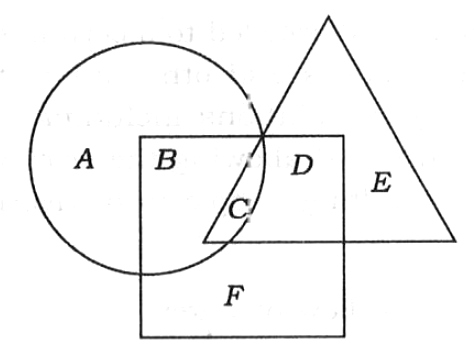
- AC
- BE
- CD
- DThere is no such slice
Show answer and explanationHide answer
Answer(B) E
Explanation
1) Women who love football = inside the triangle.
2) Not traders = outside the square.
3) The only labelled part of the triangle outside the square is E (the right-hand part of the triangle). Regions C and D are parts of the triangle inside the square.
4) So the slice is E.
- (A) C: wrong. C lies inside the square, the circle and the triangle: women football lovers who are traders.
- (B) E: correct. E is inside the triangle and outside the square.
- (C) D: wrong. D lies inside the square and the triangle: women football lovers who are traders.
- (D) There is no such slice: wrong. Region E meets both conditions.
For future exams
- Turn each condition into inside / outside: 'women who love football' = inside the triangle, 'not traders' = outside the square; then pick the labelled region that meets both.
- Ignore a shape the question does not use as a condition; here the circle is not needed to answer.
Micro topic Traders, football lovers, women regionChapter Venn Diagrams
If Bus is related to Car, then in the same way, River would be related to
- AStream
- BPond
- CLake
- DSwimming pool
Show answer and explanationHide answer
Answer(A) Stream
Explanation
A bus and a car are the same kind of thing (road vehicles), and the bus is the bigger one. So the relation is 'bigger : smaller of the same kind'. A river and a stream are both bodies of flowing water; a stream is a small river.
- (A) Stream: correct. A stream is a small river: same kind (moving water), smaller size, just as a car is a smaller road vehicle than a bus.
- (B) Pond: wrong. A pond is still (standing) water, not flowing water, so it is not the same kind as a river.
- (C) Lake: wrong. A lake is also standing water and is often bigger, not a smaller river.
- (D) Swimming pool: wrong. It is man-made still water for swimming, not a natural flowing body of water.
For future exams
- In analogies, check two things: the type (both vehicles, both flowing water) and the direction (bigger to smaller). An option that fails either test is out.
- Wiktionary defines stream as 'a small river; a large creek; a body of moving water confined by banks'.
Micro topic Bus : Car, River pairingChapter Analogy
Consider the following sequence of pairs of alphabets :
AK, BL, DN, GQ
The pair of alphabets that will come after GQ is
- ACM
- BHJ
- CKL
- DKU
Show answer and explanationHide answer
Answer(D) KU
Explanation
1. First letters: A(1), B(2), D(4), G(7). Gaps are +1, +2, +3, so the next gap is +4: 7 + 4 = 11 = K.
2. Second letters: K(11), L(12), N(14), Q(17). Gaps are again +1, +2, +3, so the next gap is +4: 17 + 4 = 21 = U.
3. Next pair = KU.
- (A) CM: wrong. C (3) would mean the first letter goes back after G (7); the series only goes forward.
- (B) HJ: wrong. H is G + 1 (repeating the first gap) and J is behind Q; both break the +4 step.
- (C) KL: wrong. K is the right first letter (G + 4), but L (12) is behind Q (17); the second letter must be Q + 4 = U.
- (D) KU: correct. Both letters move +4 at this step: G to K and Q to U.
For future exams
- Learn letter positions by the EJOTY trick: E = 5, J = 10, O = 15, T = 20, Y = 25; then U = 21 (T + 1) and K = 11 (J + 1) come at once.
- When both letters in a pair move by the same growing gaps (+1, +2, +3 ...), the distance between them stays fixed: here the second letter is always 10 places after the first (A-K, B-L, D-N, G-Q, K-U).
Micro topic Next pair in AK, BL, DN, GQChapter Alphabet Series
In a gift bag, a birthday girl found toffees and lollipops, where toffees were three times in number as compared to lollipops. Which of the following cannot be a total count of goodies in her gift bag?
- A44
- B48
- C42
- D52
Show answer and explanationHide answer
Answer(C) 42
Explanation
1. If lollipops = , toffees = .
2. Total goodies = , so the total must be a multiple of 4.
3. , and are multiples of 4; is not.
4. So 42 cannot be the total. Answer: (C) 42.
- (A) 44: wrong choice, it is possible: 11 lollipops and 33 toffees.
- (B) 48: wrong choice, it is possible: 12 lollipops and 36 toffees.
- (C) 42: correct. 42 is not a multiple of 4, so it cannot be split in the ratio with whole numbers.
- (D) 52: wrong choice, it is possible: 13 lollipops and 39 toffees.
For future exams
- In a ratio , the total must be a multiple of . Here means a multiple of 4.
- Divisibility by 4: a number is divisible by 4 if its last two digits form a number divisible by 4 (44, 48, 52 yes; 42 no).
Micro topic Toffees and lollipops in gift bagChapter Ratio & Proportion
The special edition paperback version of Roget's Thesaurus has 656 printed pages, and all are numbered except the covers. What would be the total number of digits used for page numbering this book?
- A1760
- B1680
- C1860
- D1670
Show answer and explanationHide answer
Answer(C) 1860
Explanation
1. Pages 1 to 9: 9 pages 1 digit = 9 digits.
2. Pages 10 to 99: 90 pages 2 digits = 180 digits.
3. Pages 100 to 656: pages 3 digits = digits.
4. Total = digits.
- (A) 1760: wrong. It is exactly 100 short of the correct total of 1,860, a slip in adding the three blocks.
- (B) 1680: wrong. It leaves out a block of pages; for example, counts only up to page 596.
- (C) 1860: correct. .
- (D) 1670: wrong. It is close to the three-digit part alone (1,671) and ignores pages 1 to 99.
For future exams
- Formula for pages 1 to N when N has 3 digits: (because one-digit pages save 2 each and two-digit pages save 1 each: ). Here .
- Reverse type: if a book uses D digits (), .
Micro topic Unnumbered pages, digits printedChapter Number Puzzles
The town clock of Pradoga takes 6 seconds to strike six at 6 o'clock. How much time would it take to strike eleven at 11 o'clock?
- A11 seconds
- B10 seconds
- C14 seconds
- D12 seconds
Show answer and explanationHide answer
Answer(D) 12 seconds
Explanation
1. Time is counted from the first stroke to the last stroke, so what takes time is the gaps between strokes.
2. Six strokes have gaps. 3. 5 gaps take 6 seconds, so one gap = seconds.
4. Eleven strokes have gaps.
5. Time = seconds.
- (A) 11 seconds: wrong. This assumes 1 second per stroke (6 strokes in 6 seconds), forgetting that time runs only between strokes.
- (B) 10 seconds: wrong. This counts the 10 gaps but takes each gap as 1 second instead of 1.2 seconds.
- (C) 14 seconds: wrong. No correct count of gaps gives 14; 10 gaps at 1.2 seconds is 12.
- (D) 12 seconds: correct. 10 gaps 1.2 seconds = 12 seconds.
For future exams
- Clock-strike rule: strikes have intervals. Time for strikes = . Here seconds.
Micro topic Clock strokes, time for elevenChapter Time Puzzles
Feynman made sure that the radiation exposure of the inner chamber is within tolerance limits. Opening the heavy door to the scrubbing chamber, he walked in and donned a sterile gown after the door closed behind him. Feynman sat on the scrubbing bench in the sealed chamber while the air would be cleaned by the scrubber unit. After six minutes, an inner door opened. As he walked into the inner chamber and touched the object, Feynman felt a wave of excitement washing over him. On the workbench lies the object which has the capacity of replicating and unleashing power comparable to that of the sun, albeit on a much smaller scale.
Based on the paragraph above, identify which of the following statements is best acceptable.
- ATo enter the inner chamber, one has to wait for not less than six minutes in the scrubbing chamber.
- BThe atom bomb was created by a team of which Feynman was a member.
- CFeynman was all alone in the inner chamber when he touched the object.
- DThe Laser (gun) was designed and developed in a laboratory where Feynman worked.
Show answer and explanationHide answer
Answer(A) To enter the inner chamber, one has to wait for not less than six minutes in the scrubbing chamber.
Explanation
The paragraph says Feynman sat in the sealed scrubbing chamber "while the air would be cleaned by the scrubber unit", and "after six minutes, an inner door opened". The inner door opens only after the cleaning, which took six minutes. So entry to the inner chamber needs a wait of at least six minutes in the scrubbing chamber. The other options depend on outside knowledge or on details the paragraph does not give.
- (A) To enter the inner chamber, one has to wait for not less than six minutes in the scrubbing chamber: correct. The inner door opened only after six minutes of air cleaning.
- (B) The atom bomb was created by a team of which Feynman was a member: wrong. This may be true in real history, but the paragraph never mentions an atom bomb or a team. It speaks only of an object with power "comparable to that of the sun".
- (C) Feynman was all alone in the inner chamber when he touched the object: wrong. The paragraph does not say whether anyone else was with him, either in the scrubbing chamber or in the inner chamber.
- (D) The Laser (gun) was designed and developed in a laboratory where Feynman worked: wrong. No laser is mentioned; this is outside guesswork.
For future exams
- "Best acceptable" statement questions: reject options that need outside knowledge (B, D) or assume a fact not given (C); pick the one that follows from the text.
- "Donned" means put on (clothing): Feynman put on a sterile gown.
Micro topic Feynman scrubbing chamber passageChapter Communication Skills
According to Oxford Dictionary, 'restitution' means 'the restoration of something lost or stolen to its proper owner; recompense for injury or loss'. Which of the following situations would be the nearest example of restitution?
- ARavi returned the mobile handset he purchased a week ago as the same heated up too high when viewing YouTube videos and claimed replacement with compensation.
- BDavid returned the lawn mower he borrowed from Timothy, with a broken blade that cracked upon hitting a rock when David was clearing his yard, and offered to pay for the repair and a new set of blades.
- CAmelia complained to her neighbour of her place being broken in and burgled, and demanded compensation as she had requested the neighbour to keep an eye on her place over the weekend when she is gone off to the beach.
- DSatyam returned Gurpreet's bike that he had borrowed, offered to pay for the quantity of fuel consumed, and small gift as a token of gratitude.
Show answer and explanationHide answer
Answer(B) David returned the lawn mower he borrowed from Timothy, with a broken blade that cracked upon hitting a rock when David was clearing his yard, and offered to pay for the repair and a new set of blades.
Explanation
The definition has two parts: (1) giving back something to its proper owner, and (2) making good a loss or injury. David gives the mower back to its owner, Timothy (part 1), and offers to pay for the repair and new blades for the damage he caused (part 2). Only option (B) has both parts, so it is the nearest example of restitution.
- (A) Ravi returned a faulty phone and claimed replacement with compensation: wrong. Ravi is the buyer claiming a remedy for a defect; he is not restoring someone else's property or making good a loss he caused.
- (B) David returned the borrowed mower and offered to pay for the damage: correct. Property restored to its owner plus recompense for the injury to it.
- (C) Amelia demanded compensation from her neighbour after a burglary: wrong. The neighbour neither took nor holds her goods, and nothing is restored; it is only a demand for compensation from the wrong person.
- (D) Satyam returned the bike, offered to pay for fuel and gave a small gift: weaker. The bike is returned undamaged; paying for fuel and a gift of thanks is courtesy for its use, not making good an injury or loss, so it fits the definition less closely than (B).
For future exams
- In law, restitution means compensation for losses; courts can order an offender to pay restitution to victims.
- Restitution comes from Latin restitutio, via Old French restitucion. It can also mean a return to a previous condition, as in 'the restitution of an elastic body'.
Micro topic Situation illustrating 'restitution'Chapter Vocabulary & Idioms
In the following two arithmetic operations, the numbers are correct, but the operators are all mixed up, except the '=' sign :
(i)
(ii)
Under this new usage of operators, which of the following operations is valid?
- A
- B
- C
- D
Show answer and explanationHide answer
Answer(D)
Explanation
1. From (i) : if '+' means '×', the left side is ; then '×' must mean '+', because .
2. From (ii) : if '÷' means '−', the left side is ; then '−' must mean '÷', because .
3. So the code is: + becomes ×, × becomes +, ÷ becomes −, − becomes ÷ (two swapped pairs).
4. Option (D) decodes to (using BODMAS). So (D) is valid.
- (A) : wrong. It decodes to , not 0.
- (B) : wrong. It decodes to , not 0.
- (C) : wrong. It decodes to , not 0.
- (D) : correct. It decodes to .
For future exams
- Shortcut: find the code from the example with the easiest numbers first (9 and 5 give 45 only by multiplication; 20 and 25 give 45 only by addition), then decode only the operators in each option and apply BODMAS.
- Check trick: the right side here is 0, so look for an option whose decoded form is 'something − something' with equal parts ( in option D).
Micro topic Mixed-up arithmetic operatorsChapter Logical Operations
If , then is equal to
- A0
- B1
- C2
- D4
Show answer and explanationHide answer
Answer(B) 1
Explanation
1. .
2. Move terms: , so .
3. Then ( cannot be 0, or the fraction has no meaning).
4. . Answer (B).
- (A) 0: wrong. would need with not 0, but the equation forces .
- (B) 1: correct. The equation gives , so .
- (C) 2: wrong. This would need ; it is a slip from reading the coefficient 2 in the equation as the answer.
- (D) 4: wrong. This would need (); the equation gives , not .
For future exams
- Shortcut: when a ratio is asked, first find from the given equation, then square, cube or invert it as the question needs: .
- Check by numbers: take . Then and (equal), and .
Micro topic Ratio of squares from linear equationChapter Algebra
What APSC asks in CSAT
Questions by area, CCE 2020 to 2025
400 questions from 5 papers of 80 each. Tap an area to see its questions.
Papers and syllabus
FAQ
APSC CSAT PYQs: questions students ask
Which APSC CSAT papers are included?
General Studies Paper II (CSAT) of the APSC CCE Prelims 2020, 2022, 2023, 2024 and 2025: 80 questions from each paper, 400 in all. The question numbers follow the booklets CCE 2020 Series C, CCE 2022 Series D, CCE 2023 Series A, CCE 2024 Series A, CCE 2025 Series A. The CCE 2025 paper, held in 2026, is the one students call the 2026 CSAT paper.
Is CSAT qualifying in APSC Prelims?
Yes. CSAT (Paper II) has 80 questions for 200 marks. It is qualifying: you need 33% in it, and only then are your GS Paper I marks counted for the Mains merit list.
Which CSAT topics does APSC ask most?
Across the five papers: Logical Reasoning & Mental Ability (132), Basic Numeracy (78), Comprehension (73). Use the area filter or the bars above to practise one area at a time.
Are the answers official?
Answers follow the APSC answer key (CCE 2022: final key; the other papers: the APSC provisional key, the only Paper II key we have for those exams). 21 questions carry an answer-key note: where the key was wrong or the question had an error, the note under the answer explains which answer to mark and why.
How do I practise CSAT here?
Choose an area, a paper or a question type, then switch to Practise: one question at a time, tap an option and see at once whether you are right, with the worked solution. Your record stays only in this browser on this device.