
Free for every APSC aspirant · no sign-up
APSC CSAT PYQs with Answers Prelims GS Paper II, CCE 2020 to 2025, with worked solutions
All 400 questions of the last five APSC Prelims CSAT papers, including the 2026 question paper (CCE 2025): reasoning, maths, passages, data and decision making, each with the answer and a step-by-step solution. CSAT is qualifying: you need 33% to have your GS Paper I marks counted.
If Red pairs with Yellow, then Green will pair with
- AViolet
- BBlue
- CIndigo
- DOrange
Show answer and explanationHide answer
Answer(C) Indigo
Explanation
1. The rainbow (spectrum) order is Red, Orange, Yellow, Green, Blue, Indigo, Violet (ROYGBIV).
2. Red is 1st and Yellow is 3rd: Red skips one colour (Orange) to reach Yellow, a step of +2.
3. Green is 4th; +2 gives the 6th colour, Indigo (skipping Blue).
4. Read the other way (VIBGYOR) the step is -2 and still gives Green to Indigo.
- (A) Violet: wrong. Violet is 3 places after Green (step +3); Red to Yellow is a step of 2.
- (B) Blue: wrong. Blue is the very next colour after Green (step +1), but Red to Yellow skips one colour (Orange).
- (C) Indigo: correct. Green to Indigo skips one colour (Blue), just as Red to Yellow skips Orange.
- (D) Orange: wrong. Orange comes before Green in the spectrum (step -2), the opposite direction to Red to Yellow.
For future exams
- Newton divided the colour circle into seven colours; he began with five hues and later added orange and indigo, which gives the ROYGBIV / VIBGYOR order.
- In colour analogies, first test the VIBGYOR position gap; if that gives one clear option, prefer it over looser links such as 'warm / cool' colours.
Micro topic Red : Yellow, Green pairingChapter Analogy
If ‘tiger’ is coded as ‘5regit’, then ‘deer’ will be coded as
- A4reed
- B5reed
- C4regit
- D1regit
Show answer and explanationHide answer
Answer(A) 4reed
Explanation
1. 'tiger' has 5 letters, and the code starts with 5.
2. The rest of the code, 'regit', is 'tiger' written backwards.
3. Rule: number of letters + the word reversed.
4. 'deer' has 4 letters; written backwards it is 'reed'.
5. Code for deer = 4reed. Answer: (A).
- (A) 4reed: correct. 4 letters in 'deer', followed by 'deer' reversed.
- (B) 5reed: wrong. It copies the number 5 from 'tiger'; 'deer' has only 4 letters.
- (C) 4regit: wrong. The number is right, but 'regit' is 'tiger' reversed, not 'deer'.
- (D) 1regit: wrong. Neither the number nor the letters fit 'deer'.
For future exams
- When a code mixes a number and letters, test the simplest links first: number of letters, position of the first or last letter, then the letters reversed or shifted.
Micro topic Tiger coded 5regit, code deerChapter Coding-Decoding
If Rangia is coded as Sbohjb, then Tihu will be coded as
- AUijv
- BUvij
- CUivj
- DUjiv
Show answer and explanationHide answer
Answer(D) Ujiv
Explanation
1. Compare Rangia with Sbohjb letter by letter: R→S, a→b, n→o, g→h, i→j, a→b.
2. Each letter moves one step forward in the alphabet (+1), and the order of letters is kept.
3. Apply +1 to Tihu: T→U, i→j, h→i, u→v.
4. Code for Tihu = Ujiv. Answer: (D).
- (A) Uijv: wrong. It shifts each letter by +1 but swaps the 2nd and 3rd letters (i and j); the code keeps the original order.
- (B) Uvij: wrong. The right letters, but the last three are in the wrong order.
- (C) Uivj: wrong. The right letters, but placed in the wrong order.
- (D) Ujiv: correct. T+1 = U, i+1 = j, h+1 = i, u+1 = v, in the same order as Tihu.
For future exams
- Shortcut: all four options have the same letters (U, j, i, v), so only the order matters. Code the 2nd letter of Tihu (i → j); only (D) has j in 2nd place.
Micro topic Rangia coded Sbohjb, code TihuChapter Coding-Decoding
From the given set of numbers below, identify the one which is different from the rest :
7, 13, 17, 19, 106
- A17
- B19
- C106
- DAll are same in type
Show answer and explanationHide answer
Answer(C) 106
Explanation
1. 7, 13, 17 and 19 are prime numbers: each has only two factors, 1 and itself. 2. 106 is even, so it divides by 2: . It is a composite number. 3. 106 is also the only even number and the only three-digit number in the set. So 106 is the odd one out.
- (A) 17: wrong. 17 is prime, like 7, 13 and 19.
- (B) 19: wrong. 19 is prime, like the others.
- (C) 106: correct. It is composite () and even; the rest are odd primes.
- (D) All are same in type: wrong. 106 is not prime, so the set is not all of one type.
For future exams
- Quick prime test: check division only by primes up to the square root of the number (for numbers below 121, test 2, 3, 5, 7). 2 is the only even prime, so any even number above 2 is composite.
Micro topic Odd number among primes and 106Chapter Odd One Out
A school offers Science and Arts courses. 75% of the final year students are in the Science stream. In the final examination, 25% of the Science students and 24.9% of the Arts students of the school obtained first class. The above data have been represented in the figures. In the figures, the upper row is for Science while the lower row is for Arts. The shaded portion represents the % of students securing first class while the bigger rectangle represents the % of Science or Arts students as the case may be :
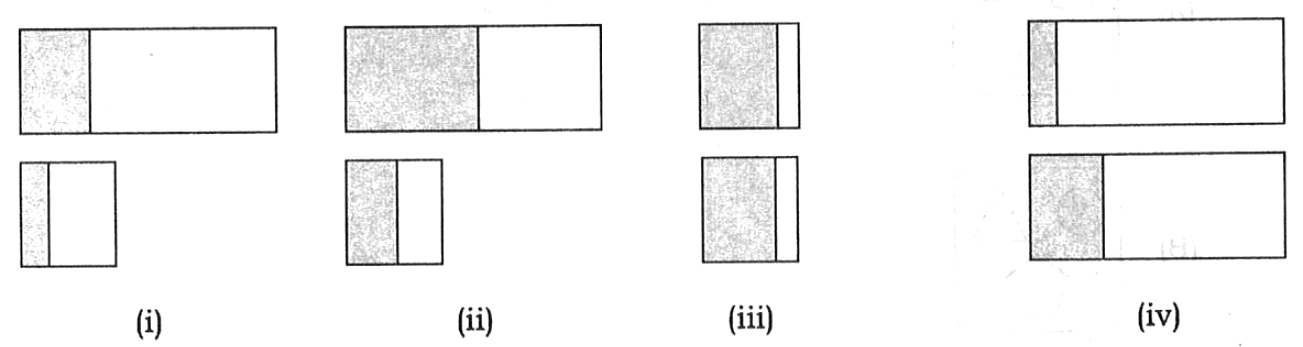
Choose the correct one from the following alternatives.
- AFigure (i) depicts the data most accurately
- BFigure (ii) depicts the data most accurately
- CFigure (iii) depicts the data most accurately
- DFigure (iv) depicts the data most accurately
Show answer and explanationHide answer
Answer(A) Figure (i) depicts the data most accurately
Explanation
1) Science = 75% and Arts = 25% of students, so the Science rectangle must be about 3 times the Arts rectangle.
2) First class: 25% of Science and 24.9% of Arts, so about one-quarter of each rectangle must be shaded, nearly the same share in both.
3) In figure (i) the Science box is about 2.7 times as wide as the Arts box (same height), and about 27% to 30% of each box is shaded.
4) Only figure (i) shows both features, so it is the most accurate.
- (A) Figure (i): correct. Science box about 3 times the Arts box, and about one-quarter of each box shaded.
- (B) Figure (ii): wrong. The box sizes are right (about 3 : 1), but more than half of each box is shaded (about 52% and 54%), not 25%.
- (C) Figure (iii): wrong. The two boxes are almost the same size (they should be 3 : 1), and about 77% to 79% of each is shaded.
- (D) Figure (iv): wrong. The two boxes are the same size, and Science is only about 11% shaded while Arts is about 29% shaded; the data say the two shares are almost equal (25% and 24.9%).
For future exams
- Check a picture in two steps: first the size of each whole (here 75 : 25 = 3 : 1), then the shaded share inside each whole (25% is one-quarter).
- 25% and 24.9% are almost equal, so the shaded parts must look equal in proportion; any figure with clearly different shaded shares is out at once.
Micro topic Science and Arts first class figuresChapter Data Interpretation
In the figure below, one space is vacant, which has been indicated as ? :
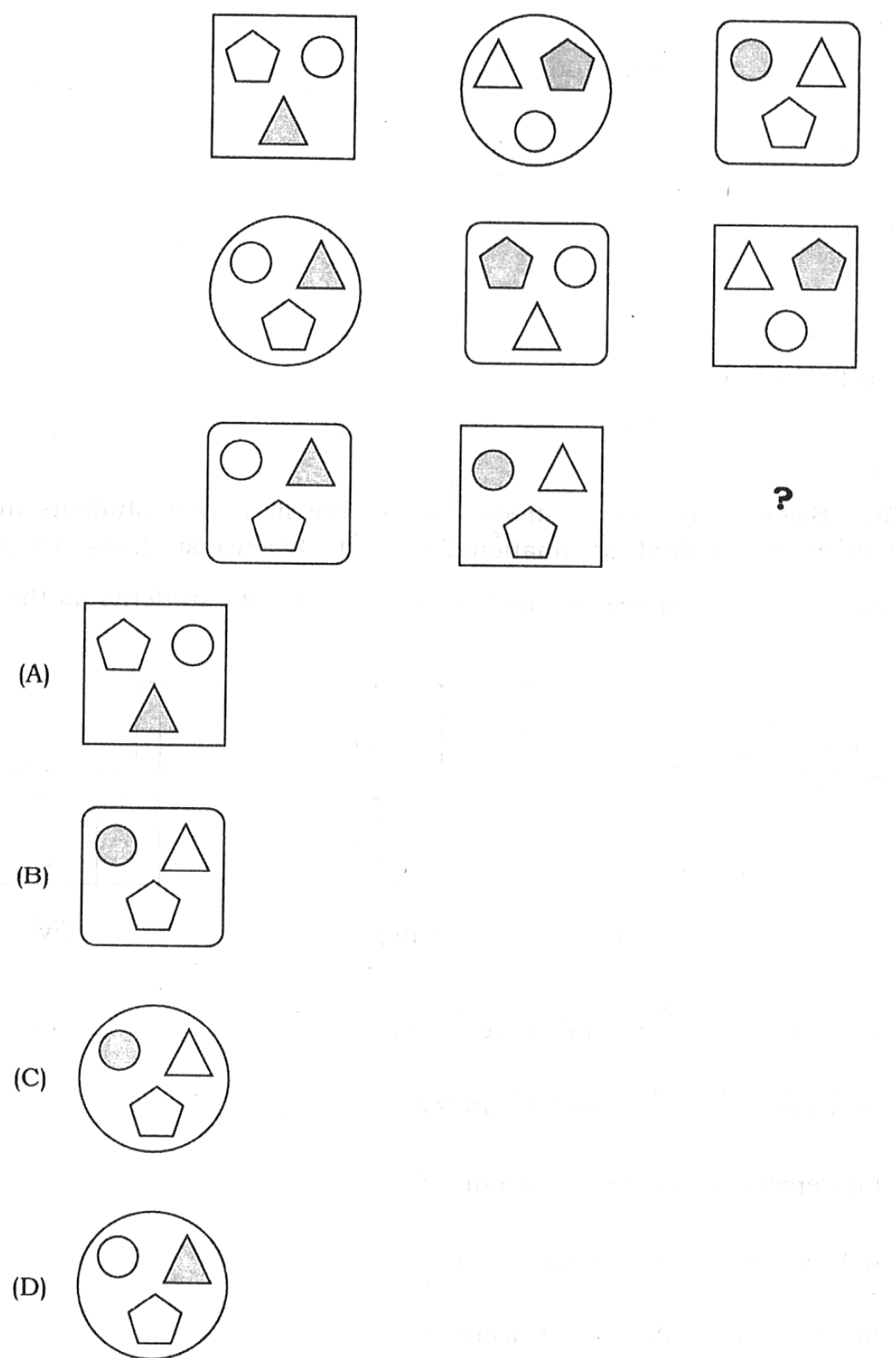
Which of the given alternatives should occupy the place marked as ? in the figure above?
- ADiagram (A) in the figure above
- BDiagram (B) in the figure above
- CDiagram (C) in the figure above
- DDiagram (D) in the figure above
Show answer and explanationHide answer
Answer(C) Circle frame with a shaded circle (top left), a triangle (top right) and a pentagon (below)
Explanation
1) Outer frames: each row has one square, one circle and one rounded square. Row 3 already has a rounded square and a square, so ? must have a circle frame. This removes (A) (square) and (B) (rounded square).
2) Shaded shapes: in the eight given figures the triangle is shaded 3 times, the pentagon 3 times and the circle only 2 times, so the missing figure must have the circle shaded.
3) The same holds frame by frame: the square frames shade triangle, pentagon, circle; the rounded frames shade circle, pentagon, triangle; the circle frames so far shade pentagon and triangle, so the third circle frame must shade the circle.
4) Option (C) is a circle frame with the circle shaded.
- (A): wrong. Square frame, but row 3 already has a square frame. It is also a copy of the first figure in row 1.
- (B): wrong. Rounded-square frame, but row 3 already has one. It is also a copy of the last figure in row 1.
- (C): correct. Circle frame, and the circle is the shaded shape, so each shaded shape appears three times and each frame type gets each shaded shape once.
- (D): wrong. The circle frame is right, but a shaded triangle would give the triangle a fourth shading and the circle frames a repeat; it is also an exact copy of the first figure in row 2.
For future exams
- In figure grids, check each feature separately: outer shape, inner arrangement, shading. Each feature usually appears once per row, or a fixed number of times in the whole grid.
- An option that exactly copies a figure already in the grid is usually wrong.
Micro topic Missing figure in pattern gridChapter Non-verbal Reasoning
The histogram below shows the production per year in thousand units from 2010 to 2020 for a certain company :
A person studied the histogram and concluded the following :
(i) The company achieved the highest growth in production per year in 2016 for the decade 2011–2020.
(ii) The production per year shows a negative growth in the year 2019 for the decade 2011–2020.
Now, choose the correct one from the following alternatives.
- ABoth conclusions (i) and (ii) are correct
- BOnly conclusion (i) is correct
- COnly conclusion (ii) is correct
- DNeither conclusion (i) nor conclusion (ii) is correct
Show answer and explanationHide answer
Answer(A) Both conclusions (i) and (ii) are correct
Explanation
1) Year-on-year change (thousand units): 2011 +1, 2012 +13, 2013 +12, 2014 +15, 2015 +15, 2016 +39 (230 to 269), 2017 +29, 2018 +17, 2019 -17 (315 to 298), 2020 +28.
2) The biggest rise is in 2016: +39, which is also the biggest in percentage terms ( = about 17.0%). So (i) is correct.
3) In 2019 production fell from 315 to 298, a negative growth of about 5.4%. So (ii) is correct.
4) Both are correct.
- Conclusion (i): correct. 2016 growth = thousand units (about 17.0%); the next best is 2017 with 29 thousand (about 10.8%).
- Conclusion (ii): correct. 2019 production (298) is less than 2018 production (315), a fall of 17 thousand units (about -5.4%); it is the only fall in the decade.
- So the code is (A). (B) and (C) each drop one true conclusion; (D) rejects both.
For future exams
- Growth in a year = this year minus last year; growth rate = . Check both when the question says 'highest growth'.
- A bar lower than the bar before it always means negative growth; spot it by eye before calculating.
Micro topic Production histogram, conclusionsChapter Data Interpretation
The pie diagram below shows the average monthly expenditure of a family. The monthly income of the family is ₹ 50,000 :
Consider the following statements :
(i) The average monthly expenditure of the family for conveyance is about ₹ 10,000.
(ii) The average monthly expenditure of the family for food is about ₹ 17,500.
Now, choose the correct one from the following alternatives.
- ABoth conclusions (i) and (ii) are correct
- BOnly conclusion (i) is correct
- COnly conclusion (ii) is correct
- DNeither conclusion (i) nor conclusion (ii) is correct
Show answer and explanationHide answer
Answer(C) Only conclusion (ii) is correct
Explanation
1) Conveyance share = 100 - (12 + 35 + 20 + 23) = 100 - 90 = 10%.
2) Taking the whole income of Rs 50,000 as the monthly spending, conveyance = 10% of 50,000 = Rs 5,000, not Rs 10,000. So (i) is wrong.
3) Food = 35% of 50,000 = Rs 17,500. So (ii) is correct.
4) Only (ii) is correct.
- Conclusion (i): wrong. Conveyance is 10% of the pie = Rs 5,000. The trap is mixing '10%' with 'Rs 10,000' (which would need 20%).
- Conclusion (ii): correct. Food is 35% of Rs 50,000 = Rs 17,500.
- So the code is (C). (A) and (B) accept the wrong conveyance figure; (D) rejects the correct food figure.
For future exams
- Missing sector of a pie chart = 100% minus the sum of the given sectors (or 360 degrees minus the given angles).
- Amount for a sector = (sector % / 100) x total; 1% of Rs 50,000 = Rs 500, so 10% = Rs 5,000 and 35% = Rs 17,500.
Micro topic Family expenditure pie chart conclusionsChapter Data Interpretation
The graphs below show the production and sales figures of a company for the decade 2011–2020. The company could sell of its products every year during the decade :
One may conclude the following :
(i) The company effected a price drop in the year 2015.
(ii) Sales-wise, the worst performing year for the company was 2020.
Now, choose the correct one from the following alternatives.
- ABoth conclusions (i) and (ii) are correct
- BOnly conclusion (i) is correct
- COnly conclusion (ii) is correct
- DNeither conclusion (i) nor conclusion (ii) is correct
Show answer and explanationHide answer
Answer(A) Both conclusions (i) and (ii) are correct (APSC final key; see the note on conclusion (ii))
Answer-key note: Error in question (key defensible)
This question is loosely worded. Conclusion (ii) depends on what 'worst performing year, sales-wise' means. If it means the lowest total sales, 2020 (Rs 900 thousand) is the second-best year and the worst is 2011 (Rs 525 thousand), so (ii) is wrong and the answer would be (B). If it means sales earned per kg produced (sales / production), the same measure needed for conclusion (i), then 2020 is the worst year of the decade (Rs 1.76 per kg), so (ii) is right and the answer is (A). APSC's final key, issued after objections, is (A). Best answer for the exam: (A). In an APSC exam, mark (A): APSC has already reviewed and kept this key.
Explanation
1) Read the graph. Production ('000 kg): 2011 = 233, 2012 = 300, 2013 = 325, 2014 = 400, 2015 = 410, 2016 = 420, 2017 = 375, 2018 = 300, 2019 = 450, 2020 = 510. Sales ('000 Rs): 525, 710, 725, 975, 800, 804, 680, 580, 840, 900.
2) Since the company sells at least 80% of its output every year, the useful measure is sales earned per kg produced (sales / production): 2011 = 2.25, 2012 = 2.37, 2013 = 2.23, 2014 = 2.44, 2015 = 1.95, 2016 = 1.91, 2017 = 1.81, 2018 = 1.93, 2019 = 1.87, 2020 = 1.76.
3) Conclusion (i): from 2014 to 2015 output rose (400 to 410) but sales fell (975 to 800); sales per kg fell from 2.44 to 1.95, the sharpest fall of the decade, so the company cut its price in 2015.
4) Conclusion (ii): on the same measure, 2020 is the worst year of the decade (Rs 1.76 per kg produced). Even if only 80% of 2020 output was sold, the price could be at most = Rs 2.21 per kg, the lowest ceiling of any year. So, judged by what its sales earned for what it produced, 2020 was the worst-performing year. APSC kept (A) in its final key after objections.
- Conclusion (i): correct. Output rose but sales value fell by about 18%; sales per kg dropped from Rs 2.44 to Rs 1.95, which points to a price cut in 2015.
- Conclusion (ii): correct on APSC's reading. Sales per kg produced was lowest in 2020 (Rs 1.76). Caution: by total sales value, 2020 (Rs 900 thousand) is the second-best year and the lowest is 2011 (Rs 525 thousand); on that reading (ii) would be wrong. See the key note.
- So the code is (A) on APSC's reading. (B) is the answer only if 'worst performing sales-wise' means the lowest total sales. (C) and (D) wrongly reject (i).
Key note: This question is loosely worded. Conclusion (ii) depends on what 'worst performing year, sales-wise' means. If it means the lowest total sales, 2020 (Rs 900 thousand) is the second-best year and the worst is 2011 (Rs 525 thousand), so (ii) is wrong and the answer would be (B). If it means sales earned per kg produced (sales / production), the same measure needed for conclusion (i), then 2020 is the worst year of the decade (Rs 1.76 per kg), so (ii) is right and the answer is (A). APSC's final key, issued after objections, is (A). Best answer for the exam: (A). In an APSC exam, mark (A): APSC has already reviewed and kept this key.
For future exams
- . If output holds steady or rises while sales value falls, the price has most likely fallen.
- In data-interpretation questions that give both output and sales, examiners often judge 'performance' by the ratio (sales per unit produced), not by the raw sales figure. Check both readings before you answer.
Micro topic Production and sales graphs conclusionsChapter Data Interpretation
Passage for Q30HideShow
The introduction of the Goods and Services Tax (GST) is a very significant step in the field of indirect tax reforms in India. By amalgamating a large number of Central and State taxes into a single tax, GST will mitigate ill effects of cascading or double taxation in a major way and pave the way for a common national market. From the consumers point of view, the biggest advantage would be in terms of reduction in the overall tax burden on goods, which is currently estimated to be around 25%–30%. It would also imply that the actual burden of indirect taxes on goods and services would be much more transparent to the consumer. Introduction of GST would also make Indian products competitive in the domestic and international markets owing to the full neutralization of input taxes across the value chain of production and distribution. Studies show that this would have a boosting impact on economic growth. Last but not the least, this tax, because of its transparent and self-policing character, would be easier to administer. It would also encourage a shift from the informal to formal economy.
On the basis of the above passage, the following assumptions have been made :
(i) Introduction of GST is a paradigm shift from the earlier tax regime.
(ii) GST subsumed all indirect taxes in India.
Which of the above assumptions is/are valid?
- AAssumption (i) only
- BAssumption (ii) only
- CBoth assumptions (i) and (ii)
- DNeither assumption (i) nor assumption (ii)
Show answer and explanationHide answer
Answer(A) Assumption (i) only
Explanation
The passage calls GST "a very significant step" in indirect tax reform: it merges many Central and State taxes into a single tax, ends cascading (tax on tax), creates a common national market and moves the economy from informal to formal. That is a basic change from the earlier tax system, so assumption (i) is valid. But the passage says GST merges "a large number of" Central and State taxes, not all indirect taxes, so assumption (ii) is not valid.
- Assumption (i): valid. Merging many taxes into one, ending cascading and creating a common national market show GST as a basic (paradigm) change from the old regime.
- Assumption (ii): not valid. The passage says "a large number of Central and State taxes". "All" goes beyond the passage.
- Code: only (i) is valid, so the answer is (A).
For future exams
- Assumption questions: words like "all", "only", "always" in an assumption usually go beyond the passage; check whether the passage says "some" or "a large number".
- "Paradigm shift" means a radical change in the usual way of thinking or doing something.
Micro topic GST passage assumptionsChapter Reading Comprehension
Passage for Q31HideShow
The new education policy must provide to all students, irrespective of their place of residence, a quality education system, with particular focus on historically marginalized, disadvantaged, and underrepresented groups. Education is a great leveler and is the best tool for achieving economic and social mobility, inclusion, and equality. Initiatives must be in place to ensure that all students from such groups, despite inherent obstacles, are provided various targeted opportunities to enter and excel in the educational system.
On the basis of the above passage, the following assumptions have been made :
(i) One of the cornerstones of the new education policy is inclusion.
(ii) The new education policy advocates quality education.
Which of the above assumptions is/are valid?
- AAssumption (i) only
- BAssumption (ii) only
- CBoth assumptions (i) and (ii)
- DNeither assumption (i) nor assumption (ii)
Show answer and explanationHide answer
Answer(C) Both assumptions (i) and (ii)
Explanation
The passage says the new education policy must provide "a quality education system" to all students, with "particular focus on historically marginalized, disadvantaged, and underrepresented groups", and calls education the best tool for "inclusion, and equality". So inclusion is a cornerstone (assumption i) and the policy advocates quality education (assumption ii). Both are valid.
- Assumption (i): valid. The focus on marginalised groups and the word "inclusion" in the passage show inclusion is central to the policy.
- Assumption (ii): valid. The first sentence says the policy must provide "a quality education system" to all students.
- Code: both are valid, so the answer is (C); (A), (B) and (D) each leave out a valid assumption.
For future exams
- Assumption questions: an assumption is valid when the passage clearly rests on it; here both are almost stated in the text.
- "Leveler" (also spelt leveller) means something that removes differences between people, such as class or wealth.
Micro topic New education policy passage assumptionsChapter Reading Comprehension
Study the following information :
(i) A, B, C, D, E and F are six graduate students studying in B. Barua College, Guwahati. They have offered major in six different subjects, viz., Physics, Chemistry, Zoology, Botany, Geology and Political Science.
(ii) Two of them belong to Nagaon, two belong to Dibrugarh and the remaining two are local.
(iii) A and F belong to Nagaon, B belongs to Dibrugarh and C is local.
(iv) D is local and has major in Zoology.
(v) A has major in Chemistry while E's major subject is Geology.
(vi) One student belonging to Nagaon is an Arts student.
(vii) Students hailing from Dibrugarh have not offered major in Physics.
Now, answer the following question :
Which of the following combinations of students and major subjects is not correct?
- AA—Chemistry
- BC—Physics
- CF—Political Science
- DB—Geology
Show answer and explanationHide answer
Answer(D) B—Geology
Explanation
1. Places: A and F are from Nagaon; B is from Dibrugarh; C and D are local. Only E is left, so E is the second Dibrugarh student.
2. Given subjects: D Zoology, A Chemistry, E Geology.
3. Left: Physics, Botany and Political Science for B, C and F.
4. One Nagaon student is an Arts student; A takes Chemistry, so F is the Arts student: F takes Political Science.
5. Dibrugarh students do not take Physics, so B takes Botany and C takes Physics.
6. Final: A Chemistry, B Botany, C Physics, D Zoology, E Geology, F Political Science. B—Geology is not correct.
- (A) A—Chemistry: correct pair, given directly in clue (v).
- (B) C—Physics: correct pair. B cannot take Physics (Dibrugarh) and F takes Political Science, so Physics goes to C.
- (C) F—Political Science: correct pair. F is the Nagaon Arts student, and Political Science is the only Arts subject.
- (D) B—Geology: NOT correct, so this is the answer. Geology belongs to E; B takes Botany.
For future exams
- Make a grid (students × place × subject). Fill the given facts first, then use 'only one left' and the negative clues (like 'not Physics') to close the gaps.
- Spot the hidden clue: Political Science is the only Arts subject in the list, so 'Arts student' fixes it.
Micro topic Six students, subjects and hometownsChapter Logical Reasoning
With reference to the Question No. 32 above, what are the major subjects of the two local students?
- APhysics and Chemistry
- BPhysics and Zoology
- CZoology and Botany
- DChemistry and Geology
Show answer and explanationHide answer
Answer(B) Physics and Zoology
Explanation
1. The two local students are C and D (clues iii and iv).
2. D takes Zoology (clue iv).
3. From the full solution of Question 32: A Chemistry, B Botany, C Physics, D Zoology, E Geology, F Political Science.
4. So the local students take Physics (C) and Zoology (D).
- (A) Physics and Chemistry: wrong. Chemistry is A's subject, and A is from Nagaon.
- (B) Physics and Zoology: correct. C (local) takes Physics; D (local) takes Zoology.
- (C) Zoology and Botany: wrong. Botany is B's subject, and B is from Dibrugarh.
- (D) Chemistry and Geology: wrong. Chemistry is A's (Nagaon) and Geology is E's (Dibrugarh).
For future exams
- Quick elimination: D (local) takes Zoology, so the answer must contain Zoology; only (B) and (C) do. Botany cannot be local because B (Dibrugarh) is left with only Botany after Physics is ruled out for him.
- In linked-question sets, solve the full grid once and answer all the questions from it.
Micro topic Subjects of two local studentsChapter Logical Reasoning
If the code for CAT is 05-03-22, then the code for DOG will be
- A07-12-22
- B06-17-09
- C11-07-22
- D06-11-09
Show answer and explanationHide answer
Answer(B) 06-17-09
Explanation
1. Alphabet positions: C = 3, A = 1, T = 20.
2. The code 05-03-22 is each position + 2 (3+2 = 5, 1+2 = 3, 20+2 = 22).
3. DOG: D = 4, O = 15, G = 7.
4. Add 2 to each: 6, 17, 9.
5. Code for DOG = 06-17-09. Answer: (B).
- (A) 07-12-22: wrong. It does not match DOG + 2 at any place (D gives 06, not 07).
- (B) 06-17-09: correct. D(4)+2 = 6, O(15)+2 = 17, G(7)+2 = 9.
- (C) 11-07-22: wrong. None of the three numbers comes from D, O or G + 2.
- (D) 06-11-09: wrong. The 1st and 3rd numbers are right, but O is the 15th letter, so 15 + 2 = 17, not 11.
For future exams
- Learn the 'EJOTY' aid for alphabet positions: E = 5, J = 10, O = 15, T = 20, Y = 25. From these, any letter's number is found in one step (for example O = 15, so P = 16).
- Shortcut: options (B) and (D) share 06 and 09, so only O needs checking.
Micro topic CAT coded 05-03-22, code DOGChapter Coding-Decoding
Pick up the most appropriate word to fill in the blank from the given alternatives :
float, hook, line, bait, net, ____
- Asaw
- Bspade
- Caxe
- Dpond
Show answer and explanationHide answer
Answer(D) pond
Explanation
Float, hook, line, bait and net are all things used in fishing. Among the options, only 'pond' belongs to fishing: it is where fish are kept and caught. Saw, spade and axe are tools for cutting wood or digging, with no link to fishing.
- (A) saw: wrong. A saw is a carpenter's tool for cutting wood.
- (B) spade: wrong. A spade is a digging tool used in farming and gardening.
- (C) axe: wrong. An axe is used to cut or chop wood.
- (D) pond: correct. It is the only option linked to fishing, the common theme of the list.
For future exams
- Method: find the common theme of the given words first (here, fishing), then pick the only option that shares it, even if it is not the exact same type of item.
- Here the three wrong options form their own group (cutting or digging tools), a sign that the odd option out is the answer.
Micro topic Fishing items, fit missing wordChapter Classification
Pick up the most appropriate word to fill in the blank from the given alternatives :
Bengal, Indo-Chinese, South China, Amur, ____
- ASumatran
- BCaspian
- CBali
- DJavan
Show answer and explanationHide answer
Answer(A) Sumatran
Explanation
Bengal, Indo-Chinese, South China and Amur (Siberian) are tiger subspecies in the traditional list of nine that are not extinct. Of the options, only the Sumatran tiger is also still living. The Caspian, Bali and Javan tigers are the three extinct subspecies.
- (A) Sumatran: correct. It is a surviving tiger subspecies, like the four in the list.
- (B) Caspian: wrong. The Caspian tiger has been extinct since the 1970s.
- (C) Bali: wrong. The Bali tiger became extinct in the 1940s.
- (D) Javan: wrong. The Javan tiger was thought to be extinct by the 1980s.
For future exams
- Traditional nine subspecies: Bengal, Malayan, Indochinese, South China, Siberian (Amur), Sumatran (surviving; South China only in captivity) and Caspian, Javan, Bali (extinct). In 2017 the IUCN Cat Classification Task Force recognised only two subspecies: P. t. tigris (mainland) and P. t. sondaica (Sunda Islands).
- The tiger is Endangered on the IUCN Red List and listed in CITES Appendix I; as of 2020 India had the largest tiger habitat, followed by Russia.
Micro topic Tiger types, fit missing wordChapter Classification
In the given list below, identify the word which is different from the rest :
inflexible, stubborn, obstinate, acquiescent, rigid, dogged
- Aacquiescent
- Bobstinate
- Cdogged
- Drigid
Show answer and explanationHide answer
Answer(A) acquiescent
Explanation
Inflexible, stubborn, obstinate, rigid and dogged all describe a person who will not change or give in. Acquiescent means willing to accept or go along with something without objecting or resisting (Wiktionary). It is the opposite idea, so it is the odd word.
- (A) acquiescent: correct. It means agreeing or submitting quietly, the opposite of stubborn.
- (B) obstinate: wrong. It means stubbornly refusing to change one's mind, the same group as stubborn.
- (C) dogged: wrong. It means stubbornly unyielding, unwilling to give up (Vocabulary.com), so it belongs to the group.
- (D) rigid: wrong. Used for a person, it means not willing to change or bend, the same group as inflexible.
For future exams
- Odd-one-out with words: find the meaning shared by most words (here, refusing to give in), then look for the antonym or the word from a different category.
- Acquiescent comes from the verb acquiesce, to accept something without protest. Example: The staff were acquiescent and signed the new rules without a word.
Micro topic Odd word among stubborn synonymsChapter Odd One Out
If Cycle pairs with Velodrome, then Boxing will pair with
- AArena
- BRing
- CCourt
- DPitch
Show answer and explanationHide answer
Answer(B) Ring
Explanation
A velodrome is an arena with an oval, banked track built for bicycle racing, so the relation is 'sport : the special place where it is played'. Boxing is fought in a ring, a raised square platform enclosed by ropes.
- (A) Arena: wrong. Arena is a general word for any large sports venue (a velodrome itself is a kind of arena); it is not the place made only for boxing.
- (B) Ring: correct. The ring is the special fighting area of boxing, just as the velodrome is the special track for cycling.
- (C) Court: wrong. A court is used for games such as tennis, badminton and basketball.
- (D) Pitch: wrong. A pitch is used for cricket, football and hockey.
For future exams
- The boxing ring is square, but the name 'ring' comes from early fights held in a rough circle drawn on the ground; hence the nickname 'squared circle'.
- Common sport : venue pairs: tennis : court, cricket : pitch, golf : course, swimming : pool, wrestling : mat or ring, skating : rink.
Micro topic Cycle : Velodrome, Boxing pairingChapter Analogy
A man drives a car from A to B with an average speed of 40 kmph and then returns to A by the same route with an average speed of 60 kmph. The average speed of the car for the entire up and down journey in kmph is
- A45
- B48
- C50
- D55
Show answer and explanationHide answer
Answer(B) 48
Explanation
1. Let the distance A to B be km. Time going = h, time returning = h.
2. Total time = h.
3. Total distance = km.
4. Average speed = km/h. Formula check: . Answer (B).
- (A) 45: wrong. No standard working gives 45; the true value 48 lies between 40 and 60 but closer to 40, because the car spends more time at the slower speed.
- (B) 48: correct. Same distance each way, so average speed = km/h.
- (C) 50: wrong. 50 is the simple average . That is only right when equal TIME is spent at each speed, not equal distance.
- (D) 55: wrong. It is above the simple average 50, but with equal distances the average must be below 50 (more time is spent at 40 km/h).
For future exams
- Formula: for equal distances at speeds and , average speed = (the harmonic mean). It is always less than .
- Average speed is always total distance ÷ total time; never just add the two speeds and halve them unless the times are equal.
Micro topic Round trip average speedChapter Average Speed
A man walks 6 km to North, then turns right through 90° and walks 8 km. Then he turns South and walks 3 km. Again, he turns right through 90° and walks 4 km and stops. How far is he now from his starting point?
- A3 km
- B4 km
- C5 km
- D6 km
Show answer and explanationHide answer
Answer(C) 5 km
Explanation
1. Put the start at . 6 km North → .
2. Facing North, a right turn faces East. 8 km East → .
3. 3 km South → .
4. Facing South, a right turn faces West. 4 km West → .
5. He is 4 km East and 3 km North of the start. Distance = km. Answer: (C).
- (A) 3 km: wrong. 3 km is only his North-South gap (); it leaves out the 4 km East gap.
- (B) 4 km: wrong. 4 km is only his East-West gap (); it leaves out the 3 km North gap.
- (C) 5 km: correct. Net 4 km East and 3 km North, and km.
- (D) 6 km: wrong. 6 km is only the first leg (North). The net position is 4 km East and 3 km North of the start, which gives 5 km.
For future exams
- Shortcut: find the net North-South distance () and net East-West distance (), then use Pythagoras. Remember the 3-4-5 and 6-8-10 triples; they appear often in direction questions.
Micro topic Walks north, right, south, distance from startChapter Direction Sense
What APSC asks in CSAT
Questions by area, CCE 2020 to 2025
400 questions from 5 papers of 80 each. Tap an area to see its questions.
Papers and syllabus
FAQ
APSC CSAT PYQs: questions students ask
Which APSC CSAT papers are included?
General Studies Paper II (CSAT) of the APSC CCE Prelims 2020, 2022, 2023, 2024 and 2025: 80 questions from each paper, 400 in all. The question numbers follow the booklets CCE 2020 Series C, CCE 2022 Series D, CCE 2023 Series A, CCE 2024 Series A, CCE 2025 Series A. The CCE 2025 paper, held in 2026, is the one students call the 2026 CSAT paper.
Is CSAT qualifying in APSC Prelims?
Yes. CSAT (Paper II) has 80 questions for 200 marks. It is qualifying: you need 33% in it, and only then are your GS Paper I marks counted for the Mains merit list.
Which CSAT topics does APSC ask most?
Across the five papers: Logical Reasoning & Mental Ability (132), Basic Numeracy (78), Comprehension (73). Use the area filter or the bars above to practise one area at a time.
Are the answers official?
Answers follow the APSC answer key (CCE 2022: final key; the other papers: the APSC provisional key, the only Paper II key we have for those exams). 21 questions carry an answer-key note: where the key was wrong or the question had an error, the note under the answer explains which answer to mark and why.
How do I practise CSAT here?
Choose an area, a paper or a question type, then switch to Practise: one question at a time, tap an option and see at once whether you are right, with the worked solution. Your record stays only in this browser on this device.