
Free for every APSC aspirant · no sign-up
APSC CSAT PYQs with Answers Prelims GS Paper II, CCE 2020 to 2025, with worked solutions
All 400 questions of the last five APSC Prelims CSAT papers, including the 2026 question paper (CCE 2025): reasoning, maths, passages, data and decision making, each with the answer and a step-by-step solution. CSAT is qualifying: you need 33% to have your GS Paper I marks counted.
During your morning walk, you observed that one of the iron manhole covers in the footpath is missing. You will
- Acontinue with your morning walk as if you have seen nothing
- Bcurse the unknown miscreant who had removed the cover and continue with your morning walk
- Cput a twig or some markers on the uncovered manhole as a precaution against possible mishap and then continue with your morning walk
- Dput a twig or some markers on the uncovered manhole as a precaution against possible mishap, alert the maintenance authority, if possible and then continue with your morning walk
Show answer and explanationHide answer
Answer(D) put a twig or some markers on the uncovered manhole as a precaution against possible mishap, alert the maintenance authority, if possible and then continue with your morning walk
Explanation
Principle: first prevent immediate harm, then report to the authority that can fix the cause. A marker warns walkers at once, and alerting the maintenance authority gets the cover replaced. Option D does both, so it is the most complete and responsible response.
- (A) continue as if you have seen nothing: wrong. An open manhole can cause serious injury; ignoring it shows no civic sense.
- (B) curse the miscreant and continue: wrong. Cursing does not protect anyone or fix the problem.
- (C) put a twig or marker and continue: partly right but incomplete. It gives a short-term warning, but the hole stays open until the authority knows about it.
- (D) put a marker, alert the maintenance authority and continue: correct. It covers both the immediate danger and the lasting fix.
For future exams
- When two options are both good and one includes the other plus an extra sensible step (here, informing the authority), choose the fuller one.
- Order to remember: safety now, then report to the responsible body, then carry on.
Micro topic Responding to open manholeChapter Decision Making
You saw some kids studying in the neighbourhood school throwing garbage on the road. You will
- Aignore the situation
- Breprimand the kids and ask them not to litter on public places in future
- Cforce the kids to clean up the litter
- Dmake a visit to the school and request the Headmaster to sensitise the students on civic sense and also on the virtues of cleanliness
Show answer and explanationHide answer
Answer(D) make a visit to the school and request the Headmaster to sensitise the students on civic sense and also on the virtues of cleanliness
Explanation
Principle: change behaviour through education and the proper channel, not through force or scolding. The Headmaster can reach all the students and build lasting civic sense. So asking the school to sensitise the children gives a long-term fix that reaches more than the few kids you saw.
- (A) ignore the situation: wrong. Littering harms public spaces; a responsible citizen should act.
- (B) reprimand the kids and ask them not to litter: weaker. It may stop these few children once, but scolding other people's children rarely changes habits and can cause conflict.
- (C) force the kids to clean up: wrong. Using force on children who are not yours is improper and may be unlawful; it causes fear, not understanding.
- (D) request the Headmaster to sensitise the students: correct. It uses the right authority and education to change behaviour for the whole school.
For future exams
- With children, APSC answers favour sensitisation through parents, teachers or the school, never punishment or force by a stranger.
Micro topic Responding to littering studentsChapter Decision Making
Three persons are currently employed in a certain section of an office, of which you are the in-charge. Two of the employees of the section are on leave today with your prior approval. During the first hour of the day, however, you received a half-day leave application from the third employee of the section. You would
- Aapprove the leave application immediately
- Bsummon the employee to your chamber and enquire about the urgency of his situation. Depending on that, you decide whether to grant him leave or not
- Csummarily reject the leave application
- Dsummarily reject the leave application and rebuke the employee for his irresponsible behaviour
Show answer and explanationHide answer
Answer(B) summon the employee to your chamber and enquire about the urgency of his situation. Depending on that, you decide whether to grant him leave or not
Explanation
Principle: balance the needs of the office with fairness and empathy to the employee. With the other two staff already on leave, the section would be empty if the third also leaves, so leave cannot be granted blindly. But the employee may have a real emergency. Asking about the urgency first and then deciding is fair to both the office and the employee.
- (A) approve immediately: wrong. It leaves the section with no staff and ignores the office's work.
- (B) enquire about the urgency, then decide: correct. It is a fair, informed decision that weighs both the work and the employee's need.
- (C) summarily reject: wrong. It ignores a possible genuine emergency and lacks empathy.
- (D) summarily reject and rebuke: wrong. Asking for leave is not irresponsible behaviour; rebuking is unfair and hurts morale.
For future exams
- In office-management questions, prefer the option that gathers facts before deciding; reject options with 'immediately', 'summarily' or 'rebuke'.
Micro topic Handling half-day leave requestChapter Decision Making
A clock shows the time as 8:30 a.m. What is the measurement of the angle made by the hands of the clock?
- A75°
- B60°
- C30°
- D45°
Show answer and explanationHide answer
Answer(A) 75°
Explanation
1. Formula: , where H = hours and M = minutes.
2. H = 8, M = 30: ; .
3. .
4. Check: the minute hand is at 6 (180°); the hour hand is halfway between 8 and 9 (). .
- (A) 75°: correct. .
- (B) 60°: wrong. 60° is the gap from 6 to 8 only; it forgets the hour hand has moved 15° past 8.
- (C) 30°: wrong. 30° is just one hour mark; it has no link to 8:30.
- (D) 45°: wrong. 45° would need the hour hand at 7:30 position; at 8:30 it is 15° past 8.
For future exams
- . If the result is more than 180°, subtract it from 360° to get the smaller angle.
- Common slip: forgetting that the hour hand moves 0.5° each minute (15° in 30 minutes).
Micro topic Angle between clock hands at 8:30Chapter Clocks
If 'P' represents '', 'Q' represents '', 'R' represents '' and 'S' represents '', then what will be the value of 9P3S4Q8R7?
- A12
- B15
- C10
- D13
Show answer and explanationHide answer
Answer(D) 13
Explanation
1. Replace the letters: 9P3S4Q8R7 becomes .
2. Use BODMAS: division and multiplication first, left to right: , then .
3. Now addition and subtraction, left to right: , then . So the value is 13.
- (A) 12: wrong. 12 is only the value of ; the slip is stopping before + .
- (B) 15: wrong. No correct reading of the signs gives 15; after , adding 8 and taking away 7 gives 13, not 15.
- (C) 10: wrong. It comes from a sign or order slip; with the right signs and BODMAS the value is 13, not 10.
- (D) 13: correct. .
For future exams
- Shortcut: first rewrite the whole expression with real signs, then apply BODMAS (Brackets, Of, Division/Multiplication left to right, Addition/Subtraction left to right). In this item and already come before and , so plain left-to-right also gives 13; BODMAS can change the result when or comes before or (for example , not 24).
Micro topic Symbol-replaced arithmetic valueChapter Coded Arithmetic
Which of the following does not belong to the rest of the group?
- ABrass
- BBronze
- CAluminum
- DStainless steel
Show answer and explanationHide answer
Answer(C) Aluminum
Explanation
Brass, bronze and stainless steel are all alloys, that is, mixtures of a metal with other elements. Aluminium is a chemical element (symbol Al, atomic number 13), a pure metal and not an alloy. So aluminium is the odd one out.
- (A) Brass: wrong. Brass is an alloy of copper and zinc, so it belongs to the group.
- (B) Bronze: wrong. Bronze is an alloy mainly of copper with about 12 to 12.5% tin, so it belongs to the group.
- (C) Aluminum: correct. Aluminium is a chemical element (Al, atomic number 13), a metal on its own, not an alloy.
- (D) Stainless steel: wrong. Stainless steel is an iron-based alloy containing at least about 10.5% chromium, so it belongs to the group.
For future exams
- Brass = copper + zinc; bronze = copper + tin. Both are copper alloys.
- Stainless steel resists rust because of its chromium content (10.5% or more).
Micro topic Odd one out among metalsChapter Classification
If RHINO is coded as PFGLM, then TIGER will be coded as
- ARGECP
- BCBAQR
- CLFDAB
- DSHIDR
Show answer and explanationHide answer
Answer(A) RGECP
Explanation
1. Compare RHINO with PFGLM: R → P, H → F, I → G, N → L, O → M.
2. Each letter moves 2 places back in the alphabet (–2).
3. Apply –2 to TIGER: T → R, I → G, G → E, E → C, R → P.
4. So TIGER = RGECP.
- (A) RGECP: correct. Each letter of TIGER moved 2 places back gives R, G, E, C, P.
- (B) CBAQR: wrong. Its first letter C is not T – 2 (R); it follows no fixed shift from TIGER.
- (C) LFDAB: wrong. T – 2 is R, not L; the letters do not follow the –2 rule.
- (D) SHIDR: wrong. S and H are T – 1 and I – 1 (a –1 shift), and the last letter R is not shifted at all; the rule here is –2.
For future exams
- Shortcut: check only the first letter of each option (T – 2 = R). Only option A starts with R, so the answer is fixed in one step.
Micro topic Letter shift coding RHINOChapter Coding-Decoding
X reached the venue of a meeting 15 minutes before time. Y reached the same venue 30 minutes late for the meeting. The meeting was over at 11 a.m., 30 minutes after Y reached the meeting. At what time did X reach the venue of the meeting?
- A9:00 a.m.
- B9:30 a.m.
- C9:45 a.m.
- D8:00 a.m.
Show answer and explanationHide answer
Answer(C) 9:45 a.m.
Explanation
1. The meeting ended at 11:00 a.m., 30 minutes after Y arrived, so Y arrived at 10:30 a.m.
2. Y was 30 minutes late, so the meeting started at 10:00 a.m.
3. X arrived 15 minutes before the start: 10:00 - 0:15 = 9:45 a.m.
- (A) 9:00 a.m.: wrong. That is 1 hour before the start; X was only 15 minutes early.
- (B) 9:30 a.m.: wrong. It takes 30 minutes before the start (mixing in Y's 30 minutes) instead of 15.
- (C) 9:45 a.m.: correct. Start 10:00 a.m. minus 15 minutes.
- (D) 8:00 a.m.: wrong. It has no link to the data; it is 2 hours before the start.
For future exams
- Method: work backwards from the one fixed clock time given (here 11:00 a.m.), one step at a time.
- Read the base of each 'before/after' carefully: Y's 30 minutes is counted from the start time, the last 30 minutes from Y's arrival.
Micro topic Arrival time from meeting timingsChapter Time Calculation
A person starts from point A and travels 3 km eastward to point B and then turns left and travels 4 km to reach point C. What is the distance between points A and C?
- A7 km
- B2 km
- C10 km
- D5 km
Show answer and explanationHide answer
Answer(D) 5 km
Explanation
1. A to B is 3 km east.
2. Facing east, a left turn means facing north, so B to C is 4 km north.
3. AB and BC are at right angles, so AC is the hypotenuse.
4. AC = km.
- (A) 7 km: wrong. is the distance walked, not the straight distance from A to C.
- (B) 2 km: wrong. It ignores the right angle between the two legs; no correct working gives 2 km.
- (C) 10 km: wrong. It is not linked to this path; 10 km would need legs of 6 km and 8 km.
- (D) 5 km: correct. Pythagoras: km.
For future exams
- Remember Pythagorean triplets: 3-4-5, 6-8-10, 5-12-13, 8-15-17. Two perpendicular legs from such a triplet give the shortest distance at once.
Micro topic Distance after left turnChapter Direction Sense
Below is a set of four diagrams where the 'square' represents 'teachers', the 'circle' represents 'doctors' and the 'triangle' represents 'musicians'. Which of the diagrams justifies the statement : "Some teachers are musicians; some musicians are doctors but no teacher is a doctor"?
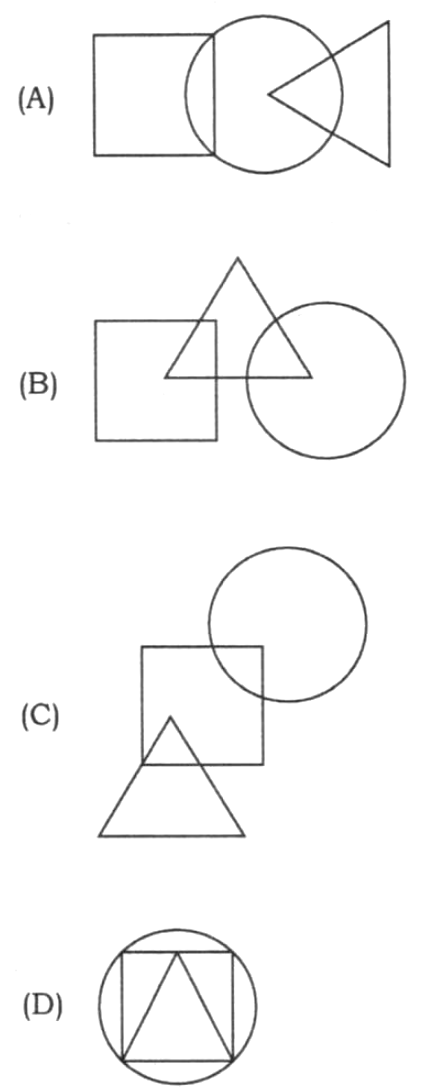
- ADiagram (A) in the figure above
- BDiagram (B) in the figure above
- CDiagram (C) in the figure above
- DDiagram (D) in the figure above
Show answer and explanationHide answer
Answer(B) square overlaps triangle, triangle overlaps circle, square and circle do not touch
Explanation
1. 'Some teachers are musicians': the square and the triangle must overlap. 2. 'Some musicians are doctors': the triangle and the circle must overlap. 3. 'No teacher is a doctor': the square and the circle must not overlap.
4. In diagram (B), the triangle cuts both the square and the circle, while the square and the circle stay apart. Answer: (B).
- (A) wrong: the square overlaps the circle, which shows some teachers are doctors; the statement says no teacher is a doctor.
- (B) correct: square–triangle overlap and triangle–circle overlap, with no square–circle overlap.
- (C) wrong: the circle overlaps the square (some teachers are doctors), and the triangle does not touch the circle (no musician shown as a doctor).
- (D) wrong: the triangle and square sit inside the circle, which would make teachers and musicians doctors.
For future exams
- Turn each part of the statement into 'overlap' or 'no overlap' for each pair of shapes, then check every diagram against all three conditions.
- 'No A is B' always means the two shapes must be fully apart.
Micro topic Venn diagram for teachers, doctors, musiciansChapter Venn Diagrams
A person walks towards the direction of his house at 7 a.m. and observes his shadow to the right. In which direction is he walking?
- ASouth
- BNorth
- CEast
- DWest
Show answer and explanationHide answer
Answer(A) South
Explanation
1. At 7 a.m. the sun is in the east.
2. A shadow falls opposite the sun, so the shadow points west.
3. The shadow is on the man's right, so his right hand points west.
4. A person whose right side is west is facing south. So he walks south.
- (A) South: correct. Facing south, the right hand points west, where the morning shadow falls.
- (B) North: wrong. Facing north, the right side is east; the morning shadow (west) would be on his left.
- (C) East: wrong. Facing east (towards the sun), the shadow would be directly behind him, not to his right.
- (D) West: wrong. Facing west, the shadow would be directly in front of him.
For future exams
- Rule: morning sun is east, so shadow points west; evening sun is west, so shadow points east. At noon in Assam (north of the Tropic of Cancer) the sun is always to the south, so the noon shadow falls to the north.
- Quick check: face north, then east is on your right and west on your left; turn to face south and the sides swap.
Micro topic Shadow direction at 7 a.m.Chapter Direction Sense
In a group of cows and hens, the number of legs is 14 more than twice the number of heads. What is the number of cows in the group?
- A7
- B9
- C10
- D8
Show answer and explanationHide answer
Answer(A) 7
Explanation
1. Let the cows be and the hens be . Heads = ; legs = .
2. Given: .
3. So , which gives .
4. . The number of hens does not matter.
- (A) 7: correct. Each cow has 2 legs more than twice its one head; 14 extra legs cows.
- (B) 9: wrong. 9 cows would give 18 extra legs, not 14.
- (C) 10: wrong. 10 cows would give 20 extra legs.
- (D) 8: wrong. 8 cows would give 16 extra legs.
For future exams
- Shortcut: if every animal is counted with 2 legs per head, each hen fits exactly and each cow has 2 extra legs. So cows = extra legs .
- General formula: number of four-legged animals = . Example: 10 heads and 28 legs give cows and 6 hens.
Micro topic Cows and hens legs and headsChapter Linear Equations
If 80% of the difference of A and B is equal to 20% of the sum of A and B, then what percent of A is B?
- A30%
- B60%
- C40%
- D70%
Show answer and explanationHide answer
Answer(B) 60%
Explanation
1. .
2. Multiply by 5: .
3. So , and .
4. B is 60% of A.
- (A) 30%: wrong. Does not satisfy ; it would need .
- (B) 60%: correct. ; check with , : and .
- (C) 40%: wrong. This is as a percent of (), not .
- (D) 70%: wrong. With , : but .
For future exams
- Trick: put and test the options in the given equation; the one that balances both sides is the answer.
Micro topic Percentage of A equal to BChapter Percentage
If RAT is coded as 9-26-7, then MONK will be coded as
- A9-25-26-7
- B14-12-13-16
- C13-25-14-11
- D26-9-8-25
Show answer and explanationHide answer
Answer(B) 14-12-13-16
Explanation
1. Normal positions of RAT are 18-1-20, but the code is 9-26-7.
2. Reverse positions (Z = 1, A = 26) fit: reverse position = 27 – normal position. R = 27 – 18 = 9, A = 27 – 1 = 26, T = 27 – 20 = 7.
3. MONK: M = 27 – 13 = 14, O = 27 – 15 = 12, N = 27 – 14 = 13, K = 27 – 11 = 16.
4. Code = 14-12-13-16.
- (A) 9-25-26-7: wrong. It does not follow 27 – position for M, O, N, K; it reuses numbers from the RAT code.
- (B) 14-12-13-16: correct. Reverse positions of M, O, N, K are 14, 12, 13, 16.
- (C) 13-25-14-11: wrong. 13, 14, 11 are the normal positions of M, N, K; the code uses reverse positions.
- (D) 26-9-8-25: wrong. It matches no position rule for MONK.
For future exams
- Rule: reverse alphabet position = 27 – normal position (A ↔ 26, M ↔ 14, N ↔ 13). Pairs that add to 27 are opposite letters (A-Z, M-N).
Micro topic Alphabet position coding MONKChapter Coding-Decoding
Find the missing number in the figure below :
- A14
- B320
- C400
- D6
Show answer and explanationHide answer
Answer(A) 14
Explanation
1. Read the numbers clockwise from 200: 200, 104, 56, 32, 20, ? (the ? is in the top-left sector, just after 20).
2. Rule: next number = half of the previous number + 4. ; ; ; .
3. So ? = .
4. Check with differences: 96, 48, 24, 12, then 6, so . Answer: 14.
- (A) 14: correct. ; the differences halve ().
- (B) 320: wrong. The numbers fall clockwise from 200, and 'half + 4' applied to 20 cannot give 320.
- (C) 400: wrong. It doubles 200, reading the circle the wrong way; going backwards the rule would give , not 400.
- (D) 6: wrong. 6 is the next difference (half of 12), not the next number.
For future exams
- In circle puzzles, first find the direction (clockwise or anticlockwise) where the numbers change smoothly; then test halving, doubling and differences.
- When differences halve each time (96, 48, 24, 12), the rule is often 'half + constant'.
Micro topic Missing number in circle figureChapter Missing Number
If 25 – 3 = 2; 36 – 5 = 1; 16 – 4 = 0; then what is 81 – 5 = ?
- A3
- B5
- C4
- D6
Show answer and explanationHide answer
Answer(C) 4
Explanation
1. The first number in each case is a perfect square.
2. Rule: . 25 – 3: . 36 – 5: . 16 – 4: . All fit. 3. 81 – 5: .
- (A) 3: wrong. It would need ; but .
- (B) 5: wrong. It is just the second number, or would need .
- (C) 4: correct. .
- (D) 6: wrong. It would need .
For future exams
- Tip: when the first numbers are 16, 25, 36, 81 (perfect squares) and normal subtraction does not fit, try square roots first. Test the rule on every given case before using it.
Micro topic Pattern of subtraction operationChapter Logical Operations
In the following sequence of numbers, which number will be present between 42 and 170? 6, 10, 22, 42, ____ , 170
- A54
- B64
- C78
- D86
Show answer and explanationHide answer
Answer(D) 86
Explanation
Each term is the previous term doubled, then 2 is subtracted and added in turn. ; ; ; ; . The number 86 fits both sides, because it also gives the last term 170.
- (A) 54: wrong. , not 54, and , not 170.
- (B) 64: wrong. , not 170.
- (C) 78: wrong. , not 170.
- (D) 86: correct. and , so the , pattern holds through the whole series.
For future exams
- Shortcut: when each term is roughly double the one before (6, 10, 22, 42 ... 170), test ' constant' first, not differences.
- Always check the missing number against the term after it too. Here only 86 gives 170 .
- Other common series types: alternating and (e.g. , ), squares or cubes (e.g. 2, 9, 28, ), and differences that form their own series.
Micro topic Missing number between 42 and 170Chapter Number Series
Five friends P, Q, R, S and T are sitting on a bench in a particular order wearing blue, red, yellow, white and green caps (not necessarily in this order). 1. P is sitting on the right of Q (next to Q) and T and is wearing a red cap. 2. R is sitting in the second position from the right. 3. T is wearing a blue cap. 4. Q is wearing a green cap and S is not wearing a white cap. What is the colour of the cap worn by R and his sitting position from the left?
- AYellow and third
- BGreen and fourth
- CWhite and third
- DWhite and fourth
Show answer and explanationHide answer
Answer(D) White and fourth
Explanation
1. Caps: P red (clue 1), T blue (clue 3), Q green (clue 4).
2. Yellow and white are left for R and S. S is not white, so S wears yellow and R wears white.
3. Clue 2: R is second from the right. With 5 seats, second from the right = fourth from the left.
4. One arrangement that fits all clues (left to right): T, Q, P, R, S. So R wears white and sits fourth from the left.
- (A) Yellow and third: wrong. Yellow goes to S, and R is fourth from the left, not third.
- (B) Green and fourth: wrong. Green is Q's cap (clue 4).
- (C) White and third: wrong. The colour is right, but second from the right in a row of 5 is fourth from the left.
- (D) White and fourth: correct. R gets the only cap left (white) and sits fourth from the left.
For future exams
- Rule: in a row of n, k-th from the right = -th from the left; here .
- Tip: fill the colour table first from the direct clues; the position part often needs only one clue.
Micro topic Five friends bench caps arrangementChapter Seating Arrangement
Choose the correct pair in which the words bear a general relationship.
- AAssam : Palash
- BKerala : Lotus
- CGujarat : Marigold
- DManipur : Glory Lily
Show answer and explanationHide answer
Answer(C) Gujarat : Marigold
Explanation
The pairs link a state with its state flower. The marigold (Tagetes erecta, Gujarati 'Galgota') is the state flower of Gujarat. In each of the other pairs the flower belongs to a different state.
- (A) Assam : Palash: wrong. Assam's state flower is the Foxtail Orchid (Kopou phul), as listed on the Assam government's state symbols page. Palash (Butea monosperma) is the state flower of Jharkhand, Madhya Pradesh and Uttar Pradesh.
- (B) Kerala : Lotus: wrong. Kerala's state flower is the Golden Shower (Kanikonna, Cassia fistula), the flower used for Vishu Kani. The lotus is the state flower of Haryana and Karnataka.
- (C) Gujarat : Marigold: correct. Marigold (Tagetes erecta) is Gujarat's state flower.
- (D) Manipur : Glory Lily: wrong. Manipur's state flower is the Shirui (Siroi) Lily (Lilium mackliniae), declared in 1989. The Glory Lily (Gloriosa superba) is the state flower of Tamil Nadu.
For future exams
- Assam's other state symbols: State Tree Hollong (Dipterocarpus macrocarpus), State Animal one-horned rhinoceros, State Bird White-winged wood duck (Deo haah), State Dance Bihu Dance.
- The Shirui Lily grows only on the Shirui Hills of Ukhrul district, Manipur; the state holds a Shirui Lily Festival to promote it.
Micro topic State symbol general relationshipChapter General Knowledge
Given below are two statements labeled as Assertion (A) and Reason (R) : Assertion (A) : Diamonds are used for cutting glass. Reason (R) : Diamond has high refractive index. Which of the following options is correct?
- AA is true but R is false
- BA is false but R is true
- CBoth A and R are true and R is the correct explanation of A
- DBoth A and R are true and R is not the correct explanation of A
Show answer and explanationHide answer
Answer(D) Both A and R are true and R is not the correct explanation of A
Explanation
Diamond is the hardest natural material (10 on the Mohs scale), so its sharp edge can scratch and cut glass, which is much softer. Diamond also has a high refractive index (about 2.42), but that is an optical property: it explains the sparkle (brilliance) of a cut diamond, not its use in cutting glass.
- A: true. Diamond-tipped tools are used to cut glass because diamond is the hardest natural substance (Mohs hardness 10); a harder material scratches a softer one.
- R: true. Diamond's refractive index is about 2.42 (2.417 for sodium light), which is high.
- R does not explain A: cutting depends on hardness, which comes from carbon atoms held tightly by strong covalent bonds in a rigid network. Refractive index only tells how much light bends and explains the brilliance of a cut diamond. So the code is (D).
For future exams
- Hardness is measured on the Mohs scale (made by Friedrich Mohs in 1812): a harder mineral scratches a softer one; diamond is 10, the top of the scale.
- Diamond's high refractive index and dispersion make a cut diamond look brighter and more colourful than glass cut the same way.
Micro topic Diamond used for cutting glassChapter Science & Tech
What APSC asks in CSAT
Questions by area, CCE 2020 to 2025
400 questions from 5 papers of 80 each. Tap an area to see its questions.
Papers and syllabus
FAQ
APSC CSAT PYQs: questions students ask
Which APSC CSAT papers are included?
General Studies Paper II (CSAT) of the APSC CCE Prelims 2020, 2022, 2023, 2024 and 2025: 80 questions from each paper, 400 in all. The question numbers follow the booklets CCE 2020 Series C, CCE 2022 Series D, CCE 2023 Series A, CCE 2024 Series A, CCE 2025 Series A. The CCE 2025 paper, held in 2026, is the one students call the 2026 CSAT paper.
Is CSAT qualifying in APSC Prelims?
Yes. CSAT (Paper II) has 80 questions for 200 marks. It is qualifying: you need 33% in it, and only then are your GS Paper I marks counted for the Mains merit list.
Which CSAT topics does APSC ask most?
Across the five papers: Logical Reasoning & Mental Ability (132), Basic Numeracy (78), Comprehension (73). Use the area filter or the bars above to practise one area at a time.
Are the answers official?
Answers follow the APSC answer key (CCE 2022: final key; the other papers: the APSC provisional key, the only Paper II key we have for those exams). 21 questions carry an answer-key note: where the key was wrong or the question had an error, the note under the answer explains which answer to mark and why.
How do I practise CSAT here?
Choose an area, a paper or a question type, then switch to Practise: one question at a time, tap an option and see at once whether you are right, with the worked solution. Your record stays only in this browser on this device.