
Free for every APSC aspirant · no sign-up
APSC CSAT PYQs with Answers Prelims GS Paper II, CCE 2020 to 2025, with worked solutions
All 400 questions of the last five APSC Prelims CSAT papers, including the 2026 question paper (CCE 2025): reasoning, maths, passages, data and decision making, each with the answer and a step-by-step solution. CSAT is qualifying: you need 33% to have your GS Paper I marks counted.
Valuing diversity and adapting behaviour in a cross-cultural environment is
- Areligious tolerance
- Bcultural sensitivity
- Cethnocentrism
- Dcultural appropriation
Show answer and explanationHide answer
Answer(B) cultural sensitivity
Explanation
Cultural sensitivity (also called cross-cultural sensitivity or cultural awareness) is the knowledge and awareness of other cultures and others' cultural identities, and acceptance of them. A culturally sensitive person values differences and adapts behaviour, for example greeting elders the way the local culture expects. It works against ethnocentrism.
- (A) religious tolerance: wrong. It covers only religion, while the question speaks of culture in general (language, food, dress, customs).
- (B) cultural sensitivity: correct. Valuing diversity and adjusting one's behaviour across cultures is its meaning.
- (C) ethnocentrism: wrong. Ethnocentrism is the opposite: judging other cultures using one's own culture as the standard.
- (D) cultural appropriation: wrong. It means taking intellectual property, traditional knowledge, cultural expressions or artifacts from another culture (often a marginalised one, without consent), not valuing and adapting to it.
For future exams
- Bennett's model of intercultural sensitivity describes a continuum running from ethnocentrism to ethnorelativism; cultural sensitivity moves a person along it.
- Cultural relativism: judging a culture by its own standards, the opposite of ethnocentrism.
Micro topic Cross-cultural diversity and adaptationChapter Communication Skills
Listening requires
- Alooking indifferent
- Bgood eye contact
- Cyawning involuntarily
- Dpaying attention to everything going on in the room
Show answer and explanationHide answer
Answer(B) good eye contact
Explanation
Principle: active listening. A good listener shows the speaker that he is attending, and the simplest sign of this is steady, natural eye contact. Eye contact keeps your attention on the speaker and tells him that his message is being received. The other options either show lack of interest or divide attention.
- (A) looking indifferent: wrong. An indifferent face tells the speaker you do not care; it discourages him and blocks communication.
- (B) good eye contact: correct. It shows attention and interest and helps you catch the speaker's non-verbal cues as well.
- (C) yawning involuntarily: wrong. Yawning is read as boredom or tiredness, a non-verbal barrier to listening.
- (D) paying attention to everything going on in the room: wrong. Listening needs focus on the speaker; attending to everything around you is distraction, not listening.
For future exams
- Signs of active listening: eye contact, nodding, an open posture, not interrupting, and asking questions or paraphrasing to check understanding.
- Hearing is the physical act of receiving sound; listening is the active, attentive act of understanding it.
Micro topic Requirements of listeningChapter Communication Skills
While communicating in a group, you should
- Ainitiate even if you are not prepared
- Bspeak out of turn
- Cintervene as many times you want to
- Dlisten if you do not know well
Show answer and explanationHide answer
Answer(D) listen if you do not know well
Explanation
Principle: group discussion etiquette. In a group you speak in turn, add value when you have something to say, and listen when you do not know the topic well. Listening first lets you learn the points of others and join later with a relevant view. The other options break turn-taking or show poor preparation.
- (A) initiate even if you are not prepared: wrong. Opening without preparation gives a weak or wrong start; initiate only when you have clear content.
- (B) speak out of turn: wrong. Interrupting others is discourteous and breaks the orderly flow of a group discussion.
- (C) intervene as many times you want to: wrong. Dominating the discussion denies others a chance; quality of points matters more than the number of interventions.
- (D) listen if you do not know well: correct. Attentive listening when you lack knowledge is courteous and helps you contribute sensibly later.
For future exams
- Group discussion etiquette: wait for your turn, address the group not one person, disagree politely with reasons, and do not dominate.
- A good summary at the end of a group discussion is valued as much as a good opening.
Micro topic Group communication etiquetteChapter Communication Skills
Feedback is crucial as it ensures
- Athat the information has been shared
- Bthat the communication process is over
- Cthat the information has been shared and understood
- Dthat the information has been understood
Show answer and explanationHide answer
Answer(C) that the information has been shared and understood
Explanation
Feedback is the receiver's response to the sender's message, and it is the last step of the communication cycle (sender, message, channel, receiver, feedback). It tells the sender two things: that the message reached the receiver and how the receiver understood it. So feedback confirms both sharing and understanding, which is option (C).
- (A) that the information has been shared: incomplete. Feedback shows receipt, but its main value is checking whether the message was understood.
- (B) that the communication process is over: wrong. Feedback keeps communication two-way and often starts a fresh exchange; it does not mark an end.
- (C) that the information has been shared and understood: correct. It covers both the receipt and the understanding of the message.
- (D) that the information has been understood: incomplete. Understanding assumes the message was first shared; option (C) states both and is the fuller answer.
For future exams
- Communication process: sender encodes, sends the message through a channel, receiver decodes, and sends feedback. Without feedback communication is one-way.
- Feedback can be verbal (a reply, a question) or non-verbal (a nod, a puzzled look).
Micro topic Purpose of feedbackChapter Communication Skills
Perceptions are largely not
- Abiased
- Bnegative
- Cdependent on the person’s knowledge, attitude and beliefs
- Dthe truth and how things exist
Show answer and explanationHide answer
Answer(D) the truth and how things exist
Explanation
Perception is how a person interprets what he sees and hears. It is filtered through his knowledge, attitudes, beliefs and past experience, so it is subjective and often biased. That is why perceptions are largely not the objective truth or the way things really exist. The question asks what perceptions are 'not', so (D) is the answer.
- (A) biased: wrong choice. Perceptions often are biased, because they are shaped by personal filters.
- (B) negative: wrong choice. Perceptions can be positive or negative; negativity is not their defining feature, so this is not what the question tests.
- (C) dependent on the person's knowledge, attitude and beliefs: wrong choice. Perceptions do depend on these; this is exactly why they differ from person to person.
- (D) the truth and how things exist: correct. Because perceptions are subjective, they usually differ from objective reality.
For future exams
- Differences in perception are a psychological barrier to communication: the same message can be read differently by two receivers.
- Common perception errors: stereotyping, halo effect (one good trait colours the whole judgement) and selective perception.
Micro topic Nature of perceptionsChapter Communication Skills
A barrier in communication can be
- Ause of jargons
- Buse of visual aids
- Cempathy with the speaker
- Dcourtesy
Show answer and explanationHide answer
Answer(A) use of jargons
Explanation
A barrier is anything that stops the message from being understood as intended. Jargon is the special vocabulary of a profession or group; a listener outside that group cannot decode it, so it is a semantic (language) barrier. Visual aids, empathy and courtesy all help communication.
- (A) use of jargons: correct. Technical words unknown to the receiver block understanding (semantic barrier).
- (B) use of visual aids: wrong. Charts, pictures and slides make a message clearer; they are aids, not barriers.
- (C) empathy with the speaker: wrong. Empathy, understanding the speaker's feelings and point of view, improves listening.
- (D) courtesy: wrong. Courtesy is one of the '7 Cs' of effective communication; it builds goodwill.
For future exams
- Types of barriers: semantic (language, jargon), physical (noise, distance), psychological (prejudice, emotions), cultural and organisational.
- The 7 Cs of communication: clear, concise, concrete, correct, coherent, complete and courteous.
Micro topic Barriers in communicationChapter Communication Skills
The gait of a person does not convey
- Athe state of his mind
- Bthe confidence of the person
- Cthe helplessness of the person
- Dthe closed personality of the person
Show answer and explanationHide answer
Answer(D) the closed personality of the person
Explanation
Gait, the way a person walks, is a body-language signal of the moment. A brisk, upright walk shows confidence; a slow, dragging walk with drooping shoulders shows sadness, tiredness or helplessness. So gait conveys state of mind, confidence and helplessness. 'Closed personality' is a lasting personality trait, and it is shown more by closed gestures such as folded arms and little eye contact than by the way a person walks.
- (A) the state of his mind: wrong choice. Gait does convey mood, for example hurried and tense, or relaxed and slow.
- (B) the confidence of the person: wrong choice. An upright, steady stride is a common sign of confidence.
- (C) the helplessness of the person: wrong choice. A shuffling walk, head down and shoulders slumped, signals dejection or helplessness.
- (D) the closed personality of the person: correct. A personality type is not read from gait; closedness shows mainly in posture and gestures.
For future exams
- Kinesics is the study of body movements, including gait, posture, gestures and facial expression, as non-verbal communication.
- Closed body language: arms or legs crossed, body turned away, little eye contact. Open body language: uncrossed arms, palms visible, facing the other person.
Micro topic Gait and personality signalsChapter Communication Skills
You are most likely to pat and shake hands when
- Ayou are being persuaded rather than trying to persuade
- Basking for a favour rather than granting one
- Clistening to someone else's excitement rather than expressing excitement
- Dresponding to an order rather than giving one
Show answer and explanationHide answer
Answer(B) asking for a favour rather than granting one
Explanation
Touch is linked to status. Psychologist Nancy Henley found that a person in power is more likely to touch a subordinate, while the subordinate is not free to touch back in the same way. Reasoning from this: the person who takes the active role, trying to win the other person over, is the one more likely to reach out with a pat or a handshake. Among the options, only (B) puts you in the active, initiating role: asking a favour is an attempt to gain agreement, and a pat or handshake helps that. In (A), (C) and (D) you are in the passive or receiving role, where touch is less likely.
- (A) you are being persuaded rather than trying to persuade: wrong. It is the persuader, the active side, who tends to reach out and touch; the person being persuaded is only receiving.
- (B) asking for a favour rather than granting one: correct. The person asking takes the initiative and uses touch to build closeness and gain agreement.
- (C) listening to someone else's excitement rather than expressing excitement: wrong. The listener is in the receiving role; it is the excited speaker who tends to reach out.
- (D) responding to an order rather than giving one: wrong. The person giving an order has more power, and the more powerful person is the one more likely to touch.
For future exams
- Haptic communication is nonverbal communication through the sense of touch. Henley's work found that a person in power is more likely to touch a subordinate, while the subordinate is not free to touch back in the same way.
- Heslin's categories of touch: functional/professional, social/polite, friendship/warmth, love/intimacy and sexual/arousal.
Micro topic Body language of patting and handshakeChapter Communication Skills
Refer to the alphanumeric series given below and answer the following question : A, *, 5, 9, I, N, &, E, @, #, U, 1, & How many vowels in the above arrangement are preceded by a symbol?
- AOne
- BTwo
- CThree
- DNone
Show answer and explanationHide answer
Answer(B) Two
Explanation
1. The vowels in the series are A, I, E and U.
2. A is the first item, so nothing precedes it.
3. I is preceded by 9 (a number), so it does not count.
4. E is preceded by & (a symbol): counts.
5. U is preceded by # (a symbol): counts.
6. So two vowels (E and U) are preceded by a symbol.
- (A) One: wrong. Both E (after &) and U (after #) qualify; you get one only if you miss one of them.
- (B) Two: correct. E and U are the only vowels with a symbol just before them.
- (C) Three: wrong. This comes from wrongly counting I, which is preceded by the number 9, not a symbol.
- (D) None: wrong. E and U are both directly preceded by symbols.
For future exams
- Method: first mark every item of the asked type (here vowels), then check only the item immediately before each one. This avoids reading the whole series again and again.
- "Preceded by" means the item just before (to the left); "followed by" means the item just after (to the right).
Micro topic Vowels preceded by symbol in seriesChapter Alphanumeric Series
What is the missing element in the series given below? ABD, EFH, IJL, MNP, QRT, ______
- AXYZ
- BVWY
- CWXZ
- DUVX
Show answer and explanationHide answer
Answer(D) UVX
Explanation
1. First letters: A, E, I, M, Q; each is 4 places ahead (A +4 = E, E +4 = I ...). Next: Q + 4 = U.
2. Inside each group the pattern is +1, +2: A B _ D, E F _ H.
3. So the next group is U, V (U + 1), X (V + 2) = UVX.
- (A) XYZ: wrong. It starts with X, but the next first letter is Q + 4 = U; it also uses +1, +1 inside.
- (B) VWY: wrong. It starts at V (Q + 5); the step between groups is 4.
- (C) WXZ: wrong. It starts at W (Q + 6); the step between groups is 4.
- (D) UVX: correct. Starts at U (Q + 4) and follows +1, +2 inside the group.
For future exams
- Shortcut: check only the first letter of each group. A, E, I, M, Q, U are 1, 5, 9, 13, 17, 21 (step 4); only option D starts with U.
Micro topic Missing group in letter seriesChapter Letter Series
When the digits within the following numbers are multiplied with each other, the product of which number is the lowest?
- A435
- B224
- C902
- D823
Show answer and explanationHide answer
Answer(C) 902
Explanation
1. 435: . 2. 224: . 3. 902: . 4. 823: .
5. The lowest product is 0, for 902.
- (A) 435: wrong. Product = 60.
- (B) 224: wrong. Product = 16, the lowest among the numbers without a zero, but still more than 0.
- (C) 902: correct. It has a 0 digit, so the product is 0.
- (D) 823: wrong. Product = 48.
For future exams
- Shortcut: any number with a 0 digit has digit product 0, the lowest possible for whole digits; spot the zero first.
Micro topic Lowest digit product in numbersChapter Number Properties
Rita told Mani, "The girl I met yesterday at the beach was the youngest daughter of the brother-in-law of my friend's mother." How is the girl related to Rita's friend?
- ACousin
- BDaughter
- CFriend
- DAunt
Show answer and explanationHide answer
Answer(A) Cousin
Explanation
1. The brother-in-law of the friend's mother is either her husband's brother or her sister's husband.
2. In both cases he is the friend's uncle (father's brother or mother's sister's husband).
3. The girl is this uncle's youngest daughter.
4. An uncle's daughter is a cousin, so the girl is the friend's cousin.
- (A) Cousin: correct. The girl is the daughter of the friend's uncle.
- (B) Daughter: wrong. The girl's father is the uncle, not the friend; the friend is in the same generation as the girl.
- (C) Friend: wrong. Friend is not a blood or marriage relation; the chain gives a family relation.
- (D) Aunt: wrong. An aunt is one generation above; the girl is the uncle's child, the same generation as the friend.
For future exams
- Brother-in-law of a woman = her husband's brother or her sister's husband; for her child, both are uncles.
- Work from the end of the sentence backwards: friend's mother → her brother-in-law (uncle) → his daughter (cousin).
Micro topic Relation through brother-in-law and motherChapter Blood Relations
If A + B indicates A is the brother of B; A – B indicates A is the sister of B; A * B indicates A is the father of B; then which of the following means that C is the son of M?
- AM – N * C + F
- BF – C + N * M
- CN + M – F * C
- DM * N – C + F
Show answer and explanationHide answer
Answer(D) M * N – C + F (asked in 3 exams)
Explanation
Read (D) one link at a time. M * N: M is the father of N. N – C: N is the sister of C, so N and C are children of the same parents. C + F: C is the brother of F, so C is male. C is a male child of M, so C is the son of M.
- (A) M – N * C + F: wrong. M is the sister of N and N is the father of C, so M is C's aunt (father's sister), not C's parent.
- (B) F – C + N * M: wrong. C is the brother of N and N is the father of M, so C is M's uncle (father's brother). M is C's nephew or niece.
- (C) N + M – F * C: wrong. M is the sister of F and F is the father of C, so M is C's aunt. C's gender is also not known here.
- (D) M * N – C + F: correct. M is the father of N, N is the sister of C (so C is also M's child), and '+' after C shows C is a brother, so male. C is the son of M.
For future exams
- Method for coded relations: write each symbol as a word, then read the chain from the person asked about (here C) back to the target (here M).
- The gender of a person comes from the symbol written right after that person's letter: 'C + F' (C is brother) proves C is male; 'N – C' only proves N is female.
- 'A is the sister of B' and 'B is the brother of A' are not the same fact: the first gives A's gender, the second gives B's gender. Always check gender before saying son, daughter, nephew or niece.
- A father's sister is an aunt; a father's brother is an uncle; a brother's child is a nephew or niece. These are the usual wrong-option traps.
Micro topic Symbol-coded family relationsChapter Coded Relations
From the given options, find the pair which is similar to the pair 8, 4.
- A27, 9
- B216, 32
- C72, 24
- D45, 5
Show answer and explanationHide answer
Answer(A) 27, 9
Explanation
1. and : the pair is (cube of a number, square of the same number).
2. and : the same rule with 3.
3. So (27, 9) is the similar pair.
- (A) 27, 9: correct. and , like and .
- (B) 216, 32: wrong. , but 32 is not (36); .
- (C) 72, 24: wrong. 72 is not a cube and 24 is not a square; they share only a ratio of .
- (D) 45, 5: wrong. 45 is not a cube; , not (125).
For future exams
- Number-pair analogy: test cube/square, square/number, , and simple ratio. Here the ratio rule fails (, but no option has ratio 2), so the power rule is the one meant.
- Learn cubes 1 to 12 and squares 1 to 30; they solve most number analogy questions on sight.
Micro topic Number pair analogyChapter Analogy
An accurate clock shows 7 a.m. at present. How many degrees will the hour hand rotate through when the clock will show 1 p.m. next day?
- A540°
- B900°
- C180°
- D360°
Show answer and explanationHide answer
Answer(B) 900°
Explanation
1. From 7 a.m. today to 7 a.m. next day = 24 hours; from 7 a.m. to 1 p.m. next day = 6 more hours. Total = 30 hours.
2. The hour hand turns 360° in 12 hours, so 30° per hour.
3. .
- (A) 540°: wrong. hours of turning; it comes from counting 7 a.m. to 1 a.m. next day.
- (B) 900°: correct. 30 hours per hour .
- (C) 180°: wrong. hours only (7 a.m. to 1 p.m. the same day); it ignores the full day in between.
- (D) 360°: wrong. hours, one round of the hour hand.
For future exams
- Hour hand: 30° per hour = 0.5° per minute. Minute hand: 6° per minute = 360° per hour.
- In one full day (24 hours) the hour hand turns 720° (two full rounds).
Micro topic Hour hand rotation over 30 hoursChapter Clocks
Statement : In a T20 cricket match played between two teams A and B, the runs scored by team A were 150, of which 120 runs were scored by the spinners. Conclusion I : 80% of team A consisted of spinners. Conclusion II : The opening batters of team A were spinners. Conclusion III : All the specialist batters of team A were spinners. Conclusion IV : The top order batters of team A failed in the match. Select the correct answer from the options given below.
- AConclusions II and IV are correct
- BOnly conclusion III is correct
- CConclusions I, III and IV are correct
- DNone of the conclusions is correct
Show answer and explanationHide answer
Answer(D) None of the conclusions is correct
Explanation
1. The only fact given: team A scored 150 runs and spinners scored 120 of them ( percent of the runs). 2. 80 percent of runs is not 80 percent of players, so I fails.
3. Nothing is said about who opened the batting (II), about the specialist batters (III) or about the top order (IV).
4. So none of the conclusions follows.
- (A) II and IV: wrong. The batting order and the top-order performance are not given in the statement.
- (B) Only III: wrong. The statement does not say who the specialist batters were.
- (C) I, III and IV: wrong. I mixes up share of runs (80 percent) with share of players; III and IV are not stated.
- (D) None: correct. Every conclusion adds information the statement does not give.
For future exams
- Trap to watch: a percentage of one thing (runs) is never a percentage of another thing (players).
- A conclusion follows only if it is definitely true from the given data; 'likely' is not enough.
Micro topic Statement and conclusions T20 spinnersChapter Syllogism
SOUTH is related to NORTH-WEST in the same way as WEST is related to
- AEAST
- BSOUTH
- CSOUTH-WEST
- DNORTH-EAST
Show answer and explanationHide answer
Answer(D) NORTH-EAST
Explanation
1. From SOUTH, turning clockwise: South → South-West (45°) → West (90°) → North-West (135°).
2. So SOUTH to NORTH-WEST is a 135° clockwise turn.
3. Apply the same turn to WEST: West → North-West (45°) → North (90°) → North-East (135°).
4. Answer: NORTH-EAST.
- (A) EAST: wrong. EAST is a 180° turn from WEST, not 135°.
- (B) SOUTH: wrong. SOUTH is a 90° anticlockwise turn from WEST.
- (C) SOUTH-WEST: wrong. SOUTH-WEST is only 45° anticlockwise from WEST.
- (D) NORTH-EAST: correct. A 135° clockwise turn from WEST reaches NORTH-EAST, just as from SOUTH it reaches NORTH-WEST.
For future exams
- Direction analogy: find the angle and the sense of turn (clockwise or anticlockwise) between the first pair, then apply exactly the same turn to the second word. Each step between the 8 directions is 45°.
- Quick check: a 135° turn always lands next to the opposite direction (here, West's opposite is East; 135° gives North-East, beside East).
Micro topic Direction word analogyChapter Analogy
Which of the following diagrams correctly represents lions, elephants and animals?
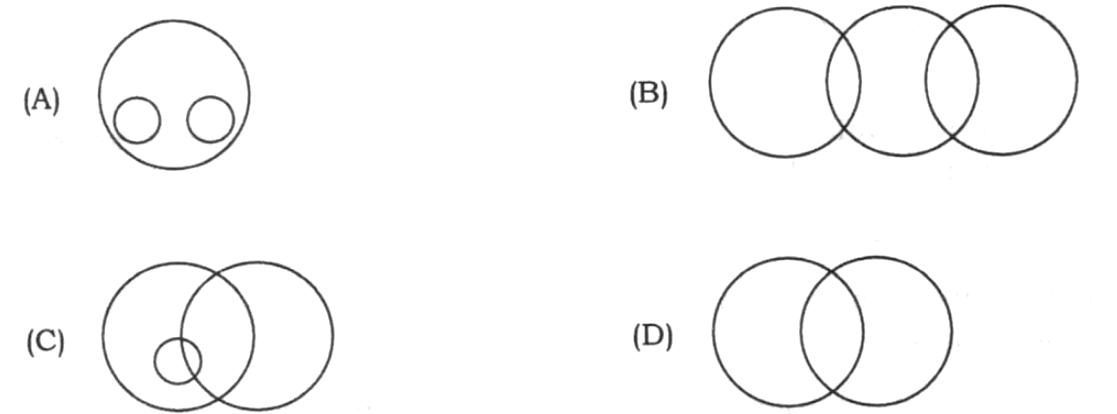
- ADiagram (A) in the figure above
- BDiagram (B) in the figure above
- CDiagram (C) in the figure above
- DDiagram (D) in the figure above
Show answer and explanationHide answer
Answer(A) one large circle (animals) containing two separate small circles (lions and elephants)
Explanation
1. All lions are animals and all elephants are animals, so both small circles must lie fully inside the 'animals' circle.
2. No lion is an elephant, so the two small circles must not touch or overlap.
3. Only diagram (A) shows one big circle with two separate small circles inside it. Answer: (A).
- (A) correct: two separate circles inside one big circle = lions and elephants are both animals and share no member.
- (B) wrong: three circles in a chain overlap partly; this would mean some lions are not animals.
- (C) wrong: a small circle inside one of two overlapping circles shows a different relation (for example, one group inside another with a partial overlap), not two separate groups inside one class.
- (D) wrong: two partly overlapping circles show only two classes with some common members, e.g. some lions are elephants.
For future exams
- Method: write the relation first (lions ⊂ animals, elephants ⊂ animals, lions ∩ elephants = empty), then pick the diagram.
- Similar pattern: 'pens, pencils, stationery' or 'Assam, Meghalaya, India' also give two separate circles inside one big circle.
Micro topic Venn diagram of animal classesChapter Venn Diagrams
A garbage truck visits your locality every alternate day. You have observed that the trashmen neither wear boots nor gloves while collecting garbage from the households. You will
- Aignore the situation
- Bapproach the trashmen and rebuke them for not wearing any protective gear
- Capproach the trashmen and offer some money to buy boots and gloves
- Ddescribe the situation in your social media account with a photo of the scene and tag the local municipal authority to your post
Show answer and explanationHide answer
Answer(D) describe the situation in your social media account with a photo of the scene and tag the local municipal authority to your post
Explanation
Principle: a public-safety problem is best solved by alerting the authority responsible for it. The trashmen work for (or under) the local municipal body, and only that body can supply and enforce safety gear for all of them. Tagging the municipal authority with a photo brings the problem to the right office and creates a public record, so it is the only option that can fix the cause.
- (A) ignore the situation: wrong. A citizen who sees a health risk to workers should act; ignoring it shows no civic sense.
- (B) approach the trashmen and rebuke them for not wearing any protective gear: wrong. The workers are the victims, not the cause; they usually are not given boots and gloves. Rebuking them is unfair and changes nothing.
- (C) approach the trashmen and offer some money to buy boots and gloves: wrong. It is kind but a one-time, private fix. It does not reach the employer, who has the duty to provide safety gear to all workers.
- (D) describe the situation on social media with a photo and tag the local municipal authority: correct. It reaches the responsible authority, adds evidence (the photo) and puts public pressure for a lasting fix for every worker.
For future exams
- Decision-making rule: when a problem is systemic (it affects many people and has an owner), choose the option that informs or involves the responsible authority, not the one that blames the weak party or gives a private one-time fix.
- Options that rebuke, punish or ignore are almost never the APSC answer in civic-sense questions.
Micro topic Civic sense situation responseChapter Decision Making
The average monthly expenditure of a small manufacturing unit is shown in the following table :
| Sl. No. | Expenditure head | Expenditure (in rupees lakh) |
|---|---|---|
| 1 | Raw materials | 12.0 |
| 2 | Salary | 4.5 |
| 3 | Packaging | 0.75 |
| 4 | Transport | 0.5 |
| 5 | Miscellaneous overhead expenditure | 3.5 |
In order to maximize the profit margin, you would
- Asuggest a replacement of the currently used raw material with a low-cost variety
- Bsuggest a reduction of the miscellaneous overhead expenditure
- Csuggest a reduction in the workforce
- Dsuggest an across-the-board salary cut
Show answer and explanationHide answer
Answer(B) suggest a reduction of the miscellaneous overhead expenditure
Explanation
1. Total monthly cost = 12.0 + 4.5 + 0.75 + 0.5 + 3.5 = Rs 21.25 lakh.
2. Miscellaneous overhead is Rs 3.5 lakh, about 16.5 percent of the cost; it is the biggest head that does not directly make or sell the product.
3. Cutting it raises the profit margin without lowering product quality (raw materials) or hurting the workforce (salary, jobs). So the sound first step is to trim overheads.
- (A) replace the raw material with a low-cost variety: wrong as a first choice. Raw material is the largest head (Rs 12 lakh, about 56 percent), but a cheaper variety can lower product quality, hurt sales and the unit's name, and so may reduce profit instead of raising it.
- (B) reduce the miscellaneous overhead expenditure: correct. It is a large (Rs 3.5 lakh) non-productive cost; cutting waste here raises the margin with no harm to quality or staff.
- (C) reduce the workforce: wrong. Fewer workers can cut output and morale; salary (Rs 4.5 lakh) supports production, so job cuts are a last resort, not the first step.
- (D) across-the-board salary cut: wrong. It hurts morale and productivity of all staff and may make good workers leave; it is unfair and not the first step.
For future exams
- Shortcut for cost-cutting tables: first add the heads, then pick the large cost that is 'waste' (overheads, miscellaneous) rather than the cost that drives quality (raw material) or people (salary, jobs).
- Share of each head: raw materials 56.5 percent, salary 21.2 percent, overheads 16.5 percent, packaging 3.5 percent, transport 2.4 percent of Rs 21.25 lakh.
Micro topic Cost cutting decision from expenditure tableChapter Decision Making
What APSC asks in CSAT
Questions by area, CCE 2020 to 2025
400 questions from 5 papers of 80 each. Tap an area to see its questions.
Papers and syllabus
FAQ
APSC CSAT PYQs: questions students ask
Which APSC CSAT papers are included?
General Studies Paper II (CSAT) of the APSC CCE Prelims 2020, 2022, 2023, 2024 and 2025: 80 questions from each paper, 400 in all. The question numbers follow the booklets CCE 2020 Series C, CCE 2022 Series D, CCE 2023 Series A, CCE 2024 Series A, CCE 2025 Series A. The CCE 2025 paper, held in 2026, is the one students call the 2026 CSAT paper.
Is CSAT qualifying in APSC Prelims?
Yes. CSAT (Paper II) has 80 questions for 200 marks. It is qualifying: you need 33% in it, and only then are your GS Paper I marks counted for the Mains merit list.
Which CSAT topics does APSC ask most?
Across the five papers: Logical Reasoning & Mental Ability (132), Basic Numeracy (78), Comprehension (73). Use the area filter or the bars above to practise one area at a time.
Are the answers official?
Answers follow the APSC answer key (CCE 2022: final key; the other papers: the APSC provisional key, the only Paper II key we have for those exams). 21 questions carry an answer-key note: where the key was wrong or the question had an error, the note under the answer explains which answer to mark and why.
How do I practise CSAT here?
Choose an area, a paper or a question type, then switch to Practise: one question at a time, tap an option and see at once whether you are right, with the worked solution. Your record stays only in this browser on this device.