APSC Current Affairs: Assam Tribune Notes with MCQs and Answer Writing (02/11/2026)
In this post
For APSC CCE and other Assam competitive exam aspirants, staying consistently updated with reliable current affairs is essential for success. This blog provides a well-researched analysis of the most important topics from The Assam Tribune dated 02 November 2026. Each issue has been carefully selected and explained to support both APSC Prelims and Mains preparation, ensuring alignment with the APSC CCE syllabus and the evolving trends of the examination.
 Last batch for APSC CCE 2027 · starts 16 NovAPSC CCE Foundation Programme₹24,999
Current Affairs Notes
From The Assam Tribune, 2 November 2026
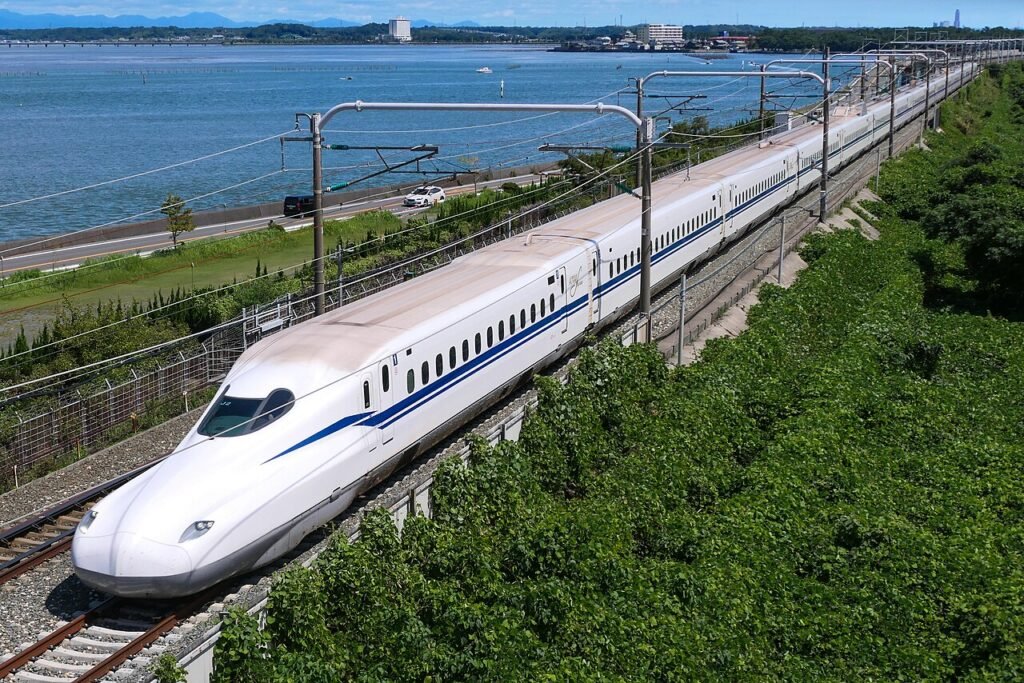
Bullet Train Northern Corridor extended to Guwahati
Open this topic as a separate page, with its MCQs →
Syllabus Mapping
- Prelims: GS Paper I (Current events of State/National importance; Economy of Assam; Geography of Assam and Northeast).
- Mains: GS Paper III (Infrastructure: railways; investment models); GS Paper V (Assam syllabus: economy, infrastructure and connectivity of Assam).
Why in News? On Saturday, 31 October, Railway Minister Ashwini Vaishnaw said the bullet train “Northern Corridor” has got the Prime Minister’s approval. The corridor will run up to Guwahati. Chief Minister Himanta Biswa Sarma welcomed the decision on Sunday, 1 November.
Current Context (The Trigger)
- Route: The Northern Corridor starts in Delhi. Its stops include Agra, Kanpur, Lucknow, Ayodhya, Varanasi, Prayagraj, Patna and Siliguri. It then goes on to Guwahati.
- Extension: The corridor was first planned to end at Siliguri. The Chief Minister says it was extended to the Northeast after he wrote to the Railway Minister and met him in July.
- Travel time: Sarma said Guwahati-Delhi would take under 8 hours.
- Reactions: Union Minister Sarbananda Sonowal thanked both Modi and Vaishnaw. State Finance Minister Jayanta Mallabaruah also welcomed it. He noted that the CM had recently said Assam is looking at an RRTS of its own.
- Railway view: Officials of the Northeast Frontier Railway (NFR) are headquartered at Maligaon. They said the extension will make transport in the East and Northeast faster and more efficient.
Core Concepts & Static GK
- Bullet train under construction: The Mumbai-Ahmedabad High Speed Rail (MAHSR) project is 508 km long. It passes through Gujarat, Maharashtra and the UT of Dadra and Nagar Haveli. It has 12 stations planned.
- Japan’s help: The MAHSR project is being built with technical and financial help from the Government of Japan.
- Land: The entire 1389.5 ha of land for the MAHSR project has been acquired.
Institutional Machinery
- NHSRCL: The National High Speed Rail Corporation Limited is the company building the MAHSR line.
- Northeast Frontier Railway: NFR is headquartered at Maligaon in Guwahati. Its officials welcomed the extension.
Assam & Northeast Linkages
- Siliguri Corridor: The route passes Siliguri. The Siliguri Corridor, or “Chicken’s Neck”, is the narrow strip of land in West Bengal that links the Northeast with the rest of India. News reports put it at about 20-22 km at its narrowest. Nepal and Bangladesh lie on either side of it, and Bhutan lies to its north.
- Rail security of the link: In February 2026, the Railway Minister spoke of special planning, including underground lines. It covers a strategic section of about 40 km. This section links the Northeast with the rest of India. He did not name the exact place.
- Not yet a project: The report is about an approval of the corridor. It gives no cost, deadline or alignment details.
Prelims Trap Zones (Watch out for)
- Endpoint Trap: The corridor was first planned to end at Siliguri. It will now extend to Guwahati.
- Name Trap: This is the “Northern Corridor”. Do not confuse it with the Mumbai-Ahmedabad line, which is a separate project with 12 planned stations.
- Announcer Trap: The Railway Minister announced it. The Prime Minister approved it. The CM welcomed it and had asked for the extension.
Introduction
The Centre has approved a bullet train Northern Corridor from Delhi to Guwahati through Uttar Pradesh, Bihar and Siliguri. For Assam, which sits at the far end of a narrow rail link, this is a major connectivity decision. It also tests how far a high-speed network can serve the eastern region.
Why the Extension Matters
- Time saving: The CM says Delhi-Guwahati can be covered in under 8 hours.
- Business access: Sarma says Assam is preparing for new high-tech industries. He links fast, flight-like travel to more jobs and business.
- Regional integration: Sonowal said the Northeast is “now firmly on the fast lane of connectivity” after decades of neglect.
Challenges
- Narrow Siliguri link: The route must cross the Siliguri Corridor, which is only about 20-22 km wide at its narrowest. Land and security planning will be hard there.
- Cost and land: On the Mumbai-Ahmedabad line, delays in land acquisition in Maharashtra held up work till 2021. Its sanctioned cost was Rs 1,08,000 crore in 2024. A line across big rivers and crowded plains will face similar issues.
- Missing details: The report does not give the alignment, stations in Assam, cost, funding model or timeline.
Government Initiatives and Plans
| Level | Initiative | Purpose |
|---|---|---|
| Centre | Northern Corridor approval | Delhi to Guwahati bullet train link via Siliguri |
| Centre | Planning for underground lines on a strategic 40 km section | Secure the rail link between the Northeast and the rest of India |
| Assam | Looking at an RRTS for Assam (as cited by the Finance Minister) | Faster regional travel |
Way Ahead
- Publish the plan: The Railways should release the alignment, cost, stations and timeline so that Assam can prepare.
- Plan the Siliguri stretch early: Alignment through the narrow corridor needs joint work with the Centre and West Bengal.
- Link first and last mile: Bullet train stations should connect to metro, buses and an RRTS. Then the time saved on the train is not lost on the road.
Conclusion
The approval puts Guwahati on the map of India’s planned high-speed rail network. Its real value will depend on how fast the project is built and how well it connects to the rest of Assam.
Makhana Cultivation in Assam’s Wetlands
Open this topic as a separate page, with its MCQs →
Syllabus Mapping
- Prelims: GS Paper I (Economic and Social Development; General issues on Environment, ecology, Bio-diversity and Climate Change; Current events of State/National importance).
- Mains: GS Paper III (Major crops, cropping patterns, marketing of agricultural produce and related constraints; Biodiversity); GS Paper V (Assam: economic development, bio-diversity and environment).
Why in News? On 1 November, at the Horticulture Research Station, Kahikuchi, experts including scientists of Assam Agricultural University (AAU) said Assam’s wetlands can support makhana farming. They want the crop developed on scientific lines, with markets in mind.
Current Context (The Trigger)
- Wetland potential: Dr Ramani Kanta Thakuria is Director of Open and Distance Learning, AAU. He said nearly one lakh hectares of Assam’s natural wetlands could be used to grow makhana.
- Survey gap: The area where makhana grows naturally has not been surveyed yet. Experts put it at 40,000 to 50,000 hectares.
- Old harvest data: Preliminary studies in 2012 looked at about 10,000 hectares in Jorhat, Sivasagar and Dibrugarh districts. They found that 50-60 tonnes of seeds were harvested every year.
- Field method: Low-lying land where paddy does not pay could be shifted to makhana. The crop needs less water than paddy.
Core Concepts & Static GK
- What is makhana: It is also called fox nut or gorgon nut. Its botanical name is Euryale ferox. It is an aquatic crop grown mainly in shallow ponds, lakes and wetlands.
- Food value: It is valued as a nutritious snack. It is low in fat and has balanced protein with 18 essential amino acids.
- Value chain: Work is created at every step: harvesting, drying, grading, popping, packaging and marketing.
- Cultivation methods: The traditional system needs about three metres of water. The field method needs only about 1 to 1.5 feet and gives higher productivity than pond and beel cultivation.
- Sunlight and air: About 10-20 per cent of the water surface should be kept open. This lets sunlight in and keeps the water aerated.
- GI tag: “Mithila Makhana” from the Mithila region of Bihar has a Geographical Indication (GI) tag.
Constitutional & Legal Framework
- Wetlands Rules, 2017: The Centre notified the Wetlands (Conservation and Management) Rules on 26 September 2017 under the Environment (Protection) Act, 1986. They follow the principle of “wise use” of wetlands. So makhana farming in a natural beel must not damage the wetland.
Schemes & Initiatives
- National Makhana Board: It was announced in the Union Budget 2025-26. Prime Minister Narendra Modi launched it at Purnea, Bihar, on 15 September 2025.
- Central scheme: The Central Sector Scheme for Development of Makhana has an outlay of Rs 476.03 crore for 2025-26 to 2030-31.
Reports, Indices & Data
- Bihar leads: Bihar is India’s leading makhana-producing state.
Assam & Northeast Linkages
- Deepor Beel: Makhana leaves spread widely over Deepor Beel Wildlife Sanctuary between February and April. Wild elephants enter the wetland to eat the plant and its fruits. They mostly leave the leaves alone. Their feeding also opens the water surface to sunlight. An expert called this “a natural solution to this natural predicament”.
- Ramsar status: Deepor Beel is a Ramsar site, designated on 19 August 2002.
- Favourable climate: Assam’s humid subtropical climate, heavy rainfall and plentiful water suit the crop.
- Existing industry: Assam already has a makhana popping industry.
Prelims Trap Zones (Watch out for)
- Depth Trap: The field method needs about 1 to 1.5 feet of water. Three metres is the need of the traditional system.
- Area Trap: One lakh hectares is the wetland area with potential. The natural makhana area is only an estimate of 40,000 to 50,000 hectares.
- State Trap: The Mithila Makhana GI tag belongs to Bihar, not Assam.
- Act Trap: The Wetlands Rules, 2017 come under the Environment (Protection) Act, 1986, not the Wild Life (Protection) Act, 1972.
Introduction
Assam has many beels and low-lying fields. Experts say makhana can turn some of them into a source of farm income. The task is to grow it without harming the wetland itself.
Economic Rationale
- Diversification: Makhana gives farmers another crop, especially on land where paddy is not economical.
- Rural jobs: Harvesting, drying, grading, popping, packaging and marketing all give work.
- Water saving: The crop needs less water than paddy.
- Market: More local production and processing could meet rising demand in the Northeast. It could also reach national and international markets.
Challenges
- Low awareness: Dr Ranjita Bezbaruah, scientist (Agronomy), AAU, named lack of awareness as a major constraint.
- Seed supply: Enough seed will come only from scientific cultivation.
- Water swings: Sudden changes in water level can damage the crop. Natural water bodies drying early because of climate change are another threat.
- Weak data: The natural growth area has not been surveyed.
- Ecology risk: Careless expansion could hurt wetland biodiversity and fisheries.
Government & Statutory Measures
| Level | Initiative | Purpose & Impact |
|---|---|---|
| Centre | Wetlands (Conservation and Management) Rules, 2017 | Protection and wise use of wetlands |
| Centre | National Makhana Board and Central Sector Scheme for Development of Makhana | Support for production, processing, value addition and marketing of makhana |
Way Ahead
- Mapping: Map agro-climatic suitability at district, block and village levels.
- Pilots: Start pilot projects. Then expand step by step with government help and farmer groups.
- Quality: Build quality control, proper packaging and processing units.
- Safeguards: Use scientific land-use planning so that wetland wildlife and fish stocks stay safe.
Conclusion
Makhana can add income and jobs in rural Assam. It will work only if farming is planned with the wetland in mind.
World Bank Poverty and Equity Brief on India’s Extreme Poverty
Open this topic as a separate page, with its MCQs →
Syllabus Mapping
- Prelims: GS Paper I (Current events of National and International importance; Economic and Social Development: Poverty, Inclusion, Social Sector Initiatives).
- Mains: GS Paper II (Welfare schemes for vulnerable sections of the population; Issues relating to poverty and hunger); GS Paper III (Indian Economy and issues relating to growth, development and employment; Inclusive growth and issues arising from it).
Why in News? An Assam Tribune editorial discusses the World Bank’s October 2026 Poverty and Equity Brief on India. The brief reports a steep fall in extreme poverty. The editorial welcomes it but questions the data and the welfare-led route out of poverty.
Current Context (The Trigger)
- Extreme poverty: As quoted in the editorial, India’s rate at $3.00 per day (2021 PPP) dropped from 27.1% in 2011 to 2.6% in 2023.
- Lower-middle-income line: The share of people below $4.20 per day dropped from 57.7% in 2011 to 16.1% in 2023.
- Projection: The $4.20 poverty rate is projected to reach 12.1% by 2028.
- Drivers named: The World Bank credits mainly strong consumption growth, more jobs (especially for women) and wider social transfers such as food subsidies.
- Its verdict: The Bank calls it “one of the fastest poverty declines in the world”.
Core Concepts & Static GK
- International Poverty Line: It is the World Bank’s line for extreme poverty. In June 2025 it was set at $3.00 per person per day (2021 PPP), replacing the $2.15 line based on 2017 PPPs.
- How $3.00 is derived: The Bank takes the national poverty lines of low-income countries. It converts them with 2021 PPPs and takes the median, $3.04. This is rounded to $3.00.
- Other lines: $4.20 is the line for lower-middle-income economies (earlier $3.65). $8.30 is the line for upper-middle-income economies (earlier $6.85).
- PPP: Purchasing power parity adjusts for price differences between countries. The prices come from the International Comparison Program (ICP).
Institutional Machinery
- World Bank: It sets the global poverty lines and publishes the Poverty and Equity Briefs.
- NITI Aayog: It publishes India’s own National Multidimensional Poverty Index (MPI).
Reports, Indices & Data
- National MPI: It has three equally weighted dimensions: health, education and standard of living. They are measured by 12 indicators. A person is “MPI poor” if deprived in one-third or more of the weighted indicators.
- NITI estimate: NITI Aayog’s January 2024 paper put multidimensional poverty at 29.17% in 2013-14 and 11.28% in 2022-23. Both years are estimates, not survey results.
- Editorial’s figure: The editorial says a Multidimensional Poverty Index fell to 15.5% in 2022-23. This is not NITI Aayog’s 11.28% figure.
- Gaps: As per the editorial, the brief says the top 10% earn 13 times more than the bottom 10%. It puts rural poverty at 19.3% and urban poverty at 8.6%. Youth unemployment rose to 15.9% by early 2026.
Prelims Trap Zones (Watch out for)
- Line Trap: The extreme poverty line is now $3.00 (2021 PPP), not $2.15 (the older 2017 PPP line).
- Threshold Trap: $4.20 is the lower-middle-income line. $8.30 is the upper-middle-income line.
- Measure Trap: The World Bank lines count people below a money value per day. The National MPI instead counts deprivations in health, education and living standards.
- Median Trap: The $3.00 line is the median of low-income countries’ national lines, not their average.
- Number Trap: For 2022-23, NITI Aayog’s MPI estimate is 11.28%. The 15.5% in the editorial is a different figure.
Introduction
The World Bank’s October 2026 brief, as quoted by the editorial, puts India’s extreme poverty at 2.6% in 2023. Cutting poverty is at the heart of inclusive growth. The editorial asks whether the gain is real and will last.
What Drove the Decline
- Consumption growth: Households spent more, which points to better living standards.
- Jobs: Employment rose, especially among women.
- Social transfers: Food subsidies and other transfers supported poor households.
Caveats Raised
- Inequality persists: The richest 10% earn 13 times more than the poorest 10%.
- Rural gap: Rural poverty (19.3%) is more than double urban poverty (8.6%).
- Youth jobs: Youth unemployment reached 15.9% by early 2026.
- Data quality: The editorial says the estimates may not stand close scrutiny if they rest on data from Indian authorities.
- Method of upliftment: It asks whether poverty fell through real social change or through handouts such as free food, monthly stipends and free scooters.
- Dependency risk: It warns that a “Rabadi culture” may weaken people’s drive to improve their own lives.
Comparative Assessment of Poverty Measures
| Measure | What it counts | Basis |
|---|---|---|
| International Poverty Line | People living below $3.00 a day | 2021 PPP; median of low-income countries’ national lines |
| Lower-middle-income line | People living below $4.20 a day | 2021 PPP; line for lower-middle-income economies |
| National MPI (NITI Aayog) | Deprivation in health, education and living standards | 12 indicators; poor if deprived in one-third or more |
Way Ahead
- Skills and jobs: Expand vocational training so people can earn on their own.
- Youth employment: Treat the 15.9% youth unemployment as a priority.
- Rural focus: Target the rural poor, where poverty is higher.
- Open data: Release survey data that independent experts can check.
- Track both measures: Read income-based and multidimensional numbers together.
Conclusion
The fall in extreme poverty is good news. Lasting progress needs jobs, skills and trusted data, not only transfers.
Asked in APSC
- APSC Prelims 2024: As per the NITI Aayog’s multi-dimensional poverty index (as per the latest statistics for 2022–23), the percentage of population in Assam classified as poor is: (practise it in the MCQs below)
- APSC Mains 2023, GS Paper 1 (15 marks): “Although India has achieved substantial economic growth in recent times, its biggest challenge today is to bridge the widening of gap between the rich and the poor.” Analyze this statement and suggest measures to address this issue.
Civilian Arms Licensing and Assam’s Special Scheme
Open this topic as a separate page, with its MCQs →
Syllabus Mapping
- Prelims: GS Paper I (Current events of State/National importance); Indian Polity (Constitution, fundamental rights).
- Mains: GS Paper II (Constitutional provisions, governance, accountability); GS Paper IV (Ethics in public administration); GS Paper V (Assam: security and administration).
Why in News? A shooting at a Guwahati hotel has raised a wider question. How well does the State manage the risks once it allows a citizen to hold a gun? An article in The Assam Tribune links this to Assam’s 2025 arms-licensing scheme. It also links it to an August 2026 Gauhati High Court ruling on gun licences.
Current Context (The Trigger)
- The trigger: Police seized a licensed pistol that may have been used in the firing. A Special Investigation Team is probing the case. The article warns against any early conclusion about the licensing process.
- Gauhati High Court: In Md. Kapiluddin Laskar and Others v. State of Assam (August 2026), the Court repeated that nobody has a fundamental right to get or renew a gun licence. It called a licence a statutory privilege. The applicant must show a justified need.
Core Concepts & Static GK
- Licence as privilege: The High Court said the licence is “only a statutory privilege” under the Arms Act, 1959. It is not a constitutional right. The Court relied on the Supreme Court’s decision in Rajendra Singh v. State of Uttar Pradesh.
- Justified need: The licensing authority decides on its own satisfaction. The Court said an applicant must clearly prove a real threat.
Constitutional & Legal Framework
- Arms Act, 1959: Section 13 deals with grant of licences. Section 14 gives grounds for refusal. Section 15 covers how long a licence lasts and its renewal. Section 17 lets the authority vary, suspend or revoke a licence.
- Section 17 grounds: Some grounds are these. The holder is unfit. Public peace or safety needs it. The licence was got by hiding facts or giving wrong information. A licence condition was broken.
- Validity: A Section 3 licence is now valid for five years. Earlier it was three years. The Arms (Amendment) Bill, 2019 made this change. Lok Sabha passed it on 9 December 2019 and Rajya Sabha on 10 December 2019.
- Firearm limit: The 2019 amendment also cut the number of firearms one person may hold from three to two. The Bill had first proposed one.
- Articles 14 and 21: Article 14 gives equality before law and guards against arbitrary State action. Article 21 covers the right to life and personal liberty. Neither Article gives a fundamental right to own a gun.
Institutional Machinery
- Licensing authority: In the case before the Gauhati High Court, the District Commissioner had found the case unfit for renewal.
Schemes & Initiatives
- Special Scheme: The Assam Cabinet approved the Special Scheme for Grant of Arms Licences to Original Inhabitants and Indigenous Indian Citizens in Vulnerable and Remote Areas of Assam in May 2025. The Cabinet decision came on 28 May 2025.
- Online portal: Applications are taken online through the Sewa Setu portal. It went live on 14 August 2025.
- Legal base: The scheme uses the central Arms Act, 1959 and the Arms Rules, 2016. Assam has not made a separate state arms law.
- Licences, not guns: The Chief Minister said the State will not supply arms. It will only give licences.
Assam & Northeast Linkages
- Who is covered: Eligible indigenous citizens living in remote and vulnerable areas. Reports say applicants must be at least 21 years old, have no criminal record and be mentally and physically fit.
- Remote areas: Reports say the scheme targets places where police take at least two hours to respond.
- Excluded towns: The Chief Minister said Guwahati, Jorhat, Dibrugarh and Silchar are outside the scheme.
Prelims Trap Zones (Watch out for)
- Law Trap: The scheme works under the central Arms Act, 1959 and Arms Rules, 2016. It is not a state law.
- Rights Trap: Articles 14 and 21 do not give a fundamental right to hold a gun. The Gauhati High Court called a licence a statutory privilege.
- Section Trap: Section 13 is grant, Section 14 is refusal, Section 15 is duration and renewal, Section 17 is variation, suspension and revocation.
- Number Trap: The 2019 amendment set the limit at two firearms per person, not one. Licence validity is five years, not three.
- Supply Trap: The State issues licences. It does not hand out weapons.
Introduction
When the State lets a citizen hold a firearm, it takes on a duty to manage the risk. Assam’s 2025 scheme makes this duty heavier, because it opens a licence route in areas seen as vulnerable.
Rationale and Risks of the Scheme
- Stated reason: People in vulnerable areas may face threats while police help is far away.
- Risk side: A gun may give a sense of safety. It can also make personal disputes, threats, impulsive acts and accidents more deadly.
- Right test: The question is not how many licences are issued. It is whether safety improves without new danger to others.
Licensing as a Continuing Responsibility
- Discretion with limits: Officials must use their discretion as the law allows, on evidence and on relevant grounds. It should be neither a rubber stamp nor an arbitrary refusal.
- After the grant: A holder’s situation can change. The authority should act on credible safety concerns. But a private quarrel or an unverified claim cannot by itself justify suspension or revocation.
- Review: Assam should check police verification, renewal, record keeping and handling of risk information from time to time.
Constitutional Rights and Administrative Ethics
- Fair criteria: Eligibility tied to residence needs clear and consistent rules. The policy should not create arbitrary lines or political favours.
- Ethics: Officials must be impartial and honest. Approving without scrutiny puts the public at risk. Refusing without legal basis wrongs an eligible applicant.
- Accountability: Officials should record their decisions and state the legal basis for any action.
Internal Security Beyond Firearms
- Not a substitute: Civilian licences should not replace policing. A lasting plan also needs quicker police response, local intelligence, public trust, steps to prevent conflict and easy access to courts.
- Transparency: The article asks the government to release anonymised figures on how many licences were sought, granted, refused, suspended or cancelled.
Way Ahead
- Measure results: Judge the scheme on outcomes, such as proven threat, consistent criteria and any misuse.
- Publish data: Release anonymised licence data where law and operations allow.
- Audit the process: Review verification, renewal and records at regular intervals.
- Strengthen policing: Invest in response time and local intelligence in remote areas.
Conclusion
The shooting does not prove any link to the special scheme or any failure by licensing authorities. It does remind the State that legal access to guns comes with duties of evidence, oversight and open review.
News in Short
- Mizoram refugee enrolment: Mizoram has taken biometric data of 29,763 out of 29,792 identified Myanmar refugees. That is a completion rate of 99.90 per cent. The work is over in eight of the State’s 11 districts.
- Kopili river acidity: NEEPCO first found the Kopili’s water acidic in 2006, with a pH of about 2.3-2.7 (neutral is 7). Sulphuric acid from rat-hole coal mines in Meghalaya caused it. The river is improving but is still not neutral.
- Exostoma nasibarbatum: A new glyptosternine catfish found in Manipur’s Bupal stream, part of the Chindwin river system. It was described in the Journal of Natural History. The name points to its long nasal barbel.
- Dysphaea assamensis: A new damselfly species from Karbi Anglong district, Assam. Its description appeared in the journal Zootaxa on 13 October 2026. It corrects a wrong identification that had stood since 1927.
- Morigaon Saksham status: Under the Mission Mobilization for AIDS Suraksha 2026, Morigaon district in Assam has earned ‘Saksham’ status. Its eART Care initiative helped link people living with HIV to antiretroviral therapy (ART).
- Bharat Renewable Energy Summit 2026: The four-day Bharat Renewable Energy Summit & Expo runs from 2 to 5 November 2026 at Bharat Mandapam, New Delhi. Its theme is ‘Invest. Innovate. Inspire’. Assam is one of 13 States and UTs showing their clean energy potential.
- Nilekani exam reform task force: The Centre has given the Nandan Nilekani-led task force on exam reforms time till January 2027. Its tenure was to end in October 2026. It was set up in July after this year’s NEET paper leak protests.
- India-Myanmar Army Staff Talks: The 8th India-Myanmar Army-to-Army Staff Talks took place at Naypyidaw. The Indian side gave training simulators to the Myanmar Army.
APSC Prelims MCQs
Practice questions on the topics above
Topic 1: Bullet Train Northern Corridor extended to Guwahati
Q1. The Railway Minister has announced approval of a bullet train Northern Corridor extending to Guwahati. Consider the following statements:
(i) The corridor begins in Delhi.
(ii) The corridor was originally meant to end at Varanasi.
(iii) The route includes Patna and Siliguri.
Which of the statements given above is/are correct?
- (a) (i) only
- (b) (i) and (iii) only
- (c) (ii) and (iii) only
- (d) (i), (ii) and (iii)
Show answer
Answer: (b) Explanation: The corridor begins in Delhi and passes Patna and Siliguri. Statement (ii) is wrong because it was first meant to end at Siliguri. Varanasi is only a stop on the way.
Q2. Consider the following statements about the land link between the Northeast and the rest of India:
(i) The Siliguri Corridor lies in West Bengal.
(ii) The Siliguri Corridor lies wholly inside Assam.
(iii) In February 2026, the Railway Minister said underground lines have been planned. They are for a strategic section of about 40 km linking the Northeast with the rest of India.
Which of the statements given above is/are correct?
- (a) (i) and (ii) only
- (b) (ii) and (iii) only
- (c) (i) and (iii) only
- (d) (i), (ii) and (iii)
Show answer
Answer: (c) Explanation: The Siliguri Corridor is a narrow strip in West Bengal, so (i) is correct and (ii) is wrong. Statement (iii) is correct: the Minister spoke of special planning, including underground lines, for a strategic section of about 40 km.
Q3. Match List-I with List-II:
| List-I | List-II |
|---|---|
| a. Headquarters of Northeast Frontier Railway | 1. Siliguri |
| b. Starting point of the Northern Corridor | 2. 12 |
| c. Original end point of the Northern Corridor | 3. Maligaon |
| d. Number of stations planned on the Mumbai-Ahmedabad line | 4. Delhi |
Select the correct answer using the codes given below:
- (a) a-4, b-3, c-1, d-2
- (b) a-3, b-4, c-1, d-2
- (c) a-3, b-4, c-2, d-1
- (d) a-1, b-4, c-3, d-2
Show answer
Answer: (b) Explanation: NFR is headquartered at Maligaon, and the corridor starts in Delhi. It was first meant to end at Siliguri, and the Mumbai-Ahmedabad line has 12 planned stations. Every other code swaps at least one pair.
Q4. Which of the following cities is NOT named as a stop on the Northern bullet train corridor announced for extension to Guwahati?
- (a) Ayodhya
- (b) Prayagraj
- (c) Bhubaneswar
- (d) Kanpur
Show answer
Answer: (c) Explanation: The route runs from Delhi through Agra, Kanpur, Lucknow, Ayodhya, Varanasi, Prayagraj, Patna and Siliguri to Guwahati. Bhubaneswar is not on it.
Topic 2: Makhana Cultivation in Assam’s Wetlands
Q5. Makhana is being promoted as a new crop for Assam’s wetlands. Consider the following statements:
(i) Its botanical name is Euryale ferox.
(ii) Mithila Makhana of Bihar has a Geographical Indication (GI) tag.
(iii) The field method needs water about three metres deep.
Which of the statements given above is/are correct?
- (a) (i) and (ii) only
- (b) (ii) and (iii) only
- (c) (i) and (iii) only
- (d) (i), (ii) and (iii)
Show answer
Answer: (a) Explanation: Makhana is Euryale ferox, and Mithila Makhana has a GI tag. Statement (iii) is wrong. The field method needs only about 1 to 1.5 feet of water. Three metres is the need of the traditional system.
Q6. Match List-I with List-II (makhana cultivation in Assam):
| List-I | List-II |
|---|---|
| a. Water depth in the field method | 1. About 3 metres |
| b. Water needed in the traditional system | 2. 1 to 1.5 feet |
| c. Water surface to be kept open | 3. 10-20 per cent |
| d. Estimated natural makhana area in Assam | 4. 40,000 to 50,000 hectares |
Select the correct answer using the codes given below:
- (a) a-2, b-1, c-3, d-4
- (b) a-1, b-2, c-3, d-4
- (c) a-2, b-1, c-4, d-3
- (d) a-3, b-4, c-1, d-2
Show answer
Answer: (a) Explanation: The field method needs 1 to 1.5 feet of water. The traditional system needs about 3 metres. About 10-20 per cent of the surface should stay open, and the natural area is estimated at 40,000 to 50,000 hectares. Option (b) swaps the two depths, and the other codes mix up the figures.
Q7. Which of the following statements is NOT correct?
- (a) Makhana leaves grow widely in Deepor Beel Wildlife Sanctuary between February and April.
- (b) Preliminary studies in 2012 found 50-60 tonnes of makhana seeds harvested yearly from about 10,000 hectares in Jorhat, Sivasagar and Dibrugarh.
- (c) Deepor Beel was designated a Ramsar site on 19 August 2002.
- (d) The Wetlands (Conservation and Management) Rules, 2017 were notified under the Wild Life (Protection) Act, 1972.
Show answer
Answer: (d) Explanation: The Wetlands Rules, 2017 were notified under the Environment (Protection) Act, 1986, not the Wild Life (Protection) Act, 1972. The other three statements are correct.
Q8. Which body, announced in the Union Budget 2025-26, was launched at Purnea in Bihar on 15 September 2025 to support the makhana sector?
- (a) National Horticulture Board
- (b) National Makhana Board
- (c) Spices Board
- (d) National Bamboo Mission
Show answer
Answer: (b) Explanation: The National Makhana Board was announced in Budget 2025-26. The Prime Minister launched it at Purnea, Bihar, on 15 September 2025. The National Horticulture Board and the Spices Board are older bodies with a wider remit, and the National Bamboo Mission deals with bamboo.
Topic 3: World Bank Poverty and Equity Brief on India’s Extreme Poverty
Q9. An Assam Tribune editorial discusses the World Bank’s October 2026 Poverty and Equity Brief on India. Consider the following statements about the brief’s figures as quoted in the editorial:
(i) The extreme poverty line used is $3.00 per day at 2021 purchasing power parity.
(ii) India’s extreme poverty rate dropped from 27.1% in 2011 to 2.6% in 2023.
(iii) The share of people below $4.20 per day dropped from 57.7% in 2011 to 12.1% in 2023.
Which of the statements given above is/are correct?
- (a) (i) only
- (b) (i) and (ii) only
- (c) (ii) and (iii) only
- (d) (i), (ii) and (iii)
Show answer
Answer: (b) Explanation: Statements (i) and (ii) are correct. In (iii), the 2023 figure was 16.1%. The 12.1% figure is the projection for 2028.
Q10. Assertion (A): Since the June 2025 update, the World Bank’s international poverty line is $3.00 per person per day. Reason (R): The line is the median of the national poverty lines of low-income countries, converted with 2021 PPPs and rounded.
- (a) Both A and R are true and R is the correct explanation of A
- (b) Both A and R are true but R is not the correct explanation of A
- (c) A is true but R is false
- (d) A is false but R is true
Show answer
Answer: (a) Explanation: The median of those national lines is $3.04. Rounded to the nearest 10 cents, it gives $3.00. So R explains A. The older $2.15 line was based on 2017 PPPs.
Q11. According to the World Bank brief discussed in the Assam Tribune editorial, which one of the following was NOT named as a main reason for the fall in India’s poverty?
- (a) Strong consumption growth
- (b) Rising employment, especially among women
- (c) Wider social transfers, including food subsidies
- (d) A sharp fall in income inequality
Show answer
Answer: (d) Explanation: The brief names (a), (b) and (c) as the main drivers. On inequality it says the opposite: the richest 10% still earn 13 times more than the poorest 10%.
Q12. Which one of the following is the World Bank poverty line for lower-middle-income economies after the June 2025 update?
- (a) $2.15 per day
- (b) $3.65 per day
- (c) $4.20 per day
- (d) $8.30 per day
Show answer
Answer: (c) Explanation: The lower-middle-income line rose from $3.65 to $4.20. $2.15 was the old extreme poverty line. $8.30 is the upper-middle-income line.
PYQ (APSC Prelims 2024): As per the NITI Aayog’s multi-dimensional poverty index (as per the latest statistics for 2022–23), the percentage of population in Assam classified as poor is:
- (A) 36.97%
- (B) 26.37%
- (C) 14.47%
- (D) 13.73%
Show answer
Answer: (C) Explanation: NITI Aayog’s discussion paper ‘Multidimensional Poverty in India since 2005-06’ (January 2024) estimated that the share of Assam’s population living in multidimensional poverty fell from 36.97% in 2013-14 to 14.47% in 2022-23. Over 80 lakh people in Assam moved out of multidimensional poverty during these nine years. Note that the 2022-23 state figures are projections based on the trend between NFHS rounds, not a fresh survey.
Topic 4: Civilian Arms Licensing and Assam’s Special Scheme
Q13. Consider the following statements about civilian gun licensing in India:
(i) Under Section 17 of the Arms Act, 1959, a licensing authority can vary, suspend or revoke a licence in certain cases.
(ii) Assam’s 2025 special arms-licensing scheme is based on a separate Assam arms law.
(iii) The Gauhati High Court held in August 2026 that nobody has a fundamental right to get or renew a gun licence.
Which of the statements given above is/are correct?
- (a) (i) only
- (b) (i) and (iii) only
- (c) (ii) and (iii) only
- (d) (i), (ii) and (iii)
Show answer
Answer: (b) Explanation: (i) and (iii) are correct. (ii) is wrong because the scheme uses the central Arms Act, 1959 and the Arms Rules, 2016, not a state law.
Q14. Match List-I (Section of the Arms Act, 1959) with List-II (Subject):
| List-I (Section) | List-II (Subject) |
|---|---|
| a. Section 13 | 1. Duration and renewal of licence |
| b. Section 14 | 2. Variation, suspension and revocation of licence |
| c. Section 15 | 3. Grant of licence |
| d. Section 17 | 4. Refusal of licence |
Select the correct answer using the codes given below:
- (a) a-4, b-3, c-1, d-2
- (b) a-3, b-4, c-2, d-1
- (c) a-3, b-4, c-1, d-2
- (d) a-1, b-4, c-3, d-2
Show answer
Answer: (c) Explanation: Section 13 is grant and Section 14 is refusal. Section 15 deals with duration and renewal. Section 17 covers variation, suspension and revocation. Option (a) swaps grant and refusal, a common trap.
Q15. Consider the following statements:
(i) Applications under Assam’s special arms-licensing scheme are taken through the Sewa Setu portal, which went live on 14 August 2025.
(ii) Article 21 of the Constitution gives a fundamental right to own a gun.
(iii) Article 14 guards against arbitrary State action.
How many of the statements given above are correct?
- (a) Only one
- (b) Only two
- (c) All three
- (d) None
Show answer
Answer: (b) Explanation: (i) and (iii) are correct. (ii) is wrong because neither Article 14 nor Article 21 gives a fundamental right to hold a gun. A licence is only a statutory privilege.
Q16. Which of the following statements about Assam’s special arms-licensing scheme is NOT correct?
- (a) The Assam Cabinet approved it in May 2025.
- (b) It is meant for eligible indigenous people living in remote and vulnerable areas.
- (c) It is run under the Arms Act, 1959 and the Arms Rules, 2016.
- (d) The State government supplies firearms to the selected applicants.
Show answer
Answer: (d) Explanation: The State gives only licences, not weapons, as the Chief Minister said at the portal launch. Options (a), (b) and (c) are correct.
Mains Answer Writing
One exam-style question with a model answer
Q. Critically examine the view that falling poverty, as measured by international agencies, must be matched by sustainable empowerment and not dependence on welfare transfers, in light of the World Bank’s October 2026 Poverty and Equity Brief on India. (250 words, 15 marks)
Model answer
Introduction: The World Bank’s October 2026 Poverty and Equity Brief reports a sharp fall in poverty in India. The real test is whether people stay out of poverty without constant state support.
1. What the Brief shows
- Extreme poverty: At the $3.00 a day line (2021 PPP), the rate fell from 27.1% (2011) to 2.6% (2023).
- Higher line: At the $4.20 a day line, the rate fell from 57.7% to 16.1% over the same years. By this measure, about 496 million people moved out of poverty.
- Drivers: Strong consumption growth, more jobs (especially for women) and wider social transfers such as food subsidies.
- Outlook: The Bank expects the $4.20 rate to fall to 12.1% by 2028.
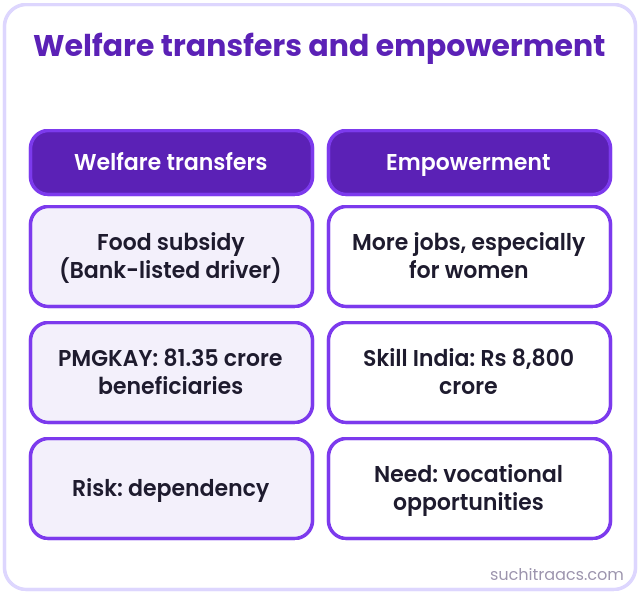
2. Welfare transfers versus empowerment
| Case for transfers | Case for empowerment |
|---|---|
| Food subsidy is one of the drivers the Bank lists. | Rising employment, especially among women, is also a driver. |
| Under PMGKAY, the Cabinet approved free foodgrains for 81.35 crore beneficiaries for five years from 1 January 2024. | In February 2025, the Cabinet approved the Skill India Programme with Rs 8,800 crore for 2022-23 to 2025-26. |
- Data doubts: The Assam Tribune editorial asks whether official Indian data behind the estimates can stand close scrutiny. The Brief itself says part of the recent gain may reflect better measurement.
- Dependence risk: The editorial warns that free food, monthly stipends and free scooters may not sustain the gains if they replace real empowerment. It calls this the “Rabadi culture”.
- Balanced view: Employment grew by about 134 million between 2017 and 2023, much of it rural women entering paid work. So transfers alone did not drive the fall.
3. Way Forward
- Skills and jobs: Link transfers to vocational training and work, especially for women.
- Data trust: Publish survey data openly for independent checks.
- Exit plan: Support could be tapered step by step as household incomes rise.
Conclusion: The fall in poverty is real progress, but transfers alone cannot hold it. Jobs and skills must carry it forward.
Prepare with SuchitraACS
APSC CCE Foundation Programme₹24,999  APSC Prelims Crash Course 2027 (GS + CSAT)₹5,999
 APSC CCE Study Materials Package (Prelims + Mains)₹4,999