APSC Current Affairs: Assam Tribune Notes with MCQs and Answer Writing (17/11/2026)
For APSC CCE and other Assam competitive exam aspirants, staying consistently updated with reliable current affairs is essential for success. This blog provides a well-researched analysis of the most important topics from The Assam Tribune dated 17 November 2026. Each issue has been carefully selected and explained to support both APSC Prelims and Mains preparation, ensuring alignment with the APSC CCE syllabus and the evolving trends of the examination.
 For working professionals and full-time aspirantsAPSC CCE Foundation Programme₹24,999
Current Affairs Notes
From The Assam Tribune, 17 November 2026
Semiconductor Skilling Lab at NIELIT Guwahati and Tata’s Jagiroad Plant
Open this topic as a separate page, with its MCQs →
Syllabus Mapping
- Prelims: GS Paper I (Current events of State/National importance; Science and Technology; Assam Economy).
- Mains: GS Paper III (Indian Economy: industrial policy, employment, skill development; Science and Technology); GS Paper II (Government policies and interventions for development); GS Paper V (Assam Economy: industrial development, human resource development).
Why in News? The Ministry of Electronics and Information Technology (MeitY) has approved a Semiconductor Assembly and ESD Training Laboratory at NIELIT Guwahati. MeitY calls it the first dedicated semiconductor packaging training lab in the Northeast. An opinion article in The Assam Tribune (17 November 2026) links it to Tata’s Rs 27,000-crore chip plant at Jagiroad in Morigaon district.
Current Context (The Trigger)
- Approved project: MeitY has approved the project titled “Setting up of Semiconductor Assembly & ESD Training Laboratory at NIELIT Guwahati”.
- Who runs it: The National Institute of Electronics and Information Technology (NIELIT) will run the lab.
- Stated aim: The lab will train people in assembly, testing, marking and packaging (ATMP). It is meant to serve the chip projects now being set up in the Northeast.
- Plant status: Tata Semiconductor Assembly and Test is already running pilot lines inside a cleanroom at Jagiroad. Commercial production is expected around December 2026 or January 2027.
- Jobs and trainees: The plant is expected to create about 15,000 direct and 12,000 indirect jobs. About two dozen Assamese women have already joined the plant. Nearly 500 more are being trained, and over 200 should join by December.
- Linked training tie-ups: NIELIT signed an MoU with Tata Electronics in January 2025. Last month, IIT Guwahati also signed a pact with Tata Electronics to set up an ATMP Centre of Excellence.
Core Concepts & Static GK
- ATMP: ATMP stands for assembly, testing, marking and packaging. It is the back-end stage, where a finished chip is sealed in a package and tested.
- Fab versus packaging: A fab is a plant that etches circuits onto silicon wafers. The article argues that packaging, not the fab, offers most of the jobs and is where India can compete in the near term.
- ESD: ESD means electrostatic discharge. A single static spark from a worker’s touch can ruin an expensive chip, so static control is a basic skill on a packaging line.
- Technologies at Jagiroad: The plant will use wire-bond and flip-chip technologies. Its chips are meant for cars, industrial machines, telecom gear, consumer electronics and AI devices.
- Shop-floor skills: Workers must learn cleanroom discipline, wire bonding, die attach and moulding, along with chip inspection and testing. These are learnt by repeated practice on machines under supervision, not from books.
- NIELIT: NIELIT is an autonomous scientific society under MeitY. It was earlier known as the DOEACC Society.
Institutional Machinery
- MeitY: The ministry approved the Guwahati lab. It is also the parent ministry of NIELIT.
- NIELIT network: NIELIT has over 50 centres and 700 accredited institutes across India. In Assam, NIELIT Guwahati and its extension centres have together trained over 1.7 lakh people.
- India Semiconductor Mission (ISM): ISM was set up as an Independent Business Division within the Digital India Corporation. It is the nodal agency for the Semicon India schemes.
- IIT Guwahati: The institute will host an ATMP Centre of Excellence with Tata Electronics. It will offer diploma and BTech programmes and carry out research.
Schemes & Initiatives
- Semicon India Programme: The Union Cabinet approved the programme in December 2021 with an outlay of Rs 76,000 crore.
- Support for ATMP units: After the Cabinet modified the programme in September 2022, compound semiconductor and ATMP/OSAT units get fiscal support of 50 per cent of capital expenditure on a pari-passu basis. The original 2021 rate was 30 per cent.
- Design Linked Incentive: This scheme supports chip design. Its nodal agency is the Centre for Development of Advanced Computing (C-DAC), a scientific society under MeitY.
- ISM 2.0: The Union Cabinet approved the second phase, Semicon 2.0, on 15 July 2026. The article puts its outlay at about Rs 1.28 lakh crore. It has six pillars, including ATMP/OSAT, research and development, and talent development.
- Cabinet approval for Assam: On 29 February 2024 the Cabinet approved three semiconductor units. One of them is Tata’s ATMP unit at Morigaon, with a capacity of 48 million chips a day.
Reports, Indices & Data
- Plant scale: Tata’s Jagiroad plant is a Rs 27,000-crore project. When fully running, it will handle about 48 million chips every day.
- Project mix: The article notes that most of the projects approved in Gujarat and Assam are packaging (ATMP or OSAT) units. Among them, only Tata-PSMC’s plant at Dholera is a real fab.
- Dholera fab: The Dholera fab was approved with an investment of Rs 91,000 crore. Its capacity is 50,000 wafer starts per month.
- Other ATMP unit: CG Power’s unit at Sanand, Gujarat, was approved with an investment of Rs 7,600 crore. Its capacity is 15 million chips a day.
Assam & Northeast Linkages
- Industrial revival: The Tata plant is built where the closed Nagaon Paper Mill stood, at Jagiroad in Morigaon district.
- State takeover of mills: The Assam government took over the assets of the Nagaon and Cachar paper mills of Hindustan Paper Corporation in March 2022, for Rs 375 crore.
- Distance: The article says Guwahati is about 60 km from Jagiroad. So trainees can learn close to the plant where they are likely to work, less than an hour away by road.
- Women in factory work: Jagiroad has focused early on hiring women. The article says this is important because very few women in the region have held factory jobs.
- Manipur: The article describes NIELIT’s Imphal centre as very active in expansion.
Prelims Trap Zones (Watch out for)
- Fab Trap: Jagiroad is an ATMP (packaging and testing) unit, not a fab. Among the approved projects named in the article, the only real fab is Tata-PSMC’s plant at Dholera, Gujarat.
- District Trap: The Tata plant is in Morigaon district, even though the old mill there was called the Nagaon Paper Mill.
- Agency Trap: NIELIT runs the training lab and comes under MeitY. ISM sits within the Digital India Corporation. C-DAC, not NIELIT, is the nodal agency for the Design Linked Incentive scheme.
- Money Trap: Rs 27,000 crore is the Jagiroad plant. The Dholera fab is Rs 91,000 crore and the Sanand unit is Rs 7,600 crore.
- Outlay Trap: Rs 76,000 crore is the first Semicon India Programme of 2021. The article puts ISM 2.0 at about Rs 1.28 lakh crore.
- Status Trap: Jagiroad is running pilot lines now. Commercial production is only expected around December 2026 or January 2027.
- Partner Trap: The NIELIT and Tata Electronics MoU dates from January 2025. The IIT Guwahati agreement with Tata Electronics came last month.
Introduction
Jagiroad was long known for the closed Nagaon Paper Mill. Today Tata’s chip assembly plant runs pilot lines on that site, and MeitY has approved a training lab at NIELIT Guwahati to supply its workers. For Assam, the lesson is that a factory and a skilling base must come together if local youth are to get the jobs.
Need for a Local Semiconductor Skilling Base
- Hiring problem: The plant expects about 15,000 direct and 12,000 indirect jobs. Before these jobs can go to locals, someone has to train them.
- Training done elsewhere: So far, local recruits have been trained at other Tata facilities. The article calls this slow and costly.
- Family deterrent: Many families hesitate to send their sons and daughters to distant states to learn a trade.
- Skills need practice: Cleanroom habits, static control and wire bonding cannot be picked up from a book. Trainees must repeat them on real machines.
- Static risk: The article notes that one careless touch can ruin a chip costing more than a worker earns in a day.
- Curriculum fit: A lab close to the plant lets the employer design the training around its own production steps.
Economic and Regional Importance
- Industrial revival: The plant gives new life to Jagiroad, which became a symbol of lost industry after the Nagaon Paper Mill shut in 2017.
- Jobs where the volume is: The article argues that packaging, not fabs, holds most chip-industry jobs. It also sees packaging as the segment where India can compete soon.
- Capital versus people: With ISM 2.0 approved at about Rs 1.28 lakh crore, the article expects skilled people, not money, to become the main bottleneck.
- Formal work close to home: Young people in the Northeast have usually hoped for government jobs or city jobs, or worked in the tea, oil and service sectors. The article sees chip packaging as a new option of skilled, formal factory work near home.
- Gender gain: About two dozen women from Assam have joined Jagiroad and nearly 500 more are in training. This opens factory careers to women in the region.
- Talent supplier: The article hopes the Northeast can become a source of talent and not only a place that receives investment.
Institutional Pipeline and Government Measures
| Level / Body | Initiative | Purpose & Impact |
|---|---|---|
| Union (MeitY) | Semicon India Programme, outlay Rs 76,000 crore, approved December 2021 | Builds a chip manufacturing base. Since September 2022, ATMP units get 50 per cent capital expenditure support. |
| Union (Cabinet) | Approval of three semiconductor units on 29 February 2024, including Morigaon | Brings a Rs 27,000-crore ATMP unit to Assam. |
| NIELIT with Tata Electronics | MoU of January 2025 on skill centres, diploma and certificate courses, workshops and internships | Tata gives the technical know-how. NIELIT handles teaching and outreach. |
| NIELIT Guwahati | Semiconductor Assembly and ESD Training Laboratory | Trains technicians and operators close to the plant. |
| NIELIT at Jagiroad | New campus announced by Union Minister Ashwini Vaishnaw | Will focus on semiconductor and electronics manufacturing. |
| IIT Guwahati with Tata Electronics | ATMP Centre of Excellence with diploma and BTech programmes and research | Produces engineers and researchers. |
Challenges
- No fab in Assam: The article warns that without wafer fabrication, Assam may stay a place for assembly work and never become a full chip hub.
- Low-end skills: If training stops at operator tasks, it misses higher-paid work. Testing, failure analysis, machine maintenance and process engineering carry more value and better wages.
- Faculty gap: Polytechnics and ITIs lack teachers who know cleanroom work.
- Awareness gap: School students get little exposure to electronics. Parents may also see these posts as contract jobs rather than careers.
- Ageing equipment: Lab machines go out of date fast. Without money for upgrades and certified trainers, the lab will fall behind industry.
- Timing: Commercial production is expected only around December 2026 or January 2027, but hiring and training must start well before that.
Way Ahead
- Certification ladder: NIELIT should build a career path so that a machine operator can grow into a technician and later a process engineer.
- Outreach: The lab should hold open days and short starter courses. The article wants it to show young people what is possible.
- Teacher training: The Assam government and MeitY should train polytechnic and ITI teachers in cleanroom practice.
- Advanced skills: Courses should go beyond operator work into testing, failure analysis, machine maintenance and process engineering.
- Funding for upgrades: The lab’s budget should include regular machine upgrades and trainers certified by industry.
- Public placement tracking: Placement data should be made public. The article’s real test is the number of local youths employed at Jagiroad and its supplier firms after three years.
Conclusion
The Guwahati lab can help grow one Morigaon factory into an industry for the whole region, but only if training goes beyond operator work. Its success should be judged by local youth in lasting, well-paid jobs, not by the number of certificates issued. Done well, it can turn the Northeast into a source of skilled people for India’s chip mission.
Asked in APSC
- APSC Mains 2023, GS Paper 3 (15 marks): “India’s first indigenous semiconductor assembly and test facility at Jagiroad shall put Assam on the world semiconductor map and transform the economic landscape of East India.” Examine the above statement with reference to the economic opportunities and employment potential of this mega project.
Sprinkler Irrigation in Tinsukia Tea Gardens and Climate Stress on Tea
Open this topic as a separate page, with its MCQs →
Syllabus Mapping
- Prelims: GS Paper I (General issues on Environment ecology, Bio-Diversity and Climate Change; Economic and Social Development; Assam Economy and Geography of Assam; Current events of State/National importance).
- Mains: GS Paper III (Major crops and cropping patterns, different types of irrigation and irrigation systems; Economic Development); GS Paper V (Geography, climate and major agricultural and industrial issues of Assam).
Why in News? A report from Doomdooma dated 16 November 2026 says that tea estates in Tinsukia district are turning to sprinkler irrigation because of dry spells and erratic rain. An India Meteorological Department district report dated 14 November shows below-normal rainfall in the district.
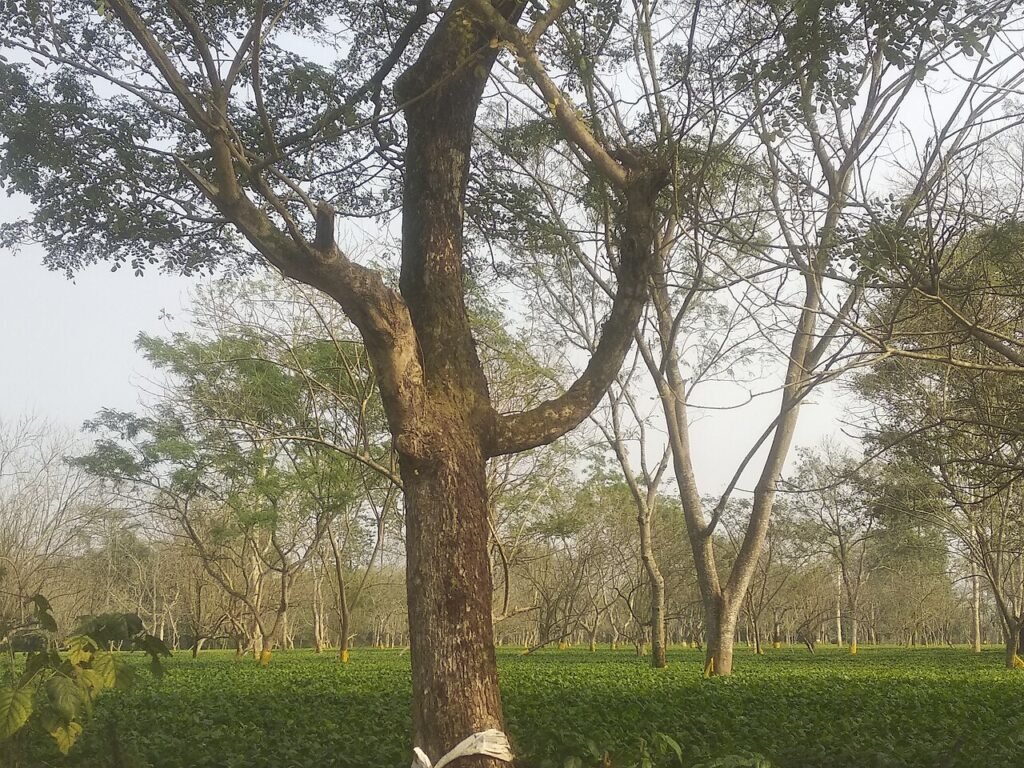
Current Context (The Trigger)
- Artificial rain over tea: Sprinklers are now a common sight in the tea gardens of Tinsukia district, mainly around Doomdooma, which the paper calls the Tea City.
- Rainfall deficit: The India Meteorological Department (IMD) report dated 14 November says Tinsukia got 116.6 mm of rain between 1 October and 14 November, against a normal of 134.5 mm. The deficit is around 13.3%.
- No rain on the report date: Tinsukia got no rain at all on 14 November, while the normal for that day is 0.3 mm. The IMD’s wider review also found October rain below normal in large parts of Assam.
- Leaf shortage: A retired tea garden manager warned that the long dry spell in the autumn flush could cut the supply of leaf and also hurt the factory season. A factory worker said factory officials have warned that workers will have no work in late November, as green leaf is short.
- Rising costs: Pumps, power, fuel, upkeep and labour all add to the cost of running sprinklers.
Core Concepts & Static GK
- Sprinkler irrigation: Water is sprayed over the bushes so that it falls like rain, which is why the paper calls it artificial rain. The Tea Board’s 2017-20 scheme listed sprinkler equipment, drip systems, pipelines, motors and pump sets as items eligible for aid.
- Fresh shoots and flush: When rain turns irregular and soil loses moisture, tea bushes cannot put out fresh shoots at the normal pace. This directly cuts the green leaf that factories process.
- Timing matters as much as totals: The paper stresses that the spread and timing of rain matter as much as the seasonal total. Long gaps between showers can stress the bushes even when the overall deficit looks moderate.
- Conventional versus drip irrigation: The Tea Board scheme for 2017-20 fixed a ceiling unit cost of Rs 40,000 per hectare for conventional irrigation and Rs 4,00,000 per hectare for drip. So drip was treated as ten times costlier per hectare. These were that scheme’s rates, not necessarily today’s.
Institutional Machinery
- India Meteorological Department: The IMD issues district rainfall reports and forecasts, which the paper uses to measure the deficit in Tinsukia. It had forecast isolated to scattered rain over Assam and Meghalaya for 15-16 and 19-21 November.
- Tea Research Association: The paper cites Tea Research Association data for the long-term fall in Assam’s rainfall and rise in minimum temperature. The association runs the Tocklai research station, whose scientists study weather trends in tea areas.
- Tea Board of India: The Tea Board is a statutory body set up on 1 April 1954 under Section 4 of the Tea Act, 1953. It works under the Department of Commerce, Ministry of Commerce and Industry. Its head office is at 14 B.T.M. Sarani (Brabourne Road), Kolkata.
- Field offices: The Tea Board website lists zonal offices at Guwahati (the North Eastern Zonal Office) and Coonoor. It also lists regional offices at Dibrugarh, Siliguri and Palampur.
Schemes & Initiatives
- Tea Development and Promotion Scheme: This Tea Board scheme for the Medium Term Framework ran from 29 December 2017 to 31 March 2020. Its plantation component covered replanting, rejuvenation pruning, irrigation and mechanisation.
- Irrigation aid (2017-20 rates): Under that scheme, aid for irrigation was 25% of actual cost, subject to ceiling unit costs. The ceiling subsidy was Rs 10,000 per hectare for conventional irrigation and Rs 1,00,000 per hectare for drip. These figures belong to the 2017-20 scheme and should not be read as current rates.
- Area limit: The 2017-20 scheme considered at most 200 hectares per estate for conventional irrigation and 30 hectares per estate for drip.
- Eligible works: Besides sprinklers and drip kits, the scheme covered pump sets with electric line connection, transformers, and civil work such as check dams and tube wells.
Reports, Indices & Data
- Long-term trend: Tea Research Association data quoted in the paper show that Assam’s rainfall dropped by over 250 mm from 1921 to 2024. The minimum temperature went up by 1.2 degrees Celsius in the same period.
- Thirty-year weather study: A June 2026 paper in the journal Frontiers in Climate analysed weather data for 1996 to 2025. It covered four tea regions: South Bank in Assam, Nagrakata in West Bengal, Anamallais in Tamil Nadu and High Ranges in Kerala.
- Humidity: The same study finds that both morning and afternoon relative humidity fell in South Bank, Assam, over the study period.
- Older Tocklai figures: A 2013 Down To Earth report quoted a Tocklai deputy director saying Assam’s rainfall had fallen by 200 mm over 90 years, with temperatures up by over 1.5 degrees Celsius. These are older numbers from a different period, so use the Tea Research Association figures above for today’s news.
Assam & Northeast Linkages
- Tinsukia’s tea history: According to the report, indigenous tea plants were found in the Sadiya area in 1823. Chabua got the first English tea garden in 1837. The Tocklai history of tea credits Scottish trader Robert Bruce with the 1823 find, made during a trading visit.
- Tea belt of Upper Assam: The paper says the region later became one of Assam’s main tea-producing centres. Doomdooma is the focus of the sprinkler story.
- Weather hits output: Tea Board data for June 2025 showed Assam’s tea output at 68.55 million kg, down from 75.91 million kg in June 2024. That is a fall of about 9.7%, which reports linked to heat, low rain and pests.
- Switch from muga to tea: The 2013 Down To Earth report said farmers in Lakhimpur, Sivasagar and Jorhat gave up muga silk for tea because of rising temperatures and erratic rain. This is dated background, not a current survey.
Prelims Trap Zones (Watch out for)
- Date Trap: According to the report, indigenous tea plants in Sadiya are dated 1823 and the first English garden at Chabua is dated 1837. Do not swap the years or the places.
- Deficit Trap: The 13.3% deficit covers only 1 October to 14 November, not the whole year. It is based on 116.6 mm against a normal of 134.5 mm.
- Data Trap: The Tea Research Association figures in today’s paper are a fall of more than 250 mm in rainfall from 1921 to 2024 and a 1.2 degree Celsius rise in minimum temperature. The older Tocklai figures of 200 mm and over 1.5 degrees come from a 2013 report.
- Grower Trap: Under the Tea Board’s 2017-20 scheme, a big grower owned more than 10.12 ha, and a small grower owned up to 10.12 ha.
- Subsidy Trap: Irrigation aid under the 2017-20 scheme was 25% of actual cost with ceilings, not full cost. Drip had a higher ceiling than conventional irrigation.
- Head Office Trap: The Tea Board’s head office is in Kolkata, not Guwahati. Guwahati has its North Eastern Zonal Office.
Introduction
Between 1 October and 14 November 2026, Tinsukia got 116.6 mm of rain against a normal of 134.5 mm, and its tea estates have started running sprinklers. Gardens that once lived on rain now need pumps, pipes and power to keep their bushes producing leaf. Assam is India’s biggest tea producer. In June 2025 alone it made 68.55 million kg of India’s 133.50 million kg, so its response to a drier climate matters for the whole industry.
Causes and Impact
- Dry spells and erratic rain: Long dry spells and uneven rain are draining soil moisture in the tea belt. Estates in Doomdooma now spray water to keep fresh-leaf production going.
- A long-term drift: Tea Research Association data cited in the paper show a fall of over 250 mm in Assam’s rainfall from 1921 to 2024. The minimum temperature went up by 1.2 degrees Celsius over the same years.
- Timing of showers: Long gaps between showers stress the bushes even when the seasonal deficit looks small, as in Tinsukia’s 13.3% shortfall.
- Less humidity: The June 2026 Frontiers in Climate study finds that morning and afternoon humidity fell in South Bank, Assam, over 1996 to 2025. Sprinklers wet the soil, but they cannot bring back that moist air.
- Falling output: Tea Board data show Assam’s June 2025 output fell to 68.55 million kg from 75.91 million kg a year earlier. In Tinsukia today, the shortage of green leaf is already cutting factory work.
- Pests and quality: In July 2025, former Tea Board chairman Prabhat Bezbaruah reported a rise in green fly, a damaging tea pest, during the heat. A 2013 report also said heat had lowered the quality of Assam tea, known for its strong, bright liquor.
- Livelihood impact: Factory workers in Tinsukia say they leave early because there is not enough leaf to process. Fewer working days mean lower earnings for them.
Comparative Assessment: Conventional and Drip Irrigation under the Tea Board’s 2017-20 Scheme
| Feature (2017-20 scheme rates) | Conventional irrigation | Drip irrigation |
|---|---|---|
| Ceiling unit cost per hectare | Rs 40,000 | Rs 4,00,000 |
| Subsidy per hectare (25% of unit cost) | Rs 10,000 | Rs 1,00,000 |
| Maximum area per estate | 200 ha | 30 ha |
| Supplier condition | No special supplier rule listed | Items must come from a reputed supplier with prior experience in installing drip systems |
Government & Institutional Measures
| Level | Initiative | Purpose & Impact |
|---|---|---|
| Centre (Tea Board) | Irrigation aid under the Tea Development and Promotion Scheme, 2017-20 | Paid 25% of actual cost, within ceilings, for sprinklers, drip kits, pumps, check dams and tube wells. |
| Centre (Tea Board) | Replanting, rejuvenation pruning and mechanisation aid, 2017-20 | Targeted ageing bushes and field work; the paper names ageing plantations as a problem for estates. |
| Centre (Tea Board) | Support for Self Help Groups and Farmer Producer Organisations of small growers, 2017-20 | Helped groups of small growers (up to 10.12 ha each) buy shared items such as weighing scales, pruning machines, harvesters and sprayers. |
| Centre (IMD) | District rainfall reports and forecasts | Give estates a measure of the deficit, such as Tinsukia’s 13.3%, and a guide to coming showers. |
Challenges
- High running costs: Pumping, electricity, fuel, maintenance and labour all raise the cost of sprinkler irrigation. For an industry already facing rising input costs, this is another burden.
- Only temporary relief: The retired manager quoted in the paper says sprinklers give only temporary relief. They cannot fully replace the natural balance of rain, humidity and temperature that tea needs.
- Ageing plantations: The paper says estates are already dealing with ageing bushes. Old bushes cope less well with moisture stress, so irrigation money may not buy full recovery.
- Aid covers only a part: Under the 2017-20 scheme the grower paid the balance 75% of the cost. Small estates may struggle to fund such a share.
- Paperwork and water access: Under the 2017-20 rules, applicants needed a surveyor’s map and an engineer’s cost estimate for sources such as check dams and tube wells. Where a state restricts drawing water from rivers or streams, a no objection certificate from its Irrigation Department was required.
- Uncertain forecasts: The IMD district forecast showed possible showers in Tinsukia on 16 November, but the paper says sustained rain remains uncertain. Estates cannot plan irrigation rounds with confidence.
- Pests under heat stress: A former Tea Board chairman reported a rise in green fly during the 2025 heat. Estates then face pest control costs on top of irrigation.
Way Ahead
- Review irrigation aid: The Tea Board should check whether its irrigation support matches today’s pump, power and pipe costs. Under the 2017-20 scheme, the aid for conventional irrigation was only Rs 10,000 per hectare.
- Water harvesting: Estates should build check dams and tube wells, which the 2017-20 Tea Board scheme treated as eligible civil work. The June 2026 study also lists rainwater harvesting as a way to cope with moisture stress.
- Shade trees: Estates should plant more permanent shade trees to cut heat stress. The June 2026 study names species such as Albizzia chinensis and Derris robusta.
- Drought-tolerant clones: Estates should use replanting to bring in drought-tolerant clones, and replanting already gets Tea Board aid. The June 2026 study also recommends drought-tolerant cultivars.
- Use weather data: Estates in Tinsukia should link irrigation rounds to IMD district rainfall reports and forecasts. This saves pumping cost on days when rain is likely.
- Group irrigation for small growers: Self Help Groups of small growers (15 to 20 members under the 2017-20 rules) could share pump sets and pipelines. The Tea Board already funded shared equipment such as sprayers for such groups, so pumps could be added.
- Protect workers: The Assam labour department and the tea industry should plan wage support for factory workers when leaf is short. A Doomdooma worker has already warned of no work late in November.
Conclusion
Tinsukia’s sprinklers show that climate stress is no longer a distant forecast for Assam’s tea gardens. Irrigation can buy time, but it raises costs and cannot restore humidity or regular rain. A lasting answer needs cheaper water storage, hardier bushes and better use of weather data, backed by Tea Board aid that keeps pace with real costs.
Asked in APSC
- APSC Prelims 2024: (answer in the MCQs below)
According to the Assam State Action Plan on Climate Change (2015–2020), which of the following temperature and rainfall changes has occurred in Assam during the period 1951–2010?- (A) Annual mean temperature and annual rainfall have both increased
- (B) Annual mean temperature and annual rainfall have both decreased
- (C) Annual mean temperature has increased, while annual rainfall has decreased
- (D) No noticeable changes in temperature and rainfall trends
BCPL Performance in 2025-26 and Assam’s Petrochemical Sector
Open this topic as a separate page, with its MCQs →
Syllabus Mapping
- Prelims: GS Paper I (Current events of State/National importance; Economy of Assam: industries and public sector enterprises).
- Mains: GS Paper III (Indian economy: industrial growth, infrastructure and energy; environment and climate commitments); GS Paper V (Assam syllabus: industry and economy of Assam).
Why in News? Brahmaputra Cracker and Polymer Limited (BCPL), the petrochemical company in Dibrugarh district of Assam, ran its plant at 106 per cent of capacity in 2025-26. It also posted a Profit After Tax of Rs 117.67 crore, as reported from Dibrugarh on 16 November 2026.
Current Context (The Trigger)
- Capacity use: BCPL ran at 106 per cent capacity utilisation in 2025-26. This means the plant worked above its rated capacity.
- Profit and revenue: The company earned a Profit After Tax (PAT) of Rs 117.67 crore. Its revenue from operations was Rs 3,725.53 crore.
- Northeast sales: Polymer sales in the Northeast rose to 48,140 metric tonnes (MT) in 2025-26, up from 43,841 MT a year earlier. The figure was 21,574 MT in 2017-18 and only 5,511 MT in 2016-17.
- Exports: BCPL sold polymers to neighbouring countries, mainly Bangladesh and Bhutan.
- New projects: The 54 KTPA (thousand tonnes per annum) HPG-2 project has reached mechanical completion, and commissioning trials are on. The Butene-1 unit stands at 97.5 per cent physical progress.
- Net Zero plan: BCPL has drawn up a Net Zero roadmap. It uses 2024-25 as the baseline year and 2045 as the target year.
Core Concepts & Static GK
- Gas cracker: A cracker breaks gas liquids or naphtha into ethylene and propylene, the building blocks of plastics. BCPL’s cracker is a dual-feed unit that uses C2+ liquids and naphtha.
- Products: The complex makes High Density Polyethylene (HDPE) and Linear Low Density Polyethylene (LLDPE) totalling 2,20,000 tonnes per annum (TPA). It also makes 60,000 TPA of polypropylene (PP).
- Technology: The cracker uses technology licensed by Lummus of the USA. The polyethylene swing unit uses INEOS technology from the UK, and the PP plant uses Lummus Novolen technology from Germany.
- Feedstock: The complex uses natural gas from Oil India Limited (OIL) and Oil and Natural Gas Corporation (ONGC). Its naphtha comes from Numaligarh Refinery Limited (NRL).
- HPG: HPG stands for Hydrogenated Pyrolysis Gasoline. BCPL lists it as a by-product of the complex, along with pyrolysis fuel oil. The company’s own chronology calls the HPG-2 project the “HPG (2nd Stage) Plant”.
- Capacity utilisation: This is actual output as a share of rated capacity. A figure above 100 per cent shows a plant producing more than its design level.
- Brands: BCPL sells its polymers under the brand names Brahma-Lene and Brahma-Pol.
Constitutional & Legal Framework
- Assam Accord link: The Ministry of Chemicals and Fertilizers describes the Assam Gas Cracker Project as an offshoot of the Assam Accord. The Accord was signed on 15 August 1985.
- Company form: BCPL was incorporated on 8 January 2007 under the Companies Act 1956. It is a joint venture and a Central Public Sector Enterprise.
- Cabinet approvals: The Cabinet Committee on Economic Affairs (CCEA) approved the project on 18 April 2006. It approved a revised cost of Rs 8,920 crore on 16 November 2011.
- Change of ministry: On 24 December 2019 the CCEA moved administrative control of BCPL from the Ministry of Chemicals and Fertilizers to the Ministry of Petroleum and Natural Gas.
Institutional Machinery
- Ownership: GAIL (India) Limited is the main promoter with 70 per cent equity. OIL, NRL and the Government of Assam hold 10 per cent each.
- Work stations: BCPL has four work stations. These are the gas dehydration unit at Duliajan, the naphtha railway siding, the Lakwa gas processing unit and the main complex at Lepetkata, Dibrugarh.
- Distance: The Duliajan and Lakwa units are about 48 km from the Lepetkata complex.
- Marketing: GAIL markets BCPL’s products. The two companies signed the marketing agreement on 11 March 2016.
- Project consultant: Engineers India Limited (EIL) is the Engineering and Project Management Consultant for the Butene-1 and HPG-2 projects. EIL held the same role for the original complex from 10 September 2007.
Schemes & Initiatives
- Butene-1 plant: The Butene-1 plant is designed for 10 KTPA and will use ethylene as input. The foundation stone for the Butene-1 and HPG-2 units was laid on 19 September 2019.
- Butene-1 benefit: Once running, the unit will partly reduce BCPL’s reliance on outside suppliers for this input.
- Feedstock subsidy: In December 2019 the CCEA approved a feedstock subsidy for BCPL. It covers 15 years of plant operation at an estimated cost of Rs 4,600 crore.
- Feedstock search: BCPL is looking at other ways of buying naphtha. The aim is more flexible supply and less exposure to shortages.
- Net Zero roadmap: BCPL is preparing a plan that sets emission cuts for each year. It will roll out in phases after detailed techno-commercial feasibility studies.
Reports, Indices & Data
- Jobs: BCPL employs 640 personnel and about 2,500 contractual workers.
- GSDP share: BCPL adds about 0.23 per cent to Assam’s Gross State Domestic Product (GSDP) on average, as per the company’s estimate.
- Project cost: The government approved the project in 2006 at a cost of Rs 5,460.61 crore. Capital expenditure up to 15 March 2016 stood at Rs 9,356.28 crore.
- Earlier milestone: BCPL first reached 100 per cent capacity utilisation in August 2017, with polymer output of 22,746 MT.
Assam & Northeast Linkages
- Location: The main complex stands at Lepetkata in Dibrugarh district. The then Prime Minister, Dr Manmohan Singh, laid its foundation stone there on 9 April 2007.
- Largest in the region: BCPL describes its plant as the largest petrochemical complex in the Northeast.
- Gas source: Natural gas from OIL reaches BCPL through the Duliajan gas dehydration unit. ONGC gas is processed at the Lakwa unit.
- State stake: The Government of Assam is itself a 10 per cent shareholder in BCPL.
- West Asia crisis: When the recent crisis in West Asia hit supplies, BCPL kept polymers flowing to essential manufacturing units. It acted as directed by the Ministry of Petroleum and Natural Gas.
Prelims Trap Zones (Watch out for)
- Location Trap: The main BCPL complex is at Lepetkata in Dibrugarh district. Duliajan and Lakwa only house associated units.
- Ownership Trap: GAIL holds 70 per cent. The remaining 30 per cent is split equally, 10 per cent each, among OIL, NRL and the Government of Assam.
- Feedstock Trap: Gas comes from OIL and ONGC, while naphtha comes from NRL. Naphtha does not come from OIL.
- Ministry Trap: BCPL was set up under the Ministry of Chemicals and Fertilizers. Since December 2019 its administrative ministry is Petroleum and Natural Gas.
- Date Trap: Commissioning was on 2 January 2016. The Prime Minister dedicated the complex to the nation on 5 February 2016.
- Target Trap: BCPL’s Net Zero target is 2045 and the baseline year is 2024-25. Do not confuse it with India’s national Net Zero target of 2070.
Introduction
BCPL grew out of the 1985 Assam Accord as a promise of industrial development for the state. In 2025-26 it ran at 106 per cent capacity and earned Rs 117.67 crore in profit after tax, even as global petrochemical markets stayed volatile. This shows that a Northeast public sector venture can be commercially sound as well as politically meaningful.
Economic Rationale of the Assam Cracker
- Accord promise: The project is an offshoot of the 1985 Assam Accord. So it carries a commitment to the state’s economic development.
- Use of local resources: The complex turns natural gas from OIL and ONGC and naphtha from NRL into polymers. So the region’s hydrocarbons are processed in the region.
- Jobs: BCPL has 640 employees and about 2,500 contractual workers. Its associated industries and ancillary work add more livelihoods.
- Share in state economy: On average, BCPL adds about 0.23 per cent to Assam’s GSDP. That is a measurable share for a single plant.
- Downstream growth: The project was expected to attract investment in downstream plastic processing industries. Rising Northeast polymer sales give such units a nearby raw material source.
- Shared ownership: The Government of Assam, OIL and NRL are shareholders. So part of the returns stays within the state and the region.
Performance and Expansion in 2025-26
- Operations: BCPL ran safely and without a break through the year. It did so despite geopolitical shocks and swings in crude oil and gas prices.
- Brand reach: Brahma-Lene and Brahma-Pol gained acceptance across customer segments. Exports went to Bangladesh and Bhutan.
- Regional market: Northeast polymer sales rose from 5,511 MT in 2016-17 to 48,140 MT in 2025-26. That is about 8.7 times the earlier level.
- HPG-2: The 54 KTPA HPG-2 project has reached mechanical completion and has all statutory clearances. Commissioning trials are on.
- Butene-1: Construction stands at 97.5 per cent progress. Along with HPG-2, the unit should help BCPL make higher-value polymers.
- Strategic supply: During the West Asia crisis BCPL kept polymers flowing to essential manufacturers on the Ministry’s directions. In the COVID-19 pandemic too, it ran at around 100 per cent capacity.
Sustainability and Institutional Features
- Net Zero by 2045: BCPL has set 2045 as its Net Zero year. It uses 2024-25 as the baseline for measuring cuts.
- Technology based choices: It is choosing decarbonisation measures based on available technology, regulations and the carbon market outlook.
- Phased plan: Implementation is proposed in phases after detailed feasibility checks. This avoids committing funds blindly.
- Ministry oversight: The Ministry of Petroleum and Natural Gas has administrative control since the December 2019 CCEA decision.
- Technology partners: Lummus and INEOS licensed the core technologies. So the plant runs on proven global processes.
Challenges
- Price volatility: Swings in crude oil and natural gas prices hit input costs and margins. The company itself named this as a challenge for 2025-26.
- Feedstock security: The plant needs a steady, fairly priced supply of gas and naphtha. This is why BCPL is looking for other naphtha sources.
- Input dependence: The company relies on external sources for Butene-1. The new unit will reduce this only to some extent.
- Geopolitical risk: The West Asia crisis showed how global disruptions can strain supply chains and supplies to industry.
- Cost overrun history: The project cost rose from Rs 5,460.61 crore in 2006 to a CCEA-approved Rs 8,920 crore in 2011. The Ministry approved a second revised estimate of Rs 9,965 crore on 30 June 2016, after commissioning in January 2016.
- Little spare capacity: Running at 106 per cent leaves little headroom. Any breakdown would directly cut supply to buyers.
- Decarbonisation cost: Net Zero by 2045 depends on technologies and carbon markets that are still changing.
Way Ahead
- Finish projects: BCPL should complete HPG-2 commissioning and the Butene-1 unit on time. This will raise value addition.
- Diversify naphtha: It should conclude the new naphtha arrangements. Then supply will not depend on a single route.
- Publish the emission plan: The year-wise reduction plan should be firmed up soon. Clear milestones will make the 2045 target credible.
- Grow regional markets: With Northeast sales at 48,140 MT, BCPL and the Assam government can encourage plastic processing units in the state.
- Build export routes: Exports to Bangladesh and Bhutan can be widened using existing customer ties.
- Local skills: BCPL already runs ITI tie-ups, apprenticeships and plastics processing training. Scaling these up can turn local youth into skilled workers for the plant and downstream units.
Conclusion
BCPL has moved from an Accord-era promise to a plant that runs above its rated capacity and supplies the Northeast market. Its next test is to finish the new units, secure feedstock and deliver the 2045 Net Zero plan. If it does, it can anchor a wider petrochemical and plastics base for Assam.
Disability Rights and the Legacy of Prof Anita Ghai
Open this topic as a separate page, with its MCQs →
Syllabus Mapping
- Prelims: GS Paper I (Current events of State/National importance; Indian Polity and Governance; social issues of vulnerable sections).
- Mains: GS Paper II (Welfare schemes for vulnerable sections by the Centre and States; laws, institutions and bodies for their protection); GS Paper I (Indian society); GS Paper V (Welfare of persons with disabilities in Assam).
Why in News? On 17 November 2026, The Assam Tribune carried an op-ed on Professor Anita Ghai, a scholar-activist of disability studies. Its three authors teach in Guwahati. They use her writings to ask whether Indian law and politics treat persons with disabilities as citizens with rights.
Current Context (The Trigger)
- The scholar: The op-ed calls Professor Anita Ghai a scholar-activist. In its view, her work broke the old Indian habit of seeing disability through pity, charity and cure.
- Her major books: The article names three works. They are Disabled Women: An Excluded Agenda of Indian Feminism (Hypatia, 2002), Rethinking Disability in India (Routledge, 2015) and the edited volume Disability in South Asia: Knowledge and Experience (SAGE, 2018).
- Her institutions: Ghai first taught at Jesus and Mary College, then at Ambedkar University Delhi. At these places she worked to make disability studies a proper university subject.
- Her view of the 1995 law: On the Persons with Disabilities Act, 1995, she wrote: “The policies stress rehabilitation but rarely map the road to implementation”.
- Her view of social movements: She argued that India’s feminist, political and environmental movements since Independence ignored disability as a basis of social grouping.
Core Concepts & Static GK
- Medical model: This view sees disability as a defect in the body. Doctors must fix it, or families must care for it. Ghai’s work challenged the “pity, charity and cure” thinking linked to it.
- Social model: This view places the problem in barriers made by society, such as stairs without ramps. Ghai wrote that India’s shift from the medical to the social model is visible. But she added that disability is still not treated as legitimate knowledge.
- Benchmark disability: The Rights of Persons with Disabilities (RPwD) Act, 2016 uses this term. It means a person with not less than 40 per cent of a specified disability, as certified. Job and education reservations apply to such persons.
- Intersectionality: This is the idea that caste, class, gender and disability overlap. Together they create combined disadvantage. Ghai placed disabled women within these layers and said Indian feminism had its own blind spot.
- Epistemic ignorance: The op-ed uses this term for Ghai’s critique of Indian academia. In her view, universities saw disability only as charity or as rules to follow. They did not study it as a field of knowledge.
Constitutional & Legal Framework
- Article 41: This Directive Principle asks the State to make effective provision for the right to work, to education and to public assistance. It covers unemployment, old age, sickness and disablement, within the State’s economic capacity.
- Persons with Disabilities Act, 1995: The earlier law recognised 7 disabilities. Its Section 33 reserved not less than 3 per cent of vacancies in government establishments for persons with disabilities.
- RPwD Act, 2016: This is Act No. 49 of 2016. It came into force on 19 April 2017 and repealed the 1995 Act. It raised the number of recognised disabilities from 7 to 21.
- Reservations under the 2016 Act: Section 34 reserves not less than 4 per cent of vacancies in government establishments for persons with benchmark disabilities. Section 32 reserves not less than 5 per cent of seats in government and government-aided higher education institutions.
- Accessibility sections: Sections 40 to 46 deal with accessibility. Section 40 asks the Centre to frame accessibility standards. Section 45 gives a five-year limit to make existing public buildings accessible after the rules are notified.
Institutional Machinery
- Nodal department: The Department of Empowerment of Persons with Disabilities (DEPwD) works under the Ministry of Social Justice and Empowerment.
- Chief Commissioner: Section 74 lets the Central Government appoint a Chief Commissioner for Persons with Disabilities. Two Commissioners assist the Chief Commissioner, and one of them must be a person with disability.
- State Commissioner: Section 79 lets each State Government appoint a State Commissioner. An advisory committee of not more than five disability-sector experts assists the State Commissioner.
- Other laws: DEPwD administers three Acts. They are the RPwD Act, 2016, the National Trust Act, 1999 and the Rehabilitation Council of India Act, 1992.
Schemes & Initiatives
- Accessible India Campaign: It is also called Sugamya Bharat Abhiyan. It was launched on 3 December 2015, the International Day of Persons with Disabilities.
- Three verticals: The campaign works on the built environment, the transport sector and the information and communication technology (ICT) ecosystem.
- Standards: DEPwD lists 13 sector-wise accessibility standards and guidelines. They include the Harmonized Guidelines and Space Standard for Universal Accessibility in India, 2021.
- Unique Disability ID: As on 15 July 2024, 1,09,55,968 Unique Disability ID (UDID) cards had been generated across India.
Reports, Indices & Data
- Census 2011: It counted 2.68 crore persons with disabilities. This was 2.21 per cent of India’s population.
- NSS 76th round: The National Statistical Office surveyed disability from July to December 2018. It found prevalence of 2.2 per cent overall, 2.3 per cent in rural areas and 2.0 per cent in urban areas.
- Old categories in data: Census 2011 used eight groups. They were seeing, hearing, speech, movement, mental retardation, mental illness, any other and multiple disability. This is far fewer than the 21 disabilities of the 2016 Act.
Assam & Northeast Linkages
- Census count: Census 2011 recorded 4,80,065 persons with disabilities in Assam. Of them, 2,57,385 were males and 2,22,680 were females.
- Largest group: In Assam, hearing disability was the largest group at 1,01,577. “Any other” disability came next at 87,461, and seeing stood at 80,553.
- State Commissioner’s office: Assam has a State Commissioner for Persons with Disabilities, the post under Section 79. The office is at Latakata, Basistha, Guwahati.
- Dhubri programme: On 7 January 2026, the Commissioner’s office and the District Commissioner’s office held a sensitisation programme on the RPwD Act at Dhubri.
- Special university demand: At a Guwahati felicitation of students with disabilities in July 2026, Social Justice and Empowerment Minister Ashwini Ray Sarkar backed a special university for persons with disabilities. He hoped it would come up in the current government’s tenure but gave no date.
- Local scholarship: Today’s op-ed comes from Assam academics. Two authors teach social work at Assam Royal Global University, and one is from the Department of Women’s Studies, Gauhati University.
Prelims Trap Zones (Watch out for)
- Reservation Trap: Government jobs carry 4 per cent under the 2016 Act. Higher education seats carry 5 per cent. The 1995 Act had 3 per cent.
- Section Trap: Section 34 deals with jobs and Section 32 with higher education seats. Section 74 is the Chief Commissioner and Section 79 the State Commissioner.
- Category Trap: The 2016 Act recognises 21 disabilities, not 7. Seven was the 1995 figure.
- Date Trap: The UN adopted the Convention on 13 December 2006. India signed it on 30 March 2007 and ratified it on 1 October 2007. It came into force on 3 May 2008.
- Launch Trap: The Accessible India Campaign began on 3 December 2015. It came before the 2016 Act, not under it.
- Court Trap: In November 2024, the Supreme Court held Rule 15(1) of the RPwD Rules, 2017 ultra vires. It did not strike down the Act itself.
Introduction
Census 2011 counted 2.68 crore Indians with disabilities, about 2.21 per cent of the population. Professor Anita Ghai argued that Indian policy has long treated them as objects of welfare, not as citizens with rights. Her ideas matter for Assam too, where 4,80,065 people were counted as disabled in 2011.
Ghai’s Contribution to Disability Thought
- Breaking pity and cure: Ghai challenged the habit of seeing disability as something to pity or cure. This moves the question from “what is wrong with the person” to “what is wrong with the setting”.
- Lived experience as knowledge: She recalled being labelled “disabled”, “handicapped” and “special” in her early years. She turned that experience into theory, giving disability studies a first-person voice.
- Disabled women: Her 2002 Hypatia article said disabled women are excluded by patriarchy and also by movements that fight it. The op-ed credits her with starting feminist disability studies in India.
- Building institutions: At Jesus and Mary College and Ambedkar University Delhi, she pushed for disability studies as a subject. The authors call her 2018 edited volume the first sustained regional dialogue of Global South activists and scholars.
- Link to Ambedkar: The 2018 volume was dedicated to B R Ambedkar’s idea of social justice. In the authors’ reading, it placed disability inside India’s constitutional promise of equality.
- Critique of law: She said the 1995 Act stressed rehabilitation but did not plan implementation. She also warned that talk of inclusion can hide bureaucratic paternalism.
Medical Model versus Social Model
| Aspect | Medical (charity) model | Social (rights) model |
|---|---|---|
| Where the problem lies | In the body, to be treated or cured. Ghai criticised this as “pity, charity and cure”. | In barriers of buildings, transport, information and attitudes. Sections 40 to 46 of the RPwD Act target such barriers. |
| Role of the person | A receiver of welfare. Ghai warned that policy treats persons with disabilities as objects of welfare. | A rights-holder. The 2016 Act gives rights such as equality and non-discrimination. |
| Role of the State | Rehabilitation and assistance. Article 41 speaks of public assistance in cases of disablement. | Removing barriers and ensuring equal access. Examples are 4 per cent of job vacancies and 5 per cent of higher education seats. |
| Who counts | A short medical list. The 1995 Act recognised 7 disabilities. | A wider list. The 2016 Act recognises 21 disabilities. |
| Where it shows in India | Ghai noted that the shift from the medical to the social model is visible but incomplete. | The Accessible India Campaign (2015) works on buildings, transport and ICT. |
Government & Statutory Measures
| Level | Initiative | Purpose & Impact |
|---|---|---|
| International | UN Convention on the Rights of Persons with Disabilities | Adopted on 13 December 2006. India ratified it on 1 October 2007, and it came into force on 3 May 2008. States must bring their laws in line with it. |
| Union | RPwD Act, 2016 | Gives effect to the Convention. It raised recognised disabilities from 7 to 21 and set 4 per cent job and 5 per cent higher education reservation. |
| Union | Accessible India Campaign | Launched on 3 December 2015 to make buildings, transport and ICT accessible. |
| Union | Unique Disability ID | 1,09,55,968 cards had been generated by 15 July 2024. One card links the person to certificates and schemes. |
| Judiciary | Rajive Raturi v Union of India (Supreme Court, 8 November 2024) | The Court held Rule 15(1) of the RPwD Rules, 2017 ultra vires because it gave only persuasive guidelines. It told the Union to frame mandatory rules under Section 40 within three months. |
| Assam | Office of the State Commissioner for Persons with Disabilities | Works from Latakata, Basistha, Guwahati. It held the Dhubri sensitisation programme on the RPwD Act on 7 January 2026. |
Challenges
- Implementation gap: Ghai said policy stressed rehabilitation but rarely mapped implementation. In Guwahati in July 2026, a disability group demanded that backlog vacancies reserved for persons with disabilities be filled.
- Weak accessibility rules: In November 2024 the Supreme Court found that Rule 15(1) gave only persuasive guidelines. The Act wanted compulsion. Without a mandatory floor, owners could treat accessibility as optional.
- Slow certification: At Dhubri in January 2026, the resource person urged the Health Department to speed up disability certificates. These certificates are needed for welfare schemes and the UDID card.
- Dated data: India’s headline count still comes from Census 2011. That Census used eight groups, far fewer than the 21 disabilities of the 2016 Act. So planning rests on old figures and a narrow definition.
- Exclusion inside movements: Ghai argued that India’s progressive movements ignored disability. Disabled women face double exclusion, from patriarchy and from the movements that oppose it.
- Poor special school facilities: At the July 2026 Guwahati event, the Pratibandhi Suraksha Sanstha, Assam asked for better infrastructure in special schools and free healthcare.
Way Ahead
- Mandatory accessibility rules: The Union should complete the non-negotiable standards the Supreme Court asked for. DEPwD has already issued draft rules of this kind for the assistive technology sub-sector.
- Enforce penalties: The Court asked the Union, States and Union Territories to apply Sections 44, 45, 46 and 89 once mandatory rules exist. This includes holding back completion certificates and imposing fines.
- Clear backlog posts in Assam: The Assam government should audit reserved vacancies and fill them. Section 34 requires at least 4 per cent of vacancies for persons with benchmark disabilities.
- Faster certificates: The Health Department should cut the time taken to issue disability certificates. The UDID card and welfare schemes depend on them.
- Inclusive education: Assam authorities should arrange schooling for children with disabilities in mainstream schools, as urged at Dhubri in January 2026.
- Disability studies in universities: Universities, including those in Assam, can follow Ghai’s example at Ambedkar University Delhi. They should treat disability as a field of knowledge, not only of policy compliance.
- Barrier-free offices: District officers in Assam should make government offices accessible. They can also run regular sensitisation drives like the Dhubri programme.
Conclusion
Ghai’s central lesson, as the authors present it, is that dignity comes from enforceable rights, not from charity or cure. India now has a rights law with 21 recognised disabilities and fixed reservations. The Centre and Assam must now close the gap between the statute and daily life.
Asked in APSC
- APSC Mains 2022, GS Paper 2 (15 marks): Discuss the challenges confronted by the Persons with Disabilities (PwDs) in India while according essential services. How does the Rights of Persons with Disabilities Act, 2016 facilitate the ‘rights’ of the PwDs? Elucidate.
News in Short
- QS Asia University Rankings 2027: For the second year running, no Indian university is in Asia’s top 50 in the QS Asia rankings. IIT Delhi is India’s best at 66th. IIT Guwahati slipped from 115th to 120th.
- Rainwater harvesting in Guwahati: The Guwahati Municipal Corporation (GMC) will make rainwater harvesting compulsory for every new building that seeks a building permission. Mayor Mrigen Sarania said the ground floor must leave space for water to soak into the soil. The aim is to raise groundwater levels.
- Bhupen Hazarika centenary finale: The birth centenary celebrations of Bharat Ratna Dr Bhupen Hazarika will close on 29 November at Bharat Mandapam, New Delhi. Prime Minister Narendra Modi will be the chief guest. He will present the Dr Bhupen Hazarika National Award to singer Usha Mangeshkar.
- Oil palm research centre, Gossaigaon: Agriculture Minister Pijush Hazarika laid the foundation of a joint oil palm research and development centre of Assam Agricultural University (AAU) and Godrej Agrovet Ltd. It will come up at the AAU Zonal Research Station, Gossaigaon, in Kokrajhar district. The Union Cabinet approved the National Mission on Edible Oils – Oil Palm on 18 August 2021 with an outlay of Rs 11,040 crore. The mission has a special focus on the North-East and the Andaman and Nicobar Islands.
- Maruti 800: The car has been chosen for the FIVA World Vehicle Heritage Award. A company statement says it is the first and only vehicle from India picked among 21 historic vehicles from across the world.
- India-Egypt trade pact: Commerce Minister Piyush Goyal said in Cairo that officials will finalise the terms of reference for a trade deal. He hopes formal talks start within 90 days. Both sides may first sign a preferential trade agreement, then widen it into a free trade agreement. In July 2022, the two countries had set an annual bilateral trade target of US$ 12 billion within five years.
- ICC Chairman: Jay Shah was reappointed unopposed as Chairman of the International Cricket Council for a second two-year term. He first took charge in December 2024 and is the youngest person ever to hold the post.
APSC Prelims MCQs
Practice questions on the topics above
Topic 1: Semiconductor Skilling Lab at NIELIT Guwahati and Tata’s Jagiroad Plant
Q1. Tata’s semiconductor plant has begun pilot operations in Assam. Consider the following statements:
(i) The plant is in Morigaon district, on the site of the former Nagaon Paper Mill.
(ii) It is a wafer fabrication unit that etches circuits onto wafers.
(iii) When fully running, it is expected to handle about 48 million chips a day.
Which of the statements given above is/are correct?
- (a) (i) and (ii) only
- (b) (ii) and (iii) only
- (c) (i) and (iii) only
- (d) (i), (ii) and (iii)
Show answer
Answer: (c) Explanation: Statements (i) and (iii) are correct. Tata’s plant stands at Jagiroad in Morigaon district, on the site of the closed Nagaon Paper Mill. When fully running, it will handle about 48 million chips a day. Statement (ii) is wrong. Jagiroad is an assembly, testing, marking and packaging (ATMP) unit, not a fab. A fab etches circuits onto wafers, and among the approved projects only Tata-PSMC’s Dholera plant in Gujarat is a fab. So options (a), (b) and (d) fail, because each includes (ii). Value addition: the Union Cabinet approved the Morigaon unit on 29 February 2024 with an investment of Rs 27,000 crore.
Q2. Consider the following statements about the Semicon India Programme:
(i) The Union Cabinet approved it in December 2021 with an outlay of Rs 76,000 crore.
(ii) The India Semiconductor Mission works as an Independent Business Division within the Digital India Corporation.
(iii) NIELIT is the nodal agency for its Design Linked Incentive scheme.
Which of the statements given above is/are correct?
- (a) (i) only
- (b) (i) and (ii) only
- (c) (ii) and (iii) only
- (d) (i), (ii) and (iii)
Show answer
Answer: (b) Explanation: Statements (i) and (ii) are correct. The Cabinet approved the programme in December 2021 with an outlay of Rs 76,000 crore. The India Semiconductor Mission was set up as an Independent Business Division within the Digital India Corporation to run it. Statement (iii) is wrong. The Centre for Development of Advanced Computing (C-DAC), not NIELIT, is the nodal agency for the Design Linked Incentive scheme. NIELIT is a training body under MeitY, which is why it runs the Guwahati lab. So (a) leaves out a true statement, while (c) and (d) include the false one. Value addition: since the September 2022 modification, ATMP units get 50 per cent of capital expenditure on a pari-passu basis.
Q3. Match List-I with List-II:
| List-I (Unit / Item) | List-II (Figure) |
|---|---|
| a. Daily capacity of Tata’s ATMP unit at Morigaon, Assam | 1. Rs 27,000 crore |
| b. Daily capacity of CG Power’s ATMP unit at Sanand, Gujarat | 2. 50,000 wafer starts per month |
| c. Capacity of the Tata-PSMC fab at Dholera, Gujarat | 3. 15 million chips a day |
| d. Investment in Tata’s Morigaon unit | 4. 48 million chips a day |
Select the correct answer using the codes given below:
- (a) a-3, b-4, c-2, d-1
- (b) a-4, b-3, c-1, d-2
- (c) a-4, b-3, c-2, d-1
- (d) a-1, b-2, c-3, d-4
Show answer
Answer: (c) Explanation: These figures come from the Cabinet approval of 29 February 2024. Tata’s Morigaon unit can handle 48 million chips a day (a-4) and involves an investment of Rs 27,000 crore (d-1). CG Power’s Sanand unit can handle 15 million chips a day (b-3). The Tata-PSMC fab at Dholera has a capacity of 50,000 wafer starts per month (c-2). Option (a) swaps the two ATMP capacities. Option (b) swaps the fab capacity with the Morigaon investment. Option (d) gets every pair wrong. Value addition: the Dholera fab was approved with an investment of Rs 91,000 crore, the largest of the three units, and is built with Powerchip Semiconductor Manufacturing Corporation (PSMC) of Taiwan.
Q4. The Tata semiconductor plant at Jagiroad, Assam, stands on the site of which defunct industrial unit?
- (a) Cachar Paper Mill
- (b) Nagaon Paper Mill
- (c) Bongaigaon Refinery
- (d) Namrup Fertilizer Plant
Show answer
Answer: (b) Explanation: The plant is coming up at Jagiroad in Morigaon district, on the site of the closed Nagaon Paper Mill. This mill belonged to Hindustan Paper Corporation and stopped work in March 2017. The Cachar Paper Mill, option (a), is a different mill in Cachar district. Its assets were taken over by the state along with Nagaon’s. Bongaigaon Refinery, option (c), and the Namrup fertilizer plant, option (d), have no link with the Tata project. Value addition: the Assam government took over the assets of the Nagaon and Cachar paper mills from Hindustan Paper Corporation in March 2022, paying Rs 375 crore.
Topic 2: Sprinkler Irrigation in Tinsukia Tea Gardens and Climate Stress on Tea
Q5. An India Meteorological Department district report dated 14 November 2026 was cited in a report on the tea gardens of Tinsukia. Consider the following statements:
(i) Tinsukia got 116.6 mm of rain from 1 October to 14 November, against a normal of 134.5 mm.
(ii) The rainfall deficit for the period was around 13.3%.
(iii) Chabua got Assam’s first English tea garden in 1823.
Which of the statements given above is/are correct?
- (a) (i) and (ii) only
- (b) (ii) and (iii) only
- (c) (i) and (iii) only
- (d) (i), (ii) and (iii)
Show answer
Answer: (a) Explanation: Statements (i) and (ii) are correct. The IMD report puts Tinsukia’s rain at 116.6 mm from 1 October to 14 November against a normal of 134.5 mm, a shortfall of about 13.3%. Statement (iii) is wrong because the first English tea garden at Chabua dates to 1837, not 1823. According to the report, 1823 is the year indigenous tea plants were found in the Sadiya region, so the two dates are often swapped. Hence options (b), (c) and (d), which all include statement (iii), are wrong. Value addition: Tocklai’s history of tea credits the Scottish trader Robert Bruce with the 1823 find of wild tea in Assam.
Q6. Match List-I with List-II:
| List-I (Item, as reported on 17 November 2026) | List-II (Figure) |
|---|---|
| a. Reported discovery of indigenous tea plants in the Sadiya region | 1. 1837 |
| b. First English tea garden at Chabua | 2. 1823 |
| c. Fall in Assam’s rainfall from 1921 to 2024 (Tea Research Association data) | 3. More than 250 mm |
| d. Rainfall received by Tinsukia from 1 October to 14 November 2026 (IMD) | 4. 116.6 mm |
Select the correct answer using the codes given below:
- (a) a-1, b-2, c-3, d-4
- (b) a-2, b-1, c-4, d-3
- (c) a-2, b-1, c-3, d-4
- (d) a-1, b-2, c-4, d-3
Show answer
Answer: (c) Explanation: The correct pairs are a-2, b-1, c-3 and d-4. According to the report, indigenous tea plants were found in Sadiya in 1823, and the first English garden came up at Chabua in 1837. Tea Research Association data show Assam’s rainfall down by more than 250 mm over 1921 to 2024. The IMD report shows Tinsukia got 116.6 mm from 1 October to 14 November 2026, against a normal of 134.5 mm. Options (a) and (d) swap the two years. Options (b) and (d) swap the long-term fall with this season’s rainfall. Value addition: the same Tea Research Association data show a 1.2 degree Celsius rise in Assam’s minimum temperature over 1921 to 2024.
Q7. Under the Tea Development and Promotion Scheme of the Tea Board for 2017-18 to 2019-20, which one of the following statements about irrigation support is NOT correct?
- (a) Sprinkler equipment, drip irrigation systems, pipelines and pump sets with electric connection were eligible items.
- (b) A big grower was defined as one who owns up to 10.12 hectares of tea area.
- (c) Assistance was 25% of the actual cost, subject to ceiling unit costs per hectare.
- (d) The area considered was limited to 200 hectares per estate for conventional irrigation and 30 hectares per estate for drip irrigation.
Show answer
Answer: (b) Explanation: Statement (b) is NOT correct. The scheme treated a big grower as one owning more than 10.12 hectares, while a small grower owns up to 10.12 hectares. Eligible irrigation items included sprinklers, drip systems, pipelines, motors and pump sets with electric line connection, so (a) is right. Aid was 25% of actual cost within ceiling unit costs of Rs 40,000 per hectare for conventional and Rs 4,00,000 per hectare for drip, so (c) is right. The area cap was 200 hectares per estate for conventional and 30 hectares for drip, so (d) is right. Value addition: these were the 2017-20 scheme’s rates, and the scheme also covered civil work such as check dams and tube wells.
Q8. The head office of the Tea Board of India, which works under the Ministry of Commerce and Industry, is located at:
- (a) Guwahati
- (b) Dibrugarh
- (c) Kolkata
- (d) Coonoor
Show answer
Answer: (c) Explanation: The Tea Board of India has its head office at 14 B.T.M. Sarani (Brabourne Road), Kolkata, under the Department of Commerce, Ministry of Commerce and Industry. Option (a) is wrong because Guwahati has the Board’s North Eastern Zonal Office, not its head office, even though Assam is India’s main tea state. Option (b) is wrong because Dibrugarh has a regional office. Option (d) is wrong because Coonoor in Tamil Nadu has a zonal office for the south. Students often pick Guwahati because of Assam’s weight in tea. Value addition: the Tea Board is a statutory body set up on 1 April 1954 under Section 4 of the Tea Act, 1953.
PYQ (APSC Prelims 2024): According to the Assam State Action Plan on Climate Change (2015–2020), which of the following temperature and rainfall changes has occurred in Assam during the period 1951–2010?
- (A) Annual mean temperature and annual rainfall have both increased
- (B) Annual mean temperature and annual rainfall have both decreased
- (C) Annual mean temperature has increased, while annual rainfall has decreased
- (D) No noticeable changes in temperature and rainfall trends
Show answer
Answer: (C) Explanation: The Assam State Action Plan on Climate Change (SAPCC) 2015–2020 used India Meteorological Department (IMD) analysis of State-level climate data for 1951–2010 (6 stations for temperature and 12 for rainfall in Assam). It found:
Topic 3: BCPL Performance in 2025-26 and Assam’s Petrochemical Sector
Q9. BCPL is Assam’s petrochemical company with several shareholders. Consider the following statements:
(i) GAIL (India) Limited holds 70 per cent equity in BCPL.
(ii) BCPL gets all its gas and naphtha feedstock from Oil India Limited.
(iii) Administrative control of BCPL moved to the Ministry of Petroleum and Natural Gas in December 2019.
Which of the statements given above is/are correct?
- (a) (i) only
- (b) (i) and (iii) only
- (c) (ii) and (iii) only
- (d) (i), (ii) and (iii)
Show answer
Answer: (b) Explanation: Statements (i) and (iii) are correct. GAIL is the main promoter with 70 per cent equity. The CCEA moved BCPL from the Ministry of Chemicals and Fertilizers to the Ministry of Petroleum and Natural Gas on 24 December 2019. Statement (ii) is wrong. Gas comes from Oil India Limited and ONGC, and naphtha comes from Numaligarh Refinery Limited. So option (a) fails because it leaves out (iii). Options (c) and (d) fail because they include (ii). Value addition: The remaining 30 per cent equity is shared equally by OIL, NRL and the Government of Assam, at 10 per cent each.
Q10. Arrange the following events related to the Assam Gas Cracker Project in chronological order:
(i) Dedication of the BCPL complex to the nation
(ii) Approval of the project by the CCEA
(iii) Commissioning of the Lepetkata complex
(iv) Laying of the foundation stone
Select the correct answer using the code given below:
- (a) (ii), (iv), (iii), (i)
- (b) (iv), (ii), (iii), (i)
- (c) (ii), (iv), (i), (iii)
- (d) (ii), (iii), (iv), (i)
Show answer
Answer: (a) Explanation: The CCEA approved the project on 18 April 2006. The then Prime Minister, Dr Manmohan Singh, laid the foundation stone at Lepetkata on 9 April 2007. The Lepetkata complex was commissioned on 2 January 2016. Prime Minister Narendra Modi dedicated it to the nation on 5 February 2016. So the order is (ii), (iv), (iii), (i). Option (b) puts the foundation stone before the approval. Option (c) swaps dedication and commissioning. Option (d) places commissioning before the foundation stone, which is impossible. Value addition: BCPL as a company was incorporated on 8 January 2007, between the approval and the foundation stone.
Q11. Under the Naphtha Sale and Supply Agreement signed in 2010, which company is the designated naphtha supplier to Brahmaputra Cracker and Polymer Limited?
- (a) Oil India Limited
- (b) Numaligarh Refinery Limited
- (c) Oil and Natural Gas Corporation
- (d) GAIL (India) Limited
Show answer
Answer: (b) Explanation: BCPL signed the Naphtha Sale and Supply Agreement with Numaligarh Refinery Limited on 29 June 2010. NRL’s naphtha is unloaded at BCPL’s railway siding, and NRL is also a 10 per cent shareholder. Option (a) is wrong because Oil India Limited supplies natural gas through the Duliajan gas dehydration unit. Option (c) is wrong because ONGC supplies gas that is processed at the Lakwa unit. Option (d) is wrong because GAIL is the 70 per cent promoter and markets BCPL’s products, but it does not supply naphtha. Value addition: The project profile put NRL’s naphtha supply at 1,60,000 tonnes per annum.
Q12. BCPL has drawn up a Net Zero roadmap. Which of the following pairs of baseline year and target year is correct as per the company?
- (a) Baseline 2020-21, target 2040
- (b) Baseline 2024-25, target 2045
- (c) Baseline 2024-25, target 2070
- (d) Baseline 2025-26, target 2045
Show answer
Answer: (b) Explanation: BCPL has adopted 2024-25 as its baseline year and aims to reach Net Zero by 2045. It is working out a plan with emission cuts for each year, to be rolled out in phases. Option (a) uses a wrong baseline and an earlier target year. Option (c) has the right baseline but pairs it with 2070, which is India’s national Net Zero target, not BCPL’s. Option (d) takes 2025-26, the latest financial year, as the baseline, which is wrong. Value addition: In 2025-26 BCPL ran at 106 per cent of capacity and earned a Profit After Tax of Rs 117.67 crore.
Topic 4: Disability Rights and the Legacy of Prof Anita Ghai
Q13. The Rights of Persons with Disabilities (RPwD) Act, 2016 replaced the Persons with Disabilities Act, 1995. Consider the following statements:
(i) It came into force on 19 April 2017.
(ii) It recognises 21 disabilities.
(iii) It reserves not less than 5 per cent of vacancies in government establishments for persons with benchmark disabilities.
Which of the statements given above is/are correct?
- (a) (i) and (ii) only
- (b) (ii) and (iii) only
- (c) (i) and (iii) only
- (d) (i), (ii) and (iii)
Show answer
Answer: (a) Explanation: Statements (i) and (ii) are correct. The Act came into force on 19 April 2017. It raised the number of recognised disabilities from 7 to 21. Statement (iii) is wrong. Section 34 reserves not less than 4 per cent of vacancies in government establishments. The 5 per cent figure belongs to Section 32, which covers seats in government and government-aided higher education institutions. So options (b), (c) and (d) all wrongly include statement (iii). The 1995 Act had 3 per cent for posts. Value addition: a benchmark disability means not less than 40 per cent of a specified disability, and Section 79 lets each State appoint a State Commissioner.
Q14. Match List-I with List-II:
| List-I (Provision under RPwD Act, 2016) | List-II (Figure) |
|---|---|
| a. Disabilities recognised | 1. 4 per cent |
| b. Seats reserved in government and aided higher education institutions | 2. 5 per cent |
| c. Vacancies reserved in government establishments | 3. 21 |
| d. Minimum extent of disability for a benchmark disability | 4. 40 per cent |
Select the correct answer using the codes given below:
- (a) a-3, b-2, c-1, d-4
- (b) a-3, b-1, c-2, d-4
- (c) a-1, b-2, c-3, d-4
- (d) a-3, b-2, c-4, d-1
Show answer
Answer: (a) Explanation: The Act recognises 21 disabilities, up from 7 under the 1995 law, so a matches 3. Section 32 reserves not less than 5 per cent of higher education seats, so b matches 2. Section 34 reserves not less than 4 per cent of government vacancies, so c matches 1. A benchmark disability is not less than 40 per cent of a specified disability, so d matches 4. Option (b) swaps the 4 and 5 per cent figures. Option (d) swaps 40 per cent and 4 per cent. Option (c) gives 4 per cent to the number of disabilities. Value addition: the 1995 Act reserved 3 per cent of vacancies under its Section 33.
Q15. In the Census 2011 data on persons with disabilities in Assam, which type of disability formed the largest group?
- (a) Seeing
- (b) Hearing
- (c) Movement
- (d) Speech
Show answer
Answer: (b) Explanation: Census 2011 recorded 4,80,065 persons with disabilities in Assam. Hearing disability was the largest group at 1,01,577. Option (a) is wrong because seeing stood at 80,553. It came after both hearing and the “any other” group of 87,461. Option (c) is wrong because movement disability was 76,007. Option (d) is wrong because speech disability was only 39,750. The Census used eight groups, far fewer than the 21 disabilities of the 2016 Act. Value addition: nationally, Census 2011 counted 2.68 crore persons with disabilities, or 2.21 per cent of the population. The NSS 76th round of 2018 put prevalence at 2.2 per cent.
Q16. India ratified the United Nations Convention on the Rights of Persons with Disabilities on which date?
- (a) 13 December 2006
- (b) 30 March 2007
- (c) 1 October 2007
- (d) 3 May 2008
Show answer
Answer: (c) Explanation: India ratified the Convention on 1 October 2007. Option (a) is wrong because 13 December 2006 is when the UN General Assembly adopted it. Option (b) is wrong because 30 March 2007 is when it opened for signature, and India signed it that day. Option (d) is wrong because 3 May 2008 is when the Convention came into force. India’s RPwD Act, 2016 says in its long title that it gives effect to this Convention. Value addition: the Accessible India Campaign, launched on 3 December 2015, drew its inspiration from the Convention. It works on buildings, transport and ICT.
Mains Answer Writing
One exam-style question with a model answer
Q. Recently, the Ministry of Electronics and Information Technology approved a semiconductor packaging training laboratory at NIELIT Guwahati, close to the Tata semiconductor unit at Jagiroad. Discuss the opportunities and challenges in building a skilled semiconductor workforce in Assam. Suggest measures to make the North-East a supplier of talent rather than only a recipient of investment. (250 words, 15 marks)
Model answer
Introduction: Jagiroad in Morigaon district was long known for the closed Nagaon Paper Mill. Today it hosts the Rs 27,000-crore Tata Semiconductor Assembly and Test unit, approved by the Union Cabinet on 29 February 2024. Such ATMP (assembly, testing, marking and packaging) units run on trained people, so the real test for Assam is skills, not money.
1. Opportunities in building a skilled semiconductor workforce in Assam
- Large job base: The Ministry of Electronics and Information Technology (MeitY) estimated in 2024 that the unit would create about 15,000 direct and 11,000-13,000 indirect jobs. When fully running, it can process about 48 million chips daily.
- Training next to the factory: MeitY has approved an ATMP training laboratory at the National Institute of Electronics and Information Technology (NIELIT), Guwahati. Trainees can practise on similar machines only about 60 km from their likely employer.
- A layered pipeline: In January 2025, NIELIT signed an MoU (memorandum of understanding) with Tata Electronics for ATMP courses and internships. IIT (Indian Institute of Technology) Guwahati has also tied up with Tata for an ATMP Centre of Excellence with diploma and BTech programmes.
- A realistic entry point: Most of the chip projects approved in Gujarat and Assam are ATMP or OSAT (outsourced semiconductor assembly and test) units. India can compete in packaging sooner than in wafer fabrication, so these skills will stay in demand.
- New work for women: About two dozen Assamese women trained at other Tata sites now work at Jagiroad. Close to 500 more are still being trained.
2. Challenges in building a skilled semiconductor workforce in Assam
- Skills need machines: Cleanroom habits, static control, wire bonding and die attach can be learnt only on equipment, under supervision. A single careless touch can ruin an expensive chip.
- Time pressure: Commercial production may start around December 2026 or January 2027. Until now, local recruits were sent to other states for training, which is slow and costly.
- Weak feeder base: Polytechnics and ITIs (Industrial Training Institutes) lack teachers who know cleanroom practice. In 2024, nine North-East institutions were in the Centre’s chip-design training list, and NIT (National Institute of Technology) Silchar was the only one from Assam.
- Social perception: Young people in the region have usually aimed for a government job or for migration to Bengaluru or Delhi. Many parents still see factory work as contract work, not a career.
- Low-value trap: Without a wafer fab, Assam may remain only an assembly centre. Its workers could then stay stuck in operator-level jobs.
3. Way Forward: measures to make the North-East a supplier of talent rather than only a recipient of investment
- A certification ladder: NIELIT should offer stacked certificates, so that an operator can grow into a technician and later a process engineer.
- Upgrade ITIs and polytechnics: The Assam government should train their teachers in cleanroom practice. Schools can add electronics bridge courses and visits to the plant.
- Move up the value chain: Courses must go beyond operator work to testing, failure analysis, machine maintenance and process engineering, which pay better. IIT Guwahati can lead research in the wire-bond, flip-chip and I-SIP (integrated system in package) technologies planned for Jagiroad.
- Fund and track results: MeitY should budget for equipment upgrades and industry-certified trainers. The number of local youth placed at Jagiroad and its suppliers should be published every year.
- Build a regional network: The new NIELIT campus announced for Jagiroad and NIELIT’s Imphal centre can spread training across the North-East. With Semicon 2.0 approved by the Union Cabinet in July 2026 at Rs 1,27,500 crore, trained people, not money, will be the main constraint.
Conclusion: Capital has already reached Jagiroad, but a factory alone will not change Assam’s industrial profile. If NIELIT, IIT Guwahati and the state build a clear ladder from ITI to research lab, the North-East can supply chip talent to the whole country, not just host plants.
Prepare with SuchitraACS
APSC CCE Foundation Programme₹24,999  APSC Prelims Crash Course 2027 (GS + CSAT)₹5,999
 APSC Prelims PYQ Book 2020-2025 (PDF)₹199See the book