Lachit Borphukan and Battle of Saraighat: APSC Current Affairs Notes and MCQs
APSC CCE current affairs notes on Lachit Borphukan and Battle of Saraighat, from The Assam Tribune of 24 November 2026, with 4 practice MCQs for Prelims.
 For working professionals and full-time aspirantsAPSC CCE Foundation Programme₹24,999
Current Affairs Notes
From The Assam Tribune, 24 November 2026
Battle of Saraighat and Lachit Borphukan’s Leadership
Syllabus Mapping
- Prelims: GS Paper I (History of India and Indian National Movement: medieval India; Current events of State/National importance); GS Paper V (History of Assam).
- Mains: GS Paper I (Indian history: military resistance and regional powers in medieval India); GS Paper V (Assam history: the Ahom state and its wars with the Mughals).
Why in News? The Assam Tribune’s opinion page on 24 November 2026 carried an article on the Battle of Saraighat (1671) and Lachit Borphukan. It recalls how the Ahoms recovered from the defeat of 1662-63, and argues that Assam needs leaders with Lachit’s spirit today. The day is also Lachit Divas, which Assam observes every 24 November, his birth anniversary.
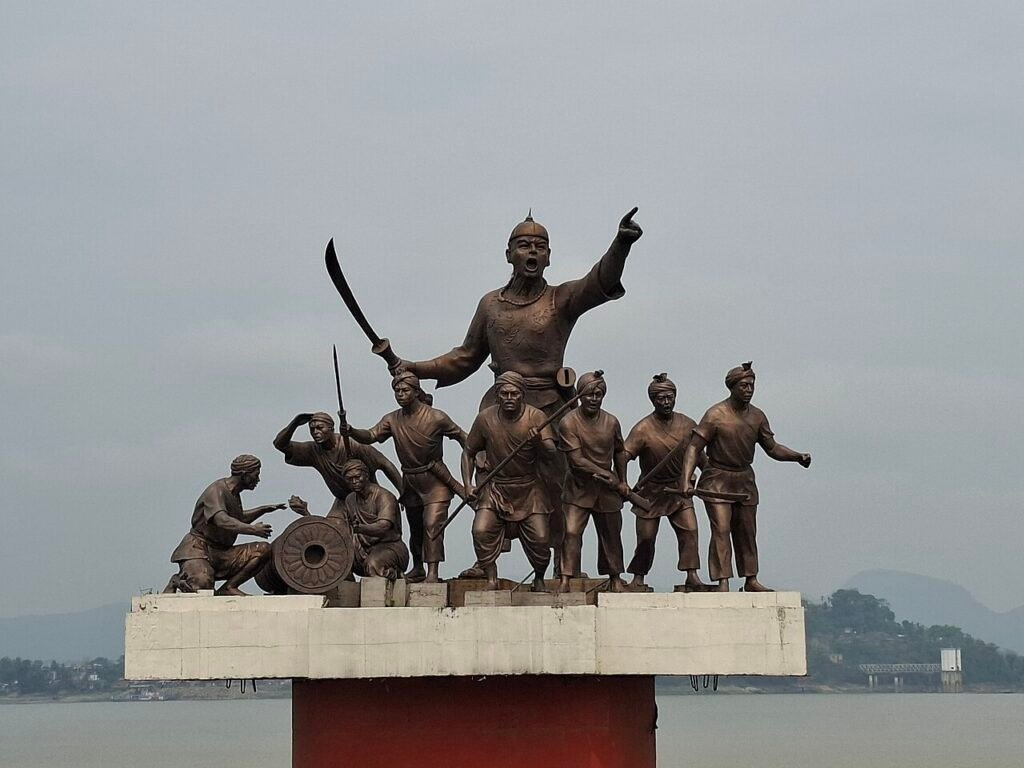
Current Context (The Trigger)
- Opinion piece: The article sets the humiliation of 1662-63, when Mir Jumla occupied the Ahom capital Garhgaon, against the Ahom victory at Saraighat in 1671, only nine years later.
- Long preparation: The writer says the victory did not come in a year or two. It was the end of a long struggle to avenge the 1662-63 invasion.
- Team effort: The article credits the king’s courage, careful planning by ministers and generals, and the readiness of ordinary Assamese of all communities to sacrifice.
- Modern argument: In the writer’s view, political conquest has given way to economic imperialism (control of trade, commerce and industry). He argues that Assam needs “modern-day Lachits” to resist outside economic pressure.
- Anniversary mark: The piece counts 355 years since Saraighat.
Core Concepts & Static GK
- Mir Jumla’s invasion: The Mughal march into Assam began on 4 January 1662. Mir Jumla entered the abandoned capital Garhgaon on 17 March 1662.
- Treaty of Ghilajharighat: The 1663 treaty forced the Ahoms to pay gold, silver and elephants, give hostages and give up territory to the Mughals.
- Change of rulers: Swargadeo Jayadhwaj Singha died in 1663, broken by the defeat. Chakradhwaj Singha then took the throne and vowed to teach the Mughals a lesson.
- Lachit’s appointment: Atan Burhagohain, the Rajmantri (the king’s chief minister), picked Lachit. King Chakradhwaj Singha and the ministers then made him commander to recover Guwahati.
- Recovery of Guwahati: Lachit marched from the capital in August 1667 and recovered Guwahati by late 1667. The article gives exact dates (20 August and 2 November 1667) and lists the forts retaken: Simulugarh, Chamdhara Garh, Kajaligarh, Itakhuli and Guwahati.
- Battle of Alaboi (1669): On 5 August 1669 the Ahoms suffered a heavy defeat at Alaboi, near Dadara-Pacharia in Kamrup district. About 10,000 Ahom soldiers died, but the war went on.
- Saraighat (1671): The decisive phase was a naval fight on the Brahmaputra near Guwahati. Lachit was seriously ill but still led the attack. The exact day is not known; accounts place it in March 1671.
Institutional Machinery
- Swargadeo: The Ahom king held the title Swargadeo. Before Saraighat, Swargadeo Chakradhwaj Singha ordered the call-up of paiks for the war.
- Paik system: Paiks were the ordinary male subjects who owed service to the state in war and labour, in return for land. All male paiks except Brahmins were called up; women and minors were left out.
- Burhagohain and Borphukan: Atan Burhagohain, the Rajmantri, organised the state for war. Lachit, as Borphukan, held the military command at Guwahati.
Assam & Northeast Linkages
- Lachit Divas: Assam marks 24 November, Lachit’s birth anniversary, as Lachit Divas across the state. It honours his courage and the Saraighat victory.
- Birth and death: The Ministry of Culture (in a PIB explainer) gives his dates as 24 November 1622 to 25 April 1672.
- 400th anniversary: President Ram Nath Kovind opened the year-long celebrations in Guwahati on 25 February 2022. Prime Minister Narendra Modi addressed the closing ceremony in New Delhi on 25 November 2022.
- Maidam and statue: Lachit’s maidam (burial mound) is at Hollongapar near Teok in Jorhat district. On 9 March 2024 the Prime Minister unveiled a 125-foot statue there (an 84-foot figure on a 41-foot base).
- Army tribute: Since 1999, the National Defence Academy (NDA) has given the Lachit Borphukan Gold Medal to its best cadet.
Prelims Trap Zones (Watch out for)
- Year Trap: Mir Jumla occupied Garhgaon in 1662, and Saraighat was fought in 1671. Alaboi (1669) was an Ahom defeat, not an Ahom win.
- Death Trap: Lachit did not die in the battle. He died on 25 April 1672, about a year after Saraighat.
- Mughal Commander Trap: Ram Singh I of Amber (the paper writes Ram Singha), son of Jai Singh, led the Mughal army at Saraighat. Mir Jumla led the earlier invasion of 1662-63.
- Divas Trap: Lachit Divas on 24 November is his birth anniversary. It is not the date of the battle, which was fought in March 1671.
- Exact Date Trap: Do not give a fixed day for Saraighat. Sources say only that it was fought around March 1671.
- Place Trap: Lachit’s maidam and the 125-foot statue are at Hollongapar near Teok in Jorhat district. They are not at Saraighat in Guwahati.
Introduction
In 1671, a seriously ill Lachit Borphukan led the Ahom forces against a large Mughal army on the Brahmaputra at Saraighat, and won. This came only nine years after Mir Jumla had occupied the Ahom capital Garhgaon. The battle is remembered as one of the finest examples of resistance in Indian history, built on planning, local knowledge and public support.
Road from Defeat to Victory
- Collapse of 1662-63: Mir Jumla’s army took Garhgaon, and the Ahom king had to flee. The 1663 treaty drained the treasury through payments in gold, silver and elephants.
- Leadership change: Jayadhwaj Singha died in 1663. His successor Chakradhwaj Singha took a vow to teach the Mughals a lesson.
- Rebuilding: The kingdom was short of paiks and weapons at that time. Atan Burhagohain organised the whole state for war.
- Merit-based choice: Atan Burhagohain spotted Lachit, the son of Momai Tamuli Borborua. Lachit had risen through posts such as Ghora Barua, Duliya Borborua, Simluguria Phukan and Dolakasharia Barua.
- Quick recovery of Guwahati: He set out in August 1667 and had retaken Guwahati, with its nearby forts, before the end of that year. The Mughals lost their main base in western Assam within months.
- Four years of preparation: Between 1667 and 1671 both sides camped around Guwahati, with only occasional fighting. Aurangzeb sent Ram Singha with a large army, and the Battle of Alaboi followed in 1669.
Elements of Lachit’s Leadership
- Use of terrain: The Ahoms chose hilly Guwahati, where Mughal cavalry could not move freely. They also built mud embankments to slow the Mughal advance on land.
- Guerrilla methods: The Ahoms used guerrilla raids (dagga judha) to wear down the Mughal camps.
- Naval strength: The decisive fight was on the river, where the Ahoms were stronger. Lachit led the boats in person at a critical moment, though he was seriously ill.
- Total mobilisation: By the king’s order, all male paiks except Brahmins were called up. Neighbouring tribal kings sent soldiers and resources.
- Inclusive effort: The article stresses that people of all ethnic communities took part. The Ministry of Culture also notes that Lachit brought together the tribal forces of Assam.
- Outcome: The Mughal army under Ram Singh was defeated at Saraighat and retreated to Rangamati in March 1671. Aurangzeb’s plan to bring Assam under Mughal rule failed.
Mughal Aims and the Modern Parallel (the writer’s view)
- Political aim: The writer says the Mughals wanted to bring Koch Bihar and Assam under their rule.
- Economic aim: He adds that the Mughals also wanted the natural resources and wealth of these kingdoms.
- Strategic aim: In his view, control of Assam would open the road to Southeast Asia, China and Burma.
- Economic imperialism: The writer argues that powers today seek control of trade and industry rather than land. He names China and the United States as countries trying to dominate India’s economy.
- Internal argument: He also claims that business groups from outside Assam are trying to take over its resources. This is the author’s opinion, not a proven finding, so students should present it as a view.
- Lesson drawn: The writer wants leaders who keep Assam secure “politically and economically” and who do not feel obliged to outside forces.
Challenges
- Uncertain details: Historians differ on some details. The exact day of Saraighat is unknown, and troop numbers vary across accounts.
- Legend versus record: The popular story that Lachit beheaded his own uncle is not found in any historical document. Students should not repeat it as fact.
- Limited national memory: For long, Lachit was little known outside Assam. The Centre treated the 400th anniversary in 2022 as a way to honour “unsung heroes” like him.
- Use in public life: Lachit’s image is now used widely in politics and public events. This makes it harder to keep the history separate from present-day agendas.
- Mixing past and present: The opinion piece links a 17th-century war to modern trade questions. The two situations differ, and claims about economic control today need data to stand up.
- Alliances on both sides: The article lists many Indian rulers and others who helped the Mughals. So the war was not a simple story of Assam against outsiders.
Way Ahead
- Source-based history: Universities and Assam’s archaeology directorate can publish verified Ahom records and Buranjis (Ahom chronicles) in simple language for students.
- Battle sites: The state can protect and study sites such as the Alaboi plains, where archaeologists have found mounds believed to be graves of the 1669 soldiers.
- Memorial as a classroom: The Hollongapar memorial near Teok, with its statue and museum, can host school visits so students learn the real story.
- Teaching military ideas: Colleges can teach Saraighat as a case study of terrain, river warfare and logistics. The NDA gold medal already links his name to young officers.
- Local economic strength: The state can back local entrepreneurs, cooperatives and skill training. Strong local firms answer outside economic pressure better than slogans do.
- Inclusive memory: Lachit Divas events can involve all communities of Assam, because the victory belonged to all of them.
Conclusion
Saraighat shows that a defeated state can recover through patient planning, the right choice of commander and the support of its people. Lachit’s example is best honoured by building local strength and by telling his story with verified facts, not by turning his name into a slogan.
Asked in APSC
- APSC Prelims 2023: (answer in the MCQs below)
If an individual is awarded with a gold medal called Lachit Borphukan Medal as the best Army Cadet, where has he/she passed out from?- (A) Indian Military Academy (IMA)
- (B) National Defence Academy (NDA)
- (C) Rashtriya Indian Military College (RIMC)
- (D) Army Cadet College (ACC)
- APSC Prelims 2022: (answer in the MCQs below)
Arrange, the following external invasions of Assam in chronological order:
(i) Invasion of Bakhtiyar Khilji
(ii) Invasion of Turbak
(iii) Invasion of Mir Jumla
(iv) Invasion of Sikandar Shah
Select the correct answer using the codes given below.- (A) (i), (ii), (iii), (iv)
- (B) (i), (iv), (ii), (iii)
- (C) (ii), (i), (iv), (iii)
- (D) (i), (ii), (iv), (iii)
All 500 APSC Prelims PYQs of CCE 2020 to 2025, with answers and explanations: practise free in the PYQ Explorer
APSC Prelims MCQs
Practice questions on this topic
Q1. The Battle of Saraighat is remembered as a landmark in Ahom history. Consider the following statements:
(i) The Battle of Alaboi in 1669 was a clear Ahom victory over the Mughals.
(ii) The Battle of Saraighat was fought in 1671 on the Brahmaputra near Guwahati.
(iii) Lachit Borphukan was the son of Momai Tamuli Borborua.
Which of the statements given above is/are correct?
- (a) (i) and (ii) only
- (b) (ii) and (iii) only
- (c) (i) and (iii) only
- (d) (i), (ii) and (iii)
Show answer
Answer: (b) Explanation: Statement (ii) is correct. The decisive Ahom victory came in 1671 in a naval fight on the Brahmaputra at Saraighat, near Guwahati. Statement (iii) is also correct, because Lachit was the son of Momai Tamuli Borborua of the Lukhurakhon clan. Statement (i) is wrong. At Alaboi, on 5 August 1669, the Ahoms suffered a heavy defeat and lost about 10,000 soldiers, though the war went on. So options (a), (c) and (d), which all include (i), are wrong. Value addition: The exact day of Saraighat is not known; accounts place it around March 1671.
Q2. Match List-I with List-II:
| List-I (Event) | List-II (Year) |
|---|---|
| a. Mir Jumla occupies Garhgaon | 1. 1669 |
| b. Lachit sets out to recover Guwahati | 2. 1671 |
| c. Battle of Alaboi | 3. 1662 |
| d. Battle of Saraighat | 4. 1667 |
Select the correct answer using the codes given below:
- (a) a-3, b-4, c-1, d-2
- (b) a-3, b-1, c-4, d-2
- (c) a-4, b-3, c-2, d-1
- (d) a-1, b-4, c-3, d-2
Show answer
Answer: (a) Explanation: Mir Jumla entered the abandoned Ahom capital Garhgaon on 17 March 1662, so a matches 3. Lachit set out from the capital for Guwahati in August 1667, so b matches 4. The Battle of Alaboi was fought on 5 August 1669, so c matches 1. The naval Battle of Saraighat was fought in 1671, so d matches 2. Option (b) swaps the years of Lachit’s march and Alaboi. Option (c) gets every pair wrong. Option (d) swaps the years of Garhgaon and Alaboi. Value addition: After Saraighat, Ram Singh’s defeated army retreated to Rangamati in March 1671.
Q3. Which one of the following statements is NOT correct?
- (a) Lachit Divas is observed in Assam on 24 November, his birth anniversary.
- (b) Under the Treaty of Ghilajharighat, the Ahoms had to give gold, silver and elephants and cede territory to the Mughals.
- (c) Ram Singh I of Amber led the Mughal side at Saraighat.
- (d) Lachit Borphukan died on the battlefield at Saraighat in 1671.
Show answer
Answer: (d) Explanation: Statement (d) is not correct. Lachit was seriously ill during Saraighat but survived the battle. The Ministry of Culture gives his date of death as 25 April 1672. Statement (a) is correct, since Lachit Divas falls on his birth anniversary, 24 November. Statement (b) is correct, because the 1663 treaty forced heavy payments and loss of territory on the Ahoms. Statement (c) is correct, as Ram Singh I of Amber, son of Jai Singh, led the Mughal forces. Value addition: President Ram Nath Kovind opened the 400th birth anniversary celebrations in Guwahati on 25 February 2022.
Q4. The Lachit Borphukan Gold Medal is awarded every year to the best cadet of which institution?
- (a) Indian Military Academy
- (b) National Defence Academy
- (c) Officers Training Academy
- (d) Air Force Academy
Show answer
Answer: (b) Explanation: Since 1999, the National Defence Academy (NDA) at Khadakwasla, Pune, has given the Lachit Borphukan Gold Medal to its best cadet. The aim is to let young soldiers draw inspiration from the Ahom commander of Saraighat. The Indian Military Academy, the Officers Training Academy and the Air Force Academy are separate training academies. Official sources link this medal only to the NDA, so options (a), (c) and (d) are wrong. Value addition: On 9 March 2024 the Prime Minister unveiled a 125-foot statue of Lachit at Hollongapar near Teok in Jorhat district.
PYQ (APSC Prelims 2023): If an individual is awarded with a gold medal called Lachit Borphukan Medal as the best Army Cadet, where has he/she passed out from?
- (A) Indian Military Academy (IMA)
- (B) National Defence Academy (NDA)
- (C) Rashtriya Indian Military College (RIMC)
- (D) Army Cadet College (ACC)
Show answer
Answer: (B) Explanation: The Lachit Borphukan Gold Medal is awarded at the National Defence Academy (NDA), Khadakwasla, Pune. Since 1999 the NDA has conferred it on a top passing-out cadet. It was instituted at the initiative of Lt Gen (Retd) S.K. Sinha, then Governor of Assam, to honour Lachit Borphukan, the Ahom general who defeated the Mughal forces at the Battle of Saraighat (1671), and to inspire young officers.
Read the full explanation, with all APSC Prelims Assam GK PYQs
PYQ (APSC Prelims 2022): Arrange, the following external invasions of Assam in chronological order:
(i) Invasion of Bakhtiyar Khilji
(ii) Invasion of Turbak
(iii) Invasion of Mir Jumla
(iv) Invasion of Sikandar Shah
Select the correct answer using the codes given below.
- (A) (i), (ii), (iii), (iv)
- (B) (i), (iv), (ii), (iii)
- (C) (ii), (i), (iv), (iii)
- (D) (i), (ii), (iv), (iii)
Prepare with SuchitraACS
APSC CCE Foundation Programme₹24,999  APSC Prelims Crash Course 2027 (GS + CSAT)₹5,999
 APSC CCE Study Materials Package (Prelims + Mains)₹4,999