
Free for every APSC aspirant · no sign-up
APSC CSAT PYQs with Answers Prelims GS Paper II, CCE 2020 to 2025, with worked solutions
All 400 questions of the last five APSC Prelims CSAT papers, including the 2026 question paper (CCE 2025): reasoning, maths, passages, data and decision making, each with the answer and a step-by-step solution. CSAT is qualifying: you need 33% to have your GS Paper I marks counted.
Pick up the most appropriate word to fill in the blank from the given alternatives :
Bengal, Indo-Chinese, South China, Amur, ____
- ASumatran
- BCaspian
- CBali
- DJavan
Show answer and explanationHide answer
Answer(A) Sumatran
Explanation
Bengal, Indo-Chinese, South China and Amur (Siberian) are tiger subspecies in the traditional list of nine that are not extinct. Of the options, only the Sumatran tiger is also still living. The Caspian, Bali and Javan tigers are the three extinct subspecies.
- (A) Sumatran: correct. It is a surviving tiger subspecies, like the four in the list.
- (B) Caspian: wrong. The Caspian tiger has been extinct since the 1970s.
- (C) Bali: wrong. The Bali tiger became extinct in the 1940s.
- (D) Javan: wrong. The Javan tiger was thought to be extinct by the 1980s.
For future exams
- Traditional nine subspecies: Bengal, Malayan, Indochinese, South China, Siberian (Amur), Sumatran (surviving; South China only in captivity) and Caspian, Javan, Bali (extinct). In 2017 the IUCN Cat Classification Task Force recognised only two subspecies: P. t. tigris (mainland) and P. t. sondaica (Sunda Islands).
- The tiger is Endangered on the IUCN Red List and listed in CITES Appendix I; as of 2020 India had the largest tiger habitat, followed by Russia.
Micro topic Tiger types, fit missing wordChapter Classification
In the given list below, identify the word which is different from the rest :
inflexible, stubborn, obstinate, acquiescent, rigid, dogged
- Aacquiescent
- Bobstinate
- Cdogged
- Drigid
Show answer and explanationHide answer
Answer(A) acquiescent
Explanation
Inflexible, stubborn, obstinate, rigid and dogged all describe a person who will not change or give in. Acquiescent means willing to accept or go along with something without objecting or resisting (Wiktionary). It is the opposite idea, so it is the odd word.
- (A) acquiescent: correct. It means agreeing or submitting quietly, the opposite of stubborn.
- (B) obstinate: wrong. It means stubbornly refusing to change one's mind, the same group as stubborn.
- (C) dogged: wrong. It means stubbornly unyielding, unwilling to give up (Vocabulary.com), so it belongs to the group.
- (D) rigid: wrong. Used for a person, it means not willing to change or bend, the same group as inflexible.
For future exams
- Odd-one-out with words: find the meaning shared by most words (here, refusing to give in), then look for the antonym or the word from a different category.
- Acquiescent comes from the verb acquiesce, to accept something without protest. Example: The staff were acquiescent and signed the new rules without a word.
Micro topic Odd word among stubborn synonymsChapter Odd One Out
If Cycle pairs with Velodrome, then Boxing will pair with
- AArena
- BRing
- CCourt
- DPitch
Show answer and explanationHide answer
Answer(B) Ring
Explanation
A velodrome is an arena with an oval, banked track built for bicycle racing, so the relation is 'sport : the special place where it is played'. Boxing is fought in a ring, a raised square platform enclosed by ropes.
- (A) Arena: wrong. Arena is a general word for any large sports venue (a velodrome itself is a kind of arena); it is not the place made only for boxing.
- (B) Ring: correct. The ring is the special fighting area of boxing, just as the velodrome is the special track for cycling.
- (C) Court: wrong. A court is used for games such as tennis, badminton and basketball.
- (D) Pitch: wrong. A pitch is used for cricket, football and hockey.
For future exams
- The boxing ring is square, but the name 'ring' comes from early fights held in a rough circle drawn on the ground; hence the nickname 'squared circle'.
- Common sport : venue pairs: tennis : court, cricket : pitch, golf : course, swimming : pool, wrestling : mat or ring, skating : rink.
Micro topic Cycle : Velodrome, Boxing pairingChapter Analogy
A man walks 6 km to North, then turns right through 90° and walks 8 km. Then he turns South and walks 3 km. Again, he turns right through 90° and walks 4 km and stops. How far is he now from his starting point?
- A3 km
- B4 km
- C5 km
- D6 km
Show answer and explanationHide answer
Answer(C) 5 km
Explanation
1. Put the start at . 6 km North → .
2. Facing North, a right turn faces East. 8 km East → .
3. 3 km South → .
4. Facing South, a right turn faces West. 4 km West → .
5. He is 4 km East and 3 km North of the start. Distance = km. Answer: (C).
- (A) 3 km: wrong. 3 km is only his North-South gap (); it leaves out the 4 km East gap.
- (B) 4 km: wrong. 4 km is only his East-West gap (); it leaves out the 3 km North gap.
- (C) 5 km: correct. Net 4 km East and 3 km North, and km.
- (D) 6 km: wrong. 6 km is only the first leg (North). The net position is 4 km East and 3 km North of the start, which gives 5 km.
For future exams
- Shortcut: find the net North-South distance () and net East-West distance (), then use Pythagoras. Remember the 3-4-5 and 6-8-10 triples; they appear often in direction questions.
Micro topic Walks north, right, south, distance from startChapter Direction Sense
Nowadays, most of the offices have gone paperless to the extent possible because
(i) a paperless office is environment friendly
(ii) paper is very costly nowadays
Choose the correct alternative.
- AOnly (i) is correct
- BOnly (ii) is correct
- CBoth (i) and (ii) are correct
- DNeither (i) nor (ii) is correct
Show answer and explanationHide answer
Answer(A) Only (i) is correct
Explanation
A reason is valid only if it truly explains the action. (i) is valid: going paperless saves paper, so fewer trees are cut and less waste is made; this is a widely stated reason for paperless offices. (ii) is not a valid reason: offices go paperless for speed, easy storage and search, and environmental benefit. Paper prices go up and down, but the cost of paper is not why offices have moved to digital files. So only (i) is correct.
- Reason (i), a paperless office is environment friendly: correct. Less paper use means less tree cutting, less waste and less energy in paper making.
- Reason (ii), paper is very costly nowadays: not correct. The cost of paper is not what drives the move to digital offices; that comes from speed, easy storage and search, and less waste. 'Very costly' is also an exaggerated claim.
- So the code is (A) Only (i). (B) and (C) wrongly accept (ii); (D) wrongly rejects (i).
For future exams
- Reason / argument rule: accept a reason only if it is true in general and directly linked to the action. Reject reasons that are exaggerated ('very costly', 'always', 'never') or only loosely linked.
Micro topic Reasons for paperless officesChapter Statement & Conclusion
The government is encouraging the use of electric vehicles because
(i) fossil fuel will not last forever
(ii) electric vehicles do not cause pollution
Choose the correct alternative.
- AOnly (i) is correct
- BOnly (ii) is correct
- CBoth (i) and (ii) are correct
- DNeither (i) nor (ii) is correct
Show answer and explanationHide answer
Answer(C) Both (i) and (ii) are correct
Explanation
The government's own stated aims for promoting electric vehicles are two: fuel security (less dependence on petrol and diesel) and less pollution. The PIB factsheet on FAME India (11 July 2022) says the National Electric Mobility Mission Plan (NEMMP) 2020 was launched in 2013 'to achieve national fuel security', and that FAME India was launched in 2015 to reduce pollution caused by diesel and petrol vehicles. Reason (i) matches the fuel-security aim (fossil fuels are limited and will not last forever). Reason (ii) matches the pollution aim: an electric vehicle has zero tailpipe emissions. So both reasons explain the policy.
- Reason (i), fossil fuel will not last forever: correct. Petrol and diesel come from limited fossil fuel; NEMMP 2020 aims at national fuel security.
- Reason (ii), electric vehicles do not cause pollution: accepted as a reason. EVs produce zero tailpipe (direct) emissions, and the FAME scheme's stated aim is to reduce pollution from petrol and diesel vehicles. Strictly, power plants that make the electricity can still pollute, so EVs cause less pollution rather than none.
- So the code is (C) Both. (A) and (B) each drop one of the two stated aims; (D) rejects both.
For future exams
- FAME India (Faster Adoption and Manufacturing of (Hybrid &) Electric Vehicles) was launched by the Ministry of Heavy Industries in 2015 under NEMMP 2020 (launched 2013); Phase II began on 1 April 2019.
- All-electric vehicles have zero tailpipe emissions, but their total (life-cycle) emissions depend on how the electricity is produced.
Update: As of November 2026: FAME-II ran from 1 April 2019 to 31 March 2024. It was followed by the PM E-DRIVE scheme (outlay Rs 10,900 crore), in force from 1 April 2024 to 31 March 2028 (Ministry of Heavy Industries, Lok Sabha reply, 10 March 2026).
Micro topic Reasons for encouraging electric vehiclesChapter Statement & Conclusion
Dengue is spreading alarmingly in certain pockets of the city. Therefore
(i) fumigation should be carried out in war footing in the affected areas
(ii) residents should be advised to avoid non-vegetarian foods
Choose the correct alternative.
- AOnly (i) is correct
- BOnly (ii) is correct
- CBoth (i) and (ii) are correct
- DNeither (i) nor (ii) is correct
Show answer and explanationHide answer
Answer(A) Only (i) is correct
Explanation
Dengue is spread by the bite of infected female mosquitoes, mainly Aedes aegypti (WHO). The right course of action must cut mosquito numbers in the affected pockets. Fumigation (fogging) on a war footing in those areas kills adult mosquitoes and so acts on the cause. Dengue does not spread through food, so avoiding non-vegetarian food has no link to the problem. Only (i) follows.
- Action (i), fumigation on war footing in affected areas: correct. Dengue spreads through Aedes mosquito bites, so urgent mosquito control in the affected pockets is a direct and practical step.
- Action (ii), avoid non-vegetarian food: not correct. WHO lists mosquito bites as the main route and rare routes such as blood transfusion, organ donation and mother to baby; food is not a route of dengue spread.
- So the code is (A) Only (i). (B) and (C) accept an action unrelated to the cause; (D) rejects a valid action.
For future exams
- Dengue virus is carried mainly by the Aedes aegypti mosquito (WHO).
- WHO prevention steps: remove artificial habitats that hold water, cover, empty and clean household water containers weekly, and use protective clothing, nets, window screens and repellents.
Micro topic Dengue spread, courses of actionChapter Statement & Conclusion
If the square represents traders, circle represents football lovers and triangle represents women who love football, then which slice represents women who love football, but are not traders?
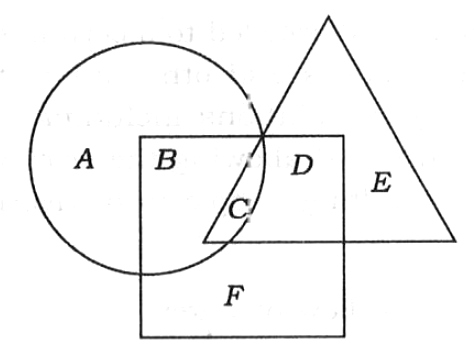
- AC
- BE
- CD
- DThere is no such slice
Show answer and explanationHide answer
Answer(B) E
Explanation
1) Women who love football = inside the triangle.
2) Not traders = outside the square.
3) The only labelled part of the triangle outside the square is E (the right-hand part of the triangle). Regions C and D are parts of the triangle inside the square.
4) So the slice is E.
- (A) C: wrong. C lies inside the square, the circle and the triangle: women football lovers who are traders.
- (B) E: correct. E is inside the triangle and outside the square.
- (C) D: wrong. D lies inside the square and the triangle: women football lovers who are traders.
- (D) There is no such slice: wrong. Region E meets both conditions.
For future exams
- Turn each condition into inside / outside: 'women who love football' = inside the triangle, 'not traders' = outside the square; then pick the labelled region that meets both.
- Ignore a shape the question does not use as a condition; here the circle is not needed to answer.
Micro topic Traders, football lovers, women regionChapter Venn Diagrams
If Bus is related to Car, then in the same way, River would be related to
- AStream
- BPond
- CLake
- DSwimming pool
Show answer and explanationHide answer
Answer(A) Stream
Explanation
A bus and a car are the same kind of thing (road vehicles), and the bus is the bigger one. So the relation is 'bigger : smaller of the same kind'. A river and a stream are both bodies of flowing water; a stream is a small river.
- (A) Stream: correct. A stream is a small river: same kind (moving water), smaller size, just as a car is a smaller road vehicle than a bus.
- (B) Pond: wrong. A pond is still (standing) water, not flowing water, so it is not the same kind as a river.
- (C) Lake: wrong. A lake is also standing water and is often bigger, not a smaller river.
- (D) Swimming pool: wrong. It is man-made still water for swimming, not a natural flowing body of water.
For future exams
- In analogies, check two things: the type (both vehicles, both flowing water) and the direction (bigger to smaller). An option that fails either test is out.
- Wiktionary defines stream as 'a small river; a large creek; a body of moving water confined by banks'.
Micro topic Bus : Car, River pairingChapter Analogy
Consider the following sequence of pairs of alphabets :
AK, BL, DN, GQ
The pair of alphabets that will come after GQ is
- ACM
- BHJ
- CKL
- DKU
Show answer and explanationHide answer
Answer(D) KU
Explanation
1. First letters: A(1), B(2), D(4), G(7). Gaps are +1, +2, +3, so the next gap is +4: 7 + 4 = 11 = K.
2. Second letters: K(11), L(12), N(14), Q(17). Gaps are again +1, +2, +3, so the next gap is +4: 17 + 4 = 21 = U.
3. Next pair = KU.
- (A) CM: wrong. C (3) would mean the first letter goes back after G (7); the series only goes forward.
- (B) HJ: wrong. H is G + 1 (repeating the first gap) and J is behind Q; both break the +4 step.
- (C) KL: wrong. K is the right first letter (G + 4), but L (12) is behind Q (17); the second letter must be Q + 4 = U.
- (D) KU: correct. Both letters move +4 at this step: G to K and Q to U.
For future exams
- Learn letter positions by the EJOTY trick: E = 5, J = 10, O = 15, T = 20, Y = 25; then U = 21 (T + 1) and K = 11 (J + 1) come at once.
- When both letters in a pair move by the same growing gaps (+1, +2, +3 ...), the distance between them stays fixed: here the second letter is always 10 places after the first (A-K, B-L, D-N, G-Q, K-U).
Micro topic Next pair in AK, BL, DN, GQChapter Alphabet Series
The special edition paperback version of Roget's Thesaurus has 656 printed pages, and all are numbered except the covers. What would be the total number of digits used for page numbering this book?
- A1760
- B1680
- C1860
- D1670
Show answer and explanationHide answer
Answer(C) 1860
Explanation
1. Pages 1 to 9: 9 pages 1 digit = 9 digits.
2. Pages 10 to 99: 90 pages 2 digits = 180 digits.
3. Pages 100 to 656: pages 3 digits = digits.
4. Total = digits.
- (A) 1760: wrong. It is exactly 100 short of the correct total of 1,860, a slip in adding the three blocks.
- (B) 1680: wrong. It leaves out a block of pages; for example, counts only up to page 596.
- (C) 1860: correct. .
- (D) 1670: wrong. It is close to the three-digit part alone (1,671) and ignores pages 1 to 99.
For future exams
- Formula for pages 1 to N when N has 3 digits: (because one-digit pages save 2 each and two-digit pages save 1 each: ). Here .
- Reverse type: if a book uses D digits (), .
Micro topic Unnumbered pages, digits printedChapter Number Puzzles
The town clock of Pradoga takes 6 seconds to strike six at 6 o'clock. How much time would it take to strike eleven at 11 o'clock?
- A11 seconds
- B10 seconds
- C14 seconds
- D12 seconds
Show answer and explanationHide answer
Answer(D) 12 seconds
Explanation
1. Time is counted from the first stroke to the last stroke, so what takes time is the gaps between strokes.
2. Six strokes have gaps. 3. 5 gaps take 6 seconds, so one gap = seconds.
4. Eleven strokes have gaps.
5. Time = seconds.
- (A) 11 seconds: wrong. This assumes 1 second per stroke (6 strokes in 6 seconds), forgetting that time runs only between strokes.
- (B) 10 seconds: wrong. This counts the 10 gaps but takes each gap as 1 second instead of 1.2 seconds.
- (C) 14 seconds: wrong. No correct count of gaps gives 14; 10 gaps at 1.2 seconds is 12.
- (D) 12 seconds: correct. 10 gaps 1.2 seconds = 12 seconds.
For future exams
- Clock-strike rule: strikes have intervals. Time for strikes = . Here seconds.
Micro topic Clock strokes, time for elevenChapter Time Puzzles
In the following two arithmetic operations, the numbers are correct, but the operators are all mixed up, except the '=' sign :
(i)
(ii)
Under this new usage of operators, which of the following operations is valid?
- A
- B
- C
- D
Show answer and explanationHide answer
Answer(D)
Explanation
1. From (i) : if '+' means '×', the left side is ; then '×' must mean '+', because .
2. From (ii) : if '÷' means '−', the left side is ; then '−' must mean '÷', because .
3. So the code is: + becomes ×, × becomes +, ÷ becomes −, − becomes ÷ (two swapped pairs).
4. Option (D) decodes to (using BODMAS). So (D) is valid.
- (A) : wrong. It decodes to , not 0.
- (B) : wrong. It decodes to , not 0.
- (C) : wrong. It decodes to , not 0.
- (D) : correct. It decodes to .
For future exams
- Shortcut: find the code from the example with the easiest numbers first (9 and 5 give 45 only by multiplication; 20 and 25 give 45 only by addition), then decode only the operators in each option and apply BODMAS.
- Check trick: the right side here is 0, so look for an option whose decoded form is 'something − something' with equal parts ( in option D).
Micro topic Mixed-up arithmetic operatorsChapter Logical Operations
A and B start walking in opposite directions. A covers 3 km and B covers 4 km. Then A turns right and walks 4 km while B turns left and walks 3 km. How far is each from the starting point?
- A5 km
- B4 km
- C10 km
- D8 km
Show answer and explanationHide answer
Answer(A) 5 km
Explanation
1. Let A walk North and B walk South from the same point .
2. A: 3 km North → . Facing North, a right turn faces East; 4 km → . A's distance = km.
3. B: 4 km South → . Facing South, a left turn faces East; 3 km → . B's distance = km.
4. Each is 5 km from the start. Answer: (A).
- (A) 5 km: correct. Each walker's two legs (3 km and 4 km) are at right angles, so each is km from the start.
- (B) 4 km: wrong. It is only one leg of each walk, not the straight-line distance.
- (C) 10 km: wrong. It adds the two walkers' distances (); the question asks how far each one is, not the total.
- (D) 8 km: wrong. No path gives 8 km; it may come from adding the two 4 km legs.
For future exams
- Each walker's two legs are always at right angles, so the starting directions and turn sides do not change each one's distance: km. Only the distance between A and B depends on the turns (here , about 7.07 km), which the question does not ask.
Micro topic Two walkers, final distanceChapter Direction Sense
In a row of 40 students, Saurav is 24th from the left end and Sachin is 26th from the right end. How many students are there between Saurav and Sachin?
- A10
- B9
- C8
- DNone of the above
Show answer and explanationHide answer
Answer(C) 8
Explanation
1. Sachin is 26th from the right in a row of 40, so from the left he is th.
2. Saurav is 24th from the left.
3. Students between positions 15 and 24 (positions 16 to 23). Answer: (C) 8.
- (A) 10: wrong. It comes from , which is the overlap count used when the two persons cross over; here it counts too many by 2.
- (B) 9: wrong. It is , the gap in positions, which counts Saurav too. You must subtract 1.
- (C) 8: correct. Positions 16 to 23 hold 8 students.
- (D) None of the above: wrong. Option (C) gives the correct count.
For future exams
- .
- When the two positions overlap (), students between = . Here .
Micro topic Row of 40, students betweenChapter Ranking & Order
Consider the following sequence of numbers :
11, 14, 19, 26
The number that will come after 26 is
- A33
- B34
- C35
- D36
Show answer and explanationHide answer
Answer(C) 35
Explanation
1. Differences: , , .
2. The differences are odd numbers rising by 2, so the next difference is 9.
3. .
4. Check another way: the terms are (, , , ), so the fifth term is .
- (A) 33: wrong. It needs a difference of 7 again; the differences grow by 2 each time.
- (B) 34: wrong. A difference of 8 breaks the odd-number pattern 3, 5, 7.
- (C) 35: correct. Difference 9 (), and .
- (D) 36: wrong. It needs a difference of 10 and is not of the form .
For future exams
- When the differences are consecutive odd numbers (1, 3, 5, 7, 9 ... or, as here, 3, 5, 7, 9), the series is + constant, because consecutive squares differ by consecutive odd numbers.
Micro topic Sequence 11, 14, 19, 26 nextChapter Number Series
Directions for Q1 and Q2HideShow
Read the following instructions carefully for Question Nos. 1 and 2 : Each of the following two items consists of four statements. Of these four statements two cannot be true, but both can be false. Study the statements carefully and identify the statements that satisfy the above conditions. Select the correct answer using the codes given below the each set of statements.
Examine the following statements and select the correct answer using the codes given below the statements :
I. All animals are carnivorous.
II. Some animals are not carnivorous.
III. Animals are not carnivorous.
IV. Some animals are carnivorous.
- AI and III
- BI and II
- CII and III
- DIII and IV
Show answer and explanationHide answer
Answer(A) I and III
Explanation
1. The condition 'cannot both be true, but can both be false' describes contrary statements.
2. Statement I is a universal positive ('All animals are carnivorous'); Statement III means 'No animals are carnivorous', a universal negative.
3. Both cannot be true at the same time, but both are false if some animals eat meat and some do not (which is the real case).
4. So I and III are the required pair.
- (A) I and III: correct. 'All A are B' and 'No A is B' are contraries: they cannot both be true, but both can be false.
- (B) I and II: wrong. 'All animals are carnivorous' and 'Some animals are not carnivorous' are contradictories: they cannot both be true and also cannot both be false (exactly one is true).
- (C) II and III: wrong. 'Some animals are not carnivorous' and 'No animals are carnivorous' can both be true (if no animal eats meat), so the first condition fails.
- (D) III and IV: wrong. 'No animals are carnivorous' and 'Some animals are carnivorous' are contradictories: exactly one must be true, so they cannot both be false.
For future exams
- Rule (square of opposition): All–No = contrary (both cannot be true, both can be false); Some–Some not = sub-contrary (both cannot be false, both can be true); All–Some not and No–Some = contradictory (one true, one false always).
- A sentence like 'Animals are not carnivorous' (no 'some') is read as the universal 'No animals are carnivorous'.
Micro topic Contradictory and contrary statementsChapter Logical Reasoning
Same directions as aboveHideShow
Read the following instructions carefully for Question Nos. 1 and 2 : Each of the following two items consists of four statements. Of these four statements two cannot be true, but both can be false. Study the statements carefully and identify the statements that satisfy the above conditions. Select the correct answer using the codes given below the each set of statements.
Examine the following statements and select the correct answer using the codes given below the statements :
I. All trains are run by diesel engine.
II. Some trains are run by diesel engine.
III. No trains are run by diesel engine.
IV. Some trains are not run by diesel engine.
- AI and II
- BII and III
- CI and III
- DI and IV
Show answer and explanationHide answer
Answer(C) I and III
Explanation
1. 'Two cannot be true, but both can be false' is the test for contrary statements.
2. Statement I ('All trains are run by diesel engine') and Statement III ('No trains are run by diesel engine') are a universal positive and a universal negative on the same subject.
3. They cannot both be true, but both are false if some trains run on diesel and some on electricity (the real case).
4. So I and III satisfy the condition.
- (A) I and II: wrong. 'All trains are diesel' and 'Some trains are diesel' can both be true (if 'all' is true, 'some' is also true).
- (B) II and III: wrong. 'Some trains are diesel' and 'No trains are diesel' are contradictories: one must be true, so they cannot both be false.
- (C) I and III: correct. 'All' and 'No' statements are contraries: never both true, but both can be false.
- (D) I and IV: wrong. 'All trains are diesel' and 'Some trains are not diesel' are contradictories: they cannot both be false.
For future exams
- Rule: contrary = All vs No (both false possible); contradictory = All vs Some-not, or No vs Some (exactly one true); sub-contrary = Some vs Some-not (both true possible, both false not possible).
- Quick test: imagine a mixed real world (some X are Y, some are not). The pair that turns out both false in that world, and can never be both true, is the contrary pair.
Micro topic Consistent statements from given setChapter Logical Reasoning
A journey starts from North towards South. Then there are four consecutive left turns. Now the journey is heading towards
- AEast
- BWest
- CNorth
- DSouth
Show answer and explanationHide answer
Answer(D) South
Explanation
1. The journey starts heading South.
2. Each left turn is . Four left turns = , one full circle.
3. Turning through a full circle brings you back to the direction you started with.
4. Check step by step: South → left = East → left = North → left = West → left = South.
5. The journey is heading South. Answer: (D).
- (A) East: wrong. East is the heading after only one left turn (or after three right turns).
- (B) West: wrong. West is the heading after three left turns.
- (C) North: wrong. North is the heading after two turns (), or the slip of reading 'starts from North' as the heading.
- (D) South: correct. Four left turns make , so the heading returns to South.
For future exams
- Rule: count total turning. Left = , right = . Four turns the same way, or two left plus two right, always give the starting direction again.
Micro topic Four left turns, final directionChapter Direction Sense
If it is sunny, I am wet. If I wear a raincoat, I sweat. When it rains, there is no sun, but I am dry; and when there is wind and no sun, my sweat evaporates. In a rainy day, if it is windy and I wear a raincoat, which one of the following statements is most appropriate?
- AI am dry.
- BI am wet.
- CI sweat.
- DI sweat and my sweat evaporates.
Show answer and explanationHide answer
Answer(D) I sweat and my sweat evaporates.
Explanation
1. It is a rainy day, so there is no sun ('When it rains, there is no sun').
2. I wear a raincoat, so I sweat ('If I wear a raincoat, I sweat').
3. There is wind and no sun, so my sweat evaporates ('when there is wind and no sun, my sweat evaporates').
4. Option (D) uses every condition given (rain, raincoat, wind) and states the full result, so it is the most appropriate statement.
- (A) I am dry: true but incomplete. It follows from 'When it rains ... I am dry', but it ignores the raincoat and the wind that the question adds on purpose; (D) explains why I stay dry.
- (B) I am wet: wrong. 'If it is sunny, I am wet', but a rainy day has no sun; the rule also says that in rain I am dry.
- (C) I sweat: incomplete. The raincoat makes me sweat, but the wind with no sun makes the sweat evaporate, so (C) misses half of the result.
- (D) I sweat and my sweat evaporates: correct. Raincoat gives sweat; wind with no sun (rainy day) makes it evaporate.
For future exams
- In 'most appropriate' questions, list each given condition and its result; the best option is the one that uses all the conditions in the question, not only one of them.
- Do not reverse a rule: 'If sunny, then wet' does not mean 'if wet, then sunny'.
Micro topic Rain, raincoat, wind conditional puzzleChapter Logical Reasoning
What APSC asks in CSAT
Questions by area, CCE 2020 to 2025
400 questions from 5 papers of 80 each. Tap an area to see its questions.
Papers and syllabus
FAQ
APSC CSAT PYQs: questions students ask
Which APSC CSAT papers are included?
General Studies Paper II (CSAT) of the APSC CCE Prelims 2020, 2022, 2023, 2024 and 2025: 80 questions from each paper, 400 in all. The question numbers follow the booklets CCE 2020 Series C, CCE 2022 Series D, CCE 2023 Series A, CCE 2024 Series A, CCE 2025 Series A. The CCE 2025 paper, held in 2026, is the one students call the 2026 CSAT paper.
Is CSAT qualifying in APSC Prelims?
Yes. CSAT (Paper II) has 80 questions for 200 marks. It is qualifying: you need 33% in it, and only then are your GS Paper I marks counted for the Mains merit list.
Which CSAT topics does APSC ask most?
Across the five papers: Logical Reasoning & Mental Ability (132), Basic Numeracy (78), Comprehension (73). Use the area filter or the bars above to practise one area at a time.
Are the answers official?
Answers follow the APSC answer key (CCE 2022: final key; the other papers: the APSC provisional key, the only Paper II key we have for those exams). 21 questions carry an answer-key note: where the key was wrong or the question had an error, the note under the answer explains which answer to mark and why.
How do I practise CSAT here?
Choose an area, a paper or a question type, then switch to Practise: one question at a time, tap an option and see at once whether you are right, with the worked solution. Your record stays only in this browser on this device.