
Free for every APSC aspirant · no sign-up
APSC CSAT PYQs with Answers Prelims GS Paper II, CCE 2020 to 2025, with worked solutions
All 400 questions of the last five APSC Prelims CSAT papers, including the 2026 question paper (CCE 2025): reasoning, maths, passages, data and decision making, each with the answer and a step-by-step solution. CSAT is qualifying: you need 33% to have your GS Paper I marks counted.
What combination of alphanumeric characters should occupy the vacant space of the given table?
- A25X
- B20X
- C1X
- D1Z
Show answer and explanationHide answer
Answer(B) 20X
Explanation
1. Read the table (checked on the printed page): row 1 = 1Y, 4Z, 7X; row 2 = 10Z, (blank), 50Y; row 3 = 3Z, 2Y, 1X.
2. Numbers, column by column: . Column 1: . Column 3: .
3. Column 2: .
4. Letters: each row has X, Y and Z once (row 1: Y, Z, X; row 3: Z, Y, X). Row 2 has Z and Y, so the blank takes X.
5. The blank is 20X.
- (A) 25X: wrong. The letter is right, but 25 fits no rule in the table; , not 25.
- (B) 20X: correct. , and X is the only letter missing from row 2.
- (C) 1X: wrong. The letter fits, but 1 does not follow the square rule; it only copies the cell 1X.
- (D) 1Z: wrong. Z is already in row 2, and 1 does not fit the number rule.
For future exams
- In number tables, test rows and columns; common rules are sum, product, and sum of squares of the two outer cells.
- When a cell has a number and a letter, solve the two parts separately; the letter part alone removes option (D) here.
Micro topic Missing entry in alphanumeric tableChapter Alphanumeric Series
Which letter of the English alphabet should occupy the blank space in the given horizontal table?
- AL
- BK
- CI
- DE
Show answer and explanationHide answer
Answer(B) K
Explanation
1. Write the position of each letter: W = 23, S = 19, Q = 17, M = 13.
2. The gaps are , , , so the next gap is .
3. , and the 11th letter is K.
4. Check: 23, 19, 17, 13, 11 are also the prime numbers in falling order, so both rules give K.
- (A) L: wrong. L = 12, a gap of from M (13); the pattern needs . Comes from taking just the letter before M.
- (B) K: correct. K = 11 continues the gaps , , , and the falling prime series 23, 19, 17, 13, 11.
- (C) I: wrong. I = 9 needs a gap of from M; that repeats the last-but-one gap and breaks the , alternation.
- (D) E: wrong. E = 5 needs a gap of ; nothing in the series supports it.
For future exams
- Shortcut: learn letter positions with EJOTY (E = 5, J = 10, O = 15, T = 20, Y = 25), then count one or two steps from the nearest anchor.
- In letter series, always test two things: the gaps between positions, and whether the positions themselves form a known set (primes, squares, odd numbers).
Micro topic Missing letter in seriesChapter Alphabet Series
In this sequence, what number would logically come next? 2, 4, 8, 4, 6, 5, 9, 4, ____
- A6
- B8
- C4
- D3
Show answer and explanationHide answer
Answer(D) 3
Answer-key note: Official key wrong
APSC provisional key: (C) 4. Our answer: (D) 3. Why: in groups of three the sums are 14 and 15, so the next group must add to 16, giving 9 + 4 + 3 = 16. With 4 the sums would be 14, 15, 17, which breaks the pattern, and we found no other simple rule (differences, alternate terms, products, grid columns) that gives 4. In the exam, mark (D) 3, the answer the logic supports; note that APSC's provisional key showed (C), and the final key may keep it.
APSC provisional key: C · Answer here: DExplanation
1. Split the series into groups of three: (2, 4, 8), (4, 6, 5), (9, 4, __).
2. Group sums: 2 + 4 + 8 = 14 and 4 + 6 + 5 = 15. The sums go up by 1.
3. So the third group must add to 16: 9 + 4 + ? = 16, so ? = 3.
4. Answer: 3.
- (A) 6: wrong. 9 + 4 + 6 = 19, not 16.
- (B) 8: wrong. 9 + 4 + 8 = 21, not 16.
- (C) 4: wrong. 9 + 4 + 4 = 17; the sums would go 14, 15, 17, which is not a steady pattern. No simple rule (differences, alternate terms, group sums or products, grid columns) gives 4.
- (D) 3: correct. 9 + 4 + 3 = 16 continues the group sums 14, 15, 16.
Key note: APSC provisional key: (C)
4. Our answer: (D)
3. Why: in groups of three the sums are 14 and 15, so the next group must add to 16, giving 9 + 4 + 3 = 16. With 4 the sums would be 14, 15, 17, which breaks the pattern, and we found no other simple rule (differences, alternate terms, products, grid columns) that gives 4. In the exam, mark (D) 3, the answer the logic supports; note that APSC's provisional key showed (C), and the final key may keep it.
For future exams
- When a series jumps up and down with no clear step, try groups of 2 or 3 and look at the sum or product of each group.
- Other checks to try: alternate terms (odd and even places) and differences between terms.
Micro topic Missing number in seriesChapter Number Series
From the given set of 5 numbers, identify the odd number out : 5712, 9211, 4307, 2309, 7512
- A9211
- B4307
- C2309
- D7512
Show answer and explanationHide answer
Answer(C) 2309
Explanation
1. Split each number into its first two digits and its last two digits.
2. Rule: first digit + second digit = the number formed by the last two digits.
3. 5712: . 9211: . 4307: (07). 7512: . All fit.
4. 2309: , but the last two digits are 09.
5. So 2309 breaks the rule and is the odd one out.
- (A) 9211: wrong. , which matches its last two digits.
- (B) 4307: wrong. , which matches its last two digits (07).
- (C) 2309: correct. , but its last two digits are 09.
- (D) 7512: wrong. , which matches its last two digits.
For future exams
- For odd-number-out with 4-digit numbers, first test a link between the first two digits and the last two (sum, difference, product); then try digit sum, repeated digits, divisibility.
- Check: 2309 is also the only prime in the set (, ; 5712 and 7512 are even), which supports the same answer.
Micro topic Odd number outChapter Odd One Out
Consider the statement and the conclusions given below : Statement : As compared to the earlier times, the weather forecasts issued by the meteorological department are fairly accurate. Conclusions : (i) In recent times, the meteorological department has hired some highly qualified individuals. (ii) The science of meteorology has made great advances in recent years. Choose the correct option.
- AOnly conclusion (i) follows
- BOnly conclusion (ii) follows
- CBoth conclusion (i) and conclusion (ii) follow
- DNeither conclusion (i) nor conclusion (ii) follows
Show answer and explanationHide answer
Answer(B) Only conclusion (ii) follows
Explanation
1. The statement says forecasts are now fairly accurate compared with earlier times.
2. Better forecasts point to progress in the science and methods of meteorology (better data, models and instruments), so (ii) follows as the natural reading.
3. Nothing in the statement mentions staff or hiring, so (i) is a guess.
4. Hence only (ii) follows.
- (A) Only (i): wrong. Hiring of qualified people is not mentioned; accuracy could improve with the same staff using better methods.
- (B) Only (ii): correct. Improved forecast accuracy over time is best explained by advances in meteorology.
- (C) Both: wrong. (i) brings in a new fact (recruitment) that the statement does not support.
- (D) Neither: wrong in the standard key, because (ii) is the direct reason implied by 'as compared to earlier times'.
For future exams
- A conclusion must come from the statement itself; any new fact (who was hired, how much money was spent) usually does not follow.
- When a statement compares 'now' with 'earlier times', the general cause (progress in the field) is usually accepted, a specific cause is not.
Micro topic Forecast accuracy conclusionsChapter Statement & Conclusion
Consider the statement and the conclusions given below : Statement : All members of the Chowdhury family of Junagarh are honest. Deepika is an honest girl. Conclusions : (i) Deepika lives in Junagarh. (ii) All honest persons are girls. Choose the correct option.
- AOnly conclusion (i) follows
- BOnly conclusion (ii) follows
- CBoth conclusion (i) and conclusion (ii) follow
- DNeither conclusion (i) nor conclusion (ii) follows
Show answer and explanationHide answer
Answer(D) Neither conclusion (i) nor conclusion (ii) follows
Explanation
1. The statement says: every member of the Chowdhury family of Junagarh is honest. It does not say that every honest person is from that family.
2. Deepika is honest, but she may or may not be a member of that family, and the statement says nothing about where she lives, so (i) does not follow.
3. One honest girl does not make all honest persons girls; family members can be honest men, so (ii) does not follow.
4. Neither follows.
- (A) Only (i): wrong. 'All family members are honest' cannot be reversed to 'all honest people are family members', so Deepika's home is unknown.
- (B) Only (ii): wrong. One example (Deepika) cannot prove a rule about all honest persons.
- (C) Both: wrong. Neither conclusion is supported.
- (D) Neither: correct. Both conclusions go beyond the statement.
For future exams
- 'All A are B' does not mean 'All B are A': all family members are honest, but not all honest people are family members.
- A single case never proves a universal ('all') conclusion.
Micro topic Family honesty conclusionsChapter Statement & Conclusion
Refer to the alphanumeric series given below and answer the following question : A, *, 5, 9, I, N, &, E, @, #, U, 1, & How many vowels in the above arrangement are preceded by a symbol?
- AOne
- BTwo
- CThree
- DNone
Show answer and explanationHide answer
Answer(B) Two
Explanation
1. The vowels in the series are A, I, E and U.
2. A is the first item, so nothing precedes it.
3. I is preceded by 9 (a number), so it does not count.
4. E is preceded by & (a symbol): counts.
5. U is preceded by # (a symbol): counts.
6. So two vowels (E and U) are preceded by a symbol.
- (A) One: wrong. Both E (after &) and U (after #) qualify; you get one only if you miss one of them.
- (B) Two: correct. E and U are the only vowels with a symbol just before them.
- (C) Three: wrong. This comes from wrongly counting I, which is preceded by the number 9, not a symbol.
- (D) None: wrong. E and U are both directly preceded by symbols.
For future exams
- Method: first mark every item of the asked type (here vowels), then check only the item immediately before each one. This avoids reading the whole series again and again.
- "Preceded by" means the item just before (to the left); "followed by" means the item just after (to the right).
Micro topic Vowels preceded by symbol in seriesChapter Alphanumeric Series
What is the missing element in the series given below? ABD, EFH, IJL, MNP, QRT, ______
- AXYZ
- BVWY
- CWXZ
- DUVX
Show answer and explanationHide answer
Answer(D) UVX
Explanation
1. First letters: A, E, I, M, Q; each is 4 places ahead (A +4 = E, E +4 = I ...). Next: Q + 4 = U.
2. Inside each group the pattern is +1, +2: A B _ D, E F _ H.
3. So the next group is U, V (U + 1), X (V + 2) = UVX.
- (A) XYZ: wrong. It starts with X, but the next first letter is Q + 4 = U; it also uses +1, +1 inside.
- (B) VWY: wrong. It starts at V (Q + 5); the step between groups is 4.
- (C) WXZ: wrong. It starts at W (Q + 6); the step between groups is 4.
- (D) UVX: correct. Starts at U (Q + 4) and follows +1, +2 inside the group.
For future exams
- Shortcut: check only the first letter of each group. A, E, I, M, Q, U are 1, 5, 9, 13, 17, 21 (step 4); only option D starts with U.
Micro topic Missing group in letter seriesChapter Letter Series
Rita told Mani, "The girl I met yesterday at the beach was the youngest daughter of the brother-in-law of my friend's mother." How is the girl related to Rita's friend?
- ACousin
- BDaughter
- CFriend
- DAunt
Show answer and explanationHide answer
Answer(A) Cousin
Explanation
1. The brother-in-law of the friend's mother is either her husband's brother or her sister's husband.
2. In both cases he is the friend's uncle (father's brother or mother's sister's husband).
3. The girl is this uncle's youngest daughter.
4. An uncle's daughter is a cousin, so the girl is the friend's cousin.
- (A) Cousin: correct. The girl is the daughter of the friend's uncle.
- (B) Daughter: wrong. The girl's father is the uncle, not the friend; the friend is in the same generation as the girl.
- (C) Friend: wrong. Friend is not a blood or marriage relation; the chain gives a family relation.
- (D) Aunt: wrong. An aunt is one generation above; the girl is the uncle's child, the same generation as the friend.
For future exams
- Brother-in-law of a woman = her husband's brother or her sister's husband; for her child, both are uncles.
- Work from the end of the sentence backwards: friend's mother → her brother-in-law (uncle) → his daughter (cousin).
Micro topic Relation through brother-in-law and motherChapter Blood Relations
If A + B indicates A is the brother of B; A – B indicates A is the sister of B; A * B indicates A is the father of B; then which of the following means that C is the son of M?
- AM – N * C + F
- BF – C + N * M
- CN + M – F * C
- DM * N – C + F
Show answer and explanationHide answer
Answer(D) M * N – C + F (asked in 3 exams)
Explanation
Read (D) one link at a time. M * N: M is the father of N. N – C: N is the sister of C, so N and C are children of the same parents. C + F: C is the brother of F, so C is male. C is a male child of M, so C is the son of M.
- (A) M – N * C + F: wrong. M is the sister of N and N is the father of C, so M is C's aunt (father's sister), not C's parent.
- (B) F – C + N * M: wrong. C is the brother of N and N is the father of M, so C is M's uncle (father's brother). M is C's nephew or niece.
- (C) N + M – F * C: wrong. M is the sister of F and F is the father of C, so M is C's aunt. C's gender is also not known here.
- (D) M * N – C + F: correct. M is the father of N, N is the sister of C (so C is also M's child), and '+' after C shows C is a brother, so male. C is the son of M.
For future exams
- Method for coded relations: write each symbol as a word, then read the chain from the person asked about (here C) back to the target (here M).
- The gender of a person comes from the symbol written right after that person's letter: 'C + F' (C is brother) proves C is male; 'N – C' only proves N is female.
- 'A is the sister of B' and 'B is the brother of A' are not the same fact: the first gives A's gender, the second gives B's gender. Always check gender before saying son, daughter, nephew or niece.
- A father's sister is an aunt; a father's brother is an uncle; a brother's child is a nephew or niece. These are the usual wrong-option traps.
Micro topic Symbol-coded family relationsChapter Coded Relations
From the given options, find the pair which is similar to the pair 8, 4.
- A27, 9
- B216, 32
- C72, 24
- D45, 5
Show answer and explanationHide answer
Answer(A) 27, 9
Explanation
1. and : the pair is (cube of a number, square of the same number).
2. and : the same rule with 3.
3. So (27, 9) is the similar pair.
- (A) 27, 9: correct. and , like and .
- (B) 216, 32: wrong. , but 32 is not (36); .
- (C) 72, 24: wrong. 72 is not a cube and 24 is not a square; they share only a ratio of .
- (D) 45, 5: wrong. 45 is not a cube; , not (125).
For future exams
- Number-pair analogy: test cube/square, square/number, , and simple ratio. Here the ratio rule fails (, but no option has ratio 2), so the power rule is the one meant.
- Learn cubes 1 to 12 and squares 1 to 30; they solve most number analogy questions on sight.
Micro topic Number pair analogyChapter Analogy
An accurate clock shows 7 a.m. at present. How many degrees will the hour hand rotate through when the clock will show 1 p.m. next day?
- A540°
- B900°
- C180°
- D360°
Show answer and explanationHide answer
Answer(B) 900°
Explanation
1. From 7 a.m. today to 7 a.m. next day = 24 hours; from 7 a.m. to 1 p.m. next day = 6 more hours. Total = 30 hours.
2. The hour hand turns 360° in 12 hours, so 30° per hour.
3. .
- (A) 540°: wrong. hours of turning; it comes from counting 7 a.m. to 1 a.m. next day.
- (B) 900°: correct. 30 hours per hour .
- (C) 180°: wrong. hours only (7 a.m. to 1 p.m. the same day); it ignores the full day in between.
- (D) 360°: wrong. hours, one round of the hour hand.
For future exams
- Hour hand: 30° per hour = 0.5° per minute. Minute hand: 6° per minute = 360° per hour.
- In one full day (24 hours) the hour hand turns 720° (two full rounds).
Micro topic Hour hand rotation over 30 hoursChapter Clocks
Statement : In a T20 cricket match played between two teams A and B, the runs scored by team A were 150, of which 120 runs were scored by the spinners. Conclusion I : 80% of team A consisted of spinners. Conclusion II : The opening batters of team A were spinners. Conclusion III : All the specialist batters of team A were spinners. Conclusion IV : The top order batters of team A failed in the match. Select the correct answer from the options given below.
- AConclusions II and IV are correct
- BOnly conclusion III is correct
- CConclusions I, III and IV are correct
- DNone of the conclusions is correct
Show answer and explanationHide answer
Answer(D) None of the conclusions is correct
Explanation
1. The only fact given: team A scored 150 runs and spinners scored 120 of them ( percent of the runs). 2. 80 percent of runs is not 80 percent of players, so I fails.
3. Nothing is said about who opened the batting (II), about the specialist batters (III) or about the top order (IV).
4. So none of the conclusions follows.
- (A) II and IV: wrong. The batting order and the top-order performance are not given in the statement.
- (B) Only III: wrong. The statement does not say who the specialist batters were.
- (C) I, III and IV: wrong. I mixes up share of runs (80 percent) with share of players; III and IV are not stated.
- (D) None: correct. Every conclusion adds information the statement does not give.
For future exams
- Trap to watch: a percentage of one thing (runs) is never a percentage of another thing (players).
- A conclusion follows only if it is definitely true from the given data; 'likely' is not enough.
Micro topic Statement and conclusions T20 spinnersChapter Syllogism
SOUTH is related to NORTH-WEST in the same way as WEST is related to
- AEAST
- BSOUTH
- CSOUTH-WEST
- DNORTH-EAST
Show answer and explanationHide answer
Answer(D) NORTH-EAST
Explanation
1. From SOUTH, turning clockwise: South → South-West (45°) → West (90°) → North-West (135°).
2. So SOUTH to NORTH-WEST is a 135° clockwise turn.
3. Apply the same turn to WEST: West → North-West (45°) → North (90°) → North-East (135°).
4. Answer: NORTH-EAST.
- (A) EAST: wrong. EAST is a 180° turn from WEST, not 135°.
- (B) SOUTH: wrong. SOUTH is a 90° anticlockwise turn from WEST.
- (C) SOUTH-WEST: wrong. SOUTH-WEST is only 45° anticlockwise from WEST.
- (D) NORTH-EAST: correct. A 135° clockwise turn from WEST reaches NORTH-EAST, just as from SOUTH it reaches NORTH-WEST.
For future exams
- Direction analogy: find the angle and the sense of turn (clockwise or anticlockwise) between the first pair, then apply exactly the same turn to the second word. Each step between the 8 directions is 45°.
- Quick check: a 135° turn always lands next to the opposite direction (here, West's opposite is East; 135° gives North-East, beside East).
Micro topic Direction word analogyChapter Analogy
Which of the following diagrams correctly represents lions, elephants and animals?
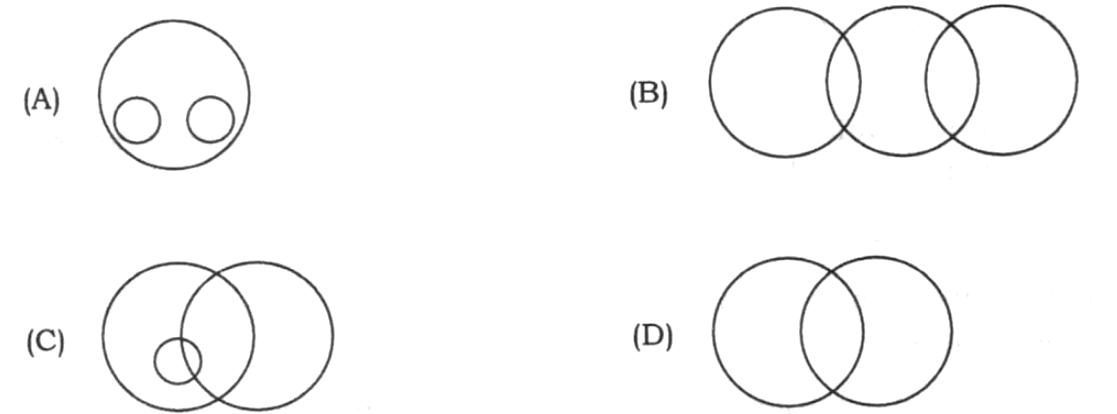
- ADiagram (A) in the figure above
- BDiagram (B) in the figure above
- CDiagram (C) in the figure above
- DDiagram (D) in the figure above
Show answer and explanationHide answer
Answer(A) one large circle (animals) containing two separate small circles (lions and elephants)
Explanation
1. All lions are animals and all elephants are animals, so both small circles must lie fully inside the 'animals' circle.
2. No lion is an elephant, so the two small circles must not touch or overlap.
3. Only diagram (A) shows one big circle with two separate small circles inside it. Answer: (A).
- (A) correct: two separate circles inside one big circle = lions and elephants are both animals and share no member.
- (B) wrong: three circles in a chain overlap partly; this would mean some lions are not animals.
- (C) wrong: a small circle inside one of two overlapping circles shows a different relation (for example, one group inside another with a partial overlap), not two separate groups inside one class.
- (D) wrong: two partly overlapping circles show only two classes with some common members, e.g. some lions are elephants.
For future exams
- Method: write the relation first (lions ⊂ animals, elephants ⊂ animals, lions ∩ elephants = empty), then pick the diagram.
- Similar pattern: 'pens, pencils, stationery' or 'Assam, Meghalaya, India' also give two separate circles inside one big circle.
Micro topic Venn diagram of animal classesChapter Venn Diagrams
A clock shows the time as 8:30 a.m. What is the measurement of the angle made by the hands of the clock?
- A75°
- B60°
- C30°
- D45°
Show answer and explanationHide answer
Answer(A) 75°
Explanation
1. Formula: , where H = hours and M = minutes.
2. H = 8, M = 30: ; .
3. .
4. Check: the minute hand is at 6 (180°); the hour hand is halfway between 8 and 9 (). .
- (A) 75°: correct. .
- (B) 60°: wrong. 60° is the gap from 6 to 8 only; it forgets the hour hand has moved 15° past 8.
- (C) 30°: wrong. 30° is just one hour mark; it has no link to 8:30.
- (D) 45°: wrong. 45° would need the hour hand at 7:30 position; at 8:30 it is 15° past 8.
For future exams
- . If the result is more than 180°, subtract it from 360° to get the smaller angle.
- Common slip: forgetting that the hour hand moves 0.5° each minute (15° in 30 minutes).
Micro topic Angle between clock hands at 8:30Chapter Clocks
If 'P' represents '', 'Q' represents '', 'R' represents '' and 'S' represents '', then what will be the value of 9P3S4Q8R7?
- A12
- B15
- C10
- D13
Show answer and explanationHide answer
Answer(D) 13
Explanation
1. Replace the letters: 9P3S4Q8R7 becomes .
2. Use BODMAS: division and multiplication first, left to right: , then .
3. Now addition and subtraction, left to right: , then . So the value is 13.
- (A) 12: wrong. 12 is only the value of ; the slip is stopping before + .
- (B) 15: wrong. No correct reading of the signs gives 15; after , adding 8 and taking away 7 gives 13, not 15.
- (C) 10: wrong. It comes from a sign or order slip; with the right signs and BODMAS the value is 13, not 10.
- (D) 13: correct. .
For future exams
- Shortcut: first rewrite the whole expression with real signs, then apply BODMAS (Brackets, Of, Division/Multiplication left to right, Addition/Subtraction left to right). In this item and already come before and , so plain left-to-right also gives 13; BODMAS can change the result when or comes before or (for example , not 24).
Micro topic Symbol-replaced arithmetic valueChapter Coded Arithmetic
Which of the following does not belong to the rest of the group?
- ABrass
- BBronze
- CAluminum
- DStainless steel
Show answer and explanationHide answer
Answer(C) Aluminum
Explanation
Brass, bronze and stainless steel are all alloys, that is, mixtures of a metal with other elements. Aluminium is a chemical element (symbol Al, atomic number 13), a pure metal and not an alloy. So aluminium is the odd one out.
- (A) Brass: wrong. Brass is an alloy of copper and zinc, so it belongs to the group.
- (B) Bronze: wrong. Bronze is an alloy mainly of copper with about 12 to 12.5% tin, so it belongs to the group.
- (C) Aluminum: correct. Aluminium is a chemical element (Al, atomic number 13), a metal on its own, not an alloy.
- (D) Stainless steel: wrong. Stainless steel is an iron-based alloy containing at least about 10.5% chromium, so it belongs to the group.
For future exams
- Brass = copper + zinc; bronze = copper + tin. Both are copper alloys.
- Stainless steel resists rust because of its chromium content (10.5% or more).
Micro topic Odd one out among metalsChapter Classification
If RHINO is coded as PFGLM, then TIGER will be coded as
- ARGECP
- BCBAQR
- CLFDAB
- DSHIDR
Show answer and explanationHide answer
Answer(A) RGECP
Explanation
1. Compare RHINO with PFGLM: R → P, H → F, I → G, N → L, O → M.
2. Each letter moves 2 places back in the alphabet (–2).
3. Apply –2 to TIGER: T → R, I → G, G → E, E → C, R → P.
4. So TIGER = RGECP.
- (A) RGECP: correct. Each letter of TIGER moved 2 places back gives R, G, E, C, P.
- (B) CBAQR: wrong. Its first letter C is not T – 2 (R); it follows no fixed shift from TIGER.
- (C) LFDAB: wrong. T – 2 is R, not L; the letters do not follow the –2 rule.
- (D) SHIDR: wrong. S and H are T – 1 and I – 1 (a –1 shift), and the last letter R is not shifted at all; the rule here is –2.
For future exams
- Shortcut: check only the first letter of each option (T – 2 = R). Only option A starts with R, so the answer is fixed in one step.
Micro topic Letter shift coding RHINOChapter Coding-Decoding
A person starts from point A and travels 3 km eastward to point B and then turns left and travels 4 km to reach point C. What is the distance between points A and C?
- A7 km
- B2 km
- C10 km
- D5 km
Show answer and explanationHide answer
Answer(D) 5 km
Explanation
1. A to B is 3 km east.
2. Facing east, a left turn means facing north, so B to C is 4 km north.
3. AB and BC are at right angles, so AC is the hypotenuse.
4. AC = km.
- (A) 7 km: wrong. is the distance walked, not the straight distance from A to C.
- (B) 2 km: wrong. It ignores the right angle between the two legs; no correct working gives 2 km.
- (C) 10 km: wrong. It is not linked to this path; 10 km would need legs of 6 km and 8 km.
- (D) 5 km: correct. Pythagoras: km.
For future exams
- Remember Pythagorean triplets: 3-4-5, 6-8-10, 5-12-13, 8-15-17. Two perpendicular legs from such a triplet give the shortest distance at once.
Micro topic Distance after left turnChapter Direction Sense
What APSC asks in CSAT
Questions by area, CCE 2020 to 2025
400 questions from 5 papers of 80 each. Tap an area to see its questions.
Papers and syllabus
FAQ
APSC CSAT PYQs: questions students ask
Which APSC CSAT papers are included?
General Studies Paper II (CSAT) of the APSC CCE Prelims 2020, 2022, 2023, 2024 and 2025: 80 questions from each paper, 400 in all. The question numbers follow the booklets CCE 2020 Series C, CCE 2022 Series D, CCE 2023 Series A, CCE 2024 Series A, CCE 2025 Series A. The CCE 2025 paper, held in 2026, is the one students call the 2026 CSAT paper.
Is CSAT qualifying in APSC Prelims?
Yes. CSAT (Paper II) has 80 questions for 200 marks. It is qualifying: you need 33% in it, and only then are your GS Paper I marks counted for the Mains merit list.
Which CSAT topics does APSC ask most?
Across the five papers: Logical Reasoning & Mental Ability (132), Basic Numeracy (78), Comprehension (73). Use the area filter or the bars above to practise one area at a time.
Are the answers official?
Answers follow the APSC answer key (CCE 2022: final key; the other papers: the APSC provisional key, the only Paper II key we have for those exams). 21 questions carry an answer-key note: where the key was wrong or the question had an error, the note under the answer explains which answer to mark and why.
How do I practise CSAT here?
Choose an area, a paper or a question type, then switch to Practise: one question at a time, tap an option and see at once whether you are right, with the worked solution. Your record stays only in this browser on this device.