
Free for every APSC aspirant · no sign-up
APSC CSAT PYQs with Answers Prelims GS Paper II, CCE 2020 to 2025, with worked solutions
All 400 questions of the last five APSC Prelims CSAT papers, including the 2026 question paper (CCE 2025): reasoning, maths, passages, data and decision making, each with the answer and a step-by-step solution. CSAT is qualifying: you need 33% to have your GS Paper I marks counted.
The Chairman of a Selection Committee arrived at the interview hall at 10 minutes to 12:30 p.m. He arrived 20 minutes earlier than the other members, who arrived late by 30 minutes of the scheduled time. At what time the interview was scheduled?
- A12:00 noon
- B12:10 p.m.
- C12:30 p.m.
- D12:40 p.m.
Show answer and explanationHide answer
Answer(B) 12:10 p.m.
Explanation
1. Chairman arrived at 10 minutes to 12:30 = 12:20 p.m.
2. He came 20 minutes before the other members, so they came at 12:20 + 20 min = 12:40 p.m.
3. The members were 30 minutes late, so the scheduled time = 12:40 − 30 min = 12:10 p.m.
- (A) 12:00 noon: wrong. Members would then be 40 minutes late, not 30.
- (B) 12:10 p.m.: correct. Members at 12:40 are exactly 30 minutes late.
- (C) 12:30 p.m.: wrong. This misreads '10 minutes to 12:30' as 12:30; members would be only 10 minutes late.
- (D) 12:40 p.m.: wrong. This is when the other members arrived, not the scheduled time.
For future exams
- '10 minutes to 12:30' means 10 minutes before 12:30, i.e. 12:20.
- Draw a simple time line (12:10 scheduled, 12:20 Chairman, 12:40 members) to avoid adding or subtracting in the wrong direction.
Micro topic Interview scheduled timeChapter Time Puzzles
A committee of five must include three instructors from amongst V, W, X, Y and Z, and two technicians from amongst α, β, γ and δ, under the following conditions : I. Z serves only if α serves. II. X serves only if Y and δ serve. III. V and W must serve together. IV. Neither α nor β can serve, if γ serves. Then which of the following is an acceptable composition of the committee?
- AX, Y, Z, γ and δ
- BV, W, Y, α and δ
- CV, W, X, β and δ
- DX, Y, Z, α and β
Show answer and explanationHide answer
Answer(B) V, W, Y, α and δ
Explanation
1. (A) has Z but no α, so it breaks condition I.
2. (C) has X but no Y, so it breaks condition II.
3. (D) has X but no δ, so it breaks condition II.
4. (B) V, W, Y, α, δ: V and W serve together (III); Z and X are absent, so I and II do not apply; γ is absent, so IV does not apply. It has three instructors (V, W, Y) and two technicians (α, δ). All conditions are met.
- (A) X, Y, Z, γ and δ: wrong. Z serves only if α serves (I); α is absent.
- (B) V, W, Y, α and δ: correct. Three instructors and two technicians, and no condition is broken.
- (C) V, W, X, β and δ: wrong. X serves only if Y and δ serve (II); Y is absent.
- (D) X, Y, Z, α and β: wrong. X needs δ as well (II); δ is absent.
For future exams
- Method: take one condition at a time and strike out every option that breaks it. Usually one or two conditions remove three options.
- 'P serves only if Q serves' means: if P is in, Q must be in. It does not mean that Q needs P.
Micro topic Committee selection constraintsChapter Logical Reasoning
If and are two integers and (I) and (II) , then what is the maximum value of ?
- A91
- B96
- C98
- D99
Show answer and explanationHide answer
Answer(D) 99
Explanation
1. For a fixed sum, the product is largest when the two numbers are as close as possible.
2. With , the closest pair would be 10 and 10, giving 100, but condition (I) says .
3. The next closest integer pair is 11 and 9: .
4. So the maximum value of is 99.
- (A) 91: wrong. , a pair that is farther apart (difference 6), so its product is smaller.
- (B) 96: wrong. (difference 4); still not the closest allowed pair.
- (C) 98: wrong. 98 cannot be made from two integers adding to 20 ( has no integer root); it is a guess just below 99.
- (D) 99: correct. , the closest unequal pair with sum 20.
For future exams
- Rule: if is fixed, is greatest when ; if they must differ (integers), take and , giving .
- Quick check: .
Micro topic Maximum product with fixed sumChapter Maximisation
Consider the following two statements : 1. All poets are creative. 2. Some creative people are philosophers. Conclusions : (I) Some poets are philosophers. (II) Some philosophers are creative. Which of the following options is correct?
- AI
- BII
- CBoth are correct
- DNeither is correct
Show answer and explanationHide answer
Answer(B) II
Explanation
1. 'Some creative people are philosophers' can be reversed: 'Some philosophers are creative'. So II follows.
2. Poets are inside creative people, but the creative people who are philosophers may be outside the poets. So 'Some poets are philosophers' (I) is only a possibility.
3. Only II follows.
- (A) I: wrong. The philosophers among creative people need not be poets; I is only possible, not certain.
- (B) II: correct. It is the direct conversion of statement 2 ('Some A are B' = 'Some B are A').
- (C) Both: wrong. I does not follow.
- (D) Neither: wrong. II follows by conversion.
For future exams
- Conversion rule: 'Some A are B' converts to 'Some B are A'; 'All A are B' converts only to 'Some B are A'.
- 'All + Some' (in this order) gives no definite conclusion between the two end terms.
Micro topic Syllogism conversion of poetsChapter Syllogism
Looking up towards the sky, David realized that the vast majority of swans flying above are blue in colour. Which of the following can David logically conclude?
- AThere is a blue swan.
- BThere is a white swan.
- CNot everything that is blue is a swan.
- DNone of the above conclusions is satisfactory
Show answer and explanationHide answer
Answer(A) There is a blue swan.
Explanation
1. David sees that the vast majority of the swans flying above are blue.
2. A 'vast majority' of a group cannot be zero, so at least one swan he saw is blue.
3. So he can conclude that there is a blue swan.
4. Nothing is said about the colour of the remaining swans or about other blue things.
- (A) There is a blue swan: correct. If most of the swans are blue, at least one blue swan exists.
- (B) There is a white swan: wrong. The colour of the remaining swans is not given; white is never mentioned.
- (C) Not everything that is blue is a swan: wrong. It may be true in real life, but the statement says nothing about blue things other than swans.
- (D) None of the above is satisfactory: wrong. (A) follows directly from the statement.
For future exams
- In logic questions, answer only from the given statement, not from general knowledge (real swans are not blue, but that does not matter here).
- 'Most', 'majority' and 'some' all guarantee at least one member; 'most' tells us nothing definite about the rest.
Micro topic Inference from majority of swansChapter Logical Reasoning
Rohit has a few cricket trophies that he placed in three different display boxes—Left, Centre and Right. Each box has space for two trophies. The Ranji is kept in the Right box. Nayudu and Premier are in the next one near the box with World. The Vizzy is kept in the Left box. The World is in the same box as Vizzy. In which box should he place the Champions?
- ARight box
- BCentre box
- CLeft box
- DAll are already full
Show answer and explanationHide answer
Answer(A) Right box
Explanation
1. Each box holds two trophies, so there are six places in all.
2. Vizzy is in the Left box, and World is with Vizzy, so Left has Vizzy and World (full).
3. Nayudu and Premier are in the box next to the box with World. The only box next to Left is Centre, so Centre has Nayudu and Premier (full).
4. Right has Ranji and one empty place.
5. So Champions goes in the Right box.
- (A) Right box: correct. Right has only Ranji, so one place is free.
- (B) Centre box: wrong. Centre is full with Nayudu and Premier.
- (C) Left box: wrong. Left is full with Vizzy and World.
- (D) All are already full: wrong. Five trophies are placed in six spaces, so one space (in Right) is free.
For future exams
- Method: place the fixed items first (Ranji, Vizzy), then the linked items (World with Vizzy), then the relative ones ('next to').
- Count spaces against items: 3 boxes x 2 = 6 spaces, 5 trophies placed, so exactly one space is left.
Micro topic Trophy box arrangementChapter Logical Reasoning
“Doramian students were right in 1995 to stage protests demanding that the university education should be made free.” Which of the following assumptions is not required for acceptance of the above situation?
- ACitizens of Doramy have the freedom to stage protests.
- BUniversities of Doramy are not fully state funded, and hence they charge fee from students.
- CDoramian universities accept enrollment of students from other countries.
- DStudents of Doramy were not happy that the university education in their country was not free.
Show answer and explanationHide answer
Answer(C) Doramian universities accept enrollment of students from other countries.
Explanation
1. The claim is that Doramian students were right to protest in 1995 for free university education.
2. For this to make sense, students must be able to protest (A), university education must not have been free, so fees were charged (B), and students must have been unhappy about it (D).
3. Whether foreign students can enrol has nothing to do with whether Doramian students were right to demand free education.
4. So (C) is the assumption that is not required.
- (A) Citizens of Doramy have the freedom to stage protests: required. Calling a protest 'right' assumes protest is a permitted way to raise a demand.
- (B) Universities are not fully state funded and charge fees: required. A demand to make education free makes sense only if it was not already free.
- (C) Universities accept foreign students: not required, so this is the answer. The admission of foreign students has no link to the demand for free education.
- (D) Students were unhappy that education was not free: required. The protest itself shows this dissatisfaction.
For future exams
- An assumption is an unstated idea that must be true for the statement to make sense. Test it by negation: if denying the option breaks the statement, it is required.
- Here, denying (C) (no foreign students) leaves the statement unchanged, so (C) is not a required assumption.
Micro topic Assumption in an argumentChapter Logical Reasoning
In a sale, the following lots are to be placed :
| Lot | Brand | Product | Price (INR) |
|---|---|---|---|
| 1 | Maximus | Filter | 10,000 |
| 2 | Desdem | Fryer | 7,000 |
| 3 | Romulus | Filter | 6,000 |
| 4 | Ignis | Heater | 4,500 |
| 5 | Florice | Fryer | 17,500 |
If the lots are placed by product, then by brand, in alphabetical order, then what would be the price of buying one item from the lot placed at the fourth position and one item from the lot placed at the second position?
- AINR 21,500
- BINR 17,500
- CINR 23,500
- DINR 24,500
Show answer and explanationHide answer
Answer(C) INR 23,500
Explanation
1. Sort by product in alphabetical order: Filter, Fryer, Heater.
2. Within each product, sort by brand: Filter: Maximus, Romulus. Fryer: Desdem, Florice. Heater: Ignis.
3. Positions: 1 Maximus Filter (10,000), 2 Romulus Filter (6,000), 3 Desdem Fryer (7,000), 4 Florice Fryer (17,500), 5 Ignis Heater (4,500).
4. Fourth + second = 17,500 + 6,000 = INR 23,500.
- (A) INR 21,500: wrong. No two lots in the table add up to 21,500; the right pair is 17,500 + 6,000.
- (B) INR 17,500: wrong. This is the price of the fourth lot (Florice) only, without adding the second lot.
- (C) INR 23,500: correct. Florice Fryer (17,500) + Romulus Filter (6,000).
- (D) INR 24,500: wrong. This is 17,500 + 7,000, which wrongly takes Desdem Fryer (position 3) as the second lot.
For future exams
- Multi-level sorting: sort fully by the first key (product), and use the second key (brand) only to break ties inside each group.
- Compare alphabetically letter by letter: Filter (F-i) comes before Fryer (F-r); Desdem (D) before Florice (F).
Micro topic Sorting lots by product and brandChapter Logical Reasoning
Based on the question, “In a developing nation like ours, should the Government be engaging more in space exploration research?”, identify which of the following is a weak argument.
- ANo, the money spent on these programmes can be used to increase the funding for education and health care, which would increase quality of life of our country's population.
- BYes, the findings and results of these space exploration programmes have been successfully applied to industry and agriculture, thereby boosting our economy in general.
- CYes, space exploration research being frontier area of research has provided a boost to our military strength.
- DNo, our country has spent too much already, and any further expense would hardly provide any marginal advantage.
Show answer and explanationHide answer
Answer(D) No, our country has spent too much already, and any further expense would hardly provide any marginal advantage.
Explanation
1. A strong argument is directly linked to the question and gives a real, important reason. A weak one is vague, unsupported or only an opinion.
2. (A) gives a clear trade-off: the money could go to education and health, which raises quality of life. Strong.
3. (B) gives a real economic benefit: results used in industry and agriculture. Strong.
4. (C) gives a concrete strategic benefit: space research helps defence. Strong.
5. (D) only says 'too much has been spent' and claims, with no reason, that more spending gives hardly any advantage. It is a bare opinion, so it is the weak argument.
- (A) No, money can go to education and health: strong. It shows a real opportunity cost for a developing nation.
- (B) Yes, results applied to industry and agriculture: strong. It names a definite benefit to the economy.
- (C) Yes, boost to military strength: strong. National security is a valid and important reason.
- (D) No, spent too much already, no marginal advantage: weak, so this is the answer. 'Too much' is vague, and the claim of no further benefit is not backed by any reason.
For future exams
- Strong vs weak arguments: an argument is weak if it is vague, an opinion without a reason, only loosely related to the question, or ignores a clear benefit.
- Both 'Yes' and 'No' arguments can be strong; judge the reason, not the side.
Micro topic Identifying a weak argumentChapter Logical Reasoning
While visiting another planet, our forefathers learnt that 1. Jhummaliya means manpower 2. Plutojhumma means superman 3. Jhummahusa means mankind. In that planet, which of the following words could possibly mean ‘kindhearted’?
- AHusabling
- BPlutoliya
- CHusapluto
- DHusajhumma
Show answer and explanationHide answer
Answer(A) Husabling
Explanation
1. 'Jhumma' is common to all three words, and 'man' is common to all three meanings, so jhumma = man.
2. Then liya = power (Jhummaliya = manpower), pluto = super (Plutojhumma = superman) and husa = kind (Jhummahusa = mankind).
3. The word order follows English: the first part of the English word comes first. 4. 'Kindhearted' = kind + hearted, so it must start with husa and have a new part (not jhumma, liya or pluto) for 'hearted'.
5. Only Husabling fits: husa = kind, bling = hearted.
- (A) Husabling: correct. Husa = kind, and 'bling' is a new part that can stand for 'hearted'.
- (B) Plutoliya: wrong. Pluto = super and liya = power, so it means 'superpower'; it has no 'kind'.
- (C) Husapluto: wrong. Husa = kind but pluto = super, so it would mean 'kind-super', not 'kindhearted'.
- (D) Husajhumma: wrong. Husa = kind and jhumma = man, so it would mean 'kindman'; 'hearted' is not 'man'.
For future exams
- Method: find the part common to two coded words and the word common to their meanings; they match. Then remove known parts to decode the rest. An option that reuses an already-decoded part for a new meaning is wrong.
Micro topic Decoding alien language wordChapter Coding-Decoding
Four entities—rhino (Kaziranga), tea (Jorhat), silk (Sualkuchi) and tiger (Manas) are linked to four persons—Priya, Raju, Sumi and Tora. Priya avoids animals, Raju loves fabrics, Sumi studies plants, and Tora tracks wildlife. Who is linked to silk?
- APriya
- BRaju
- CSumi
- DTora
Show answer and explanationHide answer
Answer(B) Raju
Explanation
1. Silk (Sualkuchi) is a fabric; Sualkuchi is a silk-weaving village.
2. Raju loves fabrics, so Raju is linked to silk.
3. The other clues fit other entities: Sumi studies plants, so she fits tea (Jorhat); Tora tracks wildlife, so he fits rhino (Kaziranga) or tiger (Manas).
- (A) Priya: wrong. Her clue (avoids animals) says nothing about fabrics.
- (B) Raju: correct. Silk is a fabric, and Raju loves fabrics.
- (C) Sumi: wrong. She studies plants, which fits tea, not silk.
- (D) Tora: wrong. He tracks wildlife, which fits rhino or tiger.
For future exams
- Method: match each person's clue to the one entity that fits it best; start with clues that have only one possible match (fabrics to silk, plants to tea).
Micro topic Linking persons to entitiesChapter Logical Reasoning
If all Zinks are Winks and no Winks are Pinks, then which of the following statements must be true?
- ASome Zinks are Pinks.
- BNo Zinks are Pinks.
- CAll Pinks are Zinks.
- DSome Winks are not Pinks.
Show answer and explanationHide answer
Answer(B) No Zinks are Pinks.
Explanation
1. All Zinks are inside Winks.
2. No Wink is a Pink, so the Winks circle and the Pinks circle do not touch.
3. Zinks sit inside Winks, so they cannot touch Pinks either.
4. Hence 'No Zinks are Pinks' must be true.
- (A) Some Zinks are Pinks: wrong. This is the opposite of the valid conclusion; Zinks are inside Winks, which are fully separate from Pinks.
- (B) No Zinks are Pinks: correct. All Z are W + No W is P gives No Z is P.
- (C) All Pinks are Zinks: wrong. Pinks and Zinks have no common member at all.
- (D) Some Winks are not Pinks: not the intended answer. It only restates statement 2 in a weaker form (true if Winks exist) and does not link Zinks with Pinks as the question expects.
For future exams
- Rule: 'All A are B' + 'No B is C' gives 'No A is C' (and so also 'Some C are not A').
- In two-statement syllogisms, the asked conclusion usually links the two end terms (here Zinks and Pinks).
Micro topic Syllogism: Zinks, Winks, PinksChapter Syllogism
In a certain village, every person is either a knight or a knave. Knights always speak the truth and knaves always lie. Two villagers, A and B, make the following statements : • A says, “B is a knave.” • B says, “A and I are both knaves.” What are A and B?
- AA is a knight, B is a knave
- BA is a knave, B is a knight
- CBoth are knights
- DBoth are knaves
Show answer and explanationHide answer
Answer(A) A is a knight, B is a knave
Explanation
1. Start with B. B says, "A and I are both knaves." 2. If B were a knight, this true statement would make B a knave. That is impossible, so B is a knave.
3. A knave lies, so "both are knaves" is false. Since B is a knave, A must be a knight.
4. Check A: A says "B is a knave", which is true, and a knight tells the truth. Everything fits. So A is a knight and B is a knave.
- (A) A is a knight, B is a knave: correct. It is the only case where both statements fit the speakers' types.
- (B) A is a knave, B is a knight: wrong. A knight B cannot call himself a knave.
- (C) Both are knights: wrong. B, as a knight, would be telling the truth while calling himself a knave, which is impossible.
- (D) Both are knaves: wrong. Then B's statement "A and I are both knaves" would be true, but a knave cannot say a true thing.
For future exams
- Shortcut: a person who says "I am a knave" (alone or with others in an AND statement) cannot be a knight, so start with that person.
- Test each option against both statements; a single contradiction removes the option.
Micro topic Knights and knaves puzzleChapter Logical Reasoning
In a certain village, two-thirds of the villagers own bicycles, one-fourth of the villagers grow vegetables, one-fifth of the villagers are employed and three-fourths of the villagers are above 30 years of age. Which one of the following statements must certainly be true?
- AAll villagers who own bicycles are employed.
- BSome villagers who are above 30 years of age own bicycles.
- COne-third of the villagers who grow vegetables own bicycles.
- DHalf of the villagers who are employed grow vegetables.
Show answer and explanationHide answer
Answer(B) Some villagers who are above 30 years of age own bicycles.
Explanation
1. Bicycle owners = of the village; people above .
2. Together , which is more than the whole village .
3. So the two groups must overlap by at least of the village.
4. Hence some people above 30 surely own bicycles. Answer (B).
- (A) All bicycle owners are employed: wrong. Bicycle owners are but the employed are only , so all owners cannot be employed.
- (B) Some villagers above 30 own bicycles: correct. , so the groups must overlap (at least of the village).
- (C) One-third of vegetable growers own bicycles: wrong. Nothing fixes this share; since , no overlap is forced, and the share could be anything from none to all.
- (D) Half of the employed grow vegetables: wrong. , so the two groups may not overlap at all; no exact share is forced.
For future exams
- Rule: two groups that are fractions a and b of the same whole must overlap when ; the least overlap is .
- "Must be true" questions: reject any option that gives an exact share (one-third, half, all) unless the data force it.
Micro topic Must-be-true fraction statementsChapter Logical Reasoning
In a group of 100 people, 60 like milk tea, 50 like green tea and 20 like neither. How many people like both milk tea and green tea?
- A10
- B20
- C30
- D40
Show answer and explanationHide answer
Answer(C) 30
Explanation
1. People who like at least one tea = (neither) .
2. Use .
3. , so .
4. Check: only milk tea 30, only green tea 20, both 30, neither 20; total .
- (A) 10: wrong. With 10 in both, at least one tea would be , leaving 0 for 'neither', not 20.
- (B) 20: wrong. This is the 'neither' number, not the overlap; it would give 90 people liking at least one tea.
- (C) 30: correct. like at least one, and neither .
- (D) 40: wrong. It would give only 70 liking at least one tea, so 30 would like neither, not 20.
For future exams
- Two-set rule: . Here .
- Quick check: the overlap can never be more than the smaller set (50) and never less than (here ).
Micro topic Two-set overlap countChapter Sets
What replaces the blank box with a question mark in it?
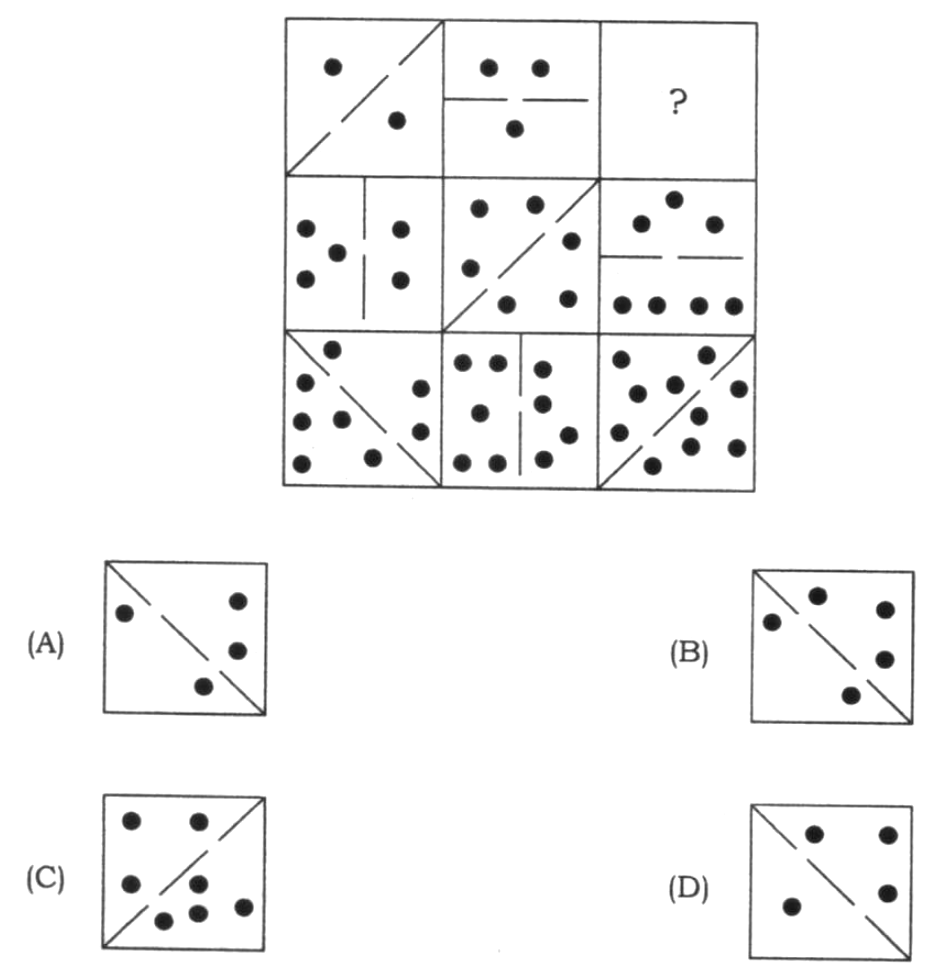
- ADiagram (A) in the figure above
- BDiagram (B) in the figure above
- CDiagram (C) in the figure above
- DDiagram (D) in the figure above
Show answer and explanationHide answer
Answer(D) the box with a \ diagonal, 3 dots above the line (upper-right) and 1 dot below it (lower-left)
Explanation
1. Read the 9 boxes row by row. Dot totals: 2, 3, ?, 5, 6, 7, 8, 9, 10, so the missing box has 4 dots.
2. The dividing line turns clockwise each step: /, —, ?, |, /, —, \, |, /. So the missing box has a \ diagonal.
3. Within each row one side of the line keeps the same number of dots and the other side grows by 1: row 2 has 3 dots fixed on one side and 2, 3, 4 on the other; row 3 has 5 fixed and 3, 4, 5; row 1 has 1 fixed and 1, 2, so the third box needs 1 on the fixed side and 3 on the other.
4. Option (D) has a \ line with 3 dots in the upper-right half and 1 dot in the lower-left half. Answer: (D).
- (A) wrong: it has the \ line and 4 dots, but they are split 2 and 2, not 3 and 1.
- (B) wrong: it has 5 dots; the series needs 4.
- (C) wrong: it has a / line and 7 dots; the series needs a \ line and 4 dots.
- (D) correct: \ line, 4 dots split 3 (upper-right) and 1 (lower-left), which fits the count, the line rotation and the row pattern.
For future exams
- In figure grids, check three things one by one: count of elements, rotation of lines, and position or split of elements.
- When two options pass the count and rotation tests (here A and D), the split of dots on each side decides it.
Micro topic Dice pattern missing figureChapter Non-verbal Reasoning
Consider the following statements and conclusions : Statements : 1. All engineers are mathematicians. 2. Some mathematicians are logicians. 3. No logician is a poet. Conclusions : (i) Some mathematicians are not poets. (ii) Some engineers are not poets. (iii) No engineer is a poet. Which conclusion (conclusions) follows (follow) from the statements?
- AOnly (i) and (ii)
- BOnly (ii)
- COnly (iii)
- DAll of the above
Show answer and explanationHide answer
Answer(A) Only (i) and (ii)
Answer-key note: Error in question (key defensible)
The question is flawed: by strict syllogism rules only conclusion (i) follows, and no option reads 'Only (i)'. Conclusion (ii) 'Some engineers are not poets' does not follow, because engineers may all be mathematicians who are not logicians, and those can be poets. APSC provisional key: (A) Only (i) and (ii). (A) is the closest option, since it is the only one that includes (i) and excludes the false (iii); so we print (A). In the APSC exam, mark (A).
Explanation
1. Some mathematicians are logicians, and no logician is a poet, so those mathematicians are not poets: (i) 'Some mathematicians are not poets' follows.
2. All engineers are mathematicians, but engineers may all be among the mathematicians who are not logicians, and those can be poets. So (ii) 'Some engineers are not poets' and (iii) 'No engineer is a poet' are only possibilities; they are not a complementary pair either.
3. Strictly, only (i) follows, and no option says 'Only (i)'.
4. (A) is the only option that contains (i) and leaves out (iii); it is the closest answer and APSC's key.
- (A) Only (i) and (ii): closest answer and APSC key. (i) follows; (ii) is only possible.
- (B) Only (ii): wrong. It leaves out (i), which certainly follows.
- (C) Only (iii): wrong. 'No engineer is a poet' is not certain; engineers have no link with logicians.
- (D) All of the above: wrong. (iii) does not follow, and (ii) is only possible.
Key note: The question is flawed: by strict syllogism rules only conclusion (i) follows, and no option reads 'Only (i)'. Conclusion (ii) 'Some engineers are not poets' does not follow, because engineers may all be mathematicians who are not logicians, and those can be poets. APSC provisional key: (A) Only (i) and (ii). (A) is the closest option, since it is the only one that includes (i) and excludes the false (iii); so we print (A). In the APSC exam, mark (A).
For future exams
- Rule: 'Some A are B' + 'No B is C' gives 'Some A are not C', but it says nothing about a smaller group inside A (here engineers).
- When no option matches exactly, pick the option that has every conclusion that surely follows and none that is surely false.
Micro topic Conclusions on engineers and poetsChapter Syllogism
The following Venn diagram shows, out of 200 people, how many own smartphones, laptops and tablets. What is the number of people who own both smartphones and laptops?
- A120
- B60
- C50
- D30
Show answer and explanationHide answer
Answer(C) 50
Explanation
1. From the figure, the Smartphones–Laptops overlap has two parts: 30 (smartphones and laptops only) and 20 (all three: smartphones, laptops and tablets).
2. People who own both smartphones and laptops = 30 + 20 = 50.
3. The 20 who own all three also own both smartphones and laptops, so they must be counted. Answer: 50.
- (A) 120: wrong. It is the total smartphone owners (60 + 10 + 20 + 30), not the overlap with laptops.
- (B) 60: wrong. 60 is the number who own only smartphones.
- (C) 50: correct. 30 (smartphones and laptops only) + 20 (all three) = 50.
- (D) 30: wrong. It counts only 'smartphones and laptops only' and leaves out the 20 who own all three.
For future exams
- 'Both A and B' = the full A ∩ B region = (A and B only) + (all three). 'Only A and B' leaves out the centre.
- The regions in this figure add up to 190, so 10 of the 200 people own none of the three devices.
Micro topic Smartphone and laptop overlapChapter Venn Diagrams
Pointing to a boy, Dipankar says, "His mother is the daughter-in-law of my mother's mother." How is Dipankar related to the boy?
- AFather
- BUncle
- CCousin
- DBrother
Show answer and explanationHide answer
Answer(C) Cousin
Explanation
1. Dipankar's mother's mother is his maternal grandmother.
2. Her daughter-in-law is the wife of her son, that is, the wife of Dipankar's maternal uncle. (Dipankar's own mother is her daughter, not daughter-in-law.)
3. The boy's mother is this aunt, so the boy is the son of Dipankar's maternal uncle.
4. So Dipankar is the boy's cousin.
- (A) Father: wrong. Dipankar's wife would be the daughter-in-law of Dipankar's own mother, not of his mother's mother.
- (B) Uncle: wrong. Dipankar and the boy are in the same generation (both grandchildren of the same grandmother).
- (C) Cousin: correct. The boy is the son of Dipankar's maternal uncle.
- (D) Brother: wrong. Dipankar's mother is the grandmother's daughter, not her daughter-in-law, so the boy is not his brother.
For future exams
- Daughter-in-law = son's wife. A woman's own daughter is never her daughter-in-law; this rules out "brother" here.
- Count generations: if two people share the same grandparent and are not siblings, they are cousins.
Micro topic Blood relation puzzleChapter Blood Relations
A cube is painted on all its faces and then cut into 27 smaller cubes. How many smaller cubes will have exactly 3 faces painted?
- A6
- B8
- C12
- D24
Show answer and explanationHide answer
Answer(B) 8
Explanation
1. 27 small cubes means each edge is cut into 3 parts (), so .
2. A small cube has 3 painted faces only if it sits at a corner of the big cube.
3. A cube always has 8 corners, whatever is ().
4. So 8 small cubes have exactly 3 faces painted.
- (A) 6: wrong. 6 is the number of cubes with exactly one face painted when : .
- (B) 8: correct. Only the 8 corner cubes have three painted faces.
- (C) 12: wrong. 12 is the number with exactly two faces painted: (one middle cube on each of the 12 edges).
- (D) 24: wrong. 24 is not a count for any painted-face type here; painted cubes plus 1 unpainted centre cube = 27.
For future exams
- For an painted cube: 3 faces = 8; 2 faces = ; 1 face = ; no face = . Check: these always add to .
Micro topic Cube with three painted facesChapter Cubes
What APSC asks in CSAT
Questions by area, CCE 2020 to 2025
400 questions from 5 papers of 80 each. Tap an area to see its questions.
Papers and syllabus
FAQ
APSC CSAT PYQs: questions students ask
Which APSC CSAT papers are included?
General Studies Paper II (CSAT) of the APSC CCE Prelims 2020, 2022, 2023, 2024 and 2025: 80 questions from each paper, 400 in all. The question numbers follow the booklets CCE 2020 Series C, CCE 2022 Series D, CCE 2023 Series A, CCE 2024 Series A, CCE 2025 Series A. The CCE 2025 paper, held in 2026, is the one students call the 2026 CSAT paper.
Is CSAT qualifying in APSC Prelims?
Yes. CSAT (Paper II) has 80 questions for 200 marks. It is qualifying: you need 33% in it, and only then are your GS Paper I marks counted for the Mains merit list.
Which CSAT topics does APSC ask most?
Across the five papers: Logical Reasoning & Mental Ability (132), Basic Numeracy (78), Comprehension (73). Use the area filter or the bars above to practise one area at a time.
Are the answers official?
Answers follow the APSC answer key (CCE 2022: final key; the other papers: the APSC provisional key, the only Paper II key we have for those exams). 21 questions carry an answer-key note: where the key was wrong or the question had an error, the note under the answer explains which answer to mark and why.
How do I practise CSAT here?
Choose an area, a paper or a question type, then switch to Practise: one question at a time, tap an option and see at once whether you are right, with the worked solution. Your record stays only in this browser on this device.