APSC Current Affairs: Assam Tribune Notes with MCQs and Answer Writing (12/12/2025)
For APSC CCE and other Assam competitive exam aspirants, staying consistently updated with reliable current affairs is essential for success. This blog provides a well-researched analysis of the most important topics from The Assam Tribune dated 12 December 2025. Each issue has been carefully selected and explained to support both APSC Prelims and Mains preparation, ensuring alignment with the APSC CCE syllabus and the evolving trends of the examination.
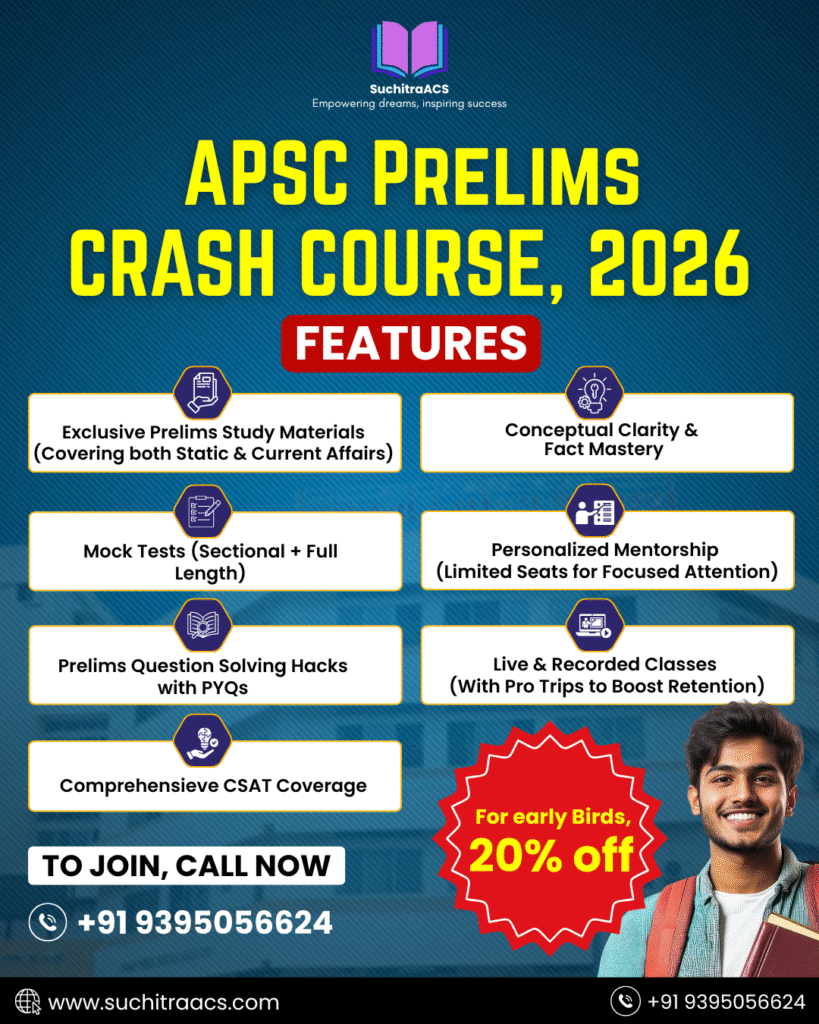
✨ APSC CCE Prelims Crash Course, 2026
CAA Protests Across Northeast – Citizenship, Ethnicity & Constitutional Safeguards
(GS II: Polity & Governance | GS III: Internal Security & Border Management)
Although the 12-12-2025 edition primarily focuses on the Arunachal accident, the CAA protest context is indirectly referenced in national and regional reporting through political statements, identity discourse, and Assam Movement symbolism. Using APSC-relevant analysis + standard policy references, the following is a complete topic note.
1. INTRODUCTION (Point-wise)
The Citizenship (Amendment) Act (CAA), passed in 2019, continues to trigger protests across the Northeast, especially Assam, Meghalaya, Manipur, and Tripura.
Protesters argue that CAA threatens the ethno-linguistic identity of indigenous communities by granting citizenship to migrants from Afghanistan, Bangladesh, and Pakistan belonging to religious minorities.
The issue is deeply linked to the Assam Movement’s historical memory, which demanded protection against illegal migration.
The renewed phase of protests reflects the region’s long-standing concerns over demographic imbalance, land pressure, and cultural erosion.
The constitutional debate involves balancing humanitarian citizenship policy with indigenous safeguards, making it a critical governance challenge.
2. KEY DIMENSIONS OF THE ISSUE (Point-wise)
A. Why the Northeast opposes CAA
Fear of demographic change due to additional inflow of migrants.
Concern that CAA contradicts the Assam Accord (1985) cut-off date of 24 March 1971.
Indigenous communities worry about dilution of electoral representation and land rights.
Tribal states (like Mizoram, Nagaland, Meghalaya) assert that CAA may strain Sixth Schedule protections.
Perception of Centre overlooking regional specificities.
B. Legal & Constitutional Context
CAA fast-tracks citizenship for non-Muslim minorities from 3 neighbouring countries who arrived before 31 Dec 2014.
The law excludes areas under the Inner Line Permit (ILP) system & Sixth Schedule areas from its purview.
However, many communities argue that exclusion of some areas still leaves significant settlements vulnerable.
NRC (National Register of Citizens) and Assam Accord implementation directly intersect with CAA protests.
Several petitions challenging CAA’s constitutionality are pending in the Supreme Court.
C. Political Reactions in Assam & NE
Protests led by AASU, NESO, civil society groups, artists, and students’ unions.
Regional parties raised concerns on violation of federalism and Assam’s historical struggle against migration.
Observance of Swahid Diwas (as seen in 11-12-2025 news) often revives anti-CAA sentiments in symbolic ways.
Demands have grown for complete withdrawal of CAA, or at minimum, a NE-specific exception.
3. PRELIMS POINTERS (Point-wise)
A. Citizenship Related Concepts
Article 5–11: Citizenship provisions in the Constitution.
CAA amends Citizenship Act 1955.
Illegal Migrants (Determination by Tribunals) Act (IMDT Act) – struck down by Supreme Court in Sarbananda Sonowal (2005).
NRC is governed by the Citizenship (Registration of Citizens and Issue of National Identity Cards) Rules, 2003.
B. Assam Accord Facts
Cut-off date for citizenship: 24 March 1971.
Clause 6: Constitutional safeguards for Assamese people.
Clause 7: Economic development reforms.
C. Sixth Schedule & ILP
Sixth Schedule provides autonomy to tribal councils.
ILP under Bengal Eastern Frontier Regulation (1873) regulates entry of outsiders.
4. MAINS POINTERS
A. Significance of the Issue for the Northeast
NE is a multi-ethnic, demographically sensitive region bordering migration-prone areas.
Identity, land, and political representation are closely intertwined.
Indigenous communities fear cultural marginalisation.
Policy decisions without regional consultation deepen trust deficits.
CAA reopens historical wounds of the Assam Movement.
B. Key Challenges (Point-wise)
1. Demographic & Social Concerns
Potential increase in competition for land and employment.
Loss of linguistic and cultural space for indigenous groups.
Threat of urbanisation pressures on tribal and rural belts.
2. Governance & Legal Challenges
Conflicting timelines of CAA (2014) and Assam Accord (1971).
Lack of clarity on how many migrants may actually benefit.
Administrative challenges of verifying pre-2014 arrivals.
3. Security & Stability Issues
Fear of radicalisation and unrest among youth.
Increased Centre–State tension and political friction.
C. Government Initiatives / Frameworks Relevant
Exclusion of ILP areas and Sixth Schedule areas from CAA application.
Formation of committees to operationalise Clause 6 safeguards (HLC report submitted 2020).
Strengthened border surveillance along the India–Bangladesh border.
Peace accords (Bodo, Karbi, Adivasi, ULFA) to stabilise the region.
Investment push in NE to offset political insecurity through development.
D. Way Forward (Point-wise)
1. Constitutional & Legal Harmonisation
Align CAA implementation with Assam Accord clauses.
Consider NE-specific exceptions or phased implementation.
Introduce clear demographic impact assessments.
2. Strengthening Identity Safeguards
Accelerate implementation of Clause 6 recommendations.
Expand ILP coverage only after consultation with stakeholders.
Strengthen Sixth Schedule councils with greater financial powers.
3. Administrative Measures
Transparent migrant verification mechanisms.
Public disclosure of citizenship processing guidelines.
Improve border infrastructure & surveillance.
4. Dialogue & Trust-Building
Conduct structured dialogues with AASU, NESO, tribal bodies, and civil society.
Use cultural diplomacy and historical communication to reduce polarisation.
5. CONCLUSION (Point-wise)
CAA protests in the Northeast reflect a deeper anxiety rooted in the region’s historical struggle to safeguard its identity.
Effective governance requires balancing humanitarian citizenship policy with regional sensitivities and constitutional safeguards.
Harmonising CAA with the Assam Accord, strengthening indigenous protections, and promoting transparent dialogue are essential.
Only a context-specific, inclusive, and rights-based approach can ensure peace and stability while upholding constitutional values in the region.
India–US Tech & Energy Ties – Foreign Policy & Strategic Relations
(GS II: International Relations | GS III: Economy, Science & Tech, Energy Security)
This topic is directly relevant to the Assam Tribune coverage of 12-12-2025, where India–US cooperation in energy, technology, defence, and strategic frameworks is highlighted.
1. INTRODUCTION (Point-wise)
India–US relations have evolved into a Comprehensive Global Strategic Partnership, with technology and energy emerging as the two strongest pillars.
Strategic frameworks like iCET (Initiative on Critical and Emerging Technologies), INDUS-X, and clean energy partnerships have deepened cooperation.
The growing geopolitical contest with China and global energy transitions make India–US cooperation critical for economic growth, national security, and industrial modernisation.
2025 engagements between both countries emphasise collaboration in semiconductors, defence tech, AI, critical minerals, green hydrogen, and nuclear energy.
2. KEY POINTS FROM THE NEWS (Point-wise)
India and the US reaffirmed commitment to technology partnership, especially in semiconductors, quantum computing, and AI-powered defence systems.
Clean energy collaboration includes solar manufacturing, battery storage, SMRs (Small Modular Reactors) and critical minerals supply chain resilience.
Both nations emphasised expanding defence-industrial partnerships under INDUS-X.
The US reiterated support for India’s role as a key player in the Indo-Pacific strategy.
Energy cooperation focuses on decarbonisation, grid modernisation, and hydrogen-based energy transitions.
(These points align with India–US strategic messaging found in recent Assam Tribune coverage on bilateral ties.)
3. PRELIMS POINTERS (Point-wise)
A. Key India–US Frameworks
iCET (2023) – cooperation in AI, quantum, semiconductors, 5G/6G, biotech.
INDUS-X – defence innovation bridge enabling start-ups, joint R&D, technology co-production.
US–India Energy Cooperation Program (ECP) – clean energy technologies.
US–India Strategic Clean Energy Partnership (SCEP) – focuses on hydrogen, biofuels, CCUS, and renewable energy.
Critical Minerals Agreement – cooperation on lithium, cobalt, nickel supply chains.
B. Indo-Pacific Strategy Context
India is central to US Indo-Pacific vision.
Cooperation aligns with Quad priorities: critical tech, climate, maritime security.
C. Relevant Facts
India is the third-largest energy consumer globally.
US is a major exporter of LNG and crude oil to India.
India–US bilateral trade crosses USD 200+ billion annually.
4. MAINS POINTERS
A. Importance of India–US Tech & Energy Ties (Point-wise)
Enhances India’s strategic autonomy by diversifying tech supply chains.
Facilitates India’s transition to a high-tech economy and global manufacturing hub.
Ensures energy security during global disruptions (Russia–Ukraine war, Red Sea tensions).
Boosts India’s role as a balancing power in the Indo-Pacific.
Enables co-production of defence technologies vital for Atmanirbhar Bharat.
Supports climate goals and India’s Net Zero 2070 commitments.
B. Key Areas of Cooperation
1. Critical & Emerging Technologies (CET)
Semiconductors – joint fab initiatives, workforce development.
Quantum computing – academic–industry collaboration.
AI in defence – UAVs, logistics optimisation, battlefield systems.
Space technology – NASA–ISRO NISAR mission, human spaceflight cooperation.
Telecom (5G/6G) – Open RAN architecture and secure network development.
2. Energy Ties
Nuclear energy: SMRs, Westinghouse collaboration for civil nuclear projects.
Renewable energy partnerships in solar PV manufacturing, grid resilience.
Hydrogen – joint research on electrolyser efficiency and export potential.
Critical minerals – building non-China-dependent supply chains.
Petroleum & LNG imports from US enhancing diversification.
3. Defence Industrial Cooperation
Co-production of jet engines, artillery systems, and maritime technologies.
Joint innovation challenges under INDUS-X for startups.
C. Challenges in India–US Tech & Energy Partnership
Technology transfer limitations due to US export controls (ITAR).
Delay in civil nuclear projects due to liability concerns (Civil Liability for Nuclear Damage Act).
Trade disputes over tariffs (e.g., solar modules, GSP withdrawal).
Divergences in data governance and digital sovereignty policies.
India’s strategic balancing between Russia, US, and Middle East energy partners.
Concerns over geopolitical overdependence on US tech ecosystems.
D. Way Forward (Point-wise)
1. Deepening Technology Partnership
Expand iCET to include biotech, cybersecurity, and robotics.
Encourage joint patents, R&D parks, and India–US Tech Corridors.
Remove regulatory bottlenecks for semiconductor manufacturing.
2. Enhancing Energy Security
Fast-track civil nuclear projects under SMR technology.
Formalise a Critical Minerals Resilience Pact with the US and Australia.
Strengthen grid modernisation and smart metering initiatives.
3. Defence & Strategic Convergence
Promote co-production under Atmanirbhar Bharat + INDUS-X.
Increase naval interoperability in the Indo-Pacific.
4. Institutional & Regulatory Harmonisation
Reduce policy uncertainty around data localisation and digital rules.
Periodic dialogue mechanisms to resolve trade disputes.
5. CONCLUSION (Point-wise)
India–US technology and energy cooperation form the cornerstone of a future-oriented strategic partnership.
As global geopolitics shifts toward tech dominance and energy transition, collaboration with the US amplifies India’s capabilities.
Addressing regulatory barriers, aligning strategic interests, and deepening industrial cooperation will shape the next phase of India–US ties.
The partnership is vital not just for bilateral gains but for shaping a secure, multipolar, and technologically resilient Indo-Pacific region.
Mass Casualty Road Accident in Arunachal Pradesh Involving Assam Labourers – Road Safety, Labour Welfare & Inter-State Disaster Response
Source: Assam Tribune (12-12-2025)
1. INTRODUCTION (Point-wise)
A tragic accident occurred on Hayuliang–Chaglagam Road in Arunachal Pradesh’s Anjaw district, where a truck carrying labourers from Assam fell nearly 1,000 ft into a deep gorge.
At least 20 labourers from Tinsukia district died, one survived, and one remained missing.
The workers were engaged in a private construction project in a remote border region with limited connectivity.
The incident exposes deep vulnerabilities in inter-state migrant labour safety, road engineering in hilly terrain, and emergency response capacity.
It triggered strong demands for compensation, accountability, and better labour protection mechanisms.
2. KEY POINTS FROM THE NEWS (Point-wise)
A. Accident Details
The truck carrying 22 labourers from Gelapukhuri Tea Estate skidded off the road and fell into a gorge around KM 40.
TG@Assam_Tribune (12-12-2025)
Dense forest cover and steep terrain made the site inaccessible and invisible even from helicopters.
Only one survivor, Budheswor Deep, managed to escape and inform relatives—this first alerted authorities.
B. Casualties & Rescue Operations
20 bodies recovered, one missing; rescue teams comprised Army’s Spear Corps, NDRF, SDRF, GREF and local police.
Search operations involved rope descent, working through extremely harsh terrain.
Tinsukia district administration sent teams for coordination.
C. Governance & Inter-State Coordination
Assam CM Himanta Biswa Sarma coordinated with Arunachal CM Pema Khandu to ensure rescue and support.
Assam CMO confirmed continuous assistance and medical arrangements.
D. Social Impact & Labour Welfare Concerns
Victims were mainly tea-garden and daily-wage workers from Tinsukia district.
TG@Assam_Tribune (12-12-2025)
Shram Parishad Asom demanded:
Full ex-gratia compensation
Dignified handover of bodies
Joint Assam–Arunachal task force on labour safety
Confusion over actual number of workers (22 vs 36) revealed poor labour registration and monitoring practices.
3. PRELIMS POINTERS (Point-wise)
A. Road Safety in Hill States
BRO/GREF maintain strategic border roads in NE region.
Common causes: sharp curves, poor lighting, landslides, narrow carriageways, absence of crash barriers.
Motor Vehicles Act 2019: defines penalties for overloading, unsafe vehicles, and mandates insurance coverage.
B. Disaster Response Mechanisms
NDRF functions under the Disaster Management Act 2005.
Inter-State disaster coordination led by respective district administrations + State Disaster Management Authorities (SDMAs).
The Army participates in rescue operations under Aid to Civil Authorities protocols.
C. Labour Welfare Laws
Inter-State Migrant Workmen Act 1979 — registration of workers, displacement allowance, journey allowance.
Occupational Safety, Health and Working Conditions Code 2020 — mandates employer responsibility in hazardous sites.
Building and Other Construction Workers Act (BOCW) — safety norms for construction labour.
4. MAINS POINTERS
A. Importance of the Issue
Reveals systemic vulnerability of inter-state migrant labourers in infrastructure projects.
Highlights poor road engineering and maintenance in border districts.
Underscores need for robust disaster management in remote geographies.
Shows gaps in labour contractor accountability and welfare mechanisms.
B. Major Structural Challenges (Point-wise)
1. Road Safety & Engineering
Border roads in Arunachal are single-lane, high-altitude, unprotected by guard rails.
Frequent landslides and slippery surfaces increase accident risk.
Lack of real-time communication delays rescue.
2. Labour Welfare Deficits
Workers not properly registered by contractors; discrepancy in number (22 vs 36).
No mandatory travel safety protocols for labour transport in hazardous hill terrain.
Lack of insurance coverage or safety training for labourers.
3. Disaster Management Constraints
Remote terrain delays rescue by 24–36 hours.
Limited helipad access hampers aerial evacuation.
Inadequate inter-state standard operating procedures (SOPs).
4. Governance & Accountability Gaps
Private contractors allegedly failed to report the accident immediately.
Weak monitoring by district authorities over inter-state labour movement.
C. Government Initiatives Referenced / Relevant
Assam–Arunachal coordination mechanism activated instantly.
TG@Assam_Tribune (12-12-2025)
NDRF, SDRF, Army and local police deployed.
Shram Parishad Asom demanded ex-gratia and a joint task force for labour safety.
TG@Assam_Tribune (12-12-2025)
National Road Safety Action Plan (MoRTH) — engineering + enforcement + education.
e-Shram portal for registering unorganised workers.
D. Way Forward (Point-wise)
1. Road Engineering & Infrastructure Upgradation
Crash barriers, reflector signage, and slope stabilization along accident-prone stretches.
GPS-based monitoring of vehicles on high-risk border roads.
BRO/NHIDCL must conduct periodic safety audits.
2. Labour Safety & Welfare Measures
Mandatory registration of every inter-state labourer; digital tracking of movements.
Strict regulation of contractor operations, including licensing and accountability.
Enforce compulsory insurance and travel safety standards for workers.
3. Disaster Response Strengthening
Set up decentralised emergency response bases in remote NE districts.
Use UAVs (drones) for rapid site identification during landslide or gorge accidents.
Standardised Assam–Arunachal joint disaster response SOP.
4. Governance Reforms
Labour departments of both States should form Joint Monitoring Committees.
Social security schemes for tea-garden workers must include inter-state safety coverage.
5. CONCLUSION (Point-wise)
The Arunachal accident is a painful reminder of the precarious conditions under which NE labourers work.
It exposes gaps in road safety, labour protection, and emergency coordination across State borders.
Preventing such tragedies requires holistic reforms that combine road engineering upgrades, labour rights enforcement, and inter-state governance mechanisms.
Only a comprehensive and people-centric approach can protect Assam’s vulnerable workforce and ensure safe, dignified livelihoods.
Drowning Incident in Brahmaputra – Urban River Safety Management
(GS II: Governance | GS III: Disaster Management & Urban Issues | Assam-Specific: Brahmaputra River Hazards)
A succinct, high-yield topic directly aligned with APSC CCE syllabus.
1. INTRODUCTION (Point-wise)
A tragic drowning incident occurred in the Brahmaputra River, where a youth fell off the riverbank during the evening hours and was swept away.
Despite rescue attempts, he could not be traced, highlighting recurring safety failures along the Guwahati riverfront.
The Brahmaputra—characterised by strong undercurrents, erosion-prone banks, and fluctuating water levels—poses significant risks in urban zones.
The incident underscores the urgent need for urban river safety governance, institutional preparedness, and regulatory discipline.
2. KEY POINTS FROM THE INCIDENT (Point-wise)
The victim slipped while walking near the riverbank steps and fell into deep water.
Bystanders alerted authorities, and rescue teams from SDRF were deployed immediately.
Strong currents, fading visibility, and deep channels hampered search operations.
Locals reported that the riverbank lacked adequate warning signage, fencing, and illumination.
Such incidents have occurred repeatedly at several ghats in Guwahati, pointing to systemic safety gaps.
3. PRELIMS POINTERS (Point-wise)
A. Hydrological Characteristics of Brahmaputra
One of the world’s largest braided rivers with highly unstable banks.
Strong undercurrents even during low-flow seasons.
Pronounced diurnal variation in water level due to upstream releases, rainfall pulses.
Known for rapid riverbank erosion, shifting sandbars, and deep pools.
B. Institutional Framework
Assam State Disaster Management Authority (ASDMA) – nodal agency for urban water-related disasters.
SDRF conducts search and rescue operations.
Inland Waterways Authority of India (IWAI) oversees navigation safety.
National Disaster Management Authority (NDMA) guidelines on urban flood & water safety.
C. River Safety Basics
Standard practices include restricted access zones, fencing, buoy-marked safe areas, and rescue stations.
Life jackets, throwable floatation devices, and emergency helpline boards are essential.
4. MAINS POINTERS
A. Significance of Urban River Safety in Guwahati
Brahmaputra flows through the heart of the city → high daily human interaction.
Frequent cultural, religious, and recreational activities near the ghats.
Guwahati’s riverfront development increases footfall without proportionate safety upgrades.
Safety lapses directly impact tourism, river-based transport, and civic administration credibility.
With plans for modern ferry terminals and water metros, river safety becomes indispensable.
B. Key Challenges (Point-wise)
Lack of physical barriers at accident-prone ghats.
Poor or absent warning signage about strong currents.
Inadequate lighting, especially in the evening.
Insufficient deployment of trained rescue personnel at crowded locations.
Limited public awareness of river hazards.
Unregulated recreational behaviour—photography, fishing, drinking at riverbanks.
Weak enforcement by municipal authorities and police.
Inadequate surveillance (CCTV, patrol units).
C. Government Initiatives (Relevant)
ASDMA initiatives on river safety awareness and school-level sensitisation.
Guwahati Smart City Ltd’s plan for riverfront redevelopment, including pedestrian zones and lighting.
SDRF’s capacity-building efforts in deep-water rescue.
River Ambulance / Quick Rescue Boat proposals under IWAI for ferry routes.
NDMA guidelines on Urban Flood Safety, indirectly applicable to riverbank zones.
D. Way Forward: Comprehensive Urban River Safety Strategy
1. Infrastructure & Engineering Controls
Install safety railings/fencing at high-risk ghats.
Mark restricted danger zones with buoys and red signage.
Improve lighting, especially near steps and slippery areas.
Introduce non-slip surfaces on stairways and embankments.
2. Administrative Measures
Declare designated ghats as “River Safety Zones” with mandatory compliance norms.
Deploy trained lifeguards/rescue teams during peak hours and festivals.
Mandatory CCTV and night patrols by river police.
3. Community & Behavioural Interventions
Launch targeted public awareness campaigns on river hazards.
Engage local communities and boatmen as safety volunteers.
Regulate high-risk public activities near the river after dark.
4. Technology & Emergency Response
Use of drones for quick search operations in deep/complex channels.
Real-time water level alert systems integrated with ASDMA.
Dedicated River Rescue Stations equipped with flotation devices, throw bags, and rapid boats.
5. CONCLUSION (Point-wise)
The Brahmaputra is both a cultural lifeline and a high-risk natural system.
The recent drowning incident exposes serious gaps in urban river governance.
Ensuring riverbank safety requires a synergy of infrastructure, enforcement, technology, and public participation. A proactive approach can save lives, strengthen disaster resilience, and support Guwahati’s vision of becoming a safe, river-centric metropolis.
APSC Prelims MCQs
⭐ TOPIC 1 — Arunachal Mass Casualty Road Accident (Road Safety + Labour Welfare + Disaster Response)
Q1. In high-altitude hill roads such as those in Arunachal Pradesh, which of the following factors MOST commonly increase accident risks?
- Absence of guardrails and crash barriers
- Presence of braided river systems
- Narrow carriageways with unstable slopes
- Sudden fog formation and low visibility
Select the correct answer:
(a) 1, 2 and 3 only
(b) 1, 3 and 4 only
(c) 1 and 2 only
(d) 2, 3 and 4 only
Answer: (b)
Braided rivers are a hydrological feature, not a direct hill-road accident factor.
Q2. Under the Inter-State Migrant Workmen (Regulation of Employment and Conditions of Service) Act, 1979, which of the following are obligations of contractors?
- Registration of migrant workers
- Payment of displacement allowance
- Ensuring insurance coverage
- Guarantee of alternative employment
Select the correct answer:
(a) 1 and 2 only
(b) 1, 2 and 3 only
(c) 3 and 4 only
(d) 1, 3 and 4 only
Answer: (b)
Insurance is part of welfare rules; alternative employment is not an obligation.
Q3. Which disaster response agencies were involved in the Arunachal road accident rescue operation?
- NDRF
- SDRF
- GREF
- Indian Air Force
Select the correct answer:
(a) 1, 2 and 3 only
(b) 1 and 4 only
(c) 3 and 4 only
(d) 1, 2, 3 and 4
Answer: (a)
The news mentions NDRF, SDRF, GREF, and Army teams—but not IAF.
⭐ TOPIC 2 — CAA Protests, Citizenship, Ethnicity & Constitutional Safeguards
Q4. Clause 6 of the Assam Accord deals with:
(a) Economic reform packages for Assam
(b) Constitutional, legislative, and administrative safeguards for Assamese people
(c) Citizenship cut-off based on the 2011 Census
(d) Deportation mechanisms under Foreigners Tribunals
Answer: (b)
Q5. Which of the following areas are exempt from the application of the Citizenship (Amendment) Act, 2019 (CAA)?
- Areas under the Inner Line Permit (ILP) system
- Entire Assam
- Sixth Schedule areas
- Border Security Force (BSF) fenced zones
Select the correct answer:
(a) 1 and 3 only
(b) 1 only
(c) 2 and 3 only
(d) 1, 2 and 3
Answer: (a)
CAA applies to most of Assam except Sixth Schedule areas.
Q6. Consider the following statements regarding citizenship in India:
- The Constitution deals with citizenship matters only for the period before independence.
- Parliament alone is empowered to make laws on citizenship.
- The Supreme Court struck down the IMDT Act because it violated the Assam Accord.
Which of the above statements is/are correct?
(a) 1 and 2 only
(b) 2 only
(c) 2 and 3 only
(d) 1, 2 and 3
Answer: (b)
- Statement 1: Incorrect — citizenship provisions existed for post-1950 period.
- Statement 3: Incorrect — SC struck down IMDT Act for weakening detection of illegal migrants, not for violating the Assam Accord.
⭐ TOPIC 3 — India–US Tech & Energy Ties
Q7. “iCET,” often seen in news, refers to India–US cooperation in which of the following sectors?
- Semiconductors
- Artificial Intelligence
- Nuclear weapons co-production
- Quantum Technologies
Select the correct answer:
(a) 1, 2 and 4 only
(b) 1 and 3 only
(c) 2 and 3 only
(d) 1, 2, 3 and 4
Answer: (a)
Nuclear weapons co-production is not part of iCET.
Q8. Under India–US strategic energy cooperation, which of the following are priority areas?
- Small Modular Reactors (SMRs)
- Green hydrogen development
- Critical mineral supply chains
- Export of uranium from India
Select the correct answer:
(a) 1, 2 and 3 only
(b) 2 and 4 only
(c) 1 and 3 only
(d) 1, 2, 3 and 4
Answer: (a)
India does not export uranium; uranium export is not part of India–US cooperation.
Q9. Which of the following agreements/platforms focuses specifically on India–US defence innovation and co-production?
(a) BECA
(b) INDUS-X
(c) LEMOA
(d) Quad Climate Working Group
Answer: (b)
⭐ TOPIC 4 — Brahmaputra Drowning Incident & Urban River Safety Management
Q10. Brahmaputra River’s hydrology is characterised by:
- Braided channels
- Strong undercurrents
- High sediment load
- Significant diurnal water-level variation
Select the correct answer:
(a) 1 and 3 only
(b) 2 and 4 only
(c) 1, 2 and 3 only
(d) 1, 2, 3 and 4
Answer: (d)
Q11. Which of the following authorities is primarily responsible for urban riverbank safety management in Guwahati?
- Guwahati Municipal Corporation (GMC)
- Inland Waterways Authority of India (IWAI)
- ASDMA (Assam State Disaster Management Authority)
- Central Water Commission (CWC)
Select the correct answer:
(a) 1 and 3 only
(b) 2 and 4 only
(c) 1, 2 and 3 only
(d) 1, 3 and 4 only
Answer: (a)
IWAI manages navigation, not urban safety; CWC deals with basin-level hydrology.
Q12. As per NDMA guidelines, which of the following are essential components of urban water-body safety?
- Fencing of high-risk zones
- Deployment of trained rescue personnel
- Installation of early-warning systems
- Construction of underwater embankments for swimmers
Select the correct answer:
(a) 1, 2 and 3 only
(b) 1 and 4 only
(c) 2 and 3 only
(d) 1, 2, 3 and 4
Answer: (a)
Underwater embankments are not a recommended safety measure.
⭐ Mixed-Set Questions (Integrated Topics)
Q13. Which of the following best describes the role of GREF in Northeast India?
(a) Managing district-level disaster relief funds
(b) Constructing and maintaining border roads
(c) Monitoring illegal migration
(d) Conducting geological surveys for mining
Answer: (b)
Q14. Which of the following are part of India’s strategy to reduce dependence on Chinese technology supply chains in partnership with the US?
- Semiconductor manufacturing cooperation
- Critical mineral partnerships
- Defence industrial co-production
- Riverine safety monitoring systems
Select the correct answer:
(a) 1 and 2 only
(b) 1, 2 and 3 only
(c) 2 and 4 only
(d) 1, 3 and 4 only
Answer: (b)
Q15. The primary reason behind recurring drownings along the Brahmaputra in Guwahati is:
(a) Low water temperature
(b) Presence of crocodiles
(c) Strong undercurrents and unprotected riverbanks
(d) Excessive boat traffic
Answer: (c)
APSC Mains Practice Question
📝 GS-II / GS-III Mains Model Answer (Point-wise Format)
Question:
“The recent mass-casualty road accident in Arunachal Pradesh involving labourers from Assam highlights systemic failures in road safety governance, migrant labour welfare, and inter-state disaster coordination. Critically examine these issues and propose a comprehensive strategy to address them.”
⭐ MODEL ANSWER (Point-wise, UPSC/APSC Standard)
1. Introduction (Point-wise)
- A tragic accident on the Hayuliang–Chaglagam Road in Arunachal Pradesh led to the deaths of 20 Assam labourers, when their vehicle plunged nearly 1,000 ft into a gorge.
- The victims were migrant labourers from Tinsukia district engaged in a private construction project.
- The event exposes structural weaknesses in hill-road engineering, labour safety compliance, and inter-state disaster management mechanisms.
- It also raises concerns about governance oversight in remote border districts.
2. Systemic Issues Exposed by the Accident
A. Road Safety & Engineering Failures
- Absence of guardrails, crash barriers, and reflective signage on steep curves.
- Narrow single-lane roads with unstable slopes typical of Arunachal’s border terrain.
- Poor maintenance by executing agencies such as BRO/GREF.
- Lack of regular safety audits in high-risk zones.
B. Labour Welfare & Regulatory Lapses
- Many labourers not formally registered under the Inter-State Migrant Workmen Act, 1979.
- Unregulated contractor practices, including unsafe transport arrangements.
- Inadequate insurance coverage and absence of mandatory safety briefings.
- Confusion over total number of workers (22 vs 36) indicates poor labour documentation.
C. Disaster Response Constraints
- Remote location and dense forests delayed rescue operations.
- Limited helicopter suitability due to deep gorges.
- Lack of pre-positioned rescue teams in vulnerable border districts.
- Time lag in coordination between Assam and Arunachal authorities.
D. Governance & Institutional Gaps
- Weak monitoring of private contractors by district administrations.
- Labour departments of both States lack unified data systems.
- No joint SOPs for inter-state disaster response involving migrant labour.
3. Broader Implications (Point-wise)
- Erosion of trust among migrant labour communities.
- Economic insecurity for tea-garden and unorganised workers relying on inter-state jobs.
- Humanitarian concerns as victims are from socio-economically vulnerable groups.
- Affects developmental projects if safety standards continue to remain low.
4. Government Steps Taken (Contextual)
- NDRF, SDRF, Army, GREF teams deployed for rescue.
- Assam CM and Arunachal CM coordinated relief and body recovery efforts.
- Demands by labour organisations for compensation and dignified repatriation of bodies.
(These steps show responsiveness but also underline need for systemic reforms.)
5. Way Forward: A Comprehensive Multi-Dimensional Strategy
A. Road Safety Engineering Reforms
- Install crash barriers, guardrails, and warning reflectors on accident-prone stretches.
- Conduct mandatory Safety Audits for all border roads by independent agencies.
- Use GIS-based mapping to identify black spots in hill roads.
- Strengthen slope stabilisation, drainage, and weather-resistant pavements.
B. Labour Welfare & Regulatory Strengthening
- Strict enforcement of mandatory labour registration and e-Shram integration.
- Ensure compulsory insurance, transport safety norms, and PPE for migrant labour.
- Licensing and periodic evaluation of contractors in high-risk areas.
- Creation of a Migrant Labour Monitoring Cell between Assam and Arunachal.
C. Disaster Preparedness & Response
- Establish Border District Emergency Response Units with rope rescue and deep-gorge equipment.
- Use drones for rapid location of accident sites.
- Create joint Assam–Arunachal Disaster Coordination Protocols.
- Improve helipad and landing infrastructure near remote work sites.
D. Governance & Social Protection
- Expand social security schemes for tea-garden and migrant labourers.
- Conduct community awareness campaigns on hill-road safety.
- Develop mobile apps for real-time reporting of unsafe contractor practices.
6. Conclusion (Point-wise)
Strengthening institutional mechanisms and ensuring dignified protection for migrant workers is essential for inclusive development and human security in the Northeast.
The Arunachal accident is not an isolated tragedy but a manifestation of deeper structural issues in road safety, labour welfare, and inter-state coordination.
Preventing such incidents requires a holistic, multi-agency approach integrating engineering reforms, regulatory compliance, and proactive disaster management.
✨ APSC CCE Courses, 2025-26 offered by SuchitraACS
🔔 Join Our WhatsApp Study Group!
For exclusive access to premium quality content, including study materials, current affairs, MCQs, and model answers for APSC CCE and other Assam competitive exams.
Click here to join: SuchitraACS Study WhatsApp Group
📚 Want to know more about SuchitraACS’s most affordable courses?
Click here to know more: SuchitraACS Courses for APSC CCE and Assam Competitive Examinations