APSC Current Affairs: Assam Tribune Notes with MCQs and Answer Writing (30/10/2026)
In this post
For APSC CCE and other Assam competitive exam aspirants, staying consistently updated with reliable current affairs is essential for success. This blog provides a well-researched analysis of the most important topics from The Assam Tribune dated 30 October 2026. Each issue has been carefully selected and explained to support both APSC Prelims and Mains preparation, ensuring alignment with the APSC CCE syllabus and the evolving trends of the examination.
 Last batch for APSC CCE 2027 · starts 16 NovAPSC CCE Foundation Programme₹24,999
Current Affairs Notes
From The Assam Tribune, 30 October 2026
Assam Committee to Draft Rules for the State Uniform Civil Code
Syllabus Mapping
- Prelims: GS Paper I (Indian Polity and Governance: Constitution, Political System, Public Policy, Rights issues; Assam Polity; Current events of State/National importance).
- Mains: GS Paper III (Constitution of India: significant provisions; Governance); GS Paper V (Polity and Governance of Assam).
Why in News? The Assam government has set up an eight-member panel to frame the rules for the Uniform Civil Code (UCC) Bill, Assam, 2026 (reported from Guwahati on 29 October 2026). The Bill now sits with the Government of India for the President’s assent.
Current Context (The Trigger)
- The committee: It has eight members. It has one month from the notification to send its draft rules to the Political (A) department.
- Who leads it: The chairman is Deba Prasad Misra, Secretary of the Home and Political departments. Tapash Gupta, Deputy Secretary in the Home and Political department, is the member-secretary.
- Other members: The Secretaries of the Finance, Legislative and Welfare of Minorities and Development departments are on it. So are an Additional Secretary of Home and Political, the Director of Prosecution, Assam, and the Assistant Inspector General of Registration, Assam.
- Where the Bill stands: The Bill is not yet law. It waits for the President’s assent.
Core Concepts & Static GK
- Uniform Civil Code: It means one common set of civil laws on marriage, divorce, succession and similar matters for all, whatever the religion. Assam’s Bill covers marriage, divorce, succession and live-in relationships.
- Rules: An Act sets the main law. Rules fill in the working details, such as forms, fees, portals and registration steps. This is why a committee drafts rules before the Act can work on the ground.
Constitutional & Legal Framework
- Article 44: It says the State shall endeavour to secure a uniform civil code for citizens throughout India. It is in Part IV (Directive Principles). Under Article 37, Directive Principles cannot be enforced by any court.
- Concurrent List: Entry 5 of List III covers marriage and divorce, infants and minors, adoption, wills, intestacy and succession, and joint family and partition. So both Parliament and State legislatures can make laws on these subjects.
- Article 254: If a State law on a Concurrent subject clashes with a Union law, the Union law prevails. Under Article 254(2), a State law reserved for the President and given assent can prevail in that State over an earlier Union law. But Parliament can still later pass a law that amends or repeals it.
- Shah Bano (1985): The Supreme Court said Article 44 had remained a dead letter. It added that a common civil code would help national integration.
Institutional Machinery
- Route of this Bill: After the Assembly passed it, the Bill was to go to the Governor of Assam and then to the President for assent. The Chief Minister said the code would be enforced after the President’s approval.
- Assam Assembly vote: The Bill was introduced on 25 May 2026. The Assembly passed it by voice vote on 27 May 2026, the last day of the session. The Speaker rejected the Opposition’s demand to send it to a select committee.
Reports, Indices & Data
- Main provisions of the Assam Bill: It makes monogamy compulsory. The minimum marriage age is 21 for grooms and 18 for brides. Bigamy and polygamy can bring up to seven years in jail. Marriages must be registered within 60 days. Live-in relationships must be registered within one month.
Assam & Northeast Linkages
- First in the Northeast: Assam is the first northeastern State to pass a UCC Bill. It is the third State after Uttarakhand and Gujarat.
- Tribal exemption: The Bill leaves out Scheduled Tribes living in Assam, to protect their customs. On 13 May 2026, Chief Minister Himanta Biswa Sarma said the tribal population had been completely exempted from the code.
- Sixth Schedule: The Sixth Schedule gives autonomy to tribal regions in Assam, namely Bodoland, Karbi Anglong and Dima Hasao.
- Earlier Assam law: The Bill repeals the Assam Compulsory Registration of Muslim Marriages and Divorces Act, 2024.
Other States, for comparison
- Goa: Goa’s family law comes from the Portuguese Civil Code of 1867. It stayed in force after liberation under the Goa, Daman and Diu (Administration) Act, 1962. In 2019 the Supreme Court called Goa a shining example of a State with a uniform civil code.
- Uttarakhand: The President gave assent to the Uttarakhand UCC Act on 11 March 2024. The State rolled it out on 27 January 2025 with a rules manual and an online portal. It excludes Scheduled Tribes and requires live-in couples to register within one month.
- Gujarat and Madhya Pradesh: The Gujarat Assembly passed its UCC Bill on 24 March 2026. Madhya Pradesh passed its Bill on 21 July 2026.
Prelims Trap Zones (Watch out for)
- Assent Trap: The Assam Bill has passed the Assembly. It is not yet an Act, because the President’s assent is awaited.
- Department Trap: The committee sends its draft rules to the Political (A) department, not to Finance or Legislative.
- Article Trap: Article 44 is a Directive Principle in Part IV. It is not a Fundamental Right.
- Goa Trap: Goa’s code is Portuguese in origin (1867). It was not made by the Indian Parliament.
- Tribal Trap: Scheduled Tribes are outside the Assam Bill and the Uttarakhand Act.
- Article 254 Trap: Presidential assent under Article 254(2) does not make a State law permanent. Parliament can still amend or repeal it later.
Introduction
Article 44 has had no national law since 1950. Now States are writing their own codes. Assam’s Bill awaits the President’s assent, and a committee is drafting its rules. The step shows how a Directive Principle is being pursued through State law.
Why States Are Moving
- Gender justice: The Assam government says a common code gives equality and gender justice.
- Constitutional room: Marriage, divorce and succession are on the Concurrent List, so States can legislate.
- Judicial push: The Supreme Court has repeatedly noted that Article 44 is still not implemented.
Challenges and Criticisms
- Federal clash: A State code on a Concurrent subject can prevail over earlier Union laws only with the President’s assent under Article 254(2). Even then, Parliament can later amend or override it.
- How uniform is it? A senior Gauhati High Court advocate asked how a code that keeps tribal groups out can be called uniform.
- Consultation: In Assam, the Opposition asked for wider consultation through a select committee. It also raised worries over the tribal exemption and the live-in rules.
- Delivery: Registration of marriages and live-in relationships needs a working portal, trained registrars and public awareness. The rules committee has one month to draft the rules that will set these steps.
Comparative Assessment
| Feature | Uttarakhand | Assam |
|---|---|---|
| Status | Act of 2024, in force since 27 January 2025 | Bill of 2026, awaiting the President’s assent |
| Scheduled Tribes | Excluded | Excluded |
| Live-in registration | Within one month | Within one month |
Way Ahead
- Clear rules: Publish simple rules, forms and a user-friendly portal, as Uttarakhand did.
- Protect customs openly: Link the tribal exemption to constitutional protections, such as the Fifth and Sixth Schedules, and state it clearly.
- Consult widely: Hold talks with communities, women’s groups and tribal councils before the law starts.
- Settle the Union-State question: Presidential assent protects the code only against earlier Union laws. A national consensus on Article 44 would remove the doubt.
Conclusion
A State UCC can advance equality in family law. Its success depends on fair rules, wide trust and a clear place in the federal scheme.
Kokrajhar-Gelephu Railway Link between Assam and Bhutan
Syllabus Mapping
- Prelims: GS Paper I (Current events of national and international importance; Indian and World Geography: Economic Geography of India).
- Mains: GS Paper II (India and its neighbourhood: relations); GS Paper III (Infrastructure: Energy, Ports, Roads, Airports, Railways etc.); GS Paper V (Economy of Assam: Infrastructure and Resources, Major Development Projects; Political and Administrative System of Assam).
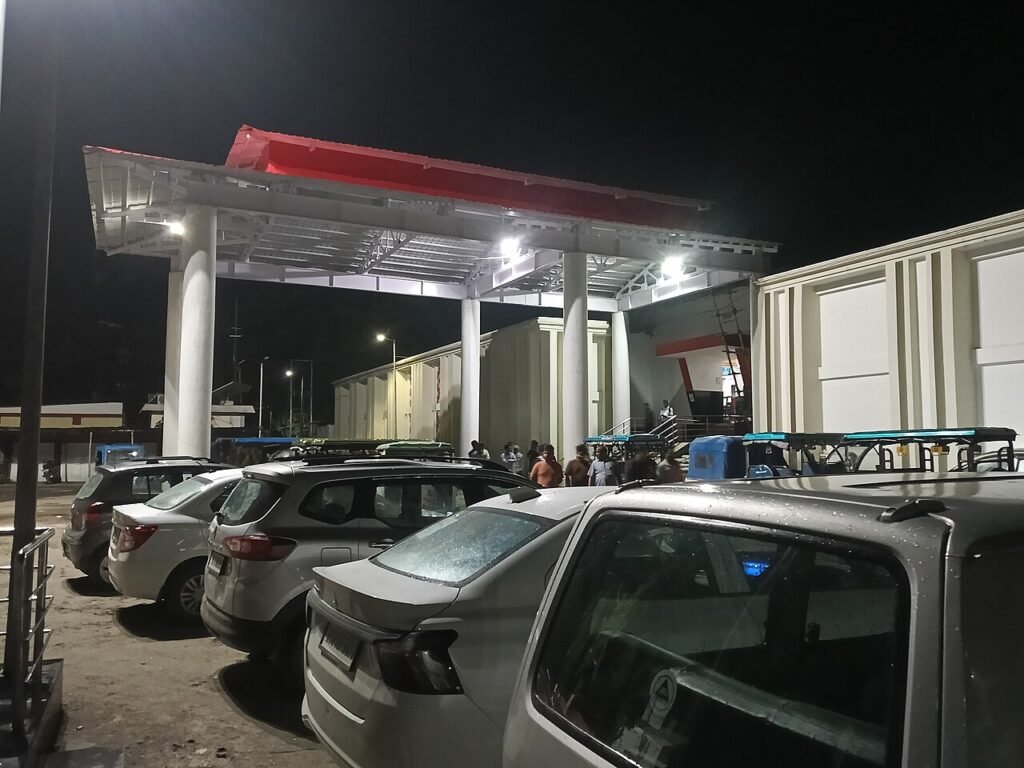
Why in News? The Centre has named the Secretary of the Bodoland Territorial Council (BTC), Kokrajhar, as the competent authority for the Kokrajhar-Gelephu new railway line project. The Ministry of Railways issued the notification under clause (7A) of Section 2 of the Railways Act, 1989. The news came from New Delhi on 29 October 2026.
Current Context (The Trigger)
- The notification: The BTC Secretary is now authorised to act as the competent authority for this special railway project. The role covers its execution, maintenance, management and operation.
- Area covered: The notification covers Kokrajhar and Chirang districts. It also covers the Kokrajhar, Sidli and Bengtol tehsils and circles.
- The line: The proposed line is 69.05 km long and joins Kokrajhar in Assam with Gelephu in Bhutan.
- Cost: Indian Railways has completed the detailed project report (DPR). The paper puts the cost at around Rs 3,500 crore.
- Stations: Six stations are planned: Balajan, Garubhasa, Runikhata, Shantipur, Dadgiri and Gelephu.
- Structures: The plan lists two important bridges, 29 major bridges, 65 minor bridges, one road overbridge, 39 road underbridges and two viaducts.
- First for Bhutan: The line is expected to give Bhutan its first railway link to India.
Core Concepts & Static GK
- Competent authority: The Railways Act defines this as a person whom the Central Government authorises by notification. The person performs the functions of the competent authority for the area named in that notification.
- Special railway project: This is a project that the Central Government notifies as such. It provides national infrastructure for a public purpose in a specified time-frame. It can cover one or more States or Union Territories.
- Why the tag matters: A special railway project has its own land acquisition chapter in the Railways Act. The Centre declares its intention to acquire land by notification.
Constitutional & Legal Framework
- Railways Act, 1989: Clause (7A) of Section 2 defines the competent authority. Clause (37A) defines the special railway project. Both came in through the Railways (Amendment) Act, 2008.
- Chapter IVA (Section 20A onwards): It covers land acquisition for a special railway project. The State Government must give the land records to the competent authority when asked.
- Public notice: The competent authority must publish the substance of the notification in two local newspapers. One of them must be in a vernacular language.
- Objections: Any person interested can object within 30 days, in writing, to the competent authority. The authority hears the objector and then allows or disallows the objection. Its order is final.
- Vesting: After the Centre declares the acquisition, the land vests in the Central Government free from all encumbrances.
Institutional Machinery
- Ministry of Railways: It issued the notification.
- BTC Secretary: He is the competent authority for this project.
- Project Steering Committee: At its first meeting in New Delhi, the two links were declared Special Railway Projects. Both sides are to meet twice a year.
Reports, Indices & Data
- Cost at announcement: When the links were announced on 29 September 2025, the Kokrajhar-Gelephu line was put at Rs 3,456 crore. The Banarhat-Samtse line was put at Rs 577 crore. The total was Rs 4,033 crore.
- Funding: India will make the entire investment in these projects, as announced by Railway Minister Ashwini Vaishnaw.
- Paper vs earlier figure: Today’s paper says “around Rs 3,500 crore” after the DPR. The 2025 announcement said Rs 3,456 crore. Use the paper’s figure for the present estimate.
Assam & Northeast Linkages
- Bodoland: The line runs through Kokrajhar and Chirang. The paper sees openings for local businesses, traders, tourism operators and service providers in the Bodoland Territorial Region (BTR).
- Condition: The paper adds that this depends on implementation and supporting investment.
- Border location: Gelephu Mindfulness City lies in southern Bhutan, next to Assam.
Gelephu Mindfulness City and the Banarhat-Samtse Link
- Gelephu Mindfulness City (GMC): It is a Special Administrative Region (SAR) of Bhutan. It was set up by Royal Charter in February 2024.
- Announcement: The King’s National Day address of 17 December 2023 announced the idea.
- Link to the railway: Reports link the rail links to Bhutan’s plan to develop Gelephu as a “mindfulness city”. They also link them to Samtse’s growth as an industrial hub.
- Second link: The Banarhat-Samtse line is about 20 km long and costs Rs 577 crore. Banarhat is in West Bengal and Samtse is in Bhutan.
- Timeline: Kokrajhar-Gelephu is expected to take about four years from 2026. Banarhat-Samtse is expected to take three years.
- Agreement: India and Bhutan signed an MoU on the first cross-border rail links during consultations between the two Foreign Secretaries in New Delhi.
Prelims Trap Zones (Watch out for)
- Authority Trap: The competent authority is the Secretary of the BTC, Kokrajhar. It is not the Deputy Commissioner or the Railway Board.
- Clause Trap: Clause (7A) defines the competent authority. Clause (37A) defines the special railway project. Do not swap them.
- Length Trap: Kokrajhar-Gelephu is 69.05 km in the paper. Banarhat-Samtse is about 20 km.
- State Trap: Banarhat is in West Bengal, not Assam. Kokrajhar is in Assam.
- Who notifies Trap: The Central Government, not the State Government, notifies a special railway project.
Introduction
The Centre has named a BTC officer as the competent authority for the Kokrajhar-Gelephu line. This is an important administrative step towards Bhutan’s first rail link to India. The project joins foreign policy, infrastructure and local governance.
Strategic and Economic Rationale
- Neighbourhood ties: The line would give Bhutan its first rail link to India. It supports India’s “neighbourhood” relations with Bhutan.
- Trade and tourism: The paper says the line could improve access to Bhutanese markets. It could also help tourism and the movement of goods and passengers.
- Bhutan’s growth plans: Reports link the line to Gelephu’s growth as a “mindfulness city”.
- Cost to India: India has said it will make the entire investment. This is a form of development partnership, but it also raises the question of returns.
Local Governance and Land
- Role of the BTC: A BTC officer will handle the competent authority’s functions, including land acquisition, in Kokrajhar and Chirang. This brings the local body into a national project.
- Process safeguards: The Act requires public notice in two local newspapers and a hearing on objections. It also counts forest dwellers with recognised forest rights as “persons interested”.
- Speed: A Bhutanese report says the special project tag means fewer regulatory hurdles.
Challenges
- Terrain: The plan needs 29 major bridges and two viaducts across varied terrain.
- Land acquisition: Land acquisition, design and tendering take about one year, by one estimate. Construction is expected to start near the end of 2026.
- Dependence on investment: The paper notes that local gains depend on implementation and supporting investment.
Comparative Assessment of the Two Links
| Feature | Kokrajhar-Gelephu | Banarhat-Samtse |
|---|---|---|
| Indian side | Kokrajhar, Assam | Banarhat, West Bengal |
| Length | 69.05 km (paper); about 69 km (2025 announcement) | About 20 km |
| Cost at announcement | Rs 3,456 crore | Rs 577 crore |
| Time estimate | About 4 years from 2026 | 3 years |
| Bhutan side | Gelephu | Samtse |
Way Ahead
- Clear land fast: Complete notices, hearings and compensation on time, with the BTC and district officials working together.
- Protect local interests: Involve local traders and communities in planning stations and logistics facilities in the BTR.
- Coordinate with Bhutan: Use the twice-yearly meetings of the steering committee to settle issues on the Bhutan side.
- Plan for traffic: Build the supporting road and logistics links so that the line is used for trade and tourism.
Conclusion
The Kokrajhar-Gelephu line can turn a long border into a trade and travel route. Its success will depend on fair land acquisition, steady funding and local participation.
Drug Pricing, Trade Margins and the DPCO Framework
Syllabus Mapping
- Prelims: GS Paper I (Current events of State/National importance; Indian Polity: statutory and regulatory bodies; Economic and social development: health).
- Mains: GS Paper II (Issues relating to development and management of social sector/services relating to health; Statutory, regulatory and quasi-judicial bodies); GS Paper III (Indian economy: government policies and interventions, pricing and public interest).
Why in News? The Supreme Court has sharply criticised the Centre and the National Pharmaceutical Pricing Authority (NPPA). The issue is the huge gap between what medicines cost to procure and their maximum retail price (MRP). Justices Vikram Nath and Sandeep Mehta are hearing two PILs on drug prices, trade margins and patients’ access to affordable care. The Assam Tribune editorial of 30 October 2026 takes up the issue.
Current Context (The Trigger)
- Court’s remark: The bench rejected the Centre’s “calibrated”, market-driven approach. It said “economic policy cannot take precedence over the lives of citizens”.
- Trade margin cap: The court asked why trade margin caps cannot be applied more widely. A 30% cap was recently introduced for 137 non-scheduled anti-cancer drugs.
- How the cap came: NPPA notified it on 17 October 2026 under Paragraph 19 of the DPCO, 2013. The revised prices apply from 9 November 2026. An NPPA pilot in 2019 had capped trade margins on 42 anti-cancer drugs at 30%.
- Coverage gap: The court said 82% to 90% of medicines are not covered by the ceiling prices of the Drugs (Prices Control) Order (DPCO), 2013. So makers can fix launch prices that nobody monitors.
- Price gaps cited: The editorial gives examples. A cancer drug or injection procured for Rs 11,000 carried an MRP of Rs 1.3 lakh. Another procured for Rs 2,700 was sold at Rs 27,000. A saline drip line bought for Rs 15 was sold at Rs 250.
Core Concepts & Static GK
- Scheduled formulation: A medicine, with its strength and dosage, listed in the First Schedule of DPCO 2013. Its price is capped by a ceiling price.
- Non-scheduled formulation: A medicine not listed in the First Schedule. The editorial says such drugs are outside price control but may rise by 10% a year.
- MRP: The maximum retail price printed on the pack. The editorial’s complaint is that the MRP can be far above the procurement cost.
- Trade margin: The gap between the price at which a seller buys a drug and the price at which it sells it. The court wants this gap capped for more drugs.
Constitutional & Legal Framework
- Essential Commodities Act, 1955: DPCO 2013 is made under Section 3 of this Act. The Order is dated 15 May 2013. It replaced the Drug (Prices Control) Order, 1995.
- Ceiling price (Para 4): Take the average price to retailer of all brands and generic versions with a market share of 1% or more. Then add a retailer margin of 16%.
- Annual revision (Para 16): The Government revises ceiling prices every year as per the Wholesale Price Index (WPI). The new prices are notified on 1 April.
- Extraordinary powers (Para 19): In extraordinary circumstances and in public interest, the Government can fix the ceiling or retail price of any drug. The new anti-cancer margin cap uses this power.
- Monitoring (Para 20): The Government monitors the MRP of all drugs, including non-scheduled ones. No maker may raise the MRP by more than ten percent over the preceding twelve months. An excess increase must be brought down. The maker must also deposit the overcharged amount with interest.
- Right to health: Article 21 guarantees the right to life. In Paschim Banga Khet Mazdoor Samity (1996), the Supreme Court held that it covers the State’s duty to give emergency medical care.
Institutional Machinery
- NPPA: Set up on 29 August 1997 as an attached office of the then Department of Chemicals and Petrochemicals. Today it is an attached office of the Department of Pharmaceuticals, Ministry of Chemicals and Fertilizers. That department has been its parent since July 2008.
- NPPA’s job: It fixes and revises prices of scheduled drugs and enforces the DPCO. It also monitors the availability of drugs and acts on shortages.
- NLEM link: The National List of Essential Medicines (NLEM) forms the First Schedule of DPCO 2013. Under Para 18, ceiling prices are reworked when the NLEM is revised, or after five years, whichever is earlier.
Schemes & Initiatives
- NLEM 2022: The Health Ministry released it on 13 September 2022. It has 384 medicines in 27 therapeutic categories. It added 34 medicines and dropped 26 from the 2015 list. It became the First Schedule of DPCO on 11 November 2022.
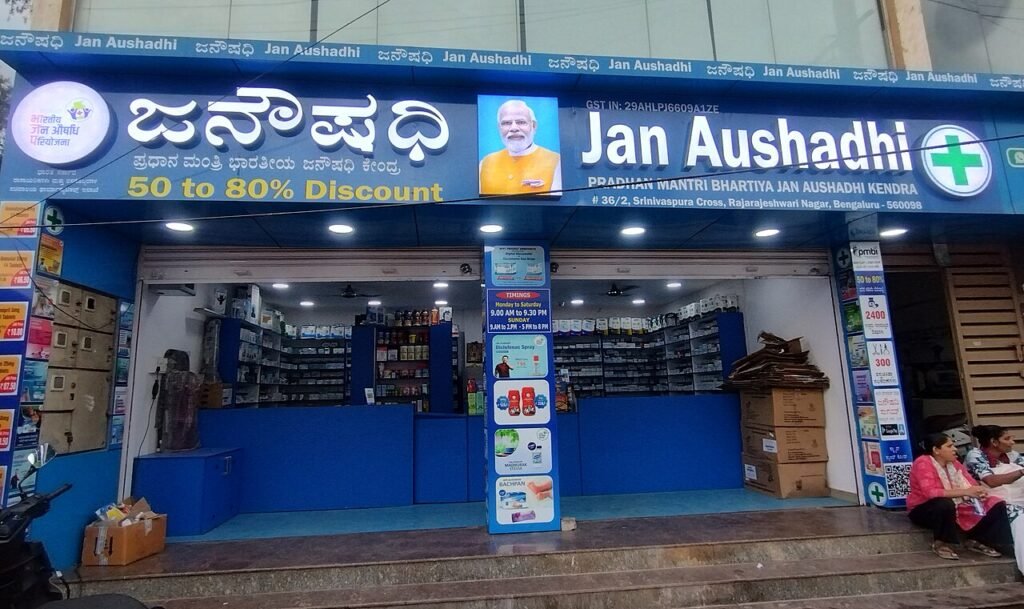
- Jan Aushadhi: The Pradhan Mantri Bhartiya Janaushadhi Pariyojana sells quality generic medicines through Jan Aushadhi Kendras. The Pharmaceuticals & Medical Devices Bureau of India (PMBI) implements it. The editorial notes that generics are affordable, but doctors are slow to prescribe them.
- Jan Aushadhi reach: These medicines are about 50% to 80% cheaper than branded ones. 17,990 Kendras had opened by 31 December 2025 (Department of Pharmaceuticals). The target is 25,000 by 31 March 2027.
Assam & Northeast Linkages
- Jan Aushadhi in the NE: A one-time extra incentive of Rs 2.00 lakh is given for Kendras opened in the North-Eastern States. Himalayan areas, island territories and aspirational districts also get it. So do Kendras opened by women, ex-servicemen, Divyangjan, SC and ST applicants.
Prelims Trap Zones (Watch out for)
- Act Trap: DPCO 2013 is made under the Essential Commodities Act, 1955. It is not made under the Drugs and Cosmetics Act, 1940.
- Cap Trap: The 10% limit applies to the yearly MRP rise of non-scheduled drugs. Scheduled drugs follow the WPI. The 30% trade margin cap in the news covers 137 non-scheduled anti-cancer drugs.
- Margin Trap: The 16% retailer margin is built into the ceiling price formula for scheduled drugs. It is not a cap on all drugs.
- Body Trap: NPPA began under the Department of Chemicals and Petrochemicals. Today it is under the Department of Pharmaceuticals, not the Health Ministry.
- List Trap: The Health Ministry prepares the NLEM. The Department of Pharmaceuticals notifies it as the DPCO schedule, and NPPA fixes the prices.
Introduction
Patients cannot bargain over medicines they need. The Supreme Court has now asked why most medicines stay outside price control and why margin caps are not used more. The real question is how to protect patients without hurting supply and new drugs.
Why the Current Framework Falls Short
- Narrow coverage: The court said 82% to 90% of medicines are outside the ceiling-price system.
- Free launch prices: Makers can fix launch prices that nobody monitors.
- Huge margins: The examples cited show MRPs many times the procurement price.
- Scheduled drugs rising faster: The editorial says prices of scheduled drugs have risen more than those of non-scheduled drugs.
- Weak transparency: The editorial finds little transparency and accountability. It says the Government has been lenient.
Impact on Citizens
- Out-of-pocket burden: Painkillers, antibiotics, anti-infectives and cardiac medicines keep getting costlier. The poor, the middle class and patients on regular medicines suffer most.
- Hospital bills: The cost of hospital treatment is also rising.
- Generic hurdle: Generics are an option, but doctors often do not prescribe them.
Government & Statutory Measures
| Level | Initiative | Purpose & Impact |
|---|---|---|
| Legal | DPCO 2013 under the Essential Commodities Act, 1955 | Ceiling price for scheduled drugs; 10% limit on yearly MRP rise for others |
| Institutional | NPPA, set up in 1997 | Fixes prices, enforces DPCO and monitors availability |
| Policy | NLEM 2022 (384 medicines) | The essential list that becomes the DPCO schedule |
| Access | Jan Aushadhi Kendras | Generic medicines about 50% to 80% cheaper than branded ones |
| Recent | 30% trade margin cap on 137 non-scheduled anti-cancer drugs (Para 19) | Limits trade mark-ups; revised prices from 9 November 2026 |
The Balancing Argument
- Against over-control: The editorial warns that needless state meddling in the market can cause bigger problems later.
- For targeted control: It still says some control is needed for life-saving and mass-use drugs.
- Court’s stand: The bench said economic policy cannot take precedence over the lives of citizens.
Way Ahead
- Widen margin caps: Extend trade margin caps beyond the 137 anti-cancer drugs, as the court has asked.
- Use Para 19 powers: Fix prices of drugs in public interest where gaps are extreme.
- Publish data: Put procurement price and MRP data in the open for key drugs.
- Push generics: Encourage doctors to prescribe generics and open more Jan Aushadhi Kendras.
Conclusion
Price control must be targeted, but it cannot be absent. Wider margin caps, open data and more generics can cut costs for patients without choking supply.
Digital Arrest Frauds and Banks’ Liability for Victims
Syllabus Mapping
- Prelims: GS Paper I (Current events of State/National importance; Indian Polity: judiciary and governance; Indian Economy: banking and financial regulation).
- Mains: GS Paper II (Judiciary; accountability and regulation; government policies and interventions); GS Paper III (Cyber security; challenges to internal security through communication networks; banking and financial inclusion).
Why in News? On 29 October 2026, the Supreme Court said banks must be made accountable for the losses of digital fraud victims. Victims of crimes such as digital arrest should be paid no less than what they lost. This applies where the fraud is traced to the institution’s lapse in due diligence.
Current Context (The Trigger)
- Bench: The hearing was before Chief Justice Surya Kant and Justices Joymalya Bagchi and V Mohana. The case is titled ‘In Re: Victims of Digital Arrest Related to Forged Documents’.
- RBI draft rules: The bench said it would examine the RBI’s proposed Know Your Customer (KYC) Amendment Directions, 2026. They are expected to be notified by 30 November and operationalised by 31 December. The court wants them to provide suitable compensation to victims when institutions fail in due diligence.
- Preventive steps: The court repeated the need for mandatory measures. Banks should briefly hold transactions that do not match a customer’s normal pattern. Suspicious activity should be flagged automatically. Doubtful transactions should be checked physically to confirm they are genuine.
- Directions to RBI: By the next hearing, the RBI must give the court the names of every authorised financial institution. The court will issue directions for all institutions without necessarily making each bank a party.
- Police alert: The court also spoke of a bank’s duty to warn nearby police stations. This applies when a customer who may be a digital arrest victim makes unusual transactions.
- Numbers: Attorney General R Venkataramani told the court that reported digital arrest cases were down by about 50 per cent from last year. The CJI said the country still lost nearly Rs 800 crore to such offences this year.
- Two gaps: The CJI named two areas needing more action: making banks accountable, and mule accounts. Mule accounts are often used to receive and pass on money from cybercrime.
Core Concepts & Static GK
- Digital arrest: Fraudsters pose as police, CBI, narcotics, RBI or Enforcement Directorate officials. They threaten victims, sometimes keep them in view on a video call, and demand money. It is not a legal procedure.
- Mule account: This is a bank account used to receive and move cybercrime money, as the paper describes.
- Due diligence: The court links the bank’s compensation duty to a failure of due diligence by the institution.
Constitutional & Legal Framework
- RBI circular, 6 July 2017: The circular (RBI/2017-18/15) is titled “Customer Protection – Limiting Liability of Customers in Unauthorised Electronic Banking Transactions”. It covers scheduled commercial banks including RRBs, small finance banks and payments banks.
- Zero liability: The customer bears no loss if the bank’s own fraud, negligence or deficiency caused it. The same holds for a third-party breach if the customer tells the bank within three working days of getting the bank’s alert about the transaction.
- Limited liability: If the customer reports in 4 to 7 working days, the liability is capped. The cap is the transaction value or a set amount, whichever is lower. The cap is Rs 5,000 for BSBD accounts and Rs 10,000 for other savings accounts.
- Bank’s duties: The bank must credit the disputed amount within 10 working days of the customer’s report. It must settle the complaint within 90 days. The bank has to prove any customer liability.
- What is new: The 2017 circular deals with unauthorised electronic transactions. In a digital arrest, the victim is usually frightened into sending the money himself. Such losses may not fit easily under the circular. The court now wants the new KYC rules to compensate these victims where the institution failed in due diligence.
- IT Act, 2000, Section 66D: It punishes cheating by personation using a communication device or computer resource. The term can extend to three years, with a fine up to Rs 1 lakh.
- BNS, 2023: Section 319 deals with cheating by personation. Under Section 319(2), the punishment is up to five years, or fine, or both. Extortion is covered by Section 308.
Institutional Machinery
- I4C: Home Minister Amit Shah inaugurated the Indian Cyber Crime Coordination Centre in New Delhi on 10 January 2020. He launched the National Cyber Crime Reporting Portal the same day.
- Helpline 1930: The Ministry of Home Affairs made 1930 the toll-free helpline for immediate reporting of financial fraud. It replaced the earlier number 155260. State and UT police run the helpline and log the fraud details.
- CFCFRMS: The Citizen Financial Cyber Fraud Reporting and Management System was launched in 2021 under I4C. It aims to report frauds quickly and stop fraudsters from siphoning off funds. It puts state police, banks and financial intermediaries on one platform.
- Reporting online: Victims can also report at cybercrime.gov.in.
- Supreme Court’s earlier push: News reports say the court took up the matter on its own. It earlier asked the CBI to probe bank officials who help run mule accounts.
Prelims Trap Zones (Watch out for)
- Number Trap: Under the 2017 circular, zero liability for a third-party breach needs reporting within three working days, not seven. Reporting in 4 to 7 working days brings limited liability.
- Date Trap: The KYC Amendment Directions, 2026 are expected to be notified by 30 November and operationalised by 31 December. They are not yet in force.
- Agency Trap: CFCFRMS and 1930 sit under I4C of the Ministry of Home Affairs, not under the RBI.
- Court Trap: The Supreme Court tied compensation of at least the lost amount to a due diligence failure by the institution. It did not say banks pay in every fraud.
Introduction
Digital arrest scams use fear and fake authority to empty bank accounts. On 29 October 2026, the Supreme Court pushed for bank accountability and compensation for victims. The case tests how far financial regulation should protect the customer.
Why Bank Accountability Matters
- Money moves through banks: Stolen money passes through mule accounts, which fraudsters use to collect and move cybercrime money.
- Losses are still large: The CJI noted nearly Rs 800 crore lost this year, even after reported cases fell by about half.
- Existing rules have limits: The 2017 circular protects customers in unauthorised transactions. It also puts the burden of proof on the bank. The court now wants a clear compensation route for victims of frauds like digital arrest.
Challenges
- Scope of banks: The RBI has to tell the court which financial institutions the new rules will cover.
- Proving failure: Compensation depends on finding that due diligence failed. Deciding this case by case can be slow.
- Balance: Automated suspension of unusual transactions can protect victims. But it may also stop genuine customers. Clear rules and quick review are needed.
- Cross-agency work: The Centre credited court intervention, ministry action and public awareness for the fall in cases. Police, banks and I4C must still act together.
Government & Statutory Measures
| Level | Initiative | Purpose & Impact |
|---|---|---|
| MHA | I4C and National Cyber Crime Reporting Portal (2020) | One national body and portal for cybercrime reporting |
| MHA | Helpline 1930 and CFCFRMS | Fast reporting and an attempt to stop money moving out |
| RBI | 2017 circular on customer liability | Zero or limited liability in unauthorised transactions |
| RBI | Draft KYC Amendment Directions, 2026 | Tighter due diligence; compensation if banks fail |
| Law | IT Act Section 66D; BNS Section 319 | Punishment for cheating by personation |
Way Ahead
- Clear compensation rule: The KYC directions should say when and how much a bank pays, as the court wants.
- Real-time alerts: Banks should pause unusual transactions and tell the local police.
- Act on mule accounts: Banks need stronger checks when opening and monitoring accounts.
- Public awareness: Citizens should know that digital arrest is a scam and report on 1930 or cybercrime.gov.in.
Conclusion
Banks hold the last point of control over a victim’s money. Making them share the loss when they fail in due diligence can push them to build better checks.
News in Short
- Teli Kivelimi Kiba: She was the first woman Gaonbura (village headman) in Naga society. She served Ighanumi village in Zunheboto district from 1936 until her death in 1956.
- Tiprasa Accord: Tripura Chief Minister Dr Manik Saha held talks with TIPRA Motha founder Pradyot Kishore Manikya Debbarma on implementing the accord. Further talks will be held in New Delhi.
- Operation Trident: Mizoram Police, the NCB and the ED launched it on 23 October in Aizawl, Champhai and Lawngtlai in Mizoram and in Churachandpur in Manipur. It led to 18 arrests and the freezing of 1,424 bank accounts.
- Samagra Seva app: Chief Minister Himanta Biswa Sarma launched this digital app for municipal services in Tinsukia. It cost about Rs 1.50 crore. Users can pay property tax and apply for trade licences.
- Perseverance rover: NASA’s rover set a distance record on Mars on 11 October, with an odometer reading of 45.22 kms. It beat the 45.16 kms of Opportunity. It uses a self-driving system called AutoNav.
- Green hydrogen offtake: Offtake contracts signed by Indian companies have crossed 5,55,610 MTPA (metric tonnes per annum). Union Minister Pralhad Joshi said developers have secured 23 major contracts. Over 70 per cent is meant for exports.
- ESIC New Amnesty Scheme, 2025: The Employees’ State Insurance Corporation extended it by three months, from 1 October 2026 to 31 December 2026, on existing terms. It lets employers settle pending disputes with ESIC out of court.
- Nobel Peace Prize 2026: Awarded to South Africa’s Navanethem ‘Navi’ Pillay, who is of Indian origin, for her efforts to promote peace and international law. She is a former UN High Commissioner for Human Rights and a former judge of the International Criminal Court.
APSC Prelims MCQs
Practice questions on the topics above
Topic 1: Assam Committee to Draft Rules for the State Uniform Civil Code
Q1. The Assam government has formed a committee to draft rules for the Uniform Civil Code (UCC) Bill, Assam, 2026. Consider the following statements:
(i) The Secretary of the Home and Political departments chairs the committee.
(ii) The committee must submit its draft rules to the Finance department within one month.
(iii) The Bill has already received the President’s assent.
Which of the statements given above is/are correct?
- (a) (i) only
- (b) (i) and (ii) only
- (c) (ii) and (iii) only
- (d) (i), (ii) and (iii)
Show answer
Answer: (a) Explanation: Deba Prasad Misra, Secretary of the Home and Political departments, is chairman, so (i) is right. The draft rules go to the Political (A) department, not Finance, so (ii) is wrong. The Bill has only been sent to the Government of India for the President’s assent, so (iii) is wrong.
Q2. Consider the following statements about the Uniform Civil Code:
(i) Article 44 is a Directive Principle of State Policy in Part IV of the Constitution.
(ii) Marriage and divorce are subjects on the Concurrent List.
(iii) The Uttarakhand UCC Act, 2024 applies to Scheduled Tribes.
Which of the statements given above is/are NOT correct?
- (a) (i) only
- (b) (ii) only
- (c) (iii) only
- (d) (i) and (ii) only
Show answer
Answer: (c) Explanation: Article 44 sits in Part IV, so (i) is correct. Entry 5 of the Concurrent List covers marriage and divorce, so (ii) is correct. The Uttarakhand Act excludes Scheduled Tribes, so (iii) is the incorrect statement.
Q3. Match List-I with List-II:
| List-I | List-II |
|---|---|
| a. Goa’s civil code | 1. Portuguese Civil Code of 1867 |
| b. Article 44 | 2. Directive Principles of State Policy (Part IV) |
| c. Uttarakhand UCC Rules, manual and portal | 3. Rolled out on 27 January 2025 |
| d. Assam UCC rules committee | 4. Sends draft rules to the Political (A) department |
Select the correct answer using the codes given below:
- (a) a-1, b-2, c-3, d-4
- (b) a-2, b-1, c-3, d-4
- (c) a-1, b-2, c-4, d-3
- (d) a-3, b-2, c-1, d-4
Show answer
Answer: (a) Explanation: Goa follows the 1867 Portuguese Civil Code. Article 44 is in Part IV. Uttarakhand rolled out its UCC with a rules manual and portal on 27 January 2025. The Assam committee gives its draft rules to the Political (A) department. Only code (a) matches all four.
Q4. Which group of residents is left out of the scope of the Assam Uniform Civil Code Bill, 2026?
- (a) Scheduled Castes
- (b) Scheduled Tribes
- (c) Other Backward Classes
- (d) Persons living in live-in relationships
Show answer
Answer: (b) Explanation: The Bill excludes Scheduled Tribes living in Assam, to protect their customs. Live-in couples are covered, since the Bill requires them to register. Scheduled Castes and OBCs are not exempt.
Topic 2: Kokrajhar-Gelephu Railway Link between Assam and Bhutan
Q5. The Centre has appointed the Secretary of the Bodoland Territorial Council as the competent authority for the Kokrajhar-Gelephu railway project under the Railways Act, 1989. Consider the following statements:
(i) A competent authority is a person authorised by the Central Government by notification for a specified area.
(ii) A special railway project is notified by the State Government concerned.
(iii) Chapter IVA of the Act deals with land acquisition for a special railway project.
Which of the statements given above is/are correct?
- (a) (i) only
- (b) (i) and (iii) only
- (c) (ii) and (iii) only
- (d) (i), (ii) and (iii)
Show answer
Answer: (b) Explanation: Statements (i) and (iii) are correct. Statement (ii) is wrong because the Central Government notifies a special railway project.
Q6. Match List-I with List-II:
| List-I | List-II |
|---|---|
| a. Kokrajhar-Gelephu line | 1. Special Administrative Region of Bhutan |
| b. Banarhat-Samtse line | 2. Competent authority for the Kokrajhar-Gelephu project |
| c. Gelephu Mindfulness City | 3. Proposed line of 69.05 km |
| d. Secretary of the BTC, Kokrajhar | 4. Link of about 20 km starting in West Bengal |
Select the correct answer using the codes given below:
- (a) a-3, b-4, c-1, d-2
- (b) a-4, b-3, c-1, d-2
- (c) a-3, b-4, c-2, d-1
- (d) a-1, b-2, c-3, d-4
Show answer
Answer: (a) Explanation: The Kokrajhar-Gelephu line is 69.05 km. The Banarhat-Samtse link is about 20 km and starts in West Bengal. Gelephu Mindfulness City is a Special Administrative Region of Bhutan. The BTC Secretary is the competent authority.
Q7. Which one of the following statements about the Kokrajhar-Gelephu railway project is NOT correct?
- (a) The notification covers Kokrajhar and Chirang districts.
- (b) Balajan, Garubhasa, Runikhata, Shantipur, Dadgiri and Gelephu are the six planned stations.
- (c) The Ministry of Railways issued the notification under clause (7A) of Section 2 of the Railways Act, 1989.
- (d) The Deputy Commissioner of Kokrajhar has been appointed the competent authority.
Show answer
Answer: (d) Explanation: The Secretary of the Bodoland Territorial Council, Kokrajhar, is the competent authority, not the Deputy Commissioner. Statements (a), (b) and (c) match the notification and the project plan.
Q8. Gelephu, at the Bhutanese end of the proposed rail link from Kokrajhar, is the site of a new city project in southern Bhutan. What is the status of this project?
- (a) A Special Administrative Region set up by Royal Charter
- (b) A Special Economic Zone run jointly by India and Bhutan
- (c) A free trade zone set up under SAFTA
- (d) A district headquarters town declared a smart city with Indian aid
Show answer
Answer: (a) Explanation: Gelephu Mindfulness City is a Special Administrative Region (SAR) of Bhutan. It was set up by Royal Charter in February 2024. It is Bhutan’s own project, not a joint zone with India or a SAFTA zone.
Topic 3: Drug Pricing, Trade Margins and the DPCO Framework
Q9. The Supreme Court has criticised the Centre and the NPPA over medicine prices. Consider the following statements about the Drugs (Prices Control) Order, 2013:
(i) It is made under Section 3 of the Essential Commodities Act, 1955.
(ii) The ceiling price of a scheduled formulation is worked out from the average price to retailer of brands and generics with a market share of 1% or more, plus a retailer margin of 16%.
(iii) It bars every increase in the MRP of non-scheduled drugs.
Which of the statements given above is/are correct?
- (a) (i) and (ii) only
- (b) (ii) and (iii) only
- (c) (i) only
- (d) (i), (ii) and (iii)
Show answer
Answer: (a) Explanation: Statement (i) matches the opening of the Order, and statement (ii) matches Para 4. Statement (iii) is wrong. Para 20 lets the MRP of a non-scheduled drug rise, but by no more than ten percent over the preceding twelve months.
Q10. Assertion (A): Medicines outside the First Schedule of DPCO 2013 still face a limit on their yearly price rise.
Reason (R): Under the DPCO, the Government monitors the MRP of all drugs, including non-scheduled formulations, and no maker may raise the MRP by more than ten percent over the preceding twelve months.
- (a) Both A and R are true and R is the correct explanation of A
- (b) Both A and R are true but R is not the correct explanation of A
- (c) A is true but R is false
- (d) A is false but R is true
Show answer
Answer: (a) Explanation: Para 20 of DPCO 2013 sets the ten percent rule for all drugs, including non-scheduled ones. That rule is exactly why a non-scheduled drug faces a limit on its yearly price rise. So both are true and R explains A.
Q11. The National Pharmaceutical Pricing Authority (NPPA) was set up on 29 August 1997. It is at present an attached office of which department?
- (a) Department of Health and Family Welfare
- (b) Department of Pharmaceuticals
- (c) Department of Consumer Affairs
- (d) Department of Chemicals and Petrochemicals
Show answer
Answer: (b) Explanation: NPPA is now an attached office of the Department of Pharmaceuticals, Ministry of Chemicals and Fertilizers. It began in 1997 under the then Department of Chemicals and Petrochemicals, so option (d) is the old parent. The Health Ministry prepares the NLEM but does not control NPPA.
Q12. The Pradhan Mantri Bhartiya Janaushadhi Pariyojana, which sells generic medicines through Jan Aushadhi Kendras, is implemented through which body?
- (a) National Pharmaceutical Pricing Authority
- (b) Central Drugs Standard Control Organisation
- (c) Pharmaceuticals & Medical Devices Bureau of India
- (d) Indian Council of Medical Research
Show answer
Answer: (c) Explanation: The Department of Pharmaceuticals runs the scheme through the Pharmaceuticals & Medical Devices Bureau of India (PMBI). NPPA fixes and monitors prices, but it does not run the Kendras.
Topic 4: Digital Arrest Frauds and Banks’ Liability for Victims
Q13. Under the RBI circular of 6 July 2017 on customer liability in unauthorised electronic banking transactions, consider the following statements:
(i) A customer has zero liability if the loss came from the bank’s own contributory fraud, negligence or deficiency.
(ii) For a third-party breach, zero liability needs the customer to report within seven working days.
(iii) The burden of proving the customer’s liability lies on the bank.
Which of the statements given above is/are correct?
- (a) (i) and (ii) only
- (b) (i) and (iii) only
- (c) (ii) and (iii) only
- (d) (i), (ii) and (iii)
Show answer
Answer: (b) Explanation: Statements (i) and (iii) match the circular. Statement (ii) is wrong because zero liability in a third-party breach needs reporting within three working days of the bank’s alert. Reporting in 4 to 7 working days brings limited liability.
Q14. The Citizen Financial Cyber Fraud Reporting and Management System (CFCFRMS), linked to the 1930 helpline, functions under which body?
- (a) National Crime Records Bureau
- (b) Indian Cyber Crime Coordination Centre
- (c) Reserve Bank of India
- (d) Financial Intelligence Unit-India
Show answer
Answer: (b) Explanation: CFCFRMS was launched in 2021 under I4C of the Ministry of Home Affairs. It links state police, banks and financial intermediaries. The RBI makes banking rules but does not run this system.
Q15. Which of the following statements about the cyber fraud reporting framework is NOT correct?
- (a) The helpline 1930 replaced the earlier number 155260.
- (b) The 1930 helpline is operated by State/UT police, who log the fraud details.
- (c) The Indian Cyber Crime Coordination Centre was inaugurated on 10 January 2020.
- (d) CFCFRMS was launched in 2018.
Show answer
Answer: (d) Explanation: CFCFRMS was launched in 2021, not 2018. Options (a), (b) and (c) are correct. 1930 replaced 155260, State/UT police run the helpline, and I4C was inaugurated on 10 January 2020.
Q16. On 29 October 2026, the Supreme Court bench led by CJI Surya Kant identified two key areas needing further intervention in the digital arrest case. These were:
- (a) accountability of banks and mule accounts
- (b) cross-border data storage and SIM card limits
- (c) accountability of telecom firms and social media platforms
- (d) cyber insurance and bank deposit insurance
Show answer
Answer: (a) Explanation: The CJI named bank accountability and mule accounts, which fraudsters use to collect and move cybercrime money. The other options are plausible but were not the two areas named.
Mains Answer Writing
One exam-style question with a model answer
Q. The Assam government has formed a committee to draft rules for the Uniform Civil Code Bill, Assam, 2026, which awaits the President’s assent. Critically examine the constitutional and administrative challenges of a State UCC in a diverse State like Assam. Suggest safeguards. (250 words, 15 marks)
Model answer
Introduction: Article 44 asks the State to endeavour to secure a uniform civil code. The Assam Assembly passed the Bill on 27 May 2026. An eight-member committee must now draft its rules within one month.
1. Constitutional challenges
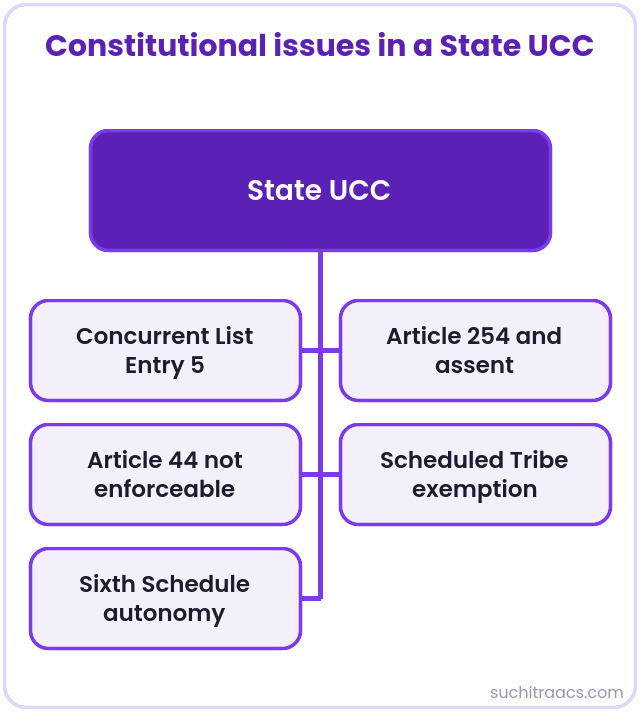
- Competence: Marriage, divorce, adoption, wills and succession are in Entry 5 of the Concurrent List. So a State can legislate, but within the limits of Article 254.
- Repugnancy: A State law that clashes with an earlier central law prevails in that State only if the President assents to it. Parliament can still amend or repeal it later.
- Directive Principle: Article 44 is not enforceable in court. Critics cite religious freedom under Articles 25 to 28 and the right to privacy.
- Tribal customs: The Bill keeps Scheduled Tribes outside its purview. Sixth Schedule councils in Bodoland, Karbi Anglong and Dima Hasao can make laws on marriage, divorce and social customs. So the code is not fully uniform.
2. Administrative challenges
- Registration load: Marriages must be registered within 60 days. Live-in relationships must be registered within one month. Registrars need staff and digital systems.
- Penalties: Bigamy or polygamy can bring up to seven years in jail. Low awareness may punish honest citizens.
- Rule-making: The committee has only government officials. No tribal council, women’s group or community body is on it.
3. Safeguards and Way Forward
- Assent first: Notify the rules only after the President’s assent. Uttarakhand’s code received assent in March 2024.
- Consultation: Publish draft rules and hear tribal councils, women’s groups and religious bodies.
- Rights: Keep the Scheduled Tribe exclusion clear. Protect live-in couples’ data.
- Capacity: Train registrars, set up online registration and a simple appeal process.
Conclusion: A State UCC can promote gender equality, but its legal footing and rules must be sound. Consultation and capacity will decide whether it unites or divides Assam’s diverse communities.
Prepare with SuchitraACS
APSC CCE Foundation Programme₹24,999  APSC Prelims Crash Course 2027 (GS + CSAT)₹5,999
 APSC CCE Study Materials Package (Prelims + Mains)₹4,999