APSC Current Affairs: Assam Tribune Notes with MCQs and Answer Writing (28/10/2026)
In this post
- Current Affairs Notes
- Defections, Resignations and Bypolls: Re-examining the Tenth Schedule
- Siang Upper Multipurpose Project: Local Protests, PFR Stage and Dams in the Eastern Himalaya
- Disaster Risk Reduction: Very Severe Cyclone Arnab and India’s UNDRR Message
- Northeast Connectivity: Mizoram’s Sairang-Hmawngbuchhuah Rail Plan, NH-15 Four-Laning and Guwahati-Bangkok Flight
- News in Short
- APSC Prelims MCQs
- Mains Answer Writing
For APSC CCE and other Assam competitive exam aspirants, staying consistently updated with reliable current affairs is essential for success. This blog provides a well-researched analysis of the most important topics from The Assam Tribune dated 28 October 2026. Each issue has been carefully selected and explained to support both APSC Prelims and Mains preparation, ensuring alignment with the APSC CCE syllabus and the evolving trends of the examination.
 Last batch for APSC CCE 2027 · starts 16 NovAPSC CCE Foundation Programme₹24,999
Current Affairs Notes
From The Assam Tribune, 28 October 2026
Defections, Resignations and Bypolls: Re-examining the Tenth Schedule
Syllabus Mapping
- Prelims: GS Paper I (Indian Polity and Governance – Constitution, Political System; Current events of State/National importance).
- Mains: GS Paper II (Parliament and State legislatures – functioning and issues arising out of these; Salient features of the Representation of People’s Act; Constitutional bodies); GS Paper V (Political and Administrative System of Assam – State Assembly).
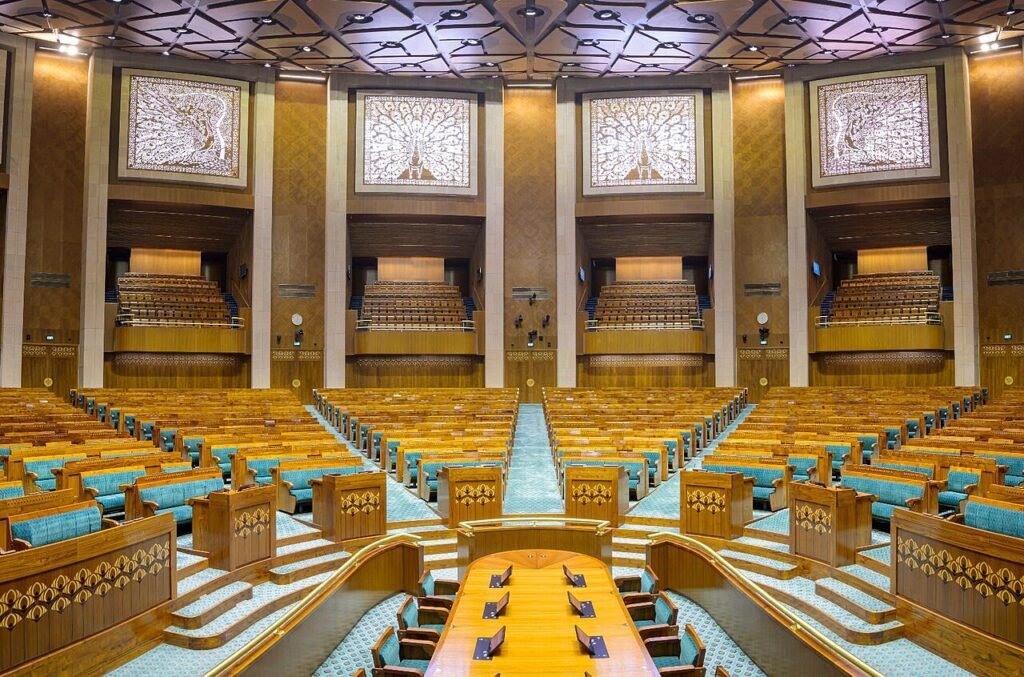
Why in News? An Assam Tribune editorial examines the Supreme Court’s decision to seek responses from the Centre and the Election Commission of India (ECI) on a plea against legislators who resign soon after winning, change party and return through by-elections.
Current Context (The Trigger)
- Court notice: The Supreme Court has asked the Centre and the ECI to respond to a plea challenging the practice of legislators resigning to switch allegiance and forcing a fresh election.
- Not a final ruling: The editorial stresses that the court has only issued notice; the constitutional questions will be settled after all parties are heard.
- Scale of defections: The Association for Democratic Reforms (ADR) and National Election Watch reported in September 2026 that 111 MPs and MLAs changed parties between 2022 and 2026, counting defections, mergers, resignations followed by bypoll wins and legislators returning after disqualification.
Core Concepts & Static GK
- Anti-defection law: The 52nd Constitutional Amendment of 1985 added the Tenth Schedule and brought the term “political party” into the Constitution.
- Grounds of disqualification: A member is disqualified for voluntarily giving up party membership or for voting or abstaining in the House contrary to the party’s direction.
- Mergers: A merger is protected from disqualification if not less than two-thirds of the legislature party agree to it.
- Nominated members: A nominated member is disqualified if they join a political party after six months from the date of taking their seat.
- Resignation is not a listed ground: Resigning the seat is not itself a ground of disqualification under the Tenth Schedule, which is why the editorial asks whether resignation can be used to get around the law’s purpose.
Constitutional & Legal Framework
- Who decides: Disqualification petitions are decided by the Speaker or Chairman of the House, subject to judicial review.
- Kihoto Hollohan v. Zachillhu (1992): The Supreme Court upheld the Tenth Schedule by a 3:2 majority, held Paragraph 7 (the bar on court jurisdiction) invalid, and ruled that the presiding officer’s decision is open to judicial review.
- 91st Amendment (2003): Omitted the split exemption (Paragraph 3), barred a member disqualified for defection from becoming a minister or holding a remunerative political post until the end of the term or re-election, whichever is earlier, and capped the Council of Ministers at 15 per cent of the total strength of the Lok Sabha or the State Assembly.
- Keisham Meghachandra Singh v. Speaker, Manipur Legislative Assembly (21 January 2020): A three-judge bench (Justices Nariman, Bose and Ramasubramanian) held that, barring exceptional circumstances, the Speaker must decide a disqualification petition within three months of filing.
- Independent tribunal: In the same judgment the Court asked Parliament to consider replacing the Speaker with a permanent tribunal headed by a retired Supreme Court judge or a retired High Court Chief Justice; this was a suggestion, not a binding direction.
Institutional Machinery
- Bye-elections: Section 151A of the Representation of the People Act, 1951 requires a vacancy to be filled within six months of its occurrence. It does not apply where the remainder of the member’s term is less than one year, or where the ECI, in consultation with the Central Government, certifies that holding it within that period is difficult.
- Cost of a bypoll: Every bypoll draws on polling staff, security forces and the administration, and is paid for largely from public funds.
- Possible ECI role: The editorial suggests the ECI could take on a larger advisory or evidence-gathering role in disqualification matters, provided its powers are clearly defined.
Assam & Northeast Linkages
- Manipur case: The Meghachandra judgment that fixed the three-month limit arose from a defection dispute in the Manipur Legislative Assembly.
- Northeast in the ADR data: In the ADR count, Nagaland recorded the highest number of party switches (32), largely linked to the NDPP-NPF realignment; Meghalaya (6) and Manipur (5) also figure in the list.
Prelims Trap Zones (Watch out for)
- Amendment Trap: The Tenth Schedule came through the 52nd Amendment (1985), not the 91st; the 91st (2003) removed the split provision.
- Authority Trap: Under the Tenth Schedule the Speaker or Chairman decides disqualification, not the ECI; the three-month limit and the tribunal idea came in Meghachandra (2020), and the tribunal was only a suggestion.
- Resignation Trap: Resigning a seat is not itself a Tenth Schedule ground of disqualification; on the current plea the Court has only issued notice and has given no final ruling.
- Bypoll Trap: The six-month rule of Section 151A has exceptions (less than one year of term left; ECI certification after consulting the Centre).
Introduction
The Tenth Schedule was meant to curb defections, yet legislators who resign and return through bypolls under a new banner raise a fresh question about the sanctity of the electoral mandate. The editorial argues that the answer lies in clear rules that safeguard honest political choice while discouraging deliberate evasion.
Causes and Impact
- Breach of public trust: Giving up a fresh mandate within weeks merely to change sides, with no compelling reason, betrays the voters’ trust.
- Financial burden: Taxpayers fund repeated elections; voters who have already voted must return to the booth.
- Representation gap: The constituency loses its representative, sometimes when local concerns need urgent attention.
- Legislative arithmetic: In closely contested Houses even a handful of switches can influence government formation and majorities.
Challenges / Limits of the Present Law
- Delay: Long-drawn proceedings and disputes over disqualification and the Speaker’s powers have shown up the law’s weaknesses.
- Pre-emptive resignation: Some legislators have quit their seats before disqualification proceedings could be completed.
- Presiding officer’s position: Critics see a perception of bias when the ruling party gains from changes in numbers.
- Counter-view: A rigid law could let party leaderships suppress dissent, and a legislator should not be forced to stay with a party whose conduct has become unacceptable.
- Re-election is not a cure: A fresh mandate does not erase how the vacancy arose, especially when the original mandate was only weeks old.
Comparative Assessment: Two Positions
| Aspect | Case for restricting resignation-led switches | Case for legislator’s freedom |
|---|---|---|
| Mandate | A mandate is not a commodity to be traded at convenience | A bypoll lets the electorate endorse or reject the switch |
| Cost | Avoidable expenditure falls on taxpayers | Blanket penalties could create constitutional difficulties |
| Dissent | Deterrence needed against calculated evasion | Rigid rules may penalise principled disagreement |
Way Ahead
- Independent decision-maker with timelines: The editorial suggests an independent mechanism with fixed timelines; this echoes the Supreme Court’s 2020 three-month limit and tribunal suggestion. Any change needs careful constitutional consideration and must preserve judicial review.
- Cooling-off restrictions: Parliament could consider a time-bound bar on ministerial office, or on contesting the resulting bypoll, for legislators who resign to escape pending disqualification, backed by clear statutory grounds and safeguards.
- Cost recovery: Making former legislators bear the cost of a bypoll would need a firm legal basis and a fair procedure to fix responsibility.
- Party accountability: Parties that plan or reward such switches should also be brought within the accountability framework.
Conclusion
The real issue is not whether a legislator may leave a party, but whether resignation should be allowed to defeat the mandate that put the legislator in the House. Clear, fair rules can protect conscience while restoring public faith in representative democracy.
Siang Upper Multipurpose Project: Local Protests, PFR Stage and Dams in the Eastern Himalaya
Syllabus Mapping
- Prelims: GS Paper I (General issues on Environment, ecology and biodiversity; Current events of State/National importance; Physical geography of India and the North-East).
- Mains: GS Paper III (Environmental impact assessment; Infrastructure: energy; Conservation); GS Paper II (Governance, transparency and public consultation); GS Paper V (Assam syllabus: environment, resources and economy of Assam and the North-East).
Why in News? On 27 October in Itanagar, Arunachal Pradesh Minister Ojing Tasing held talks with the East Siang Downstream Dam Affected People’s Forum on the proposed 11,200 MW Siang Upper Multipurpose Project (SUMP), while Peoples Party of Arunachal president Nabam Vivek demanded the withdrawal of paramilitary forces and the release of arrested protesters. An Assam Tribune editorial of 28 October describes a “violent mass stir” in the State and warns of the combined impact of Arunachal’s mega dams on Arunachal and Assam.

Current Context (The Trigger)
- Talks with the affected forum: Minister Ojing Tasing (Rural Development and Panchayati Raj; represents Pangin constituency) met a delegation of the East Siang Downstream Dam Affected People’s Forum (ESDDAPF), led by president Oni Tamuk and general secretary Jobomchang Mengu. The forum speaks for communities in 72 villages. The meeting discussed the project and its Pre-Feasibility Report (PFR).
- Government line: Tasing said national priorities must be balanced with local interests and that transparency and dialogue are essential. The State holds that the feasibility study has to be completed first, before it decides if and in what form the project goes ahead.
- High-level committee: In September the State Cabinet approved an empowered high-level committee, chaired by Tasing, to oversee PFR survey activities in Siang and Upper Siang districts.
- Opposition demand: PPA president and MLA Nabam Vivek (speaking at Doimukh on 27 October) asked the State to pull paramilitary forces out of the Siang belt, free people detained during the protests and put dialogue first.
- Editorial view: The editorial finds that local stakeholders were barely consulted and names the Adi tribe and villages such as Parong, Riew, Geku and Sitang as fearing loss of ancestral land, homes and livelihoods.
Core Concepts & Static GK
- Pre-Feasibility Report (PFR): the first technical study for a hydropower project; it does not approve a dam or serve as a construction plan. Later steps include a detailed environmental study, a public hearing before environmental clearance and a Social Impact Assessment before land acquisition.
- Environmental clearance stages (EIA Notification, 2006): screening, scoping, public consultation and appraisal; the public hearing is run by the State Pollution Control Board at or near the project site; Category A projects are appraised by the central Expert Appraisal Committee.
Constitutional & Legal Framework
- LARR Act, 2013: a Social Impact Assessment is part of the acquisition process; prior consent of at least 80% of affected families is needed when land is acquired for private companies and 70% for public-private partnership projects, while government projects need no such consent.
Institutional Machinery
- Empowered high-level committee: State body for PFR survey activities in Siang and Upper Siang districts, chaired by Ojing Tasing.
- NHPC: the central public sector hydropower company that prepared the SUMP PFR and is building the Dibang project.
Reports, Indices & Data
- Dams listed in the editorial: Kamala Hydroelectric Project 1,720 MW and Kalai-II 1,200 MW (both recently approved), Dibang Multipurpose Project 2,880 MW (278 m, described as India’s largest and tallest, due for completion in 2032), and SUMP 11,200 MW. The Centre’s plan for Arunachal is about 60,000 MW.
- Dibang (NHPC): 12 underground units of 240 MW, concrete gravity dam about 278 m high in Lower Dibang Valley district near Roing, cost Rs 31,876.39 crore (May 2021 prices), nine years from CCEA approval of 27 February 2023, flood moderation up to 3,000 cumecs.
Assam & Northeast Linkages
- Downstream Assam: The editorial warns that the combined effect of these dams could prove catastrophic for both Arunachal and Assam.
- Flood and China angle: The project is being examined for flood moderation, and its strategic value has been linked to possible upstream interventions in the Brahmaputra basin.
Prelims Trap Zones (Watch out for)
- Capacity Trap: SUMP is 11,200 MW as printed, not 11,000 MW.
- Stage Trap: SUMP is at the PFR stage; a PFR is not a project approval, a DPR or an environmental clearance.
- Chair Trap: The high-level PFR committee is chaired by Ojing Tasing, not the Chief Minister.
- Status Trap: Dibang (2,880 MW) is the one under construction by NHPC; Kamala and Kalai-II are the newly approved ones.
Introduction
Large dams on the Siang promise energy, water storage and flood moderation, but they raise hard questions of displacement, free and informed consent, and fair rehabilitation. The latest talks and protests show that the PFR stage has itself become a test of trust between the State and indigenous communities.
Displacement, Consent and Rehabilitation Concerns
- Loss of land and identity: Adi communities fear losing ancestral land, homes and traditional livelihoods, issues the editorial says “cannot be brushed aside”.
- Consultation deficit: The editorial finds little consultation so far, whereas the minister himself accepts that the concerns and rights of communities must stay central.
- Legal safeguards: A Social Impact Assessment, a public hearing before environmental clearance and consent rules under the land acquisition law are the formal routes for voice and rehabilitation planning.
Governance and Trust at the PFR Stage
- Security versus dialogue: The PPA says deploying paramilitary forces and making arrests at the PFR stage is counter-productive and could undermine the project’s prospects.
- Dialogue steps: Talks with the downstream forum and a dedicated committee are early confidence-building measures, but the forum covers 72 villages whose concerns will need continuing engagement.
Environmental and Cumulative Impact
- Fragile geography: The editorial calls the region highly vulnerable seismologically and a biodiversity hotspot, where mega dams have gone ahead without adequate scientific study.
- Cumulative effect: Kamala, Kalai-II, Dibang and SUMP together could be catastrophic for Arunachal and Assam, it argues.
- Policy inconsistency: The editorial contrasts the Centre’s recent shift against new hydro projects in the upper Ganga in Uttarakhand with its pursuit of mega dams in Arunachal.
Energy, Flood and Strategic Rationale
- Case for the project: SUMP is being assessed for energy and water security, flood moderation and regional development, and its strategic value is linked to possible upstream interventions in the Brahmaputra basin.
Way Ahead
- Transparent PFR: Explain the objectives, benefits and implications to affected people in plain terms, as the PPA and the minister both stress.
- Consent before commitment: Treat community consent as a precondition for any decision beyond the feasibility stage.
- Independent cumulative studies: Commission basin-wide scientific studies covering seismic risk, river ecology and downstream Assam before approving further dams.
- Rehabilitation plan: Prepare a Social Impact Assessment and a rehabilitation package together with affected communities and local panchayats before any land acquisition.
Conclusion
Hydropower in the Eastern Himalaya can serve national goals only if affected communities are partners, not bystanders. Dialogue, science and consent must precede construction.
Disaster Risk Reduction: Very Severe Cyclone Arnab and India’s UNDRR Message
Syllabus Mapping
- Prelims: GS Paper I (Current events of State/National and International importance; General issues on Environment, ecology and disaster management).
- Mains: GS Paper III (Disaster and disaster management); GS Paper II (Governance; India and international institutions and agreements); GS Paper V (Assam: floods, erosion and earthquake hazards).
Why in News? Andhra Pradesh and Odisha made large-scale preparations on 27 October 2026 ahead of the landfall of the “very severe” cyclonic storm Arnab near Visakhapatnam, expected in the early hours of 28 October. The same day in New Delhi, PK Mishra, Principal Secretary to the Prime Minister, addressed a disaster risk reduction meeting convened by the UNDRR and co-chaired by India and the United Kingdom.

Current Context (The Trigger)
- Landfall forecast: IMD’s 5.30 pm bulletin expected landfall between 2 am and 4 am on 28 October, with sustained winds of 125-135 kmph and gusts up to 150 kmph; the storm was 170 km south-southwest of Visakhapatnam and 170 km east-northeast of Machilipatnam.
- Andhra Pradesh: 2,131 cyclone shelters across 20 districts, 1,087 medical teams on standby, 8,281 emergency beds, 1,274 ambulances, 1,351 pregnant women shifted to hospitals, and cyclone alerts to the mobile phones of 2.70 crore people.
- Odisha: schools closed in 16 of 30 districts; more than 30,000 of a target of 48,000 people moved to shelters; 294 rescue teams (9 NDRF, 60 SDRF, 225 Fire Services); a “zero casualty” target was set.
- Disruption: the Railways cancelled at least 50 trains and at least 21 flights were cancelled at Vijayawada and Visakhapatnam airports.
- UNDRR meeting: Mishra said the coming decade must also protect development gains and reduce economic losses, not only save lives, and urged faster implementation of the Sendai Framework up to 2030.
Core Concepts & Static GK
- Very Severe Cyclonic Storm (VSCS): in IMD’s classification this category begins at maximum sustained winds of 64 knots (about 118 km/h) and lies below the Extremely Severe Cyclonic Storm; the Severe Cyclonic Storm below it is 48 to 63 knots.
- Naming: cyclones over the Bay of Bengal and Arabian Sea are named by RSMC New Delhi from a panel list, used in sequence, column by column; a name once used is not repeated. Arnab is Bangladesh’s name, first in column 3 of the list, followed by Murasu (India).
- Sendai Framework 2015-2030: adopted at the Third UN World Conference on Disaster Risk Reduction in Sendai, Japan, on 18 March 2015, with four priorities: understanding disaster risk; strengthening disaster risk governance; investing in disaster risk reduction for resilience; and enhancing preparedness for effective response (“Build Back Better” in recovery).
Constitutional & Legal Framework
- Disaster Management (Amendment) Act, 2025: the Bill was introduced in Lok Sabha on 1 August 2024 and passed by Lok Sabha on 12 December 2024; Rajya Sabha passed it with technical amendments on 25 March 2025, and Lok Sabha agreed to those amendments on 27 March 2025. It lets NDMA and SDMAs (instead of the Executive Committees) prepare disaster management plans, requires national and State disaster databases, allows States to constitute a State Disaster Response Force and gives statutory status to the National Crisis Management Committee and the High Level Committee.
- Urban authorities: the law allows States to set up an Urban Disaster Management Authority for State capitals and cities with a municipal corporation, chaired by the Municipal Commissioner with the District Collector as vice chairperson.
Institutional Machinery
- Response forces: Odisha’s rescue deployment combined NDRF, SDRF and Fire Services teams; the State’s Special Relief Commissioner said 135 permanent and about 1,600 temporary cyclone shelters were ready.
- NCMC and HLC: the Cabinet Secretary chairs the NCMC, the nodal body for major disasters; the High Level Committee provides financial assistance to States and approves assistance from the National Disaster Mitigation Fund.
Schemes & Initiatives
- 10-point agenda on DRR (2016): Mishra cited the Prime Minister’s 10-point agenda of 2016. It was announced at the Asian Ministerial Conference on Disaster Risk Reduction held in New Delhi in November 2016.
Reports, Indices & Data
- Sendai targets: the framework has seven global targets (A to G), including reducing disaster mortality (A), the number of affected people (B) and direct economic loss relative to global GDP (C), and increasing availability of multi-hazard early warning systems (G), all by 2030.
Assam & Northeast Linkages
- Hazard profile: ASDMA’s hazard profile describes Assam as highly earthquake-prone, with great earthquakes in 1897 and 1950, along with acute flood and erosion problems. Cyclone preparedness lessons (shelters, early alerts, evacuation) are therefore relevant for multi-hazard planning in Assam.
Prelims Trap Zones (Watch out for)
- Name Trap: Arnab was proposed by Bangladesh, not India; India’s next name on the list is Murasu.
- Category Trap: Arnab is a “very severe” cyclonic storm, not an “extremely severe” or “super” cyclonic storm.
- Number Trap: the Sendai Framework has four priorities and seven targets, and runs 2015-2030; the 10-point agenda is from 2016 and the Disaster Management amendments from 2025.
- Body Trap: the UNDRR meeting was co-chaired by India and the United Kingdom, and was addressed by the Principal Secretary to the PM.
Introduction
Better early warning, preparedness and response have helped India save lives in disasters, but economic losses remain high, as the Principal Secretary to the PM noted at the UNDRR meeting. Cyclone Arnab shows the state of this preparedness on the east coast.
Causes and Impact
- Multi-hazard spillover: Odisha’s Disaster Management Minister warned that heavy rain upstream in Chhattisgarh and Jharkhand could cause flash floods and waterlogging in the State’s western and northern parts, and the storm also brought rain to parts of West Bengal.
- Economic disruption: cancelled trains and flights, closed schools, banned beach entry and ports (Paradip, Dhamra, Gopalpur) stepping up preparations show the cost to connectivity and livelihoods.
- Interlinked drivers: Mishra stressed that climate change, urban growth, expanding infrastructure and environmental degradation are increasingly interconnected.
Challenges / Operational Bottlenecks
- Silos: he asked departments to stop working in isolation and to look at risks, and the chain effects they set off, as a whole.
- Financing: he stressed that disaster financing must deliver measurable outcomes and called for outcome-based financing.
- Rebuilding vulnerability: recovery must be planned in advance so that rebuilding lowers old vulnerabilities instead of recreating them.
Government & Statutory Measures
| Level | Initiative | Purpose & Impact |
|---|---|---|
| International | Sendai Framework 2015-2030 | Seven targets and four priorities to cut disaster losses |
| National | Disaster Management (Amendment) Act, 2025 | Statutory NCMC and HLC, databases, State response forces, NDMA/SDMA-prepared plans |
| State | Odisha and Andhra Pradesh cyclone preparations | Shelters, evacuation, medical teams, mobile alerts to 2.70 crore people in Andhra Pradesh |
Way Ahead
- Prevention and resilient infrastructure: more investment in prevention, mitigation and institutional capacity, with resilient infrastructure and stronger urban institutions.
- Technology: AI, machine learning and multi-hazard early warning systems, where every warning leads quickly to action and to release of funds.
- Nature-based solutions: build them into development planning.
Conclusion
Saving lives is now a proven strength; protecting livelihoods and assets is the next test. Prevention, outcome-based financing and early warning that leads to action are the way to meet the Sendai goals by 2030.
Northeast Connectivity: Mizoram’s Sairang-Hmawngbuchhuah Rail Plan, NH-15 Four-Laning and Guwahati-Bangkok Flight
Syllabus Mapping
- Prelims: GS Paper I (Current events of State/National importance; infrastructure – railways, national highways and airports).
- Mains: GS Paper III (Infrastructure: roads, railways, airports); GS Paper II (India and its neighbourhood, Act East); GS Paper V (Assam economy and infrastructure).
Why in News? On Tuesday (27 October 2026) Mizoram Chief Minister Lalduhoma and Northeast Frontier Railway officials discussed a proposed 230.11-km rail extension from Sairang to Hmawngbuchhuah in southern Mizoram. The same day, IndiGo launched a direct Guwahati-Bangkok service, and a Gazette notification of 21 October 2026 declared the intention to acquire land for four-laning NH-15 in Darrang, Assam.
Current Context (The Trigger)
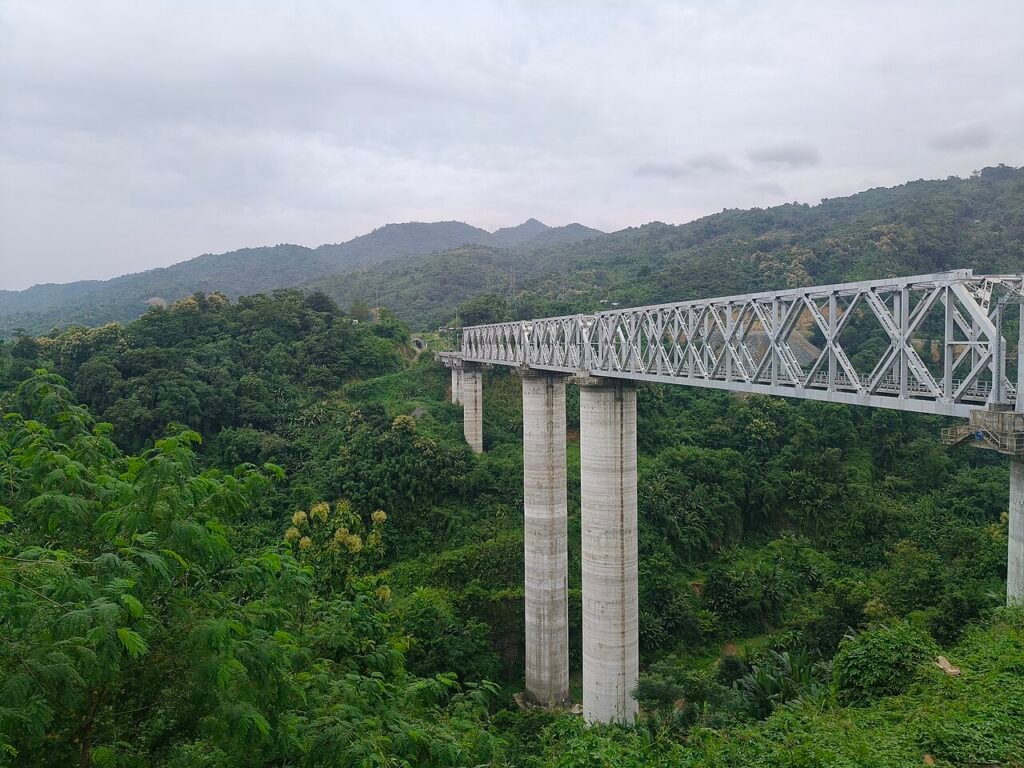
- Mizoram rail plan: The line is proposed from Sairang to Hmawngbuchhuah in Lawngtlai district, near the State’s southernmost end, over 230.11 km through six districts: Aizawl, Serchhip, Hnahthial, Lunglei, Lawngtlai and Siaha.
- Design features: 20 stations (including existing Sairang), design speed up to 130 km per hour, and 143 tunnels of about 135 km combined length.
- NH-15 notification: S.O. 5724(E), dated 21 October 2026 and issued under section 3A(1) of the National Highways Act, 1956, concerns the four-lane NH-15 stretch between Baihata Chariali and Mission Chariali in Darrang district (Design Chainage Km 10.400 to Km 71.900; the Mangaldoi Bypass is left out).
- Guwahati-Bangkok flight: IndiGo will fly twice a week (Wednesdays and Saturdays) under its regular schedule effective 31 October; 6E 1085 departs Guwahati at 6.15 pm and 6E 1086 leaves Bangkok at 8.50 am (local times).
- Airport network: With Bangkok, Lokapriya Gopinath Bardoloi International Airport (LGBIA) is linked to five international and 24 domestic destinations, and is managed by Adani Airport Holdings Limited.
Core Concepts & Static GK
- Bairabi-Sairang line (existing): A 51.38-km broad-gauge line that brought Mizoram’s capital region onto the national rail network; Prime Minister Narendra Modi inaugurated the line and Sairang station on 13 September 2025.
- Sairang-Hmawngbuchhuah history: An earlier 223-km version of this line was shelved as economically non-viable; railway officials later said it would be revived because it is strategically important for linking the Northeast with the Kaladan project under the Act East Policy.
- Kaladan Multi-Modal Transit Transport Project: Links Kolkata Port to Sittwe Port in Myanmar by sea, then runs along the Kaladan river from Sittwe to Paletwa, and by road from Paletwa to Zorinpui on the India-Myanmar border in Mizoram.
- Act East Policy: The successor to the Look East Policy, built on commerce, culture and connectivity; the Centre describes the Northeast as a vital gateway to Southeast Asia.
Constitutional & Legal Framework
- National Highways Act, 1956 (land acquisition): Section 3A allows the Central Government to notify its intention to acquire land needed for a national highway for a public purpose.
- Objections (section 3C): Any interested person may object to the Competent Authority within 21 days of publication in the Official Gazette; the Competent Authority’s order on objections is final.
- Later steps: After objections are decided, a declaration of acquisition follows (section 3D) and the Competent Authority fixes compensation (section 3G).
Institutional Machinery
- Competent Authority: For this NH-15 stretch the notification names ADC (Land Acquisition), Darrang as the Competent Authority to receive objections.
- Northeast Frontier Railway (NFR): Its officials briefed the Mizoram Chief Minister on the route and infrastructure; the Chief Administrative Officer of Indian Railways, Anjani Kumar Maurya, attended.
Reports, Indices & Data
- Prix Versailles: LGBIA’s bamboo-inspired Terminal 2 has been named in the Prix Versailles World’s Most Beautiful Airports List 2026.
Assam & Northeast Linkages
- Assam highway: The NH-15 stretch in Darrang district runs from Baihata Chariali to Mission Chariali; the Mangaldoi Bypass is excluded from this notification.
- Assam aviation: The Bangkok flight gives Northeast travellers another overseas link from Guwahati, with expected gains in tourism, trade and cultural exchange.
- Mizoram: The proposed corridor would carry rail from Sairang deep into Mizoram’s south, up to Lawngtlai district.
Prelims Trap Zones (Watch out for)
- Name Trap: The proposed extension ends at Hmawngbuchhuah (Lawngtlai district), not Sairang; Sairang is the existing terminus of the Bairabi-Sairang line.
- Number Trap: 230.11 km, 20 stations, 143 tunnels (about 135 km) and 130 km per hour are the figures printed; do not confuse them with the 51.38-km Bairabi-Sairang line or the earlier 223-km proposal.
- Section Trap: Section 3A is the intention to acquire; objections lie under section 3C within 21 days.
- Date Trap: The Guwahati-Bangkok service was launched with a special inaugural schedule on 27 October; regular twice-weekly operations are effective 31 October.
Introduction
Rail, road and air links are central to integrating the hilly Northeast with the rest of India and with Southeast Asia. Today’s three developments, a Mizoram rail extension plan, an Assam highway acquisition notice and a new Guwahati-Bangkok flight, show all three modes moving together under the Act East approach.
Importance / Economic Rationale
- Strategic reach: The Sairang-Hmawngbuchhuah line is meant to take rail to Mizoram’s far south and connect with the Kaladan project to Myanmar.
- Trade and tourism: The airport authorities expect the Bangkok flight to support tourism, trade and cultural exchanges.
- Gateway role: Airport authorities say the new link strengthens Guwahati’s position as the Northeast’s main air gateway.
Challenges / Operational Bottlenecks
- Terrain: Difficult hilly terrain requires 143 tunnels of about 135 km, which shows the engineering difficulty.
- Economic viability: The earlier version of the line was dropped as economically non-viable and revived on strategic grounds.
- Environmental opposition: The Aizawl-based Centre for Environment and Social Justice has opposed the extension, warning of damage to the fragile hilly ecology and to water sources.
- Land acquisition: Highway projects depend on a time-bound process of notice, objections and hearing before the land is acquired.
- Local identity: The Chief Minister urged that stations use the names of villages and localities as the local communities use them.
Government & Statutory Measures
| Mode | Initiative | Purpose & Impact |
|---|---|---|
| Rail | Proposed Sairang-Hmawngbuchhuah line (230.11 km) | Extend rail through six districts into southern Mizoram |
| Road | Four-laning of NH-15, Baihata Chariali to Mission Chariali, Darrang | Land acquisition process begun under the National Highways Act, 1956 |
| Air | IndiGo Guwahati-Bangkok service | Additional overseas link; LGBIA now has five international destinations |
Way Ahead
- Coordinate with Kaladan: Align the Mizoram rail plan with progress on the Kaladan project so the connectivity serves its strategic purpose.
- Fair acquisition: Hear objections on NH-15 land promptly and settle compensation transparently under the Act.
- Consult locals: Involve communities in naming stations and planning the alignment, as the Mizoram Chief Minister suggested.
- Build on the airport: Use the Bangkok link to promote Northeast tourism and trade.
Conclusion
Connectivity across rail, road and air is the base for the Northeast’s role as India’s gateway to Southeast Asia. Balancing terrain, environment and local concerns will decide how well these plans deliver.
News in Short
- GST changes from 1 November 2026: Under CBIC notifications dated 26 October, new rules on post-sale discounts and credit notes take effect on 1 November 2026. Businesses with an inverted duty structure can also claim 90 per cent provisional refunds upfront, subject to risk checks.
- Local FASTag pass: From 1 November 2026, residents within 20 km of a National Highway toll plaza can buy an annual concessional pass. It costs Rs 1,500 for plazas outside municipal or local town limits and Rs 3,000 for plazas within them, and is valid for that one plaza only.
- E100 flex-fuel vehicles: MoRTH has amended the Central Motor Vehicles Rules 1989 to allow flex-fuel vehicles that run on up to E100 (nearly pure ethanol). Petroleum Minister Hardeep Singh Puri said there is no immediate plan to raise ethanol blending beyond 20 per cent.
- Lakhpati Didi in Manipur: Manipur aims to have 1 lakh Lakhpati Didis by 2029, up from 26,000 now. A Lakhpati Didi is an SHG woman whose household earns Rs 1,00,000 or more a year, sustained for at least four agricultural seasons or business cycles. The initiative was launched in August 2023 under DAY-NRLM.
- SARAS Aajeevika Mela: The 18th edition (2026) of this 10-day fair opened at the City Convention Centre, Imphal. SARAS stands for Sale of Articles of Rural Artisans Society.
- Olive pilot in Karbi Anglong: KAAC’s Agriculture department and Assam Agricultural University have started a pilot with about 16,000 olive saplings brought from Rajasthan.
- Ship recycling and HKC: Cyprus backed India’s effort to get EU recognition for eligible Indian ship-recycling yards. South Korean shipping firm HMM discussed using Indian yards that comply with the Hong Kong Convention, and KOMERI explored ties with the proposed India Ship Technology Center.
APSC Prelims MCQs
Practice questions on the topics above
Topic 1: Defections, Resignations and Bypolls: Re-examining the Tenth Schedule
Q1. According to the ADR and National Election Watch report cited in the news, how many MPs and MLAs changed political parties between 2022 and 2026?
- (a) 11
- (b) 101
- (c) 111
- (d) 211
Show answer
Answer: (c) Explanation: The report, released in September 2026, counted 111 MPs and MLAs changing parties in 2022-2026, covering defections, mergers, resignations followed by bypoll wins and returns after disqualification. The other figures are near-miss distractors.
Q2. In Keisham Meghachandra Singh v. Speaker, Manipur Legislative Assembly (2020), the Supreme Court held that, absent exceptional circumstances, a Speaker should decide a disqualification petition within:
- (a) one month of filing
- (b) three months of filing
- (c) six months of filing
- (d) the remaining term of the House
Show answer
Answer: (b) Explanation: The Court set three months from filing as the outer limit. Six months is the Section 151A bypoll period, a different rule, and is the trap in (c).
Q3. Under Section 151A of the Representation of the People Act, 1951, a vacancy in a legislature must ordinarily be filled by a bye-election within:
- (a) one month of the vacancy
- (b) three months of the vacancy
- (c) six months of the vacancy
- (d) one year of the vacancy
Show answer
Answer: (c) Explanation: The section requires a bye-election within six months, except where the remainder of the term is less than one year or the ECI, in consultation with the Centre, certifies it is difficult. One year is the term-remainder threshold, not the filling period.
Q4. Consider the following statements regarding the Tenth Schedule:
1. The decision of the Speaker or Chairman on disqualification is open to judicial review.
2. The 91st Amendment Act, 2003 introduced the exemption allowing one-third of a legislature party to split away without disqualification.
Which of the statements given above is/are correct?
- (a) 1 only
- (b) 2 only
- (c) Both 1 and 2
- (d) Neither 1 nor 2
Show answer
Answer: (a) Explanation: Statement 1 is correct: Kihoto Hollohan (1992) held Paragraph 7 invalid and made such decisions subject to judicial review. Statement 2 is wrong: the 91st Amendment removed the split exemption; it did not introduce it.
Topic 2: Siang Upper Multipurpose Project: Local Protests, PFR Stage and Dams in the Eastern Himalaya
Q5. In the news, the East Siang Downstream Dam Affected People’s Forum, which met an Arunachal Pradesh minister on 27 October, represents communities spanning how many villages?
- (a) 52
- (b) 62
- (c) 72
- (d) 82
Show answer
Answer: (c) Explanation: The forum, led by president Oni Tamuk, represents communities spanning 72 villages that could be affected by the Siang Upper Multipurpose Project. The other figures are distractors.
Q6. The high-level committee approved by the Arunachal Pradesh Cabinet in September to oversee PFR survey activities in Siang and Upper Siang districts is chaired by:
- (a) Chief Minister Pema Khandu
- (b) Ojing Tasing
- (c) Nabam Vivek
- (d) Oni Tamuk
Show answer
Answer: (b) Explanation: Ojing Tasing, the Rural Development and Panchayati Raj Minister, chairs it. Nabam Vivek is the PPA president and Oni Tamuk the forum president.
Q7. Which of the following hydropower projects in Arunachal Pradesh, mentioned in the news, is being built by NHPC and described as India’s largest and tallest, with a 278 m dam?
- (a) Kamala Hydroelectric Project
- (b) Kalai-II Hydroelectric Project
- (c) Dibang Multipurpose Project
- (d) Siang Upper Multipurpose Project
Show answer
Answer: (c) Explanation: Dibang is 2,880 MW with a dam about 278 m high. Kamala (1,720 MW) and Kalai-II (1,200 MW) are other recently approved projects, and SUMP (11,200 MW) is only at the PFR stage.
Q8. Consider the following statements regarding the environmental clearance process under the EIA Notification, 2006:
1. It includes the stages of screening, scoping, public consultation and appraisal.
2. The public hearing is conducted by the State Pollution Control Board at or near the project site.
3. A Pre-Feasibility Report by itself amounts to environmental clearance.
Which of the statements given above is/are correct?
- (a) 1 only
- (b) 1 and 2 only
- (c) 2 and 3 only
- (d) 1, 2 and 3
Show answer
Answer: (b) Explanation: Statements 1 and 2 are correct. Statement 3 is wrong because a PFR is only the first technical study and does not approve a dam; environmental clearance comes much later, after the EIA study and public hearing.
Topic 3: Disaster Risk Reduction: Very Severe Cyclone Arnab and India’s UNDRR Message
Q9. The very severe cyclonic storm Arnab, which was expected to make landfall near Visakhapatnam on 28 October 2026, was named by which country on the WMO/ESCAP Panel list for the North Indian Ocean?
- (a) India
- (b) Bangladesh
- (c) Oman
- (d) Myanmar
Show answer
Answer: (b) Explanation: Arnab is Bangladesh’s name, first in column 3 of the panel list; India’s name that follows it is Murasu.
Q10. The disaster risk reduction meeting at which PK Mishra spoke in New Delhi on 27 October 2026 was convened by the UNDRR and co-chaired by India and which other country?
- (a) Japan
- (b) Australia
- (c) The United Kingdom
- (d) The United States
Show answer
Answer: (c) Explanation: The meeting was co-chaired by India and the United Kingdom. Japan is a tempting option because the Sendai Framework was adopted in Sendai, Japan, but it was not a co-chair.
Q11. Which one of the following is NOT one of the four priorities for action of the Sendai Framework for Disaster Risk Reduction 2015-2030?
- (a) Understanding disaster risk
- (b) Strengthening disaster risk governance to manage disaster risk
- (c) Creating a global disaster insurance pool
- (d) Investing in disaster risk reduction for resilience
Show answer
Answer: (c) Explanation: The four priorities are understanding risk, strengthening governance, investing in resilience and enhancing preparedness for effective response. A global insurance pool is not one of them.
Q12. Which one of the following bodies was given statutory status by the Disaster Management (Amendment) Act, 2025?
- (a) National Crisis Management Committee
- (b) National Executive Committee
- (c) National Disaster Response Force
- (d) State Executive Committee
Show answer
Answer: (a) Explanation: The amendment gave statutory status to the NCMC (chaired by the Cabinet Secretary) and the High Level Committee. The NDRF and the National and State Executive Committees already existed under the 2005 Act; the amendment shifted plan preparation from the Executive Committees to NDMA and SDMAs.
Topic 4: Northeast Connectivity: Mizoram’s Sairang-Hmawngbuchhuah Rail Plan, NH-15 Four-Laning and Guwahati-Bangkok Flight
Q13. The proposed railway extension from Sairang is planned to end at Hmawngbuchhuah. In which district of Mizoram is Hmawngbuchhuah located?
- (a) Siaha
- (b) Lunglei
- (c) Lawngtlai
- (d) Serchhip
Show answer
Answer: (c) Explanation: The paper places Hmawngbuchhuah in Lawngtlai district, near the State’s southernmost end. Siaha, Lunglei and Serchhip are other districts on the proposed route but not the terminus.
Q14. Which of the following manages Lokapriya Gopinath Bardoloi International Airport, Guwahati, which IndiGo now links with Bangkok?
- (a) Airports Authority of India
- (b) Adani Airport Holdings Limited
- (c) NHIDCL
- (d) Northeast Frontier Railway
Show answer
Answer: (b) Explanation: The airport authorities state that LGBIA is managed by Adani Airport Holdings Limited. NHIDCL is a highway-building agency and NFR is a railway zone, so (c) and (d) are distractors; the Airports Authority of India is not the body named as the airport’s manager.
Q15. Under the National Highways Act, 1956, after a section 3A notification, an interested person may object to the use of the land within how many days, and to whom?
- (a) 15 days, to the Central Government
- (b) 21 days, to the Competent Authority
- (c) 30 days, to the High Court
- (d) 60 days, to the District Collector
Show answer
Answer: (b) Explanation: The notification states that objections go to the Competent Authority within twenty-one days of publication in the Official Gazette, and the Competent Authority’s order is final. The other options give wrong periods or wrong authorities.
Q16. Consider the following statements regarding rail and transport links in the Northeast:
1. The Bairabi-Sairang line in Mizoram is 51.38 km long.
2. The proposed Sairang-Hmawngbuchhuah line is to be built with a design speed of 130 km per hour.
3. The Kaladan project links Kolkata Port with Sittwe Port in Myanmar before continuing by river and road.
Which of the statements given above is/are correct?
- (a) 1 only
- (b) 1 and 2 only
- (c) 2 and 3 only
- (d) 1, 2 and 3
Show answer
Answer: (d) Explanation: Statement 1 is correct: the line is 51.38 km. Statement 2 is correct: the proposed line is designed for speeds up to 130 km per hour. Statement 3 is correct: the Kaladan route goes from Kolkata to Sittwe by sea, then by the Kaladan river to Paletwa and by road to Zorinpui on the Mizoram border.
Mains Answer Writing
One exam-style question with a model answer
Q. The Supreme Court has recently sought responses from the Centre and the Election Commission on legislators resigning soon after election, changing party allegiance and returning through bypolls. In this context, critically examine the adequacy of the Tenth Schedule in checking political defections, and suggest reforms that protect voters’ mandate without curbing legitimate dissent. (250 words, 15 marks)
Model answer
Introduction: The 52nd Amendment (1985) added the Tenth Schedule to disqualify defectors. Resigning, switching sides and winning the bypoll now tests its reach.
1. Where the Tenth Schedule works
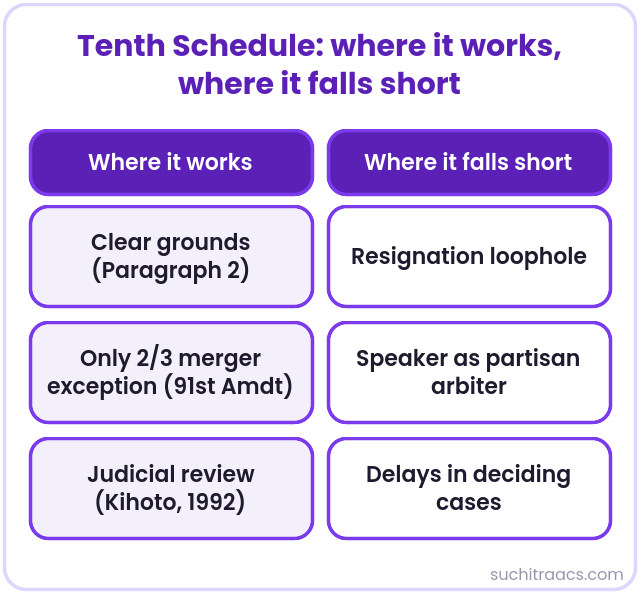
- Clear grounds: Paragraph 2 covers voluntarily giving up membership, voting or abstaining against the party’s direction, and an independent joining a party.
- Tighter exceptions: The 91st Amendment (2003) removed the split exception, leaving only a two-thirds merger. It also barred disqualified defectors from becoming ministers until their term ends or they are re-elected (Articles 75(1B), 164(1B)).
- Judicial check: In Kihoto Hollohan (1992), the Court struck down paragraph 7 and held that the Speaker’s rulings are open to judicial review.
2. Where it falls short
- Resignation loophole: Members quit before proceedings end and re-contest on another ticket. ADR counted 111 MPs and MLAs switching parties in 2022-2026.
- Partisan arbiter: The Speaker decides (paragraph 6), and is often seen as biased.
- Delay: Keisham Meghachandra Singh (2020) set three months, barring exceptional circumstances, and asked Parliament to consider a permanent tribunal.
3. Way Forward
- Independent adjudicator: An outside body that decides within fixed timelines, subject to judicial review.
- Targeted consequences: A time-bound, statutory bar on contesting the bypoll or holding office for those who resign to defeat pending proceedings.
- Protect dissent: Leave members free to resign on genuine grounds.
- Party accountability: Hold accountable the parties that engineer or reward defections.
Conclusion: The Tenth Schedule has curbed open defection but not planned evasion through resignation. Reform should close that gap and still leave room for dissent based on conscience.
Prepare with SuchitraACS
APSC CCE Foundation Programme₹24,999  APSC Prelims Crash Course 2027 (GS + CSAT)₹5,999
 APSC CCE Study Materials Package (Prelims + Mains)₹4,999