
APSC CCE Mains PYQ Solved | APSC CCE 2023 Model Answer
Preparing for the APSC CCE Mains Examination requires much more than just reading books and making notes. One of the most effective ways to understand the actual demand of the examination is by practicing and analyzing Previous Year Questions (PYQs).
To help aspirants prepare in a smarter and more strategic way, SuchitraACS brings you APSC CCE Mains PYQs with Detailed Model Answers. These answers are written in a structured, exam-oriented, and high-scoring format based on the latest APSC trend.
APSC Mains GS Paper 1: 2023: With the dangers of global climate change becoming a reality, it is now time to replace the discourse of economic growth with that of conservation of nature. Do you agree? Give reasons for your answer. (10 marks, 150 Words)
Model Answer:
The IPCC AR6 Report explicitly warns of irreversible climate tipping points, yet completely replacing the discourse of economic growth with conservation is a flawed, zero-sum approach; rather, they must be harmonized through Sustainable Development to ensure intergenerational equity.
1. The Need to Shift Away from Purely GDP-Centric Economic Growth
The traditional “growth at all costs” model is ecologically bankrupt and necessitates a strong focus on conservation:
- Market Failure and Ecological Deficit: Traditional GDP calculation treats environmental degradation as income generation. According to the World Bank, environmental damage costs India roughly 5.7% of its GDP annually.
- Climate Change Vulnerability: Unregulated industrialization exacerbates extreme weather. (e.g., Assam’s Brahmaputra Valley faces intensified, unpredictable annual floods and rapid riverbank erosion due to upstream deforestation and climate anomalies).
- Loss of Ecosystem Services: Over-exploitation compromises vital, unpaid ecosystem services (water regulation, carbon sequestration). The destruction of urban wetlands for real estate directly leads to urban flooding.
2. Why Completely “Replacing” Growth with Conservation is Impractical (The Indian Context)
While conservation is critical, abandoning economic growth is disastrous for a developing nation:
- Poverty Alleviation: As highlighted by Indira Gandhi at the 1972 Stockholm Conference, poverty itself degrades the environment. With millions still in multidimensional poverty (UNDP MPI), economic growth is the only vehicle to ensure food, health, and housing security.
- Financing the Green Transition: Conservation and climate mitigation require massive capital. Economic growth provides the fiscal space to fund mega-initiatives like the National Green Hydrogen Mission and India Semiconductor Mission.
- Technology and Capacity Building: A stagnant economy cannot innovate. High-tech interventions like the Cold Mix Asphalt technology for rural roads or advanced early warning systems for floods require robust economic backing.
- Social Justice vs. Elitist Conservation: Extreme conservation often displaces marginalized communities. (e.g., Restricting indigenous access to forest resources under strict wildlife conservation laws jeopardizes tribal livelihoods).
3. The Synthesis: Paradigm Shift Towards “Green Growth”
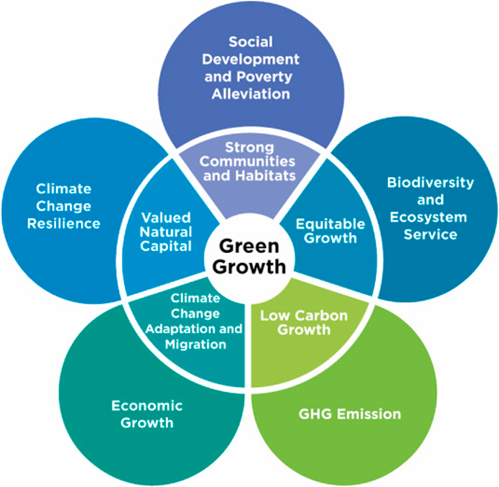
The discourse must pivot from replacement to synergy—decoupling economic growth from greenhouse gas (GHG) emissions.
- Green GDP & Natural Capital Accounting: National accounting must reflect the depletion of natural resources, shifting the focus to the quality, not just the quantity, of growth.
- Circular Economy: Transitioning from the linear “take-make-dispose” model to resource efficiency and Extended Producer Responsibility (EPR).
- Targeted Eco-Infrastructure: Integrating traditional ecological knowledge with modern development. (e.g., Promoting eco-tourism in Assam’s Majuli Island and Dehing Patkai, ensuring local revenue generation while protecting biodiversity).
- Energy Transition: Empowering the poor through sustainable means, such as the PM Ujjwala Yojana, which protects both human health and forest cover by replacing firewood with clean energy.
We must fulfill our Fundamental Duty [Article 51A(g)] to protect the natural environment without compromising the socioeconomic aspirations of our masses. Harmonizing SDG 8 (Decent Economic Growth) with SDG 13 (Climate Action) is the only pragmatic roadmap for realizing an inclusive, resilient Viksit Bharat 2047.
✨ Looking for top-quality APSC Mains Guidance with Personalised Mentor?
🔔 Join Our WhatsApp Study Group!
For exclusive access to premium quality content, including study materials, current affairs, MCQs, and model answers for APSC CCE and other Assam competitive exams.
Click here to join: SuchitraACS Study WhatsApp Group
📚 Want to know more about SuchitraACS’s most affordable courses?
Click here to know more: SuchitraACS Courses for APSC CCE and Assam Competitive Examinations


