
APSC CCE Mains PYQ Solved | APSC CCE 2023 Model Answer
Preparing for the APSC CCE Mains Examination requires much more than just reading books and making notes. One of the most effective ways to understand the actual demand of the examination is by practicing and analyzing Previous Year Questions (PYQs).
To help aspirants prepare in a smarter and more strategic way, SuchitraACS brings you APSC CCE Mains PYQs with Detailed Model Answers. These answers are written in a structured, exam-oriented, and high-scoring format based on the latest APSC trend.
APSC Mains GS Paper 1: 2023: Give an idea of the distribution and ecological characteristics of the tropical rain forest and explain the causes of its rapid degradation. (10 marks, 150 Words)
Model Answer:
According to the FAO Global Forest Resources Assessment, tropical rainforests are the most biologically diverse terrestrial biomes, harboring over 50% of global flora and fauna despite covering only about 6% of the Earth’s surface. Often termed the “lungs of the planet,” they play a critical role in global carbon sequestration and climate regulation.
1. Distribution of Tropical Rainforests They are primarily concentrated in the equatorial belt between 10° North and 10° South latitudes.
- Neotropical Realm (South & Central America): The Amazon Basin accounts for over half of the Earth’s remaining rainforests.
- Afrotropical Realm (Africa): The Congo Basin and Madagascar.
- Indo-Malayan Realm (Asia & Australasia): Southeast Asia (Indonesia, Malaysia, Philippines) and Northern Australia.
- Indian Context: Found in the Western Ghats, Andaman & Nicobar Islands, and the North-Eastern region.
- Assam-Specific Context: Upper Assam is home to the Dehing Patkai National Park, often referred to as the “Amazon of the East,” representing a contiguous patch of lowland tropical wet evergreen forest.
2. Ecological Characteristics
- Climatic Parameters: Characterized by uniform megathermal conditions (average temperature 25°C-28°C) and heavy, year-round precipitation (often exceeding 200-250 cm annually) with high humidity.
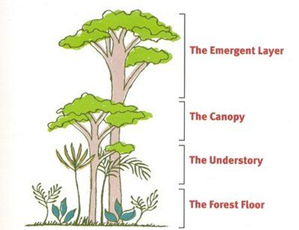
- Vertical Stratification: Vegetation is highly structured into distinct layers:
- Emergent Layer: Giant trees reaching 40-60 meters.
- Canopy Layer: Dense roof absorbing 90% of sunlight.
- Understory & Forest Floor: Adapted to low light, rich in ferns, mosses, and fungi.
- High Biodiversity and Endemism: Extremely rich species composition with complex symbiotic relationships (e.g., epiphytes, lianas, and specialized pollinators).
- Paradoxical Soil (Oxisols/Latosols): The soil is highly leached, acidic, and nutrient-poor. Nutrients are primarily locked in the living biomass, and rapid decomposition by fungi immediately recycles fallen organic matter.
3. Causes of Rapid Degradation As per Global Forest Watch, the tropics lost over 4.1 million hectares of primary forest in recent years due to anthropogenic pressures:
- Agricultural Expansion: The leading cause of deforestation.
- Global Example: Cattle ranching and soy cultivation in the Amazon.
- Assam/NE Context: Unsustainable cycles of Jhum (shifting) cultivation and encroachment by tea estates into forest fringes.
- Commercial Plantations: Replacement of highly diverse primary forests with monoculture cash crops, notably Palm Oil in Southeast Asia (Indonesia/Malaysia) and rubber plantations.
- Extractive Industries (Mining & Logging): Selective logging for valuable tropical timber degrades the canopy.
- Assam Example: Open-cast and illegal rat-hole coal mining in the Makum coalfields adjacent to the Dehing Patkai elephant reserve poses a severe threat.
- Infrastructure Development: Linear intrusions like highways, railways, and mega-hydroelectric dams fragment habitats, creating edge effects and blocking wildlife corridors.
- Climate Change & Forest Fires: Altered precipitation patterns (e.g., El Niño-induced droughts) have increased the frequency and intensity of catastrophic forest fires, turning net carbon sinks into carbon emitters.
Halting the degradation of tropical rainforests is a non-negotiable imperative to achieve SDG 13 (Climate Action) and SDG 15 (Life on Land). Integrating indigenous conservation wisdom (like Assam’s sacred groves) with stringent enforcement of the Forest (Conservation) Amendment Act, promotes ecological security vital for a sustainable and resilient Viksit Bharat 2047.
✨ Looking for top-quality APSC Mains Guidance with Personalised Mentor?

🔔 Join Our WhatsApp Study Group!
For exclusive access to premium quality content, including study materials, current affairs, MCQs, and model answers for APSC CCE and other Assam competitive exams.
Click here to join: SuchitraACS Study WhatsApp Group
📚 Want to know more about SuchitraACS’s most affordable courses?
Click here to know more: SuchitraACS Courses for APSC CCE and Assam Competitive Examinations


