APSC CCE Mains PYQ 2020, Essay Paper: Knowledge is its own reward
Many aspirants treat the APSC Essay paper as a game of luck, hoping for a “common” topic to appear. But a deep dive into the archives tells a different story. From the philosophical depth of the 2020 papers to the tech-heavy debates of 2024, the Essay paper isn’t a test of your memory—it’s a test of your perspective. In this post, we’re moving beyond just listing old questions. We are deconstructing the recurring themes, the “Assam-specific” weightage, and how you can use the past to predict your future success in the Mains
Here is a structured, detailed look at how to approach this topic.
APSC Mains Essay Paper, 2020: Knowledge is its own reward
Model Answer:
The pursuit of understanding has long been categorized by the external benefits it provides—wealth, status, or the ability to manipulate the world to our advantage. However, a deeper philosophical tradition suggests that the true value of learning is not found in the “dividends” it pays in the marketplace, but in the internal transformation it brings to the seeker. The statement that knowledge is its own reward posits that the act of knowing is an end in itself, a source of intrinsic satisfaction that requires no further justification. In an era obsessed with “utility” and “monetization,” this philosophy invites us to reclaim the “joy of discovery” and the “peace of clarity.” To analyze why the intellect finds its greatest fulfillment in itself, we must examine the concept of intellectual curiosity, the liberation from fear, and the ethical “Dharma” of lifelong learning.
Historically, the greatest scholars and sages were driven by a “thirst” that gold could not quench. In the ancient intellectual landscape of India, and specifically within the “Gurukul” tradition that once flourished across the sub continent, knowledge was termed “Vidya”—something that illuminates the inner self. For the great polymaths of Assam, such as the linguists and chroniclers of the Ahom courts, the meticulous recording of history and the study of languages were acts of “cultural preservation” that provided a deep sense of purpose. They did not seek “royal titles” as their primary goal; the “perfection of the record” was the reward. This historical foundation teaches us that while “Artha” (wealth) is a necessity of life, “Gyan” (knowledge) is the luxury of the soul.
Psychologically, the human brain is a “pattern seeking machine” that experiences a profound neurochemical reward when it masters a new concept. The “Aha!” moment—that sudden flash of clarity when a complex problem is solved—is one of the most intense forms of human pleasure. This is the “intrinsic motivation” that keeps a scientist in a lab late at night or a student buried in a difficult textbook. When knowledge is pursued for an external reward, like a grade or a salary, the “joy of learning” often diminishes. However, when the pursuit is “self directed,” the brain enters a state of “flow” where the effort itself becomes the satisfaction. In this state, the “improvements of tomorrow” are not just material but “cognitive,” as the mind becomes more agile, resilient, and expanded.
The socio economic dimension of this topic focuses on the “Human Capital” versus “Human Spirit” debate. Modern education often treats knowledge as a “tool for the economy,” aligning with the Sustainable Development Goal of “Decent Work and Economic Growth” (SDG 8). While this is a realistic necessity, we must not lose sight of “Quality Education” (SDG 4) as a means of personal enrichment. A society that views knowledge only as a “product” risks producing “skilled laborers” who lack “intellectual depth.” When knowledge is viewed as its own reward, it creates a citizenry that is “informed and critical,” capable of navigating the complexities of democracy and social change with “wisdom” rather than just “data.” It is the transition from “earning a living” to “learning a life.”
If we look through a psychological lens, knowledge acts as the ultimate “antidote to fear.” Much of human anxiety is rooted in the “unknown.” Prejudice, as we have previously explored, is the child of ignorance. When we acquire knowledge about the “other,” about the “cosmos,” or about the “workings of our own psyche,” the world becomes a less threatening place. This “liberation from fear” is a reward that no amount of material wealth can buy. It provides a “mental sanctuary” that remains unshakable even during times of external crisis. For an aspirant facing the uncertainties of a competitive career, the “internal library” of knowledge they build is their greatest source of confidence. Even if the external “result” is delayed, the “growth of the intellect” is a permanent victory.
Furthermore, the “Dharma” of knowledge involves the “ethics of curiosity.” It is the responsibility to remain a “student of the universe” throughout one’s life. In our local culture, the reverence for the “Guru” and the “Shastra” was based on the belief that knowledge is “sacred.” This sacredness implies that knowledge should not be “debased” by being used solely for selfish gain. The “blessed and virtuous” seeker is one who shares knowledge freely, realizing that it is a “lamp” that does not lose its light by lighting another. This “multiplier effect” of knowledge is its own reward; by teaching others, we deepen our own understanding and contribute to the “collective enlightenment” of society.
From an administrative and governance perspective, the “knowledge as reward” philosophy is essential for “integrity.” A civil servant who is motivated by the “knowledge of the law” and the “understanding of the people” will always act with greater “fairness” than one motivated by “promotion or power.” When the “mastery of the subject” is the goal, the “quality of service” naturally improves. In Assam, as we move toward a “Viksit State,” we need professionals who are “passionate about their craft.” Whether it is an engineer building a bridge or a teacher in a primary school, the “reward” of knowing they have done their job with “intellectual excellence” is the most sustainable form of motivation.
Ethically, this philosophy addresses the “vanity of the modern age.” We are often told that we are “what we have” or “what we achieve.” The “knowledge as reward” theme tells us that we are “what we know” and “how we think.” It promotes a “minimalist” approach to status and a “maximalist” approach to understanding. It encourages us to seek “depth over surface” and “truth over trends.” In the realm of personal growth, this means valuing the “process of the struggle” to understand a difficult philosophy or a complex scientific theory. The “mental muscle” built during that struggle is the “intrinsic prize.”
The “inter paragraph linkage” of our intellectual journey suggests that “Gyan” is the final destination of all human effort. While we must work to afford the “improvements of tomorrow,” those improvements are ultimately meant to give us the “leisure to learn.” If we reach the peak of economic success but remain “intellectually hollow,” our journey is incomplete. We must balance our “material aspirations” with our “intellectual hunger.” As we move toward a “Viksit Bharat,” our progress must be “knowledge led,” where every citizen is empowered to seek the “truth” for its own sake.
In conclusion, knowledge is indeed its own reward because it provides the “only true freedom”—the freedom of the mind. It is a “treasure” that cannot be stolen, a “friend” that never leaves, and a “light” that never fades. While the world may or may not reward our “intellect” with fame or fortune, the “universe” rewards it with “wonder and meaning.” The “act of knowing” is the highest function of the human spirit, and in that act, we find the “peace and purpose” we seek.
As we look toward the horizon of an increasingly “automated and algorithmic” future, the “human capacity for deep knowledge” will be our most precious asset. We must cherish the “thirst for understanding” as a “sacred fire.” We must realize that every book read, every skill mastered, and every truth uncovered is a “blessing” in itself. In the spirit of our immortal heritage, which teaches us that “knowledge is power” but “wisdom is peace,” let us act with the “Gyan” that our greatest wealth is stored within our minds. Let our journey toward the future be “blessed and virtuous,” guided by the “reverence for learning” and the “joy of the intellect.” Only when we realize that the “search is the find” will we truly be wealthy in the ways that matter most. Let our “intellectual adventure” continue, for in the vast ocean of the cosmos, the “drop of knowledge” we carry is our only true compass.
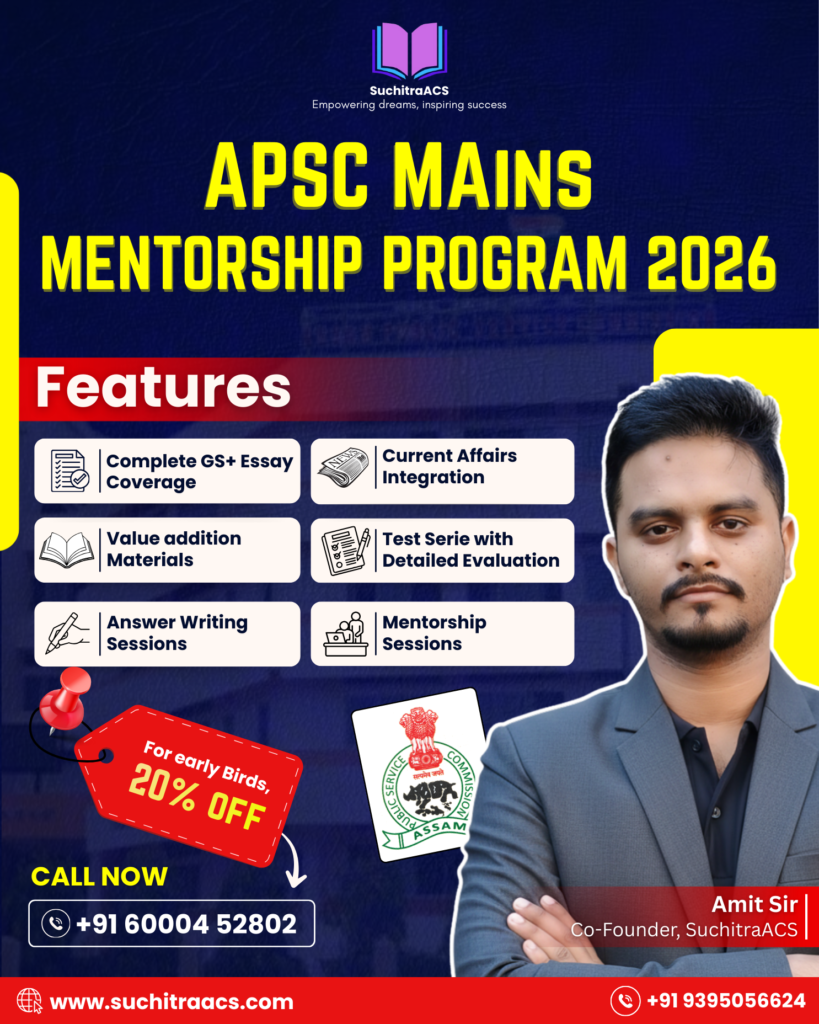
✨ Looking for top-quality APSC Mains Guidance with Personalised Mentor?
🔔 Join Our WhatsApp Study Group!
For exclusive access to premium quality content, including study materials, current affairs, MCQs, and model answers for APSC CCE and other Assam competitive exams.
Click here to join: SuchitraACS Study WhatsApp Group
📚 Want to know more about SuchitraACS’s most affordable courses?
Click here to know more: SuchitraACS Courses for APSC CCE and Assam Competitive Examinations