ICJ Rohingya genocide ruling on Myanmar: APSC Current Affairs Notes and MCQs
APSC CCE current affairs notes on ICJ Rohingya genocide ruling on Myanmar, from The Assam Tribune of 20 November 2026, with 4 practice MCQs for Prelims.
 For working professionals and full-time aspirantsAPSC CCE Foundation Programme₹24,999
Current Affairs Notes
From The Assam Tribune, 20 November 2026
ICJ Genocide Ruling on Myanmar and the Rohingya
Syllabus Mapping
- Prelims: GS Paper I (Current events of national and international importance; International Relations and associated current affairs).
- Mains: GS Paper II (International relations: India and its neighbourhood, international institutions and agreements); GS Paper V (Assam syllabus: International Relations, Security and borders as they affect Assam and the Northeast).
Why in News? On Thursday, 19 November 2026, the International Court of Justice (ICJ) at The Hague gave its ruling. It held by 9 votes to 6 that Myanmar is responsible for genocide against the Rohingya. The acts took place during its 2017 military operation in northern Rakhine state. The court ordered Myanmar to let the Rohingya return safely, to punish those responsible and to pay compensation.
Current Context (The Trigger)
- The verdict: By a 9-6 majority, the ICJ held that Myanmar “has committed genocide against the Rohingya group in northern Rakhine state”. It found this to be a breach of Myanmar’s duties under the Genocide Convention.
- Who read it: ICJ President Yuji Iwasawa read out the judgment of the 15-judge bench. The reading in the Great Hall of Justice lasted nearly three hours.
- What the court found: The court found that thousands of Rohingya civilians were killed by Myanmar’s security forces. It also found widespread sexual violence, extreme violence against children and attacks on people trying to flee. According to the paper, the court said the evidence showed that about 10,000 Rohingya were killed.
- Orders to Myanmar: Myanmar must allow the Rohingya a “safe, voluntary and dignified return” to the places where they lived. It must also investigate, prosecute and punish the people who carried out genocidal acts.
- Compensation: Myanmar has to pay compensation to the Rohingya. The court will fix the amount at a later stage of the case.
- A first, stated precisely: This is the first time the ICJ has held a state itself responsible for committing genocide. In Bosnia and Herzegovina v. Serbia and Montenegro (2007), the court found that genocide took place at Srebrenica. But it held Serbia responsible only for failing to prevent and punish it, not for committing it.
- The applicant: The Gambia, a Muslim-majority African country, brought the case under the 1948 Genocide Convention. The ICJ records the filing date as 11 November 2019.
Core Concepts & Static GK
- What genocide means: Article II of the Genocide Convention defines genocide as certain acts. They must be done with intent to destroy, in whole or in part, a national, ethnical, racial or religious group, as such. The key test is this intent, not the number of dead.
- Five listed acts: The acts are killing members of the group and causing them serious bodily or mental harm. They also include inflicting conditions of life meant to destroy the group, imposing measures to prevent births, and forcibly transferring children to another group.
- Punishable acts: Article III makes five things punishable. These are genocide, conspiracy to commit it, direct and public incitement, attempt, and complicity.
- Duty to prevent and punish: Under Article I, states confirm that genocide is a crime under international law in peace and in war. They undertake to prevent it and to punish it.
- Who can be punished: Article IV applies to rulers, public officials and private individuals alike. Article VI says accused persons are tried by a court of the state where the act took place. They can also be tried by an international penal tribunal whose jurisdiction the parties have accepted.
- Adoption and force: The UN General Assembly adopted the Convention on 9 December 1948 through resolution 260 (III). It came into force on 12 January 1951.
- The ICJ route: Article IX sends disputes between parties about the Convention to the ICJ at the request of any party. This includes disputes on a state’s responsibility for genocide.
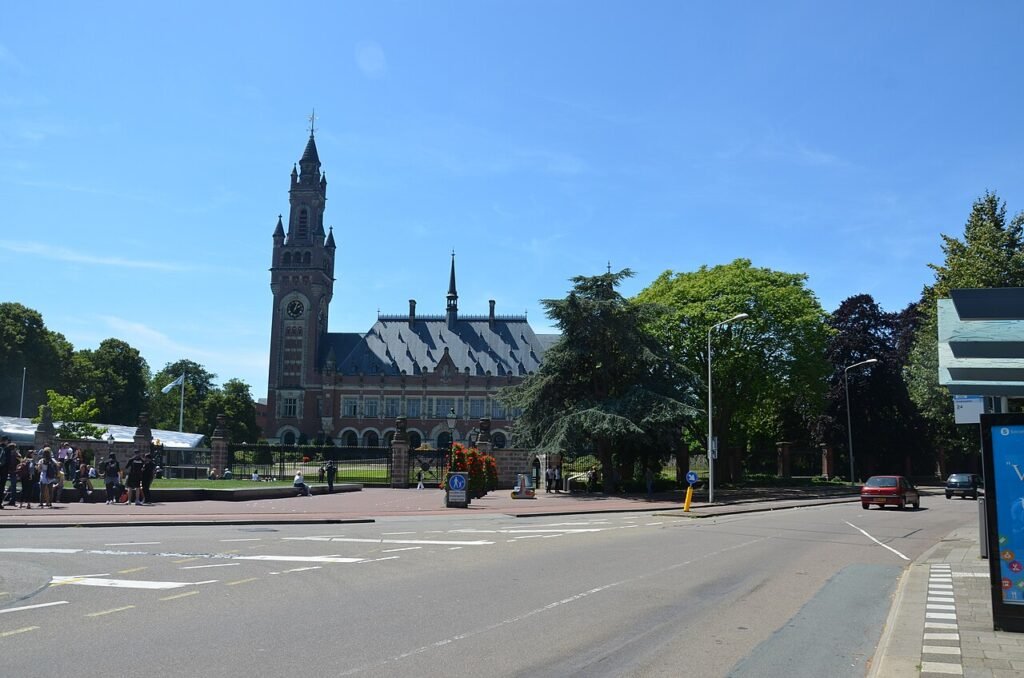
- About the ICJ: The ICJ is the principal judicial organ of the United Nations. It was set up by the UN Charter in June 1945 and began work in April 1946. It sits in the Peace Palace at The Hague and is the only principal UN organ not located in New York.
Constitutional & Legal Framework
- Only states can be parties: Article 34 of the ICJ Statute says only states may be parties in cases before the Court. That is why The Gambia, a state, sued Myanmar and no individual stood trial.
- Binding but limited: Article 59 says a decision binds only the parties and only in that case. Article 60 says the judgment is final and without appeal.
- Compliance under the UN Charter: Article 94(1) of the UN Charter obliges every member to comply with the ICJ’s decision. This applies in any case to which it is a party.
- Enforcement route: Under Article 94(2), the other party can go to the Security Council if a state does not comply. The Council may make recommendations or decide on measures.
- Weak enforcement record: On 31 July 1986, a Security Council draft calling for compliance with the Nicaragua judgment got eleven votes. It still failed because a permanent member, the United States, voted against it.
- Ad hoc judges: Article 31 lets a party with no judge of its nationality on the bench choose a judge for that case.
Institutional Machinery
- Composition of the ICJ: The Court has 15 judges, and no two may be nationals of the same state.
- Election: The UN General Assembly and the Security Council vote separately for each seat. A candidate needs a majority in both bodies.
- Term: Judges serve nine-year terms and can be re-elected. One-third of the Court is elected every three years.
- Presidency: The judges elect a President and a Vice-President by secret ballot for three-year terms. Yuji Iwasawa presided as President on 19 November 2026.
- Two functions: The Court settles legal disputes between states, called contentious cases. It also gives advisory opinions on legal questions sent by authorised UN organs and agencies.
- Seat: Article 22 of the Statute fixes the seat at The Hague, though the Court may sit elsewhere.
Reports, Indices & Data
- The 2017 exodus: The UN Fact-Finding Mission on Myanmar reported that “clearance operations” followed attacks by the Arakan Rohingya Salvation Army (ARSA) on 25 August 2017. Nearly 725,000 Rohingya had fled to Bangladesh by mid-August 2018.
- Deaths and destruction: The same Mission called an estimate of up to 10,000 deaths “conservative”. It found that at least 392 villages in northern Rakhine were partly or fully destroyed.
- Camps in Bangladesh: The UN refugee agency (UNHCR) says close to one million Rohingya refugees live in 33 crowded camps in Cox’s Bazar district.
- UN fact-finding mission on genocide: The Mission gave its report to the Human Rights Council session of September 2018. It found acts that fell under four of the five genocidal acts. It said there was enough information to investigate and prosecute senior Myanmar army officers for genocide.
Assam & Northeast Linkages
- Border states: India’s border with Myanmar is 1,643 km long. It runs through Arunachal Pradesh (520 km), Nagaland (215 km), Manipur (398 km) and Mizoram (510 km). Assam does not touch this border.
- Who guards it: The Assam Rifles guards the India-Myanmar border, according to the Home Ministry’s Annual Report 2019-20.
- Free Movement Regime: Under the Free Movement Regime (FMR), hill tribe members living within 16 km on either side of the border could cross. They needed a border pass. The pass was valid for one year, and each visit could last up to two weeks.
- FMR suspended: On 8 February 2024, Union Home Minister Amit Shah said the Home Ministry had recommended the immediate suspension of the FMR. He cited internal security and the demographic structure of the border states.
- Fencing plan: On 6 February 2024, Mr Shah announced that the entire 1,643-km Myanmar border would be fenced. A 10 km stretch at Moreh in Manipur had already been fenced by then.
Prelims Trap Zones (Watch out for)
- ICJ versus ICC: The ICJ decides disputes between states, and only states can be parties. The International Criminal Court tries individuals, so the ICJ ruling does not by itself jail any Myanmar officer.
- Who filed the case: The Gambia filed it on 11 November 2019. It was not Bangladesh and not the Rohingya themselves.
- Dates: The Gambia filed in 2019, and the ICJ ordered provisional measures on 23 January 2020. The genocide ruling came on 19 November 2026. Do not mix the three.
- Vote count: The merits ruling was 9-6 on a 15-judge bench. Each of the four provisional measures of 2020 was adopted unanimously.
- “First” trap: Bosnia v. Serbia (2007) also involved genocide, but Serbia was held liable only for failing to prevent and punish it. The 2026 Myanmar ruling is the first in which the ICJ held a state responsible for committing genocide.
- Treaty dates: The Convention was adopted on 9 December 1948 but came into force on 12 January 1951. India ratified it on 27 August 1959, and Myanmar on 14 March 1956.
- India and refugees: India is not a party to the 1951 Refugee Convention or its 1967 Protocol. The point came up in the Supreme Court’s Rohingya case.
- Binding effect: The judgment binds only Myanmar and The Gambia, and it cannot be appealed. Enforcement depends on the Security Council under Article 94(2) of the UN Charter.
Introduction
On 19 November 2026, the ICJ ruled by 9 votes to 6 that Myanmar is responsible for genocide against the Rohingya in 2017. It is the first time the ICJ has held a state itself responsible for committing genocide. The ruling matters for India because Myanmar is a neighbour, Rohingya live in India, and four Northeast states border Myanmar.
Legal Significance of the Ruling
- State responsibility: The judgment places responsibility on the state of Myanmar, not on named individuals. Article IX of the Convention allows the ICJ to rule on a state’s responsibility for genocide.
- Intent test met: Myanmar argued that the 2017 campaign was a lawful counter-insurgency operation, and the court did not accept this. So a security reason cannot cancel a finding of intent to destroy a group.
- Remedies ordered: The court ordered investigation, prosecution and punishment of those responsible. It also ordered return of refugees and compensation, so the remedies go beyond a mere declaration.
- Standing of a third state: The Gambia is not a victim state, yet the case reached a merits judgment. In its judgment of 22 July 2022, the ICJ held that it had jurisdiction under Article IX and that the application was admissible.
- Earlier signal: On 23 January 2020, the Court ordered provisional measures to protect the Rohingya in Myanmar. Each of the four measures was adopted unanimously.
- Wider docket: The paper notes that the court also has genocide cases connected with the war in Gaza and the war in Ukraine. This ruling is likely to be cited in those cases.
- Link to the earlier UN finding: In 2018 the UN Fact-Finding Mission said senior Myanmar army officers should be investigated and prosecuted for genocide. The court has now made a binding legal finding on the same events.
Humanitarian and Accountability Dimension
- Scale of displacement: Nearly 725,000 Rohingya had fled to Bangladesh by mid-August 2018, according to the UN Fact-Finding Mission. Bangladesh has carried this burden for years.
- Protracted camp life: UNHCR says close to one million Rohingya refugees live in 33 crowded camps in Cox’s Bazar district.
- Right of return: The court demanded a “safe, voluntary and dignified return”. Return needs real safety on the ground, and the court has now made it a legal order.
- Victim voices: Rohingya rights activist Yasmin Ullah called it “a great day for the Rohingya” and for oppressed people everywhere. Such a ruling gives survivors public recognition of their suffering.
- Compensation pending: The court will decide the amount of compensation later. The wait before any payment will again test the patience of refugees.
- Sexual violence and children: The court found widespread sexual violence and extreme violence against children. These findings matter for later reparations and protection programmes.
India’s Position and Concerns
- Treaty obligations: India signed the Genocide Convention on 29 November 1949 and ratified it on 27 August 1959. It is therefore bound by the duty in Article I to prevent and punish genocide.
- Reservation on the ICJ clause: India has a reservation to Article IX. A dispute involving India can go to the ICJ under the Convention only with the consent of all parties to it.
- Refugee law gap: India is not a party to the 1951 Refugee Convention or its 1967 Protocol. So Rohingya in India have no formal refugee status.
- Supreme Court’s stand: On 8 April 2021, in Mohammad Salimullah v. Union of India, the Supreme Court declined to free Rohingya held in a Jammu holding centre. It said they should not be deported unless the prescribed procedure is followed.
- Government’s numbers and argument: The Home Ministry has estimated that around 40,000 Rohingya live in India as undocumented persons. In court, the Union argued that non-refoulement (no forced return to danger) binds only states party to the Refugee Convention.
- Neighbourhood balance: India has to work with Myanmar on border security and connectivity, while Bangladesh hosts the Rohingya. The ruling may push India to speak more clearly on safe return.
- Moral standing: On the same day, the leaders of the US, China and Russia also backed UN reform, which India has long demanded. India’s voice on international law will count for more if it backs the ruling’s call for accountability.
Northeast Border Angle
- Long open border: The 1,643-km India-Myanmar border touches Arunachal Pradesh, Nagaland, Manipur and Mizoram. Any new displacement in Myanmar can spill over into these states.
- End of the FMR: The Home Ministry recommended suspending the Free Movement Regime on 8 February 2024. It cited internal security and the demographic structure of the border states.
- Fencing on the ground: In February 2024, the Home Ministry said 10 km at Moreh in Manipur was already fenced. Two 1-km pilot projects with a hybrid surveillance system were under way in Arunachal Pradesh and Manipur.
- Mizoram’s objection: In January 2024, Mizoram Chief Minister Lalduhoma told the Centre that fencing the border was “unacceptable”. He said the border divides the Mizo people.
- Assembly resolutions: The Mizoram Assembly passed a resolution against fencing on 28 February 2024. The Nagaland Assembly followed on 1 March 2024 and also opposed ending the FMR.
- Assam’s concern: Assam does not border Myanmar, but any refugee flow into the region feeds its long debate on detecting and deporting foreigners.
Challenges
- Weak enforcement: The ICJ has no police of its own. Under Article 94(2) it depends on the Security Council, where a permanent member can block action, as the United States did over Nicaragua in 1986.
- Myanmar’s compliance: Myanmar told the court the campaign was a lawful operation against insurgents, and the judges rejected this. A state that denies the finding is unlikely to comply quickly.
- Binding only on parties: Article 59 of the ICJ Statute limits the decision to The Gambia and Myanmar. Other states have no direct duty under the judgment, though the Convention binds them to prevent genocide.
- Safe return is hard: Close to one million Rohingya remain in camps in Cox’s Bazar. They cannot return home safely until conditions in Rakhine improve.
- Split bench: The 9-6 vote shows that judges differed. A narrow majority gives critics room to question the reasoning.
- India’s dilemma: India is not a party to the Refugee Convention, and the Union argues that non-refoulement binds only parties to it. This leaves the legal status of Rohingya in India unsettled.
- Border security pressure: The plan to fence all 1,643 km faces resistance. The Mizoram and Nagaland Assemblies have both passed resolutions against it.
Way Ahead
- Back safe return: India should support a verified, voluntary return process for the Rohingya through the UN and regional forums. The court itself demanded a “safe, voluntary and dignified return”.
- Use Security Council channels: India has long pushed for UN reform. It can press for a working enforcement route under Article 94(2) of the UN Charter.
- Clear refugee framework: The Home Ministry could frame a written national policy on asylum seekers. The Supreme Court has already said deportation needs due procedure.
- Humanitarian help to Bangladesh: India can support Bangladesh, which hosts the camps in Cox’s Bazar, with relief and health assistance. This would ease pressure on the region’s borders.
- Balanced border management: The Centre should consult border communities before fencing. The Mizoram and Nagaland Assemblies have already objected.
- Back accountability: India can encourage investigation and prosecution of the guilty, as the court ordered. This keeps its position in line with Article I of the Convention.
Conclusion
The ICJ has turned years of UN reports and charges into a binding legal finding. The real test is whether Myanmar complies and whether the Security Council acts if it does not. For India and the Northeast, the best path is to back safe return and accountability while keeping the border secure and humane.
APSC Prelims MCQs
Practice questions on this topic
Q1. The International Court of Justice (ICJ) recently ruled on a genocide case concerning Myanmar. Consider the following statements:
(i) The case was filed by The Gambia in 2019.
(ii) The ruling that Myanmar committed genocide was by a 9-6 decision.
(iii) The ICJ can try individual military officers for genocide.
Which of the statements given above is/are correct?
- (a) (i) only
- (b) (i) and (ii) only
- (c) (ii) and (iii) only
- (d) (i), (ii) and (iii)
Show answer
Answer: (b) Explanation: Statement (i) is correct. The Gambia instituted the case on 11 November 2019 under the Genocide Convention. Statement (ii) is correct. On 19 November 2026 the court found by 9 votes to 6 that Myanmar committed genocide. Statement (iii) is wrong. Under Article 34 of the ICJ Statute only states can be parties, so the court decides state responsibility and does not try individuals. Option (a) misses statement (ii), while options (c) and (d) wrongly include statement (iii). Value addition: Under Article VI of the Convention, individuals are tried by a court of the state where the act happened or by an international penal tribunal.
Q2. Match List-I with List-II (Articles of the Genocide Convention, 1948):
| List-I (Article) | List-II (Subject) |
|---|---|
| a. Article II | 1. Disputes go to the ICJ |
| b. Article VI | 2. Punishable acts such as conspiracy and incitement |
| c. Article IX | 3. Definition of genocide |
| d. Article III | 4. Trial by the territorial state’s court or an international penal tribunal |
Select the correct answer using the codes given below:
- (a) a-3, b-4, c-2, d-1
- (b) a-4, b-3, c-1, d-2
- (c) a-3, b-1, c-4, d-2
- (d) a-3, b-4, c-1, d-2
Show answer
Answer: (d) Explanation: Article II defines genocide as acts committed with intent to destroy a national, ethnical, racial or religious group, so a matches 3. Article VI says accused persons are tried by a competent court of the territorial state or an international penal tribunal, so b matches 4. Article IX sends disputes between parties to the ICJ, so c matches 1. Article III lists punishable acts such as conspiracy and incitement, so d matches 2. Option (a) swaps c and d, option (b) swaps a and b, and option (c) swaps b and c. Value addition: The Convention came into force on 12 January 1951.
Q3. Which of the following statements about the International Court of Justice is NOT correct?
- (a) Individuals can be parties in cases before the Court.
- (b) The seat of the Court is at The Hague.
- (c) Its judgment is final and without appeal.
- (d) A party with no judge of its nationality may choose a judge for the case.
Show answer
Answer: (a) Explanation: Option (a) is the incorrect statement. Article 34 of the ICJ Statute says only states may be parties in cases before the Court. That is why The Gambia, a state, filed the Myanmar case. Option (b) is correct because Article 22 fixes the seat at The Hague. Option (c) is correct because Article 60 says the judgment is final and without appeal. Option (d) is correct because Article 31 allows a judge ad hoc when a party has no judge of its nationality on the bench. Value addition: Article 59 says the decision binds only the parties and only in that particular case.
Q4. India ratified the Convention on the Prevention and Punishment of the Crime of Genocide in which year?
- (a) 1951
- (b) 1956
- (c) 1959
- (d) 1978
Show answer
Answer: (c) Explanation: India ratified the Genocide Convention on 27 August 1959, according to the UN Treaty Collection. Option (a), 1951, is the year the Convention entered into force, on 12 January, not the year of India’s ratification. Option (b), 1956, is the year Myanmar ratified it, on 14 March. Option (d), 1978, is the year The Gambia acceded, on 29 December. All three wrong options are real dates linked to the Convention, which is why they work as traps. Value addition: India signed the Convention on 29 November 1949. It has a reservation to Article IX. That article needs the consent of all parties before a dispute goes to the ICJ.
Prepare with SuchitraACS
APSC CCE Foundation Programme₹24,999  APSC Prelims Crash Course 2027 (GS + CSAT)₹5,999
 APSC Prelims PYQ Book 2020-2025 (PDF)₹199See the book