Yarn winding machine for Assam handloom: APSC Current Affairs Notes and MCQs
APSC CCE current affairs notes on Yarn winding machine for Assam handloom, from The Assam Tribune of 12 November 2026, with 4 practice MCQs for Prelims.
 For working professionals and full-time aspirantsAPSC CCE Foundation Programme₹24,999
Current Affairs Notes
From The Assam Tribune, 12 November 2026
Four-in-One Yarn Winding Machine for Handloom Weavers
Syllabus Mapping
- Prelims: GS Paper I (Current events of State/National importance; General issues on science and technology in everyday life; Economic and Social Development).
- Mains: GS Paper III (Indian Economy: inclusive growth, employment, science and technology applications); GS Paper V (Assam: handloom and handicraft economy, rural livelihoods).
Why in News? The Rural Technology Action Group (RuTAG) at the Indian Institute of Technology (IIT) Guwahati has developed a four-in-one yarn winding machine for handloom weavers. It has been field tested in Assam and Meghalaya, and the report is datelined Guwahati, 11 November.
Current Context (The Trigger)
- New machine: RuTAG IIT Guwahati has built a four-in-one yarn winding machine to ease the tiring preparatory steps of handloom weaving.
- Four operations in one unit: The machine does hank-to-bobbin winding, bobbin-to-pirn winding, doubling and cone-to-bobbin winding.
- Field trials: The machine was tested at several weaving locations in Assam and Meghalaya. Weavers who took part gave feedback on its convenience and efficiency.
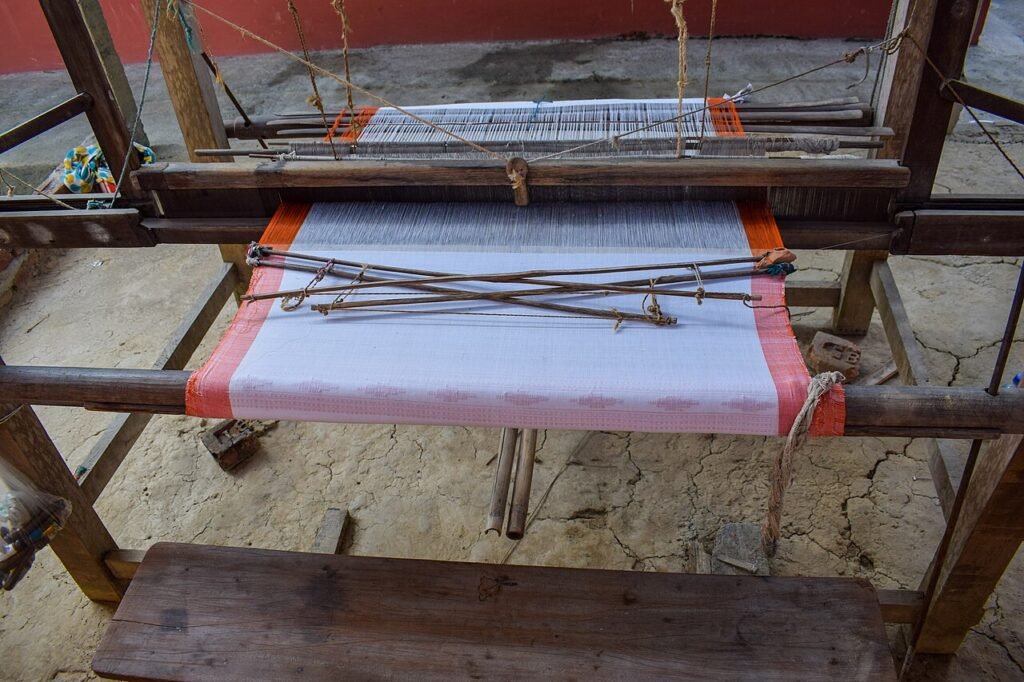
- Old method: Most weaving households still wind yarn by hand, often on a manually operated charkha. Depending on working conditions, hand methods may handle only about 1-2 kg of yarn a day.
- Next step: Commercialisation of the machine is in process. Weavers can contact RuTAG for procurement and demonstration.
Core Concepts & Static GK
- Yarn winding: It is a preparatory step in which yarn is moved from hanks, cones or other packages onto bobbins and pirns. This lets the yarn feed smoothly during weaving.
- Doubling: Two or more ends of yarn are wound together onto one package. Where needed, this yarn then goes for twisting.
- Cone-to-bobbin winding: Yarn is shifted from a large cone onto smaller bobbins suited to the next operation. The team kept this option because market yarn now comes in cone or reel form too.
- Rural Technology Action Group (RuTAG): It is an initiative of the Office of the Principal Scientific Adviser (PSA) to the Government of India, running since 2004. It offers demand-driven science and technology support to rural areas.
- RuTAG objectives: It aims to develop technologies from socio-economic data, validate prototypes and commercialise them. It works with stakeholders such as non-governmental organisations, self-help groups, startups and incubators.
Constitutional & Legal Framework
- Handlooms Act, 1985: The Handlooms (Reservation of Articles for Production) Act, 1985 is Act No. 22 of 1985. It lets the Centre reserve articles for production on handlooms only.
- Reserved articles: The Act reserves 11 specified textile articles for handloom production.
- Enforcement: Government agencies inspect powerloom units to stop them from making items reserved for handlooms.
- Geographical Indications Act, 1999: It protects registered geographical indications from unauthorised use. Registered users may approach the police against illegal manufacture or marketing.
Institutional Machinery
- RuTAG 1.0: Launched in 2004, it set up centres at seven IITs between 2004 and 2013. IIT Madras came first in 2004, IIT Guwahati followed in 2005 and IIT Kanpur was last in 2013.
- RuTAG 2.0: It was launched in April 2023. Seven Project Implementing Agencies run it, and IIT Guwahati is one of them.
- Programme head: Dr Rakesh Kaur, Adviser/Scientist ‘G’, is the RuTAG Programme Head and Coordinator.
- Scheme delivery: Under the National Handloom Development Programme, implementing agencies include weavers’ cooperative societies, federations, Handloom Producer Companies and participating banks.
Schemes & Initiatives
- National Handloom Development Programme (NHDP): It was formulated for 2021-22 to 2025-26 and takes a need-based approach to handloom development. It continues in 2026-27 with a budget allocation of Rs 205 crore.
- Small Cluster Development Programme: It funds small handloom clusters with up to Rs 2 crore. The help covers better looms, lighting, worksheds, design, product development and marketing.
- Raw Material Supply Scheme: It reimburses freight on all types of yarn. It also gives a 15% price subsidy on specified yarns, within quantity limits.
- Handloom Weaver MUDRA scheme: It offers handloom loans at a concessional 6% interest for three years. Government interest subvention of up to 7% supports it.
- Handloom Mark: It was launched in 2006 to give handwoven goods a collective identity and assure buyers that the product is handwoven.
Reports, Indices & Data
- Fourth All India Handloom Census, 2019-20: It recorded about 31.45 lakh handloom households. It counted 35.22 lakh weavers and allied workers.
- Allied workers: Of the workers counted, 8.48 lakh were allied workers doing pre-loom and post-loom jobs such as winding, warping, dyeing and calendaring.
- Women in the workforce: Women number 25.46 lakh, which is more than 72% of all workers in weaving and allied work.
- Looms: The census recorded 28.20 lakh looms. Of these, 25.30 lakh were in rural areas and 2.90 lakh in urban areas.
- Census history: India has held four handloom censuses, in 1987-88, 1995-96, 2009-10 and 2019-20.
Assam & Northeast Linkages
- Largest weaver base: The 2019-20 census table shows Assam with 11,07,428 handloom weavers, the highest among all States and Union Territories. West Bengal is next with 3,66,656.
- Allied workers in Assam: Assam also has 1,76,453 allied workers. These people do pre-loom and post-loom jobs such as winding, warping and dyeing.
- Meghalaya: The census table lists 41,221 handloom weavers in Meghalaya, the second State where the machine was tested.
- Other Northeast States: Manipur has 2,12,481 handloom weavers and Tripura has 1,11,927, as per the same census table.
- IIT Guwahati centre: The RuTAG centre at IIT Guwahati dates from 2005, the second of the seven RuTAG 1.0 centres.
Prelims Trap Zones (Watch out for)
- Agency Trap: RuTAG belongs to the Office of the Principal Scientific Adviser, not the Ministry of Textiles. IIT Guwahati is only one of its implementing agencies.
- Operation Trap: The four functions are hank-to-bobbin, bobbin-to-pirn, doubling and cone-to-bobbin winding. Spinning and dyeing are not among them.
- Status Trap: The machine has been field tested, and its commercialisation is still in process. It is not yet on the market.
- Location Trap: Trials were held in Assam and Meghalaya. Other north-eastern States are not named in the report.
- Number Trap: The Act reserves 11 articles for handlooms. The 1-2 kg a day figure refers to manual winding, not to the new machine.
Introduction
A report datelined Guwahati, 11 November says RuTAG IIT Guwahati has developed one machine that does four yarn winding jobs. Weavers in Assam and Meghalaya have already tried it. Assam has the most handloom weavers of any State, 11,07,428 in the 2019-20 census. So a small gain in the preparatory stage matters to many homes. The test is whether such a tool can cut drudgery without changing the craft itself.
Why Yarn Preparation Needs Attention
- Essential first step: Winding moves yarn onto bobbins and pirns so that it handles smoothly in the loom. Good winding leads to better fabric.
- Slow output: Hand methods may process only about 1-2 kg of yarn a day, depending on working conditions. A weaver who spends hours winding has less time to weave.
- Health strain: Winding by hand is repetitive work done for long hours in poor postures. This has raised worries about weavers’ health.
- Hidden workforce: Winding is an allied activity. The census counted 8.48 lakh allied workers, and Assam alone has 1,76,453 of them.
- Women carry the load: More than 72% of the handloom workforce is women. Any drudgery in preparation falls mostly on them.
What the Four-in-One Machine Offers
- One unit, four jobs: A weaver need not own separate equipment for each winding step. The same machine can do hank, pirn, doubling and cone winding work.
- Built from experience: RuTAG earlier made a hank-to-bobbin machine and a pirn winding machine. The team found the two jobs are not needed at the same time, so one machine could do both.
- Fits market yarn: Yarn is now sold on cones and reels. The cone or reel provision keeps the machine useful for what weavers actually buy.
- Better posture: According to Prof Sashindra K Kakoty, the machine reduces body pain because awkward postures are not needed.
- Craft stays intact: The machine only speeds up yarn preparation. The weaving itself stays traditional, as Prof Kakoty explained.
- Wider use: The team says power loom users can also use it to cut preprocessing time.
Handloom Sector: Scale and Support
- Large livelihood base: The 2019-20 census counted 35.22 lakh handloom weavers and allied workers across India.
- Rural and women-led: Nearly nine out of ten handlooms are in rural India, and women are over 72% of workers.
- Assam leads: Assam has 11,07,428 weavers, ahead of West Bengal at 3,66,656.
- Productivity schemes work: Under the Small Cluster Development Programme, workshed beneficiaries saw average daily earnings rise from Rs 328 to Rs 465.
- Technology raises income: Electronic jacquard users reported average monthly income rising from Rs 9,600 to Rs 15,000.
- Market protection: The Handlooms Act reserves 11 articles for handlooms, and the Handloom Mark had 29,402 registrations by 30 June 2026.
Government Support Available to Weavers
- Cluster help: Small clusters can get up to Rs 2 crore for looms, worksheds and marketing. From 2021-22 to June 2026, 357 clusters were sanctioned.
- Mega clusters: A mega handloom cluster can receive central help of up to Rs 30 crore over five years.
- Credit: Weaver MUDRA loans carry a concessional 6% interest. More than 40,000 loans worth about Rs 280 crore were sanctioned from 2021-22 to June 2026.
- Insurance: Pradhan Mantri Jeevan Jyoti Bima Yojana gives Rs 2 lakh on death from any cause. Pradhan Mantri Suraksha Bima Yojana gives Rs 2 lakh for accidental death or permanent total disability.
- Yarn support: The Raw Material Supply Scheme gives a 15% subsidy on specified yarns.
- Recognition: The Sant Kabir Handloom Award carries Rs 3.5 lakh and the National Handloom Award carries Rs 2 lakh.
Challenges
- Not yet commercial: The machine is still being commercialised, so most weavers cannot buy it today.
- Cost and access: Many weaving households work on small incomes. The report gives no price, so affordability is unknown.
- Small field sample: Trials covered several locations in two States. Wider testing across other weaving areas is still needed.
- Shared tool problem: Allied workers, who do jobs like winding, were 8.48 lakh in the census. A machine owned by one household may not reach them unless sharing is organised.
- Other bottlenecks remain: Winding is only one preparatory step. Warping, dyeing and marketing still need support.
- Competition from powerlooms: The Handlooms Act reserves only 11 articles, and agencies must keep inspecting powerloom units to enforce it.
Way Ahead
- Fast commercial launch: RuTAG and its manufacturing partner should set a clear price and delivery timeline, as commercialisation is already in process.
- Link with cluster schemes: The Ministry of Textiles can allow such machines as an eligible item. This can be done under Small Cluster Development Programme support for looms and accessories.
- Shared winding centres: Weavers’ cooperatives and Handloom Producer Companies can buy one machine per cluster and run it as a common facility.
- Training with demonstration: RuTAG already offers demonstration to weavers, and the Assam government’s handloom department can add hands-on training at cluster level.
- Women-focused rollout: Distribution should reach women winders and allied workers first, since they are the majority of the workforce.
- Feedback loop: Further trials in more Assam districts and in Meghalaya should feed design changes before large-scale production.
Conclusion
The four-in-one winding machine tackles a small but real pain point in a sector where Assam has more weavers than any other State. Its value will be judged by price, reach to women winders and whether it is bought through cluster schemes, not by the prototype alone.
APSC Prelims MCQs
Practice questions on this topic
Q1. RuTAG at IIT Guwahati has developed a yarn winding machine for handloom weavers. Consider the following statements:
(i) The machine combines four winding functions in a single unit.
(ii) It has been field tested with weavers in Assam and Meghalaya.
(iii) It is designed only for power loom users and cannot be used by handloom weavers.
Which of the statements given above is/are correct?
- (a) (i) and (ii) only
- (b) (ii) and (iii) only
- (c) (i) only
- (d) (i), (ii) and (iii)
Show answer
Answer: (a) Explanation: Statement (i) is correct because RuTAG IIT Guwahati joined hank-to-bobbin winding, bobbin-to-pirn winding, doubling and cone-to-bobbin winding in one unit. Statement (ii) is correct because the trials were held at several weaving locations in Assam and Meghalaya. Statement (iii) is wrong. The machine is targeted at handloom users, and the coordinator only added that power loom users can also use it to cut preprocessing time. So options (b) and (d), which include (iii), are wrong, and option (c) leaves out the correct statement (ii). Value addition: Hand winding on a charkha may process only about 1-2 kg of yarn a day, which is the problem the machine addresses.
Q2. The Rural Technology Action Group (RuTAG) was in the news. Consider the following statements:
(i) It is an initiative of the Union Ministry of Textiles.
(ii) RuTAG 2.0 was launched in April 2023.
(iii) IIT Guwahati is one of the seven Project Implementing Agencies of RuTAG 2.0.
Which of the statements given above is/are correct?
- (a) (i) and (iii) only
- (b) (ii) and (iii) only
- (c) (i) and (ii) only
- (d) (i), (ii) and (iii)
Show answer
Answer: (b) Explanation: Statement (ii) is correct, since RuTAG 2.0 was launched in April 2023. Statement (iii) is correct, since seven agencies implement RuTAG 2.0 and IIT Guwahati is among them. The others are IIT Bombay, IIT Delhi, IIT Madras, IIT Roorkee, ICAR-NAARM Hyderabad and Sher-e-Kashmir University of Agricultural Sciences and Technology. Statement (i) is wrong. RuTAG is an initiative of the Office of the Principal Scientific Adviser to the Government of India, not the Ministry of Textiles. Options (a), (c) and (d) all include (i), so they are wrong. Value addition: RuTAG has run since 2004. RuTAG 1.0 set up centres at seven IITs between 2004 and 2013, with IIT Guwahati joining in 2005.
Q3. Match List-I with List-II:
| List-I (Handloom measure) | List-II (Feature) |
|---|---|
| a. Handloom Mark scheme | 1. Observed on 7 August |
| b. India Handloom Brand | 2. Launched in 2006 |
| c. Handlooms Act, 1985 | 3. Reserves 11 specified textile articles |
| d. National Handloom Day | 4. Launched on the first National Handloom Day in 2015 |
Select the correct answer using the codes given below:
- (a) a-1, b-2, c-3, d-4
- (b) a-2, b-3, c-4, d-1
- (c) a-2, b-4, c-3, d-1
- (d) a-4, b-2, c-1, d-3
Show answer
Answer: (c) Explanation: The Handloom Mark scheme was launched in 2006 to assure buyers that a product is handwoven, so a matches 2. The India Handloom Brand was launched on the first National Handloom Day on 7 August 2015, so b matches 4. The Handlooms Act, 1985 reserves 11 specified textile articles for handlooms, so c matches 3. National Handloom Day is observed on 7 August, so d matches 1. Option (a) gives the brand the year 2006. Option (b) gives the brand the Act’s 11 articles. Option (d) gives the Act the 7 August date. Value addition: National Handloom Day commemorates the Swadeshi Movement launched in 1905.
Q4. As per the Fourth All India Handloom Census 2019-20, which State has the largest number of handloom weavers?
- (a) West Bengal
- (b) Manipur
- (c) Tamil Nadu
- (d) Assam
Show answer
Answer: (d) Explanation: Assam is correct. The census table lists 11,07,428 handloom weavers in Assam, far ahead of every other State. West Bengal is second with 3,66,656 weavers, so option (a) is wrong. Manipur has 2,12,481 and Tamil Nadu has 1,97,818, so options (b) and (c) are also wrong, even though both have strong weaving traditions. Value addition: Assam also has 1,76,453 allied workers, and the whole country had 26,73,891 weavers and 8,48,621 allied workers in the census.
Prepare with SuchitraACS
APSC CCE Foundation Programme₹24,999  APSC Prelims Crash Course 2027 (GS + CSAT)₹5,999
 APSC CCE Study Materials Package (Prelims + Mains)₹4,999