
APSC Answer Writing (Daily) based on Assam Tribune – 29/10/2026
For APSC CCE and other Assam Competitive examinations aspirants, practicing Daily Answer Writing is vital. This blog covers the most important Main question and its model Answer from the Assam Tribune today (29-10-2026).
 Last batch for APSC CCE 2027 · starts 16 NovAPSC CCE Foundation Programme₹24,999
Mains Answer Writing
From The Assam Tribune, 29 October 2026
Q. ‘Culture survives when people have secure homes, dignified livelihoods and confidence in the future.’ In the light of this statement, discuss how river erosion, youth migration and the economic vulnerability of artisans threaten Assam’s cultural identity, and suggest a policy roadmap to turn heritage into a source of livelihood. (250 words, 15 marks)
Model answer
Introduction: Assamese identity is rooted in mati, which shelters ancestral homes, nurtures satras and namghars and gives Bihu its rhythm. When land, youth and craft are lost together, the culture loses the base on which it lives.
1. River erosion: loss of the geography of belonging
- Memory lost: families lose the bheti (ancestral homestead); a house can be rebuilt, the memory of a place cannot.
- Double loss: the river takes the village, and the search for work then dissolves the community that gave it meaning.
- Language: Assamese lives in the namghar, courtyard, market, field and handloom, so when these spaces break up the language weakens.
2. Youth migration: a second displacement
- Structural drain: an economy that keeps exporting its most ambitious people loses entrepreneurship, institutional capacity and cultural continuity.
- Silent erosion: children raised outside drift from family stories, while ageing parents stay behind.
3. Economic vulnerability of artisans
- Husori: once a community practice, it increasingly appears in large commercial spectacles while practitioners gain little.
- Handloom: weavers face cheap imitations and weak market access, even as mekhela chador and the gamosa are celebrated.
4. Policy roadmap: heritage as livelihood
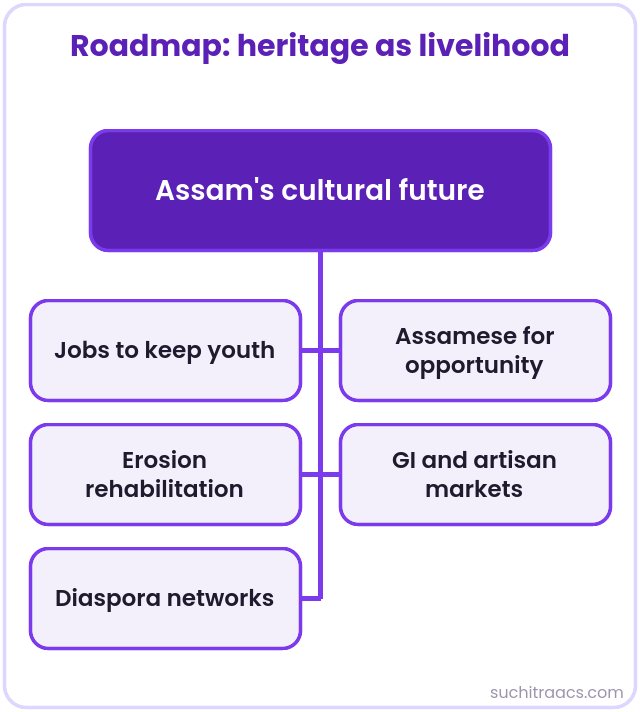
- Stay-reasons for youth: build industries in technology, research, sports, tourism, agribusiness, renewable energy and creative enterprise.
- Language of opportunity: keep Assamese useful in education, jobs, media, technology and commerce.
- Erosion as planned challenge: long-term planning, climate-proof farming, flood-adaptive housing, lasting resettlement and secure land for the displaced.
- Artisan economy: stronger GI protection, consumer awareness, branding, digital commerce, cooperative ownership and direct global market access.
- Diaspora: professional networks, investment platforms, research links and incentives for returning talent.
Conclusion: Economic policy and cultural policy cannot be kept apart. If artisans become entrepreneurs and villages resilient, heritage can become a foundation of modernity rather than a memory of loss.
Prepare with SuchitraACS
APSC CCE Foundation Programme₹24,999  APSC Mains Mentorship Programme (MMP)₹9,999
 APSC Prelims Crash Course 2027 (GS + CSAT)₹5,999



