APSC CCE Mains PYQ 2020, Essay Paper: A good life is one inspired by love and guided by knowledge
Many aspirants treat the APSC Essay paper as a game of luck, hoping for a “common” topic to appear. But a deep dive into the archives tells a different story. From the philosophical depth of the 2020 papers to the tech-heavy debates of 2024, the Essay paper isn’t a test of your memory—it’s a test of your perspective. In this post, we’re moving beyond just listing old questions. We are deconstructing the recurring themes, the “Assam-specific” weightage, and how you can use the past to predict your future success in the Mains
Here is a structured, detailed look at how to approach this topic.
APSC Mains Essay Paper, 2020: A good life is one inspired by love and guided by knowledge
Model Answer:
The quest for a meaningful existence has been the central theme of human philosophy since the dawn of consciousness. While many have sought the “good life” in the accumulation of wealth, power, or fame, the philosopher Bertrand Russell distilled the essence of a worthy life into two vital components: love and knowledge. He posited that a good life is one inspired by love and guided by knowledge. This duality suggests that while love provides the “motive” or the energy for living, knowledge provides the “direction” and the tools to make that love effective. In the context of our evolving modern world and the cultural heritage of Assam, this philosophy serves as a blueprint for personal fulfillment and social harmony. To understand this dynamic, we must analyze the interplay between empathy and intellect, the role of education in refining our emotions, and the ethical “Dharma” of a life lived for others.
Historically, the most revered figures in human history have been those who embodied this perfect harmony. In our own land, the life of Srimanta Sankardeva is a testament to this principle. His “inspiration” was a profound, universal love for all living beings, reflecting the “Ekasarana” philosophy. However, he did not rely on emotion alone; he “guided” that love through a vast body of knowledge, encompassing literature, music, drama, and social organization. He realized that to truly uplift the people of the Brahmaputra valley, love needed the structure of art and the clarity of spiritual knowledge. This historical example teaches us that love without knowledge is often “impotent,” while knowledge without love is “inhumane.”
Psychologically, love is the “emotional engine” of the human spirit. It is the force that breaks the walls of the “ego” and connects the individual to the “collective.” Whether it is the love for one’s family, one’s community, or humanity at large, this inspiration provides the resilience to face life’s hardships. However, love in its raw form can sometimes be “blind” or misguided. This is where the “guidance of knowledge” becomes essential. Knowledge allows us to understand the “consequences” of our actions. For instance, the love a parent has for a child is an inspiration, but the knowledge of how to nurture that child’s physical and mental health is what turns that love into a “good life” for the offspring. Knowledge acts as the “rudder” that prevents the “ship of love” from crashing into the rocks of ignorance or fanaticism.
If we look through a sectoral lens, particularly in the realm of social service and public policy, this philosophy is the bedrock of “effective altruism.” Many people are inspired by a love for the marginalized and a desire to eradicate poverty, which aligns with the Sustainable Development Goal of “No Poverty” (SDG 1). Yet, this love remains a mere sentiment if it is not guided by the “knowledge of economics,” “social dynamics,” and “administrative efficiency.” A doctor in a rural hospital in Assam is inspired by the love for their patients, but it is their “medical knowledge” that saves lives. This synergy ensures that our good intentions lead to “real world improvements.” It is the transition from “sympathy” to “service through skill.”
The socio-economic dimension of this topic focuses on the “Human Capital” of a nation. A society that prioritizes “Quality Education” (SDG 4) is essentially providing its citizens with the “knowledge” required to live a good life. However, education must go beyond “intellectual accumulation.” It must include the “education of the heart.” If we produce a generation of highly knowledgeable engineers or scientists who lack the “inspiration of love,” we risk creating a world of “technological coldness” where progress is measured by machines rather than human happiness. True progress happens when we use our knowledge to solve the problems that love makes us care about—such as the “Climate Crisis” or “Structural Injustice.”
Furthermore, the “Dharma” of a good life requires a balance between “internal peace” and “external action.” Knowledge gives us the ability to perceive the “truth” of our existence, while love gives us the courage to “act upon that truth.” In the modern age of digital distraction and rising mental health challenges, we need the “knowledge of the self” to maintain our balance. We must understand the workings of our own minds to prevent the “shadows of greed or envy” from eclipsing our “inspiration of love.” A life guided by knowledge is one that practices “discernment,” knowing what to hold onto and what to let go of in the pursuit of a “blessed and virtuous” existence.
From an administrative perspective, a “good governance” model is one that is inspired by the love for the people and guided by the knowledge of the law and data. For a civil servant or an aspirant, the “motive” must be the welfare of the “last person in the queue.” This is the “love” for the nation. But the “execution” must be based on the “knowledge” of the terrain, the culture, and the specific needs of the community. When a policy is built on this dual foundation, it ceases to be a mere file and becomes a “tool of transformation.”
Ethically, this philosophy addresses the “paradox of the modern world.” We have more “knowledge” than any previous generation, yet we still struggle with conflict and inequality. This is because our “growth in knowledge” has not been matched by a “growth in love.” We have the knowledge to build weapons of mass destruction, but we lack the love to dismantle them. We have the knowledge to produce surplus food, but we lack the love to ensure it reaches the hungry. The “good life” at a global scale is only possible when we use our “collective intellect” to serve our “collective heart.”
The “inter-paragraph linkage” of our personal and national journey suggests that we are all “works in progress.” We must strive to expand our “capacity to love” and our “thirst for knowledge” simultaneously. One should not be sacrificed for the other. As we move toward a “Viksit Bharat,” our progress must be “humane.” We must cherish the “Linguistic Pride” of our mother tongue because we love our roots, but we must also seek the “knowledge of the world” to ensure our roots can nourish a global canopy.
In conclusion, a good life is a “tapestry” woven with the threads of the heart and the mind. Love provides the “why” of our existence, and knowledge provides the “how.” Without love, life is a “desert of logic”; without knowledge, life is a “jungle of emotion.” Together, they create a “garden of purpose” where the individual can flourish and the society can thrive.
As we look toward the horizon of our future, let us commit to being “lifelong students” and “constant lovers” of humanity. We must realize that every “improvement of tomorrow” depends on the “wisdom we cultivate today.” In the immortal spirit of our heritage, let us remember that “Gyan” (knowledge) is the light that makes “Prema” (love) visible and effective. In the words of the poet, “Siro senehee mor vasa jononi,” just as we protect the purity of our mother tongue, let us protect the “purity of our intent and the clarity of our intellect.” Let us ensure that our journey remains “blessed and virtuous” by ensuring that our “intelligence” is always at the service of our “empathy.” Only then will we truly live a “good life” that leaves the world better than we found it.
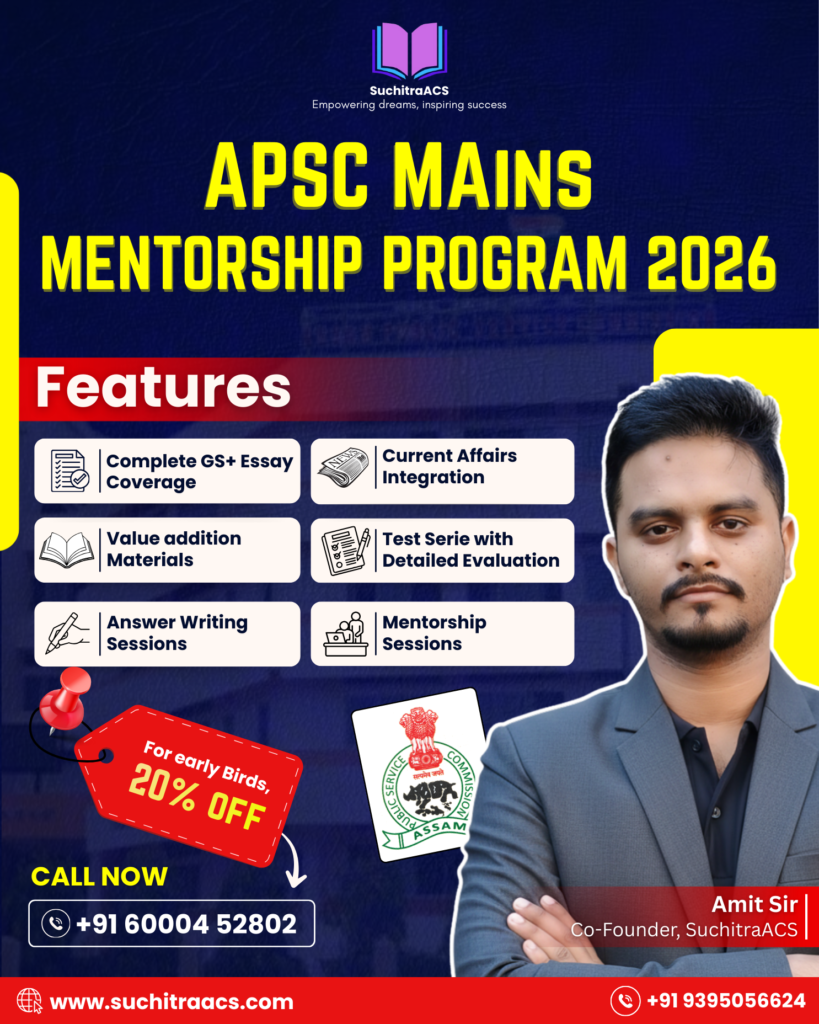
✨ Looking for top-quality APSC Mains Guidance with Personalised Mentor?
🔔 Join Our WhatsApp Study Group!
For exclusive access to premium quality content, including study materials, current affairs, MCQs, and model answers for APSC CCE and other Assam competitive exams.
Click here to join: SuchitraACS Study WhatsApp Group
📚 Want to know more about SuchitraACS’s most affordable courses?
Click here to know more: SuchitraACS Courses for APSC CCE and Assam Competitive Examinations