
APSC CCE Mains PYQ Solved | APSC CCE 2023 Model Answer
Preparing for the APSC CCE Mains Examination requires much more than just reading books and making notes. One of the most effective ways to understand the actual demand of the examination is by practicing and analyzing Previous Year Questions (PYQs).
To help aspirants prepare in a smarter and more strategic way, SuchitraACS brings you APSC CCE Mains PYQs with Detailed Model Answers. These answers are written in a structured, exam-oriented, and high-scoring format based on the latest APSC trend.
APSC Mains GS Paper 1: 2023: Discuss the major factors contributing towards the selection of location for a manufacturing industry and explain with examples the role of market in this regard. (15 marks, 250 Words)
Model Answer:
According to the World Bank’s World Development Report, industrial location is determined by a complex interplay of spatial economics, where industries seek the optimum location to minimize aggregate production and logistics costs while maximizing revenue.
1. Major Factors Influencing the Selection of Industrial Location
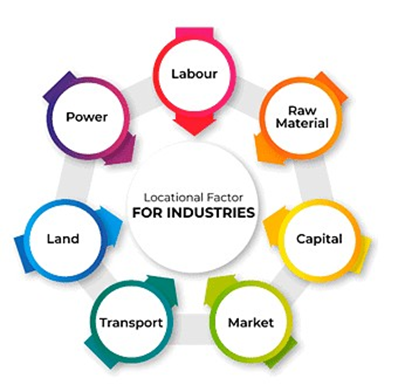
Based on Alfred Weber’s Theory of Industrial Location, the primary determinants can be classified as follows:
- Raw Material Proximity: Crucial for weight-losing industries where the raw material is bulky.
- Assam Example: Tea processing factories are located directly inside the estates of the Brahmaputra Valley because green tea leaves lose significant weight upon drying.
- National Example: Iron and steel industries (TISCO) in the Chota Nagpur Plateau (proximity to coal and iron ore).
- Energy and Power: Energy-intensive industries locate near power sources to minimize transmission costs.
- Example: Aluminium smelting plants (like HINDALCO in Odisha) require massive electricity, situating near coalfields.
- Labour Availability: Industries requiring high manual or specialized intervention concentrate where labor is abundant and skilled.
- Example: The diamond cutting industry in Surat and the garment clusters in Tirupur.
- Government Policy and Infrastructure: Strategic state interventions, SEZs, and the Production-Linked Incentive (PLI) Scheme alter natural geographical disadvantages.
- Assam Example: The upcoming Tata Semiconductor Plant in Jagiroad is heavily influenced by the Assam Semiconductor Policy and the strategic push under the Act East Policy.
- Transport & Logistics: Port proximity remains vital for export-oriented units. (The National Logistics Policy and PM Gati Shakti aim to optimize this by reducing logistics costs to global standards of ~8%).
2. The Critical Role of the Market in Industrial Location
The market dictates location when the cost of transporting the finished good exceeds the cost of transporting the raw materials. Industries locate near markets under the following conditions:
- Weight-Gaining Industries: If the final product is heavier or bulkier than the raw materials, the plant is set up near the consumer base.
- Example: Beverage/Soft-drink bottling plants (like Coca-Cola). The syrup is transported globally, but water is added near the urban market to avoid shipping heavy liquid over long distances.
- Perishability of the Final Product: Goods with a short shelf life must reach the market immediately.
- Example: Dairy processing units (Amul) and commercial bakeries are clustered around urban agglomerations.
- Fragility: Manufactured goods that are prone to breakage during transit.
- Example: Glass manufacturing industries are highly market-oriented to minimize transit damage.
- Agile and Consumer-Driven Sectors: Industries that must respond instantly to changing consumer tastes or require post-sales service.
- Example: High-end electronics assembly (mobile manufacturing in Noida/Sriperumbudur) and fast-fashion garments.
- Assam Example: The establishment of massive FMCG hubs (Patanjali, Dabur) in Kamrup and Tezpur is strategically positioned to capture the captive market of the entire North-East as a single gateway.
Comparative Presentation: Raw Material vs. Market Orientation
| Determinant | Industry Characteristic | Classic Example |
| Raw Material Oriented | Weight-losing, perishable raw material. | Sugar mills (UP/Maharashtra), Jute mills (Hooghly). |
| Market Oriented | Weight-gaining, perishable final product, fragile. | Automobile assembly (Chennai), Bottling plants. |
| Footloose Industries | Lightweight components, driven by tech/skills, transport cost negligible. | Software parks (Bengaluru), Diamond cutting. |
Optimal spatial planning of manufacturing industries, synergized with multi-modal connectivity under PM Gati Shakti, is imperative to achieve SDG 9 (Industry, Innovation, and Infrastructure) and ensure balanced regional development for a resilient Viksit Bharat 2047.
✨ Looking for top-quality APSC Mains Guidance with Personalised Mentor?

🔔 Join Our WhatsApp Study Group!
For exclusive access to premium quality content, including study materials, current affairs, MCQs, and model answers for APSC CCE and other Assam competitive exams.
Click here to join: SuchitraACS Study WhatsApp Group
📚 Want to know more about SuchitraACS’s most affordable courses?
Click here to know more: SuchitraACS Courses for APSC CCE and Assam Competitive Examinations


