APSC Current Affairs: Assam Tribune Notes with MCQs and Answer Writing (29/10/2026)
For APSC CCE and other Assam competitive exam aspirants, staying consistently updated with reliable current affairs is essential for success. This blog provides a well-researched analysis of the most important topics from The Assam Tribune dated 29 October 2026. Each issue has been carefully selected and explained to support both APSC Prelims and Mains preparation, ensuring alignment with the APSC CCE syllabus and the evolving trends of the examination.
 Last batch for APSC CCE 2027 · starts 16 NovAPSC CCE Foundation Programme₹24,999
Current Affairs Notes
From The Assam Tribune, 29 October 2026
Cancer Burden and Registry Data in Kamrup Urban
Syllabus Mapping
- Prelims: GS Paper I (Current events of State/National importance; Economic and Social Development – Social Sector Initiatives; Assam Economy and social development).
- Mains: GS Paper II (Government policies and interventions in health, a social sector service); GS Paper V (Assam: social development, health and public policy).
Why in News? On 28 October 2026 it was reported from Guwahati that ICMR’s Population Based Cancer Registry (PBCR) for Kamrup and the report “Assam Cancer Burden Profile 2026” place Kamrup Urban among the areas with the highest cancer incidence in India. On the same day, the National Pharmaceutical Pricing Authority (NPPA) released revised maximum retail prices (MRPs) for 543 brands of anti-cancer medicines, to apply from 9 November 2026.
Current Context (The Trigger)
- Incidence rank: Kamrup Urban (the urban areas of Kamrup Metropolitan and Kamrup districts) has 211.2 new cancer cases per 1,00,000 males, fourth highest in India, and 174.1 per 1,00,000 females, third highest.
- Source of data: The figures are from the “Consolidated Report of Population Based Cancer Registry (PBCR) – Kamrup” and the “Assam Cancer Burden Profile 2026”, published by ICMR through its National Institute of Non-Communicable Disease Epidemiology, Bengaluru.
- Leading sites: Males: oesophagus, hypopharynx, lung, mouth, stomach and prostate. Females: breast, gall bladder, oesophagus, cervix uteri, ovary and stomach.
- Tobacco-related sites: They make up 66.9 per cent of adult male cancers and 40 per cent of adult female cancers in Kamrup Urban.
- Late detection: About 74 per cent of oral cancers were first seen at the loco-regional stage, and around 50 per cent of lung cancers were found only after distant spread (metastasis).
- Mortality: Among males, oesophageal cancer had the largest share of cancer deaths (19.3 per cent); among females, cancer of the cervix uteri led (19.3 per cent), with breast cancer next (13.1 per cent).
- Childhood cancer: In the 0-14 age group, lymphoid leukaemia was the top cancer for both boys and girls.
- Policy response: NPPA’s revised MRP list covers 543 anti-cancer brands, effective 9 November 2026, and follows its recent trade margin rationalisation exercise.
Core Concepts & Static GK
- Population Based Cancer Registry (PBCR): It systematically collects data on all new cancer cases in a well-defined population, drawing on many sources such as government and private hospitals, nursing homes, clinics, diagnostic laboratories and registrars of births and deaths.
- Why PBCR data matter: Because the population covered is defined, a PBCR can give incidence rates per 1,00,000 people, which a single hospital’s patient count cannot.
- Microscopic verification: A data-quality indicator; in PBCR-Kamrup, 82.74 per cent of male cases (4,420) and 83.99 per cent of female cases (3,663) were confirmed by microscopic verification.
- Cumulative risk: On 2015-2019 data, roughly one in four males (25 per cent) and one in five females (20 per cent) in the covered area would develop cancer before age 75.
Constitutional & Legal Framework
- DPCO 2013 (price control): Drug prices are regulated under the Drugs (Prices Control) Order, 2013. Scheduled formulations (based on the National List of Essential Medicines) have ceiling prices fixed by NPPA; for all drugs, including non-scheduled formulations, Paragraph 20 bars a manufacturer from raising the MRP by more than 10 per cent of the MRP in the preceding twelve months.
- Trade margin rationalisation: In a 2019 pilot, NPPA capped trade margins on 42 anti-cancer drugs at 30 per cent, which cut the MRP of 526 brands of non-scheduled anti-cancer medicines by up to 90 per cent. In October 2026 the exercise was extended to 137 non-scheduled anti-cancer drugs, with revised prices from 9 November and expected MRP cuts of up to 70 per cent.
- COTPA 2003: The Cigarettes and Other Tobacco Products Act, 2003 (notified 19 May 2003) covers smoking in public places (Section 4), advertisement of tobacco products (Section 5), sale to and by minors and near educational institutions (Section 6) and packaging and labelling (Section 7).
Institutional Machinery
- National Cancer Registry Programme (NCRP): Started by ICMR in December 1981 as a long-term activity; the first three PBCRs, at Bengaluru, Chennai and Mumbai, began functioning in January 1982.
- ICMR-NINE (formerly NCDIR): The ICMR-National Centre for Disease Informatics and Research, Bengaluru, was renamed ICMR-National Institute of NCD Epidemiology (ICMR-NINE) by a notification of 29 April 2026. It coordinates the PBCRs and gives them training, technical support, data evaluation and analysis.
- PBCR-Kamrup: Set up by ICMR in 2003 at the Dr B Borooah Cancer Institute (BBCI), Guwahati; it has produced cancer incidence data for over two decades.
- NPPA: Works under the Department of Pharmaceuticals, Ministry of Chemicals and Fertilizers.
Schemes & Initiatives
- NP-NCD: The National Programme for Prevention and Control of Cancer, Diabetes, Cardiovascular Diseases and Stroke (NPCDCS), launched in 2010, was renamed the National Programme for Prevention and Control of Non-Communicable Diseases (NP-NCD) in 2023; more NCDs such as chronic kidney disease and fatty liver disease have been added. It is funded through the NCD flexi-pool of the National Health Mission.
- Ayushman Bharat PM-JAY: Launched on 23 September 2018 at Ranchi, it gives cover of up to Rs 5 lakh per family per year for secondary and tertiary care hospitalisation, cashless at empanelled hospitals; cancer treatment packages are included. The National Health Authority implements it nationally.
- Assam Cancer Care Foundation (ACCF): A joint venture of the Government of Assam and Tata Trusts building a network of 17 cancer care hospitals across the State. On 28 April 2022, at Dibrugarh, seven hospitals (Dibrugarh, Kokrajhar, Barpeta, Darrang, Tezpur, Lakhimpur and Jorhat) were dedicated to the nation and foundation stones were laid for seven more (Dhubri, Nalbari, Goalpara, Nagaon, Sivasagar, Tinsukia and Golaghat) under phase 2.
Reports, Indices & Data
- Trend: Incidence climbed steadily in both sexes over the period studied: for males from 170.7 to 222.5 per 1,00,000, and for females from 146.3 to 189.9 per 1,00,000.
- Assam projection: The report puts new cancer cases in Assam at more than 51,736 in 2026, going up to 53,399 by 2030, an increase of over three per cent.
- Scope warning: The report itself cautions that the cumulative-risk estimates are for Kamrup Urban, not for the whole of Assam.
Assam & Northeast Linkages
- Demand for notification: Dr Debabrata Barmon, Dean (Academics) of BBCI and Principal Investigator of PBCR-Kamrup, wants cancer declared a notifiable disease so that cases can be tracked and control strategies strengthened across the State.
- BBCI Director’s view: Dr Bibhuti Bhusan Borthakur described reliable registry data as the “bedrock” for planning prevention, treatment and palliative care.
Prelims Trap Zones (Watch out for)
- Rank trap: Males: 4th highest (211.2); females: 3rd highest (174.1). Do not swap the ranks or the figures.
- Two male figures: 211.2 is the rate quoted with the national rank, while 170.7 to 222.5 is the rise over the study period; these are different numbers in the report.
- Name trap: ICMR’s Bengaluru institute that coordinates the cancer registries is now ICMR-National Institute of NCD Epidemiology (ICMR-NINE); “National Centre for Disease Informatics and Research (NCDIR)” was its name until the renaming notified on 29 April 2026.
- Scope trap: The 1-in-4 (males) and 1-in-5 (females) cumulative risk is for Kamrup Urban, not all of Assam.
- Tobacco share trap: 66.9 per cent is for adult males and 40 per cent for adult females.
- Death figures: Male oesophageal and female cervical cancer deaths are both 19.3 per cent; female breast cancer deaths are 13.1 per cent.
- Price-control trap: Ceiling prices apply to scheduled drugs; non-scheduled drugs have no ceiling price, but their MRP rise is capped at 10 per cent over the preceding twelve months.
- Date trap: The NPPA list was released on 28 October (Wednesday), but the revised MRPs apply from 9 November 2026.
Introduction
A population-based registry turns scattered hospital records into incidence rates that planners can use. The Kamrup data show a high and rising burden, with a large tobacco-linked share and late presentation, while NPPA’s repricing addresses the cost side of treatment.
Causes and Impact of the Rising Burden
- Tobacco-linked sites: Tobacco-related cancers form 66.9 per cent of adult male and 40 per cent of adult female cancers, so a large share is potentially preventable.
- Rising trend: Incidence rose continuously in both sexes over the study period.
- Late diagnosis: About 74 per cent of oral cancers reach care at the loco-regional stage and around 50 per cent of lung cancers only after distant spread, which raises treatment cost and lowers survival chances.
- Gendered burden: Cervix uteri and breast cancers are the leading causes of female cancer deaths, sites where screening is relevant.
- State-level load: Assam is projected to see over 51,736 cases in 2026 and 53,399 by 2030.
Challenges / Operational Bottlenecks
- Data coverage: The detailed estimates describe Kamrup Urban only, so Assam-wide planning needs more registry data.
- Tracking gap: BBCI’s principal investigator says cancer must be made a notifiable disease to track cases and strengthen control statewide.
- Affordability: Ceiling prices cover only scheduled medicines; many anti-cancer drugs are non-scheduled and limited only by the 10 per cent annual rule, which is why NPPA has used trade margin rationalisation.
- Price relief still pending: The revised MRPs take effect on 9 November 2026, and the list will keep changing as manufacturers submit revised prices for non-scheduled anti-cancer drugs.
Government Initiatives (National & Assam)
| Level | Initiative | Purpose & Impact |
|---|---|---|
| National | NCRP (ICMR, since 1981-82) | Registry network that produces cancer incidence data. |
| National | NP-NCD (earlier NPCDCS) | Prevention, early diagnosis and control of NCDs including cancer, funded under the National Health Mission. |
| National | Ayushman Bharat PM-JAY | Up to Rs 5 lakh per family per year for secondary and tertiary care hospitalisation, including cancer packages. |
| National | NPPA price control and trade margin rationalisation | Revised MRPs for 543 anti-cancer brands from 9 November 2026. |
| National | COTPA 2003 | Regulates smoking in public places, advertising, sale and packaging of tobacco products. |
| Assam | PBCR-Kamrup at BBCI | Reliable local incidence data since 2003. |
| Assam | Assam Cancer Care Foundation | Assam government-Tata Trusts network of 17 cancer hospitals; seven dedicated on 28 April 2022. |
Way Ahead
- Notify cancer: Consider making cancer a notifiable disease in Assam, as the PBCR-Kamrup investigator suggests, to track cases and plan statewide.
- Tobacco control: Enforce COTPA provisions more strictly, since tobacco-related sites dominate the male burden.
- Early detection: Use screening and early diagnosis under NP-NCD so that oral and other cancers are caught before the loco-regional or metastatic stage.
- Expand registry coverage: Extend population-based data beyond Kamrup Urban so that Assam-wide estimates rest on local evidence.
- Make care reachable: Link the ACCF district hospital network with PM-JAY cover and the lower drug prices so that treatment is near and affordable.
Conclusion
Kamrup’s registry data show that much of the burden is tied to tobacco and late detection, so prevention and early screening can pay off. Reliable data, affordable medicines and nearby treatment centres together decide whether higher incidence turns into higher mortality.
Flood Recovery and Rehabilitation after the July Floods in Assam
Syllabus Mapping
- Prelims: GS Paper I (Current events of State/National importance; Economic and Social Development – Sustainable Development, Inclusion, Social Sector Initiatives; Geography of Assam).
- Mains: GS Paper III (Disaster and disaster management; Inclusive growth and issues arising from it; Economics of animal-rearing); GS Paper V (Disaster Management of Assam; Economy of Assam – Government Welfare Schemes for Farmers and Laborers).
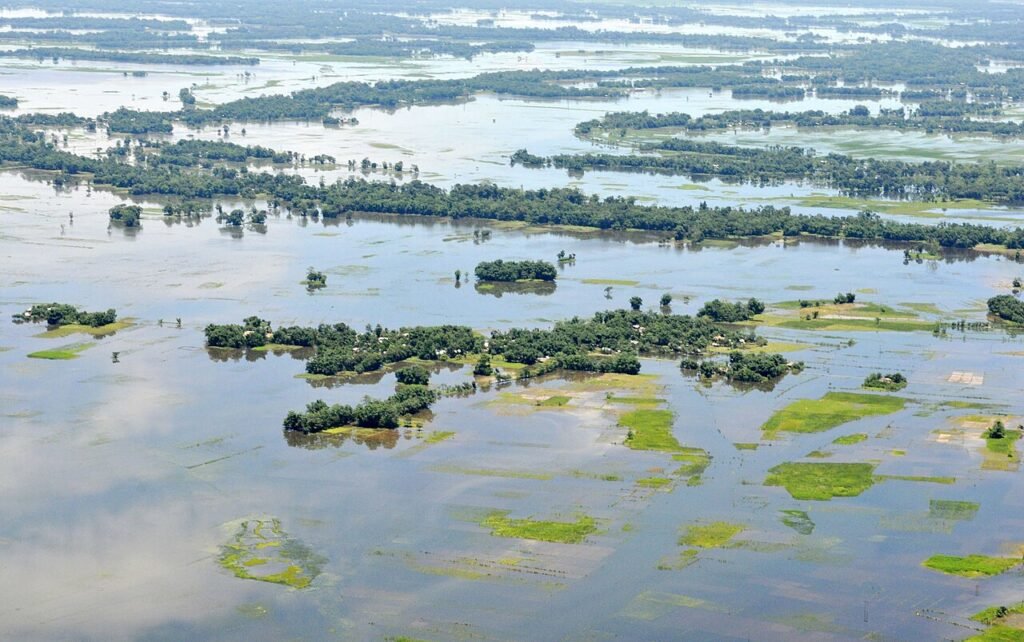
Why in News? A ground report from Nepali Khuti (Bihubar), a village on the Sivasagar-Nagaland border, dated 28 October, shows that three months after the July floods families still live in makeshift shelters and depend on relief, while the State carries out a damage assessment and has proposed an NDDB-backed dairy hub for the village.
Current Context (The Trigger)
- Scale of the July floods: Official figures quoted in the report say the floods affected 27 districts of Assam, claimed 106 lives (including 17 children) and left 10 people missing; more than 2,700 houses were fully damaged and another 11,000 partially damaged.
- Relief paid so far: Affected families in the village got a one-time grant of Rs 15,000 from the State government, some tin sheets, and promises of new houses and support to restart dairy farming.
- Next steps: The State is conducting a damage assessment survey to work out the compensation needed; the final report is then to go to the Centre so that funds can be released.
- Long-term plan: The Assam government has proposed turning Nepali Khuti into a modern dairy hub in collaboration with the National Dairy Development Board (NDDB).
- Ground picture: Only a handful of the 60 to 70 houses in the worst-hit village survived. A Gorkha organisation has built about 25 huts, and the shelters people now live in were put up largely with the help of NGOs and philanthropic individuals.
Core Concepts & Static GK
- Disaster management in law: Section 2(e) of the Disaster Management Act, 2005 treats disaster management as a continuous, integrated process that runs from prevention, mitigation and preparedness through rescue and relief to rehabilitation and reconstruction. The Nepali Khuti report shows the relief phase running down before livelihood recovery has begun.
- Livelihood-based recovery: Villagers earned from small dairy units, grocery shops, farming and trades such as painting; with cattle, shops and silt-covered farmland lost, the proposed dairy hub is central to recovery.
Constitutional & Legal Framework
- Disaster Management Act, 2005: Act No. 53 of 2005, dated 23 December 2005, creates a three-tier structure of authorities (national, state, district).
- Disaster Management (Amendment) Act, 2025: The Bill was introduced in Lok Sabha on 1 August 2024; the Act received Presidential assent on 29 March 2025 and came into force on 9 April 2025. It lets NDMA and SDMAs (instead of the executive committees) prepare the national and state disaster plans, provides for national and state disaster databases, gives statutory status to the National Crisis Management Committee and the High Level Committee, lets States constitute a State Disaster Response Force, and lets States set up Urban Disaster Management Authorities for state capitals and cities with a municipal corporation.
Institutional Machinery
- Three tiers under the 2005 Act: The National Disaster Management Authority (NDMA) is chaired by the Prime Minister (Section 3); the State Disaster Management Authority (SDMA) by the Chief Minister (Section 14); the District Disaster Management Authority (DDMA) by the Collector/District Magistrate/Deputy Commissioner, with the elected representative of the local authority as co-chairperson (Section 25). In Sixth Schedule areas, the Chief Executive Member of the autonomous district council is the co-chairperson.
- ASDMA: The Assam State Disaster Management Authority was notified in 2007; the Chief Minister is Chairperson and the Revenue and Disaster Management Minister is Vice Chairperson, with a State Executive Committee chaired by the Chief Secretary.
- Urban authority (2025 amendment): The Municipal Commissioner chairs and the District Collector is vice-chairperson of an Urban Disaster Management Authority; other members are specified by the State.
- NDRF (Force): Section 44 provides for a National Disaster Response Force; under Section 45 its general superintendence, direction and control vest in the NDMA.
- Brahmaputra Board: A statutory body under the Brahmaputra Board Act, 1980 (enacted 1 September 1980), headquartered at Guwahati under the Ministry of Jal Shakti; it plans and carries out flood and bank-erosion control in the Brahmaputra Valley and prepares a Master Plan for it.
- NDDB: Set up in 1965 and declared an institution of national importance by the National Dairy Development Board Act, 1987; its head office is at Anand, Gujarat.
Schemes & Initiatives
- SDRF and NDRF funding: The State Disaster Response Fund is the State’s primary fund for relief in notified disasters. The Centre contributes 75% for general States and 90% for Northeast and Himalayan States (the pattern of the 15th Finance Commission period, 2021-26); the 16th Finance Commission (2026-31) has recommended the same 90:10 and 75:25 sharing. The National Disaster Response Fund is funded 100% by the Centre and gives additional help when a calamity is beyond a State’s coping capacity.
- Mitigation funds: Following the 15th Finance Commission, the Centre constituted the National Disaster Mitigation Fund on 5 February 2021 and asked States to set up State Disaster Mitigation Funds; the 16th Finance Commission’s 90:10 and 75:25 sharing covers both SDRF and SDMF.
Reports, Indices & Data
- Flood proneness of Assam: As per the Rashtriya Barh Ayog assessment cited by the Assam Water Resources Department, about 39.58 per cent of Assam’s land area is flood-prone, and this is about 9.40 per cent of India’s total flood-prone area. (Sources differ on the absolute area in hectares, so only the percentages are given here.)
Assam & Northeast Linkages
- Assam in the funding category: As a Northeast State, Assam falls in the 90:10 group for SDRF; the 16th Finance Commission’s state-wise table lists disaster management grants of Rs 5,243 crore for Assam for 2026-31.
- Migration signal: A villager said some young people are thinking of moving to cities such as Bengaluru and Chennai for work; a couple have already left and a few more plan to go after the festive season.
Prelims Trap Zones (Watch out for)
- Funding Trap: The National Disaster Response Fund is NOT shared with States; it is wholly funded by the Centre. The 90:10 sharing applies to the SDRF of Northeast and Himalayan States.
- Chair Trap: The DDMA is chaired by the Collector/Deputy Commissioner (the elected local representative is only co-chairperson); an Urban Disaster Management Authority is chaired by the Municipal Commissioner.
- Section Trap: NDMA is Section 3, SDMA Section 14, DDMA Section 25 and the NDRF (Force) Section 44 of the 2005 Act.
- Year Trap: Disaster Management Act is 2005; the Amendment Act received assent on 29 March 2025; NDDB was set up in 1965 but its Act is of 1987; the Brahmaputra Board Act is of 1980.
- Number Trap: Deaths in the July floods are 106 (17 children) with 10 missing; do not mix these with the 27 districts affected.
Introduction
The aftermath of a flood is often judged by how fast relief reaches people, but recovery is measured by whether homes, incomes and communities are restored. Nepali Khuti, three months after the July floods, shows a gap between emergency relief and durable rehabilitation. The Disaster Management Act, 2005, which counts rehabilitation and reconstruction as part of disaster management, provides the institutional frame for both.
Causes and Impact of the Recovery Gap
- Loss of assets: Houses, cattle, small shops and farmland were lost or buried under silt, uprooted trees and debris.
- Livelihood shock: Dairy, farming and petty trade were the earnings of many; the report sees restoring livelihoods as a bigger challenge than rebuilding homes.
- Dependence on relief: Two villagers estimated that their remaining rice and other supplies would last only another 20 to 25 and 20 to 30 days respectively.
- Displacement and migration: Some young people are considering moving to cities, which can hollow out the village.
Challenges / Operational Bottlenecks
- Inadequate one-time aid: One villager said the Rs 15,000 ran out within days, as labourers charged Rs 500 a day and clearing silt and debris cost about Rs 1,500 per room.
- Dependence on voluntary groups: Shelters came largely from NGOs and philanthropic individuals, while the promised new houses remain only an assurance.
- Assessment-to-release lag: Central funds depend on the State’s final assessment report, so rehabilitation waits on the survey.
- Recurrent risk: With about 39.58 per cent of Assam’s land area flood-prone, rebuilding in the same place without risk-sensitive design invites repeat losses.
Government & Statutory Measures
| Level | Initiative | Purpose & Impact |
|---|---|---|
| Union | Disaster Management Act, 2005 and 2025 amendment | Three-tier authorities; plans and databases; urban authorities and State response forces |
| Union | SDRF/NDRF financing | Immediate relief via SDRF (90:10 for Northeast); NDRF, fully central, supplements for calamities beyond a State’s capacity |
| Union | Brahmaputra Board | Master Plan for flood and bank-erosion control in the Brahmaputra Valley |
| Assam | ASDMA and DDMAs | State and district disaster management structure |
| Assam | Proposed NDDB dairy hub at Nepali Khuti | Livelihood-based rehabilitation around dairying |
Way Ahead
- Faster assessment and payment: Complete the damage survey quickly and release compensation that matches real reconstruction costs.
- Livelihood first: Put the NDDB dairy hub on a clear timeline, with restocking of cattle and restoration of fodder land, so that families have income before relief ends.
- Silt and land restoration: Organise desilting of farmland and homesteads, paying local people for the labour.
- Risk-sensitive rebuilding: Use raised plinths and flood-resilient design, drawing on the State Disaster Mitigation Fund.
- Use the 2025 amendment: Maintain the State disaster database and strengthen the plans now prepared by the SDMA.
- Stem distress migration: Local jobs and skilling for young people so that migration is a choice rather than a compulsion.
Conclusion
Recovery is complete only when families regain stable incomes in a safer setting, not when relief trucks stop coming. Linking rehabilitation to livelihoods, as the proposed dairy hub attempts, can make Assam’s recovery more resilient.
Land, Language and Heritage Livelihoods: Assam’s Cultural Future
Syllabus Mapping
- Prelims: GS Paper I (Current events of State/National importance; Economic and Social Development – Social Sector Initiatives; Geography of Assam).
- Mains: GS Paper I (Indian Heritage and Culture; Salient features of Indian Society; Effects of globalization on Indian society); GS Paper V (History, Art, Culture, Tradition and Heritage of Assam; Economy of Assam; Disaster Management with emphasis on Assam).
Why in News? In an opinion article on page 6 of The Assam Tribune of 29 October 2026, the Vice-Chancellor of Pragjyotishpur University argues that Assam’s deepest challenge is the quiet erosion of the physical, economic and cultural foundations of belonging, and sets out a five-part agenda on youth, language, ecological displacement, village economies and confidence.
Current Context (The Trigger)
- The writer’s framing: According to the writer, the problem is larger than riverbank erosion, lost farmland or youth migration; it is the weakening of the foundations of belonging. The writer describes land (mati) as what sustains families, ancestral homes, satras and namghars and sets the rhythm of Bihu.
- Bheti: The writer uses the word bheti for the ancestral homestead and argues that when erosion swallows a village, families lose it together with the memories tied to it.
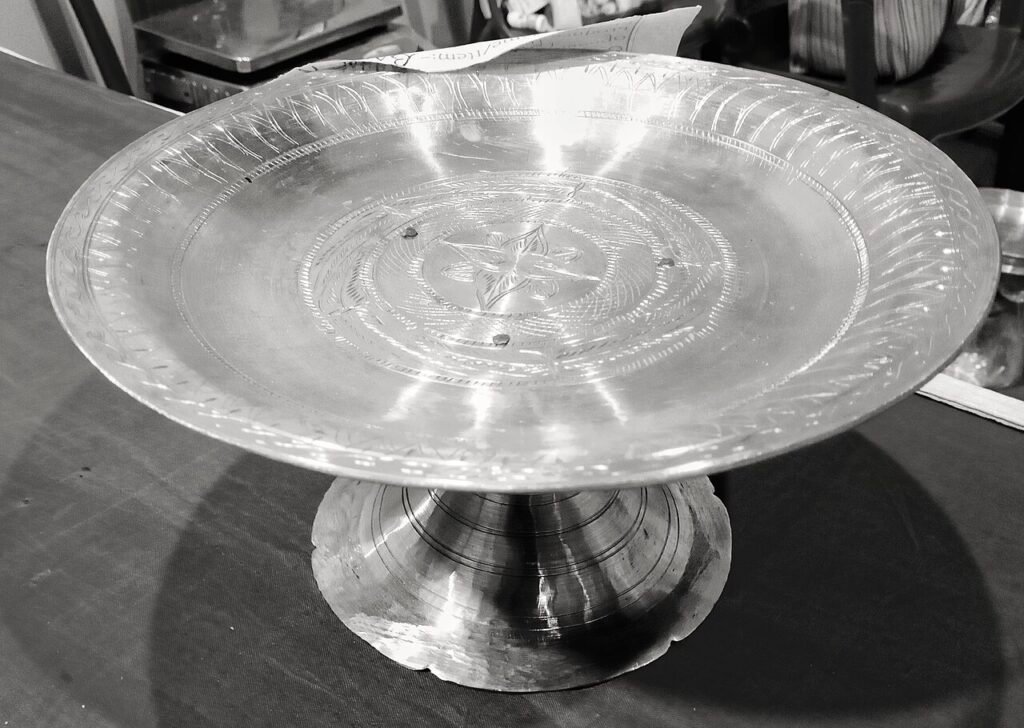
- Heritage and artisans: The writer contrasts the celebration of heritage (the gamosa, Bihu, the Ahom legacy) with the weak economic position of artisans and weavers, and calls for stronger GI protection, consumer awareness, branding, digital commerce, cooperative ownership and direct market access.
Core Concepts & Static GK
- Geographical Indication (GI): A list of Assam GI products on the SLBC North East portal (nic.in, dated May 2024) classifies each entry under the goods categories of Section 2(f) of the GI Act, 1999, such as Handicraft, Agricultural and Manufactured. In that list Judima is the only entry classed as Manufactured, while Tezpur Litchi, Kaji Nemu and Joha Rice of Assam are classed as Agricultural.
- Clause 6 of the Assam Accord: It provides that constitutional, legislative and administrative safeguards, as may be appropriate, shall be provided to protect, preserve and promote the cultural, social and linguistic identity and heritage of the Assamese people.
Constitutional & Legal Framework
- Clause 6 committee: In July 2019 the Centre reconstituted a 14-member high-level committee under retired Gauhati High Court judge Justice Biplab Kumar Sarma to suggest ways of implementing Clause 6. It handed its report to the Assam Chief Minister on 25 February 2020; the report carries 67 recommendations on land, language and culture, and in September 2024 the Assam Cabinet decided to implement 57 of them.
- Definition of “Assamese people”: The committee proposed 1 January 1951 as the cut-off for defining the “Assamese people”: indigenous tribes, other indigenous communities and other Indian citizens residing in Assam on or before that date, and their descendants.
Schemes & Initiatives
- PM Vishwakarma: Launched on 17 September 2023 (Vishwakarma Day) with an outlay of Rs 13,000 crore for FY 2023-24 to FY 2027-28, it supports artisans and craftspeople in 18 family-based traditional trades.
- Who implements it: It is jointly implemented by the Ministry of MSME, the Ministry of Skill Development and Entrepreneurship and the Department of Financial Services (Ministry of Finance).
- Benefits: Stipend of Rs 500 per day during skill training; toolkit incentive of Rs 15,000 as an e-voucher; collateral-free loans of Rs 1 lakh (18 months) and then Rs 2 lakh (30 months) at a concessional interest of 5 per cent; and Re 1 per digital transaction for up to 100 transactions a month.
- Reach: As on 31 August 2025 around 30 lakh artisans and craftspeople had registered, and Raajmistri (mason) was the most registered trade.
Reports, Indices & Data
- Erosion: According to the Assam Water Resources Department, a study found that rivers have eroded 4.27 lakh hectares of the state since 1950, about 7.40 per cent of the state’s area, with average annual erosion of about 8,000 hectares.
Assam & Northeast Linkages
- GI products of Assam: The SLBC North East list includes Gamosa of Assam, Muga Silk of Assam (and its logo), Assam Jaapi, Majuli Mask of Assam, Assam Majuli Manuscript Painting, Assam Bihu Dhol, Sarthebari Metal Craft, Assam Asharikandi Terracotta Craft, Joha Rice of Assam, Tezpur Litchi, Kaji Nemu and Judima.
- Bodo products: The same list shows 13 Bodo-named GI entries (for example Bodo Dokhona, Bodo Eri Silk, Bodo Gamsa and Bodo Jwmgra), with BTAD shown as the supporting body.
- Shared GI: Arunachal Pradesh Singpho Phalap (Singpho Tea) and Assam Mishing Handloom Products are listed with an area of production spanning Arunachal Pradesh and Assam.
Prelims Trap Zones (Watch out for)
- Cut-off Trap: The Accord’s citizenship cut-off is March 1971 (entry before 25 March 1971, as written into Section 6A of the Citizenship Act, 1955), while 1 January 1951 is the date in the Sarma committee’s proposed definition of “Assamese people”. Do not swap them.
- Ministry Trap: PM Vishwakarma is not a single-ministry scheme; MSME, MSDE and the Department of Financial Services implement it together.
- Stipend Trap: Rs 500 is a per-day training stipend, and Rs 15,000 is the toolkit incentive, not a stipend.
- Erosion Trap: 4.27 lakh hectares is the cumulative loss since 1950, while 8,000 hectares is the average annual rate.
Introduction
The writer holds that Assamese consciousness has long been rooted in mati, and that losing land often means losing a culture. The central question the writer poses is “What kind of Assam are we building?”, and the answer offered is that culture endures where people feel secure in their homes, earn a dignified living, belong to lively communities and trust the future.
Land, Erosion and Displacement
- Double loss: In the writer’s view, displaced families suffer twice: first the river carries away the village, and then the need to find work scatters the community that made the place meaningful.
- Beyond the Brahmaputra: The writer wants the debate widened beyond the Brahmaputra, because erosion anywhere in Assam wipes out cultural memory along with farmland.
- Scale of the problem: The Assam Water Resources Department puts cumulative erosion since 1950 at 4.27 lakh hectares, about 7.40 per cent of the state’s area.
Language Needs a Landscape
- Social spaces: The writer argues that Assamese survives in everyday settings such as the namghar, courtyards, markets, fields, looms, festivals and songs, so the language weakens when these spaces break down.
- Language of opportunity: For the writer, Assamese has to stay useful in education, jobs, media, technology, commerce and public life, not only as heritage.
- Policy link: The terms set by the Union Cabinet in January 2019 for the Clause 6 committee included measures to protect Assamese and other indigenous languages of Assam.
Youth Migration and the Diaspora
- Structural issue: The writer respects the right of young people to seek opportunity elsewhere, but argues that an economy that keeps exporting its most ambitious people loses entrepreneurship, institutional capacity and cultural continuity.
- Small silences: The writer describes cultural loss as arriving “through thousands of small silences”, as children raised outside Assam drift away from family stories and traditions.
- Diaspora as asset: The writer suggests linking the diaspora to Assam through professional and research networks, investment and enterprise platforms, cultural bodies, and incentives for talent that comes back.
Heritage Without Livelihood
- Paradox: The writer argues that Assam celebrates its heritage more readily than it supports the people who keep it alive, citing Husori moving into large commercial shows and weavers losing out to cheap imitations and poor market access.
- Existing protection: Several Assam crafts already hold GI status (for example Gamosa, Muga Silk, Assam Jaapi), so the writer’s call for consumer awareness, branding and market access would build on registration.
- Central support: PM Vishwakarma offers recognition, training, tools, credit and digital incentives for traditional artisans in its 18 trades.
Way Ahead
- Reasons to stay: As the writer proposes, develop sectors that can match ambition, such as science and technology, research, sports, tourism, agribusiness, renewable energy and creative enterprises, so that leaving Assam becomes a choice and not an economic compulsion.
- Language of opportunity: Keep Assamese useful in education, jobs, media, technology and commerce.
- Ecological displacement: Handle it as a planned, long-term task: farming that withstands climate shocks, housing that adapts to floods, lasting resettlement and secure land for the displaced, with resilience built before disaster strikes.
- Village economies: Revive the economic life of villages and plan economic development and cultural policy together.
- Artisan enterprise: Cooperative ownership, digital commerce, modern branding and direct access to global markets for weavers and artisans.
Conclusion
The writer concludes that Assam has repeatedly adapted through upheaval without losing its distinctiveness, and that heritage should become a foundation of modernity rather than a memory of loss. For an aspirant, the point to carry is that cultural policy, land security and livelihoods have to be planned together.
Greenfield Shipbuilding Yard at Thoothukudi and the Shipbuilding Development Scheme
Syllabus Mapping
- Prelims: GS Paper I (Current events of State/National importance; Economic and Social Development – infrastructure, investment models).
- Mains: GS Paper III (Infrastructure: ports and shipping; Investment models; Industrial policy and manufacturing); GS Paper V (Assam syllabus: inland water transport and the Brahmaputra).
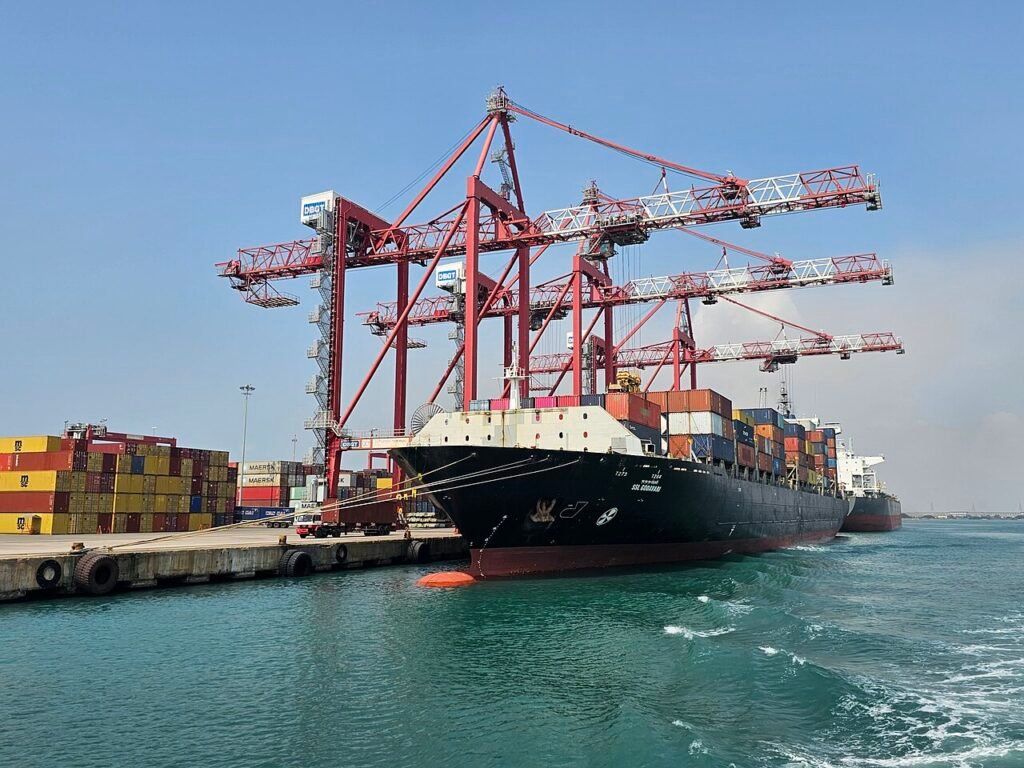
Why in News? On 28 October 2026, Union Minister of Ports, Shipping and Waterways Sarbananda Sonowal held talks with HD Hyundai Chairman Chung Kisun, during his four-day visit to South Korea, to take forward India’s planned $4-billion greenfield shipyard at Thoothukudi, Tamil Nadu, according to a press release from Seoul.
Current Context (The Trigger)
- The investor: At the meeting, HD Korea Shipbuilding & Offshore Engineering (HD KSOE) confirmed again that it will be a primary strategic investor in the project, together with National Shipbuilding & Heavy Industries Park, Tamil Nadu Limited (NSHIP-TN).
- Next steps: A Joint Working Group is to supervise the project, settle the joint venture structure and complete the Detailed Project Report (DPR), all within six months.
- Scale: Planned under the Centre’s Shipbuilding Development Scheme, the yard is to build 2.5 million Gross Tonnage a year; when finished it would be the largest commercial shipyard in India.
- Division of roles: HD KSOE brings design, manufacturing and operations know-how; NSHIP-TN handles land allotment, infrastructure and statutory clearances.
- Demand: Sonowal said the yard would build for export markets and for the domestic need of over 400 vessels required by Indian public agencies. He called the MoU of 20 April 2026 “the bedrock” of the project.
Core Concepts & Static GK
- Greenfield vs brownfield yard: A greenfield yard is built from scratch on new land; a brownfield project expands an existing yard. Under the Shipbuilding Development Scheme, greenfield clusters get 100% capital support for common infrastructure through a 50:50 Centre-State special purpose vehicle, while existing yards get 25% of the approved cost for upgrades such as dry docks and shiplifts.
- Gross Tonnage (GT): A measure of a ship’s overall internal volume, commonly used to express how much a shipyard can build in a year.
Institutional Machinery
- Parties to the April 2026 MoU: HD KSOE, NSHIP-TN (a special purpose vehicle promoted by V.O. Chidambaranar Port Authority and SIPCOT, Tamil Nadu) and Sagarmala Finance Corporation Limited, which works under the Ministry of Ports, Shipping and Waterways. The ministry described the project as India’s first mega greenfield shipyard.
- National Shipbuilding Mission: Set up under the September 2025 package to oversee all its initiatives. It has given in-principle approval to the Thoothukudi greenfield shipbuilding cluster.
Schemes & Initiatives
- The Rs 69,725 crore package (Union Cabinet, 24 September 2025): Shipbuilding Financial Assistance Scheme (Rs 24,736 crore, extended to 31 March 2036), Maritime Development Fund (Rs 25,000 crore) and Shipbuilding Development Scheme (Rs 19,989 crore).
- Shipbuilding Development Scheme: Ten years (to March 2036): Rs 9,930 crore for greenfield clusters, Rs 8,261 crore for brownfield expansion, Rs 1,443 crore for shipbuilding risk coverage (government-backed cover for pre-shipment, post-shipment and vendor-default risks) and Rs 305 crore for capability building, including an India Ship Technology Centre under the Indian Maritime University.
- Shipbuilding Financial Assistance Scheme: Assistance of 15% for vessels below Rs 100 crore, 20% above Rs 100 crore and 25% for green, hybrid or specialised vessels (minimum 30% domestic value addition), plus a Shipbreaking Credit Note worth 40% of a ship’s scrap value when it is scrapped at an Indian yard.
- Maritime Development Fund: A Rs 20,000 crore Maritime Investment Fund (49% government capital) and a Rs 5,000 crore Interest Incentivisation Fund offering lenders an interest incentive of up to 3% on loans to Indian shipyards.
Reports, Indices & Data
- India’s position: India accounts for less than 1% of the global shipbuilding market. Its capacity is put at about 0.072 million GT, against about 20 million GT for South Korea and 9 million GT for Japan; China, South Korea and Japan together build 98.5% of the world’s ships. The planned 2.5 million GT at Thoothukudi is many times India’s present capacity.
- Targets: Maritime India Vision 2030 aims to put India among the top ten shipbuilding nations by 2030, and the Maritime Amrit Kaal Vision 2047 aims for the top five by 2047.
- Ship recycling: India was the world’s leading ship-recycling nation in 2025 with a 35.4% share (up from 30.1% in 2024), as cited by the ministry from UNCTAD data.
Assam & Northeast Linkages
- Minister from Assam: Sarbananda Sonowal, who leads these talks, is the Lok Sabha MP from Dibrugarh and a former Chief Minister of Assam.
- Pandu ship repair facility, Guwahati: The Inland Waterways Authority of India (IWAI) and Cochin Shipyard Ltd are jointly designing and implementing a ship repair facility at Pandu, with technical support from IIT Madras. A June 2026 report still described it as under construction; it is meant for vessels on the Brahmaputra (National Waterway 2) and the Barak (National Waterway 16), which now have to go to Kolkata for dry-dock repairs.
Prelims Trap Zones (Watch out for)
- Location Trap: The yard is at Thoothukudi in Tamil Nadu. Greenfield clusters are also proposed in Andhra Pradesh and Gujarat, so do not mix up the states.
- Capacity Trap: Annual capacity 2.5 million GT; investment $4 billion. Do not confuse with the 4.5 million GT capacity target of the whole package.
- Role Trap: HD KSOE gives technical expertise; NSHIP-TN handles land, infrastructure and statutory clearances.
- Outlay Trap: Shipbuilding Development Scheme Rs 19,989 crore; Shipbuilding Financial Assistance Scheme Rs 24,736 crore; Maritime Development Fund Rs 25,000 crore.
- Date Trap: The MoU was signed on 20 April 2026; the meeting now in the news was on 28 October 2026, and the Joint Working Group has six months to finalise the DPR.
Introduction
India holds less than 1% of the global shipbuilding market even though it is a major trading nation and the world’s leading ship recycler. The Thoothukudi yard, backed by a Korean shipbuilder and planned under the Rs 19,989 crore Shipbuilding Development Scheme, will test whether foreign technology partnerships and public capital support can create large-scale capacity.
Need / Economic Rationale
- Captive demand: Indian public agencies need over 400 vessels, giving a ready order book alongside exports.
- Strategic autonomy: A domestic yard ecosystem reduces dependence on foreign yards for commercial and public-sector ships and supports the 2030 and 2047 maritime goals.
- Jobs and supply chain: The ministry expects about 15,000 direct jobs from the Thoothukudi project once operations stabilise, besides indirect employment.
Challenges / Operational Bottlenecks
- Capacity gap: India’s capacity of about 0.072 million GT is tiny next to South Korea (about 20 million GT) and Japan (about 9 million GT).
- Cost of capital and imports: Expensive capital and financing, and reliance on imported components and advanced materials, remain obstacles.
- Execution risk: The project is still at the DPR and joint venture stage, with the Joint Working Group given six months; land, clearances and the final ownership structure remain to be settled.
Government Initiatives (National & Assam)
| Level | Initiative | Purpose & Impact |
|---|---|---|
| Centre | Shipbuilding Development Scheme (Rs 19,989 crore) | Capital support for greenfield clusters and brownfield upgrades, India Ship Technology Centre, risk coverage |
| Centre | Shipbuilding Financial Assistance Scheme (Rs 24,736 crore) | 15% to 25% assistance for vessels; Shipbreaking Credit Note; National Shipbuilding Mission |
| Centre | Maritime Development Fund (Rs 25,000 crore) | Long-term finance for tonnage, shipyards and ports; interest incentive on shipyard loans |
| Centre and Tamil Nadu agencies | NSHIP-TN, Thoothukudi cluster | Anchor SPV for commercial shipbuilding with HD KSOE as technical partner |
| Northeast | IWAI-Cochin Shipyard repair facility at Pandu, Guwahati | Repair base for Brahmaputra and Barak inland vessels |
Way Ahead
- Time-bound DPR and JV: Meet the six-month timeline for the DPR and joint venture structure, with clear equity and technology-transfer terms.
- Anchor demand: Convert the over 400 vessel requirement of public agencies into firm, scheduled orders to de-risk the yard.
- Ancillary ecosystem: Build a local base for marine equipment and materials to cut import dependence.
- Skills and design: Use the India Ship Technology Centre for design and research capability.
- Inland and NE capacity: Complete the Pandu facility so that Brahmaputra and Barak vessels need not go to Kolkata for repairs.
Conclusion
The Thoothukudi yard can help India climb the global shipbuilding ranks only if technology transfer, financing and orders line up. Success would support the goals of a top-ten place by 2030 and a top-five place by 2047.
News in Short
- Agarwood export to Dubai: Assam exported 123 kg of agarwood chips to Dubai; the State accounts for around 81 per cent of India’s agarwood (per the CM’s Office), and the sector supports over 50,000 farmers and workers. Agarwood is a fragrant wood formed in certain trees of the genus Aquilaria.
- 14th International Tourism Mart: Tawang hosts the 14th ITM from 29 to 31 October, organised by the Union Tourism Ministry with Arunachal Pradesh and other North Eastern States, to promote the region’s tourism business.
- DA/DR hike: The Union Cabinet approved a 3 per cent rise in Dearness Allowance and Dearness Relief over the existing rate of 60 per cent of basic pay/pension, benefiting over 1.17 crore Central employees and pensioners, effective 1 July 2026.
- SCO Civilisational Dialogue Forum: India has invited all SCO members, including Pakistan, to the forum in New Delhi from 20 to 22 November, jointly organised by the Ministry of Culture and the MEA.
- Brahmaputra Sailing Expedition MENU 2026: Flagged off from Biswanath ghat by NCC Directorate NER, Shillong, in honour of Ahom General Lachit Borphukan; 100 Naval NCC cadets will cover 248 km over 10 days.
- Engineering exports and Oman: EEPC India data show engineering goods exports up 20.91 per cent year-on-year at $12.17 billion in September 2026, a sixth straight month of growth; shipments to Oman jumped 59 per cent to $136.3 million, helped by the India-Oman FTA in force since June.
- Graduates’ and teachers’ constituency polls: In the 23 October polls to 28 Legislative Council seats in Uttar Pradesh, Maharashtra, Bihar and Karnataka, only registered graduate and teacher voters took part, and voting was by ballot paper instead of EVMs.
- Schedule I species: One rhinoceros horn and seven pieces of swamp deer antlers were recovered at Gohpur (Biswanath); both species are in Schedule I of the Wildlife (Protection) Act, 1972.
APSC Prelims MCQs
Practice questions on the topics above
Topic 1: Cancer Burden and Registry Data in Kamrup Urban
Q1. The Population Based Cancer Registry (PBCR) for Kamrup, based at the Dr B Borooah Cancer Institute, Guwahati, has reported high cancer incidence in Kamrup Urban. Consider the following statements:
(i) The National Cancer Registry Programme was started by ICMR, and its first three PBCRs were at Bengaluru, Chennai and Mumbai.
(ii) PBCR-Kamrup was established in 2003 by ICMR at the Dr B Borooah Cancer Institute.
(iii) A population-based cancer registry records only those patients who are treated in a single hospital.
Which of the statements given above is/are correct?
- (a) (i) only
- (b) (i) and (ii) only
- (c) (ii) and (iii) only
- (d) (i), (ii) and (iii)
Show answer
Answer: (b) Explanation: Statements (i) and (ii) are correct: NCRP began under ICMR (December 1981) with PBCRs at Bengaluru, Chennai and Mumbai from January 1982, and PBCR-Kamrup was set up in 2003 at BBCI. Statement (iii) is wrong because a PBCR records all new cases in a defined population from many sources (hospitals, clinics, laboratories); recording only one hospital’s patients describes a hospital-based registry.
Q2. NPPA released a revised list of MRPs for 543 anti-cancer brands on 28 October 2026. Consider the following statements:
(i) NPPA functions under the Department of Pharmaceuticals, Ministry of Chemicals and Fertilizers.
(ii) Under the Drugs (Prices Control) Order, 2013, NPPA fixes ceiling prices for scheduled formulations.
(iii) For non-scheduled formulations, manufacturers are free to raise the MRP by any amount in a year.
Which of the statements given above is/are NOT correct?
- (a) (i) only
- (b) (ii) only
- (c) (iii) only
- (d) (i) and (iii) only
Show answer
Answer: (c) Explanation: Statements (i) and (ii) are correct. Statement (iii) is incorrect: although non-scheduled drugs have no ceiling price, Paragraph 20 of DPCO 2013 bars a manufacturer from raising the MRP by more than 10 per cent of the MRP in the preceding twelve months.
Q3. Match List-I with List-II:
| List-I (Programme / Law / Body) | List-II (Feature) |
|---|---|
| a. NP-NCD | 1. Cover of up to Rs 5 lakh per family per year for secondary and tertiary care hospitalisation |
| b. Ayushman Bharat PM-JAY | 2. Joint venture of the Government of Assam and Tata Trusts |
| c. COTPA 2003 | 3. Deals with smoking in public places and sale of tobacco products to and by minors |
| d. Assam Cancer Care Foundation | 4. Earlier known as NPCDCS (launched in 2010), renamed in 2023 |
Select the correct answer using the codes given below:
- (a) a-4, b-1, c-3, d-2
- (b) a-1, b-4, c-3, d-2
- (c) a-4, b-1, c-2, d-3
- (d) a-3, b-1, c-4, d-2
Show answer
Answer: (a) Explanation: NP-NCD is the renamed NPCDCS (launched 2010, renamed 2023); PM-JAY gives up to Rs 5 lakh per family per year for secondary and tertiary care hospitalisation; COTPA 2003 regulates smoking in public places and sales to and by minors; the Assam Cancer Care Foundation is an Assam government-Tata Trusts joint venture. The other codes swap these pairs.
Q4. According to the Assam Cancer Burden Profile 2026 as reported on 28 October 2026, what share of adult male cancers in the urban areas of Kamrup Metropolitan and Kamrup districts are tobacco-related?
- (a) 40.0 per cent
- (b) 74.0 per cent
- (c) 50.0 per cent
- (d) 66.9 per cent
Show answer
Answer: (d) Explanation: Tobacco-related sites account for 66.9 per cent of adult male cancers. The 40 per cent figure is for adult females, 74 per cent is the share of oral cancers presenting at the loco-regional stage, and 50 per cent is the share of lung cancers diagnosed at distant metastatic stages.
Topic 2: Flood Recovery and Rehabilitation after the July Floods in Assam
Q5. With reference to India’s disaster management framework, as amended in 2025, consider the following statements:
(i) The National Disaster Management Authority is chaired by the Prime Minister.
(ii) States may set up Urban Disaster Management Authorities for state capitals and cities with a municipal corporation.
(iii) For Northeast States, the Centre contributes 75 per cent of the State Disaster Response Fund.
Which of the statements given above is/are correct?
- (a) (i) and (ii) only
- (b) (ii) and (iii) only
- (c) (i) only
- (d) (i), (ii) and (iii)
Show answer
Answer: (a) Explanation: Statement (i) is correct (Section 3 of the 2005 Act). Statement (ii) is correct: the 2025 amendment enables Urban Disaster Management Authorities, chaired by the Municipal Commissioner. Statement (iii) is wrong: the Centre’s share of SDRF is 90 per cent for Northeast and Himalayan States; 75 per cent applies to general States.
Q6. Match List-I with List-II:
| List-I (Body) | List-II (Feature) |
|---|---|
| a. Assam State Disaster Management Authority | 1. Head office at Anand, Gujarat |
| b. District Disaster Management Authority | 2. Chaired by the Collector/District Magistrate/Deputy Commissioner |
| c. National Dairy Development Board | 3. Chaired by the Chief Minister |
| d. Brahmaputra Board | 4. Prepares a Master Plan for flood and bank-erosion control in the Brahmaputra Valley |
Select the correct answer using the codes given below:
- (a) a-3, b-1, c-2, d-4
- (b) a-2, b-3, c-1, d-4
- (c) a-3, b-2, c-1, d-4
- (d) a-3, b-2, c-4, d-1
Show answer
Answer: (c) Explanation: ASDMA, as the State authority, is chaired by the Chief Minister (3); the DDMA is chaired by the Collector/District Magistrate/Deputy Commissioner (2); NDDB’s head office is at Anand (1); the Brahmaputra Board prepares the flood and bank-erosion Master Plan (4).
Q7. Which of the following statements is NOT correct?
- (a) The Disaster Management (Amendment) Act, 2025 gives statutory status to the National Crisis Management Committee.
- (b) The National Disaster Response Fund is funded jointly by the Centre and the States in the ratio of 75:25.
- (c) The Brahmaputra Board was established under the Brahmaputra Board Act, 1980 and is headquartered at Guwahati.
- (d) Under the 2005 Act, the elected representative of the local authority is co-chairperson of the District Disaster Management Authority.
Show answer
Answer: (b) Explanation: The National Disaster Response Fund is funded entirely by the Centre; the 75:25 sharing relates to the SDRF of general States. The other statements are correct.
Q8. The National Dairy Development Board, with which the Assam government has proposed to develop a dairy hub at Nepali Khuti, was declared an institution of national importance by an Act of Parliament in which year?
- (a) 1965
- (b) 1980
- (c) 2005
- (d) 1987
Show answer
Answer: (d) Explanation: NDDB was set up in 1965 but became an institution of national importance under the National Dairy Development Board Act, 1987. 1980 is the year of the Brahmaputra Board Act and 2005 of the Disaster Management Act.
Topic 3: Land, Language and Heritage Livelihoods: Assam’s Cultural Future
Q9. PM Vishwakarma supports traditional artisans and craftspeople. Consider the following statements:
(i) It was launched on 17 September 2023.
(ii) The toolkit incentive under it is Rs 15,000, given as an e-voucher.
(iii) It is implemented solely by the Ministry of Textiles.
Which of the statements given above is/are correct?
- (a) (i) only
- (b) (i) and (ii) only
- (c) (ii) and (iii) only
- (d) (i), (ii) and (iii)
Show answer
Answer: (b) Explanation: The scheme was launched on 17 September 2023 and gives a Rs 15,000 toolkit e-voucher, so (i) and (ii) are correct. Statement (iii) is wrong: it is implemented jointly by the Ministry of MSME, the Ministry of Skill Development and Entrepreneurship and the Department of Financial Services.
Q10. Assertion (A): Clause 6 of the Assam Accord is linked to safeguards for the cultural, social and linguistic identity of the Assamese people.
Reason (R): Clause 6 fixed 1 January 1951 as the cut-off date for granting Indian citizenship to immigrants.
Select the correct answer:
- (a) Both A and R are true and R is the correct explanation of A
- (b) Both A and R are true but R is not the correct explanation of A
- (c) A is true but R is false
- (d) A is false but R is true
Show answer
Answer: (c) Explanation: A is true, since Clause 6 provides for constitutional, legislative and administrative safeguards for the identity and heritage of the Assamese people. R is false: the Accord’s citizenship cut-off is March 1971 (entry before 25 March 1971), and 1 January 1951 is only the date in the Sarma committee’s proposed definition of “Assamese people”, not a citizenship cut-off.
Q11. In the list of GI products of Assam hosted on the SLBC North East portal, which of the following is classed as “Manufactured” goods?
- (a) Judima
- (b) Tezpur Litchi
- (c) Kaji Nemu
- (d) Joha Rice of Assam
Show answer
Answer: (a) Explanation: Judima is the only entry classed as Manufactured in that list. Tezpur Litchi, Kaji Nemu and Joha Rice of Assam are classed as Agricultural.
Q12. According to the Assam Water Resources Department, about how much land have Assam’s rivers eroded since 1950?
- (a) 8,000 hectares
- (b) 42,700 hectares
- (c) 2.7 lakh hectares
- (d) 4.27 lakh hectares
Show answer
Answer: (d) Explanation: The department puts the figure at 4.27 lakh hectares, about 7.40 per cent of the state’s area. The 8,000 hectares in option (a) is the average annual rate of erosion, not the cumulative loss.
Topic 4: Greenfield Shipbuilding Yard at Thoothukudi and the Shipbuilding Development Scheme
Q13. A greenfield shipyard at Thoothukudi has been discussed between India and HD Hyundai. Consider the following statements:
(i) The yard is proposed to have an annual capacity of 2.5 million Gross Tonnage.
(ii) HD KSOE will facilitate land allocation and statutory clearances for the project.
(iii) A Joint Working Group is to finalise the Detailed Project Report within six months.
Which of the statements given above is/are correct?
- (a) (i) and (ii) only
- (b) (i) and (iii) only
- (c) (ii) and (iii) only
- (d) (i), (ii) and (iii)
Show answer
Answer: (b) Explanation: Statements (i) and (iii) are correct. Land allocation, infrastructure and clearances are to be facilitated by NSHIP-TN, while HD KSOE provides technical expertise in design, manufacturing and operations, so (ii) is wrong.
Q14. Match List-I (Component of the September 2025 shipbuilding package) with List-II (Outlay):
| List-I | List-II |
|---|---|
| a. Shipbuilding Development Scheme | 1. Rs 25,000 crore |
| b. Shipbuilding Financial Assistance Scheme | 2. Rs 19,989 crore |
| c. Maritime Development Fund | 3. Rs 24,736 crore |
Select the correct answer using the codes given below:
- (a) a-1, b-2, c-3
- (b) a-3, b-1, c-2
- (c) a-2, b-3, c-1
- (d) a-2, b-1, c-3
Show answer
Answer: (c) Explanation: The Shipbuilding Development Scheme has Rs 19,989 crore, the Shipbuilding Financial Assistance Scheme Rs 24,736 crore and the Maritime Development Fund Rs 25,000 crore; together they make Rs 69,725 crore.
Q15. With reference to the Shipbuilding Development Scheme and related initiatives, which of the following is NOT correct?
- (a) Greenfield shipbuilding clusters can receive 100% capital support through a 50:50 Centre-State special purpose vehicle.
- (b) The India Ship Technology Centre is to be established under the Indian Maritime University.
- (c) The Shipbuilding Financial Assistance Scheme provides a Shipbreaking Credit Note equal to 40% of scrap value.
- (d) The Thoothukudi shipyard is proposed in Andhra Pradesh as the first mega greenfield yard.
Show answer
Answer: (d) Explanation: The yard is proposed at Thoothukudi in Tamil Nadu, not Andhra Pradesh. Statements (a), (b) and (c) match the scheme details.
Q16. The Pandu ship repair facility in Guwahati, linked to inland water transport in the Northeast, is being developed by:
- (a) Inland Waterways Authority of India with Cochin Shipyard Ltd
- (b) Sagarmala Finance Corporation with HD KSOE
- (c) NSHIP-TN with the Assam government
- (d) Shipping Corporation of India with Kolkata Port Trust
Show answer
Answer: (a) Explanation: IWAI and Cochin Shipyard Ltd are jointly designing and implementing the Pandu facility, with IIT Madras giving technical support. Sagarmala Finance Corporation, HD KSOE and NSHIP-TN are parties to the Thoothukudi MoU.
Mains Answer Writing
One exam-style question with a model answer
Q. ‘Culture survives when people have secure homes, dignified livelihoods and confidence in the future.’ In the light of this statement, discuss how river erosion, youth migration and the economic vulnerability of artisans threaten Assam’s cultural identity, and suggest a policy roadmap to turn heritage into a source of livelihood. (250 words, 15 marks)
Model answer
Introduction: Assamese identity is rooted in mati, which shelters ancestral homes, nurtures satras and namghars and gives Bihu its rhythm. When land, youth and craft are lost together, the culture loses the base on which it lives.
1. River erosion: loss of the geography of belonging
- Memory lost: families lose the bheti (ancestral homestead); a house can be rebuilt, the memory of a place cannot.
- Double loss: the river takes the village, and the search for work then dissolves the community that gave it meaning.
- Language: Assamese lives in the namghar, courtyard, market, field and handloom, so when these spaces break up the language weakens.
2. Youth migration: a second displacement
- Structural drain: an economy that keeps exporting its most ambitious people loses entrepreneurship, institutional capacity and cultural continuity.
- Silent erosion: children raised outside drift from family stories, while ageing parents stay behind.
3. Economic vulnerability of artisans
- Husori: once a community practice, it increasingly appears in large commercial spectacles while practitioners gain little.
- Handloom: weavers face cheap imitations and weak market access, even as mekhela chador and the gamosa are celebrated.
4. Policy roadmap: heritage as livelihood
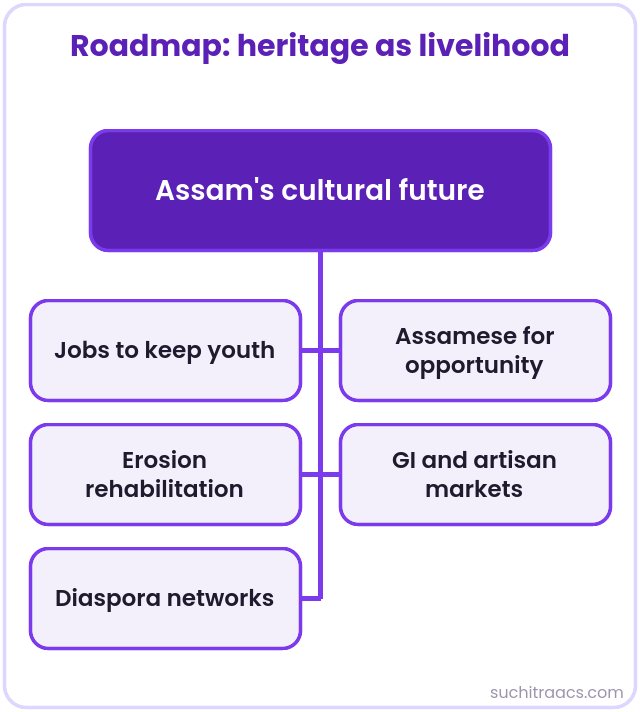
- Stay-reasons for youth: build industries in technology, research, sports, tourism, agribusiness, renewable energy and creative enterprise.
- Language of opportunity: keep Assamese useful in education, jobs, media, technology and commerce.
- Erosion as planned challenge: long-term planning, climate-proof farming, flood-adaptive housing, lasting resettlement and secure land for the displaced.
- Artisan economy: stronger GI protection, consumer awareness, branding, digital commerce, cooperative ownership and direct global market access.
- Diaspora: professional networks, investment platforms, research links and incentives for returning talent.
Conclusion: Economic policy and cultural policy cannot be kept apart. If artisans become entrepreneurs and villages resilient, heritage can become a foundation of modernity rather than a memory of loss.
Prepare with SuchitraACS
APSC CCE Foundation Programme₹24,999  APSC Prelims Crash Course 2027 (GS + CSAT)₹5,999
 APSC CCE Study Materials Package (Prelims + Mains)₹4,999