
APSC CCE Mains PYQ Solved | APSC CCE 2023 Model Answer
Preparing for the APSC CCE Mains Examination requires much more than just reading books and making notes. One of the most effective ways to understand the actual demand of the examination is by practicing and analyzing Previous Year Questions (PYQs).
To help aspirants prepare in a smarter and more strategic way, SuchitraACS brings you APSC CCE Mains PYQs with Detailed Model Answers. These answers are written in a structured, exam-oriented, and high-scoring format based on the latest APSC trend.
APSC Mains GS Paper 1: 2023: Name the major earthquake-prone areas of the world and give details of the Circum-Pacific Belt. (10 marks, 150 Words)
Model Answer:
According to the United Nations Office for Disaster Risk Reduction (UNDRR), nearly 90% of the world’s earthquakes occur along well-defined seismic belts where tectonic plate interactions are most intense.
1. Major Earthquake-Prone Areas of the World
Global seismicity is concentrated primarily along three major tectonic belts:
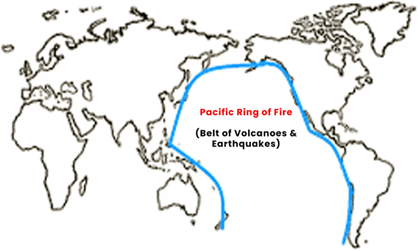
- Circum-Pacific Belt (The Ring of Fire): The most active zone, accounting for approximately 81% of the world’s largest earthquakes.
- Alpine-Himalayan Belt (Mid-Continental Belt): Extends from the Mediterranean through the Middle East and the Himalayas to Southeast Asia, causing 15% of global seismic activity.
- Assam/NE Context: This belt places the entire North-East India in Seismic Zone V, making it one of the most hazardous regions (e.g., 1950 Assam-Tibet Earthquake).
- Mid-Atlantic Ridge: Located along a divergent plate boundary where the seafloor spreads, resulting in frequent but mostly moderate, shallow-focus earthquakes.
2. Details of the Circum-Pacific Belt
The Circum-Pacific Belt is a horseshoe-shaped zone of high seismic and volcanic activity encircling the Pacific Ocean basin.
A. Geological Mechanism
- Convergent Plate Boundaries: It is characterized by subduction zones where denser oceanic plates (e.g., Pacific, Nazca, Philippine plates) slide beneath lighter continental plates.
- Fault Systems: Includes massive transform faults, such as the San Andreas Fault in California, where plates slide horizontally.
B. Key Geographical Features
- Deep Sea Trenches: Presence of deep oceanic trenches like the Mariana Trench and Peru-Chile Trench.
- Island Arcs: Formation of volcanic island chains such as the Japanese Archipelago and the Aleutian Islands.
C. Seismic Impact and Stakeholders
| Component | Impact/Detail |
| Magnitude | Home to the world’s strongest quakes (e.g., 9.5 magnitude Valdivia quake, Chile). |
| Secondary Hazards | High risk of Tsunamis due to undersea megathrust events (e.g., 2011 Tohoku Earthquake). |
| Affected Nations | Japan, Philippines, Indonesia, Chile, USA (West Coast), and New Zealand. |
D. Strategic Disaster Management (Global Best Practices)
- Japan’s ‘ShakeOut’ Drills: World-leading community-based preparedness.
- Building Codes: Strict adherence to seismic-resistant architecture (Base Isolation technology).
3. Comparative Seismic Vulnerability: A Snapshot
| Feature | Circum-Pacific Belt | Alpine-Himalayan Belt |
| Boundary Type | Primarily Subduction (Ocean-Cont.) | Collision (Cont.-Cont.) |
| Intensity | Very High (Megathrust quakes) | High (Deep-seated thrust faults) |
| Example | 2011 Japan Earthquake | 2015 Nepal/1897 Shillong Quake |
Promoting disaster-resilient infrastructure and adhering to the Sendai Framework is vital to ensuring human-centric governance and a Viksit Bharat by 2047.
✨ Looking for top-quality APSC Mains Guidance with Personalised Mentor?

🔔 Join Our WhatsApp Study Group!
For exclusive access to premium quality content, including study materials, current affairs, MCQs, and model answers for APSC CCE and other Assam competitive exams.
Click here to join: SuchitraACS Study WhatsApp Group
📚 Want to know more about SuchitraACS’s most affordable courses?
Click here to know more: SuchitraACS Courses for APSC CCE and Assam Competitive Examinations


